Arturo Ricci stands as a prominent figure in late 19th and early 20th-century Italian art, celebrated for his exquisite genre scenes that lovingly recreated the opulent world of 18th-century European aristocracy. His canvases are windows into a bygone era of powdered wigs, silk gowns, and refined social rituals, rendered with meticulous detail and a vibrant palette. While not an innovator in the avant-garde sense, Ricci was a master craftsman whose work captured the nostalgic and aesthetic sensibilities of his time, earning him considerable acclaim both in Italy and internationally.
The Formative Years and Florentine Roots
Arturo Ricci was born in Florence, Italy, in 1854. This birth year, along with his year of death in 1919, is consistently reported across various art historical records and databases, confirming its accuracy. Florence, a city steeped in artistic heritage, undoubtedly provided a rich environment for the young Ricci. He pursued his formal artistic training at the prestigious Accademia di Belle Arti di Firenze (Florence Academy of Fine Arts), a venerable institution that had nurtured countless masters.
During his studies, Ricci came under the tutelage of Tito Conti (1842–1924). Conti was himself a respected painter known for his historical genre scenes, portraits, and Orientalist themes, characterized by precise draughtsmanship and a rich application of color. Under Conti's guidance, Ricci would have honed his technical skills, particularly in figure painting, costume rendering, and the creation of complex, multi-figure compositions. It is noted that Ricci quickly absorbed these lessons, and some accounts suggest he even surpassed his master in the specific niche of historical costume pieces. His dedication and talent were evident early on, setting the stage for a successful career.
The Allure of the Ancien Régime: Ricci's Artistic Focus
Ricci's artistic oeuvre is overwhelmingly dedicated to depictions of 18th-century aristocratic life. This period, often referred to as the Ancien Régime, particularly its Rococo phase, held a particular fascination for artists and collectors in the late 19th century. It represented an age of elegance, leisure, and refined sensibility, a stark contrast to the rapidly industrializing world in which Ricci lived. His paintings are not historical documents in the strict sense but rather romanticized evocations of a perceived golden age.
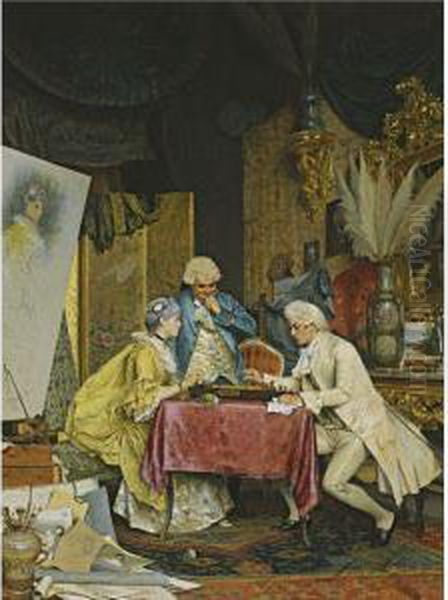
His canvases typically feature sumptuously decorated interiors, where elegantly attired men and women engage in various social activities: courtship rituals, musical performances, card games, leisurely conversations, or the signing of marriage contracts. These scenes are often imbued with a lighthearted, sometimes subtly suggestive, narrative. The artist excelled at capturing the nuances of social interaction – a knowing glance, a whispered secret, a polite gesture – all contributing to the storytelling quality of his work. The settings are invariably luxurious, filled with ornate furniture, gilded mirrors, plush draperies, and delicate porcelain, all rendered with an almost photographic precision.
Stylistic Hallmarks: Detail, Color, and Texture
Arturo Ricci's style is often described as a form of Rococo Revival or "troubadour style," a broader 19th-century trend that looked back to earlier historical periods for inspiration. His technique was characterized by a high degree of finish and meticulous attention to detail. This is particularly evident in his rendering of fabrics. Silks, satins, velvets, and lace are depicted with extraordinary skill, capturing their sheen, texture, and the way they drape and fold. The intricate patterns of brocades and the delicate embroidery on gowns are painstakingly illustrated, making his paintings a feast for the eyes.
His color palette was typically bright, rich, and harmonious, reflecting the cheerful and opulent nature of his subjects. He employed a smooth brushstroke, leaving little evidence of the artist's hand, which was characteristic of academic painting of the era. Compositionally, Ricci's paintings are carefully arranged, often with a central group of figures that draws the viewer's eye, surrounded by supporting characters and a wealth of decorative elements. He demonstrated a keen understanding of perspective and the interplay of light and shadow, which added depth and realism to his idealized scenes. His works often explore the dynamics of family life and romantic encounters, hinting at the subtle tensions and affections within these aristocratic circles.
Notable Works and Thematic Recurrences
While a comprehensive catalogue raisonné might be extensive, several paintings exemplify Ricci's style and thematic preoccupations. "The Village Wedding," famously acquired by the American industrialist and philanthropist Andrew Carnegie, showcases his ability to manage a complex, celebratory scene filled with numerous figures and intricate details. Other titles that frequently appear in auction records and collections include "The Wedding Contract," "A Game of Chess," "The Music Lesson," "The Suitor's Visit," "The Christening Party," and "Preparing for the Ball."
These titles themselves indicate the recurring themes in his work: significant life events, leisure activities, and moments of social importance within the aristocratic milieu. Courtship is a particularly prevalent theme, with paintings often depicting young lovers, chaperones, and the delicate dance of romantic pursuit. The expressions and body language of his figures are key to conveying the narrative, often hinting at unspoken emotions or social conventions. His ability to create these charming vignettes, filled with life and character, was central to his appeal.
The Broader Artistic Context: Genre Painting in the Late 19th Century
Arturo Ricci worked during a period when academic art still held considerable sway, even as Impressionism and other avant-garde movements were challenging traditional artistic norms. Historical genre painting, particularly scenes from the 17th and 18th centuries, was immensely popular with the burgeoning middle and upper classes in Europe and America. These paintings offered a form of escapism, a glimpse into a world perceived as more elegant, romantic, and refined.
Ricci was not alone in catering to this taste. Several contemporaries specialized in similar subject matter. Among them, Vittorio Reggianini (1858–1938) is perhaps the most closely comparable. Reggianini, also Italian, produced works remarkably similar in style and theme to Ricci's, focusing on 18th-century costume pieces with an emphasis on luxurious fabrics and amorous encounters. Their careers ran parallel, and they both enjoyed significant success with an international clientele.
Another notable contemporary was Frédéric Soulacroix (1858–1933), a French painter of Italian descent who also spent much of his career in Florence. Soulacroix specialized in depicting elegant ladies in luxurious 18th and early 19th-century attire, often in solitary poses or intimate domestic settings. His meticulous rendering of silk and satin rivals that of Ricci and Reggianini, and he too found a ready market for his polished and charming compositions.
Pio Ricci (1850-1919), who shared Arturo's surname and was also active in Florence, painted in a similar vein, focusing on historical genre scenes, often with a humorous or anecdotal touch. While the exact nature of their relationship (if any beyond professional colleagues) is not always clearly documented, their thematic and stylistic similarities place them within the same artistic current.
These artists, along with others like Gaetano Chierici (1838–1920), known for his charming and sentimental depictions of Italian peasant family life, or Antonio Paoletti (1834–1912), who often painted Venetian genre scenes, represent a significant strand of 19th-century Italian art that prioritized narrative, technical skill, and popular appeal. Even the Austrian-Italian painter Eugene de Blaas (1843–1931), famous for his vibrant portrayals of Venetian beauties and everyday life, shared this commitment to polished realism and engaging subject matter, albeit with a different regional focus.
The influence of earlier Rococo masters like Jean-Antoine Watteau (1684–1721), with his fêtes galantes, François Boucher (1703–1770), known for his mythological scenes and portraits, and Jean-Honoré Fragonard (1732–1806), celebrated for his playful and erotic genre paintings, is palpable in the work of Ricci and his contemporaries. They revived the spirit, if not always the deeper allegorical content, of these 18th-century giants. One might also consider the broader European context of academic historical painters like the Frenchman Jean-Léon Gérôme (1824–1904) or the Dutch-born Lawrence Alma-Tadema (1836–1912) in Britain, who, while often depicting classical antiquity or other historical periods, shared a commitment to meticulous research, archaeological detail, and a highly polished finish that appealed to Victorian and Belle Époque sensibilities.
International Acclaim and Patronage
Arturo Ricci's paintings found favor not only with Italian collectors but also with an international clientele, particularly in Britain and the United States. The Gilded Age in America, with its newly wealthy industrialists, saw a surge in art collecting, and works like Ricci's, with their depictions of aristocratic lineage and refined taste, were highly sought after. The aforementioned acquisition of "The Village Wedding" by Andrew Carnegie is a testament to this transatlantic appeal.
His success was facilitated by art dealers who recognized the market for such works. Ricci's paintings were exhibited in various European cities, further enhancing his reputation. He spent the majority of his life and career in Florence, a city that remained a significant art center and a popular destination for Grand Tour travelers and art enthusiasts, which likely contributed to his international exposure. The consistent demand for his work allowed him to maintain a prolific output throughout his career.
Personal Life, Anecdotes, and Distinctions
Detailed personal anecdotes about Arturo Ricci, the 19th-century Florentine painter, are not extensively recorded in mainstream art historical accounts in the way they might be for more revolutionary or controversial figures. His life appears to have been largely dedicated to his craft, achieving success through skill and an astute understanding of market tastes.
It is crucial to distinguish Arturo Ricci, the painter (1854-1919), from other individuals who may share the name "Ricci" and appear in different contexts or time periods. For instance, information sometimes surfaces regarding a "Ricci" involved in Italian political events around World War I, or contemporary individuals in public life with the same surname. These references, such as those concerning a Ricci involved in anti-war strikes or modern-day personalities like a Filipino actor named Ricci Paolo Rivero and his relationships, are unrelated to the Florentine artist Arturo Ricci. Such conflations can occur, especially in broad information searches, but art historical scholarship focuses on the painter's documented life and artistic production. Similarly, the French philosopher and sociologist Jean Baudrillard (1929-2007), while a significant intellectual figure of the 20th century, operated in an entirely different field and era and has no direct artistic connection or interaction with Arturo Ricci, the painter.
The primary "story" of Arturo Ricci is told through his canvases: a consistent dedication to a particular vision of elegance and historical romance, executed with consummate skill. His interactions with contemporaries like Vittorio Reggianini and Frédéric Soulacroix were likely centered on shared artistic interests and the professional milieu of Florentine and international art circles that appreciated their specific genre. They were part of a cohort of artists who found success in a style that, while not avant-garde, was highly accomplished and deeply appreciated.
Legacy and Enduring Appeal
Arturo Ricci passed away in 1919, the year after the end of World War I, an event that profoundly reshaped European society and, consequently, its artistic landscape. The taste for Rococo Revival scenes, while never entirely disappearing, waned in the face of Modernism's ascendancy. However, Ricci's paintings have maintained a consistent presence in the art market. His works continue to appear regularly at major auction houses, often commanding respectable prices, which speaks to their enduring decorative appeal and the craftsmanship they embody.
His paintings are held in numerous private collections worldwide and occasionally feature in museum exhibitions focusing on 19th-century academic or genre painting. The charm, elegance, and meticulous execution of his work continue to attract admirers who appreciate the nostalgic vision of a more graceful, albeit idealized, past. He remains a significant representative of a particular strand of late 19th-century European art that celebrated beauty, narrative, and technical virtuosity.
In conclusion, Arturo Ricci was a highly skilled and successful painter whose career was built on his ability to transport viewers to the opulent and refined world of 18th-century aristocracy. A product of the Florentine academic tradition, he mastered the art of the costume piece, creating intricate, colorful, and engaging scenes that delighted an international clientele. While operating within established conventions rather than challenging them, his dedication to his craft and the sheer beauty of his canvases ensure his place as a notable figure in the history of genre painting and the Rococo Revival. His work serves as a charming visual record of the Belle Époque's fascination with the elegance of a bygone era.