Carlo Pittara (1836-1890) stands as a significant figure in nineteenth-century Italian art, particularly within the vibrant artistic landscape of Piedmont. A dedicated painter of landscapes and animal subjects, Pittara was instrumental in fostering a regional expression of Naturalism, most notably through his central role in the Scuola di Rivara (Rivara School). His journey from academic training to a profound engagement with the direct observation of nature reflects broader European artistic currents, yet his work retains a distinctly Italian sensibility, capturing the serene beauty and rural life of his native region.
Early Life and Artistic Formation
Born in Turin in 1836, Carlo Pittara's artistic inclinations led him to the prestigious Accademia Albertina di Belle Arti in his hometown. This institution, a cornerstone of artistic education in Piedmont, would have provided him with a solid grounding in academic principles, emphasizing drawing, composition, and the study of Old Masters. During his formative years at the Accademia, he studied under figures such as the Italian painter Giuseppe Camillo, who would have reinforced the traditional approaches prevalent at the time.
However, Pittara's interests soon extended beyond the purely academic. A crucial phase in his development was his training in Geneva, Switzerland, under the Swiss animal painter Charles Humbert. Geneva, at that time, was a notable center for artists, and Humbert specialized in animal subjects, a genre that would become a lifelong passion for Pittara. This specialized instruction in animal anatomy and behavior provided him with the technical skills to depict animals with accuracy and empathy, moving beyond mere representation to capture their character and vitality. This focus on animal painting, or "animalier" art, was a respected, if sometimes niche, field, and Pittara's dedication to it set him apart.
The Parisian Sojourn and Barbizon Influences
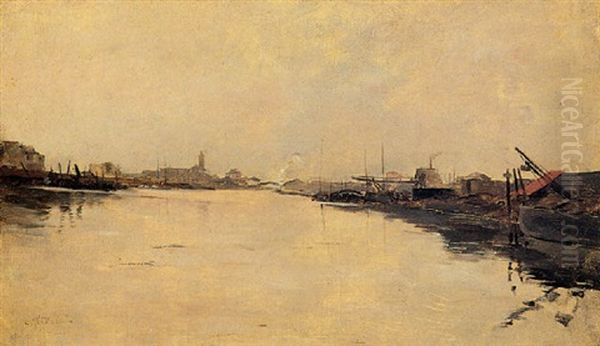
The year 1860 marked a pivotal moment in Pittara's artistic trajectory: his journey to Paris. The French capital was then the undisputed epicenter of the art world, a crucible of innovation and debate. It was here that Pittara encountered the revolutionary ideas of Realism, championed by Gustave Courbet, and the more lyrical naturalism of the Barbizon School. He reportedly met and established connections with leading figures such as Jean-Baptiste-Camille Corot, whose atmospheric landscapes and subtle tonal harmonies were transforming the genre.
The Barbizon School, active in the Forest of Fontainebleau near the village of Barbizon, included artists like Théodore Rousseau, Jean-François Millet, Charles-François Daubigny, Constant Troyon, and Narcisse Virgilio Díaz de la Peña. These painters rejected the idealized landscapes of Neoclassicism and the dramatic narratives of Romanticism. Instead, they advocated for painting directly from nature (en plein air), capturing the fleeting effects of light and atmosphere and depicting the unadorned reality of rural life and the natural world. Courbet, with his more overtly political and socially conscious Realism, also profoundly impacted the artistic climate, challenging the Salon system and advocating for art that depicted the "real and existing." Pittara absorbed these influences, which resonated with his existing interest in nature and animal life, steering him away from purely academic constraints towards a more direct and truthful engagement with his subjects.
Return to Italy and the Genesis of the Rivara School
Upon his return to Italy around 1861, Pittara brought with him the fresh perspectives gained in Paris. He eventually settled in Rivara, a picturesque village in the Canavese region of Piedmont, near Turin. The tranquil beauty of the local countryside, with its rolling hills, verdant pastures, and rustic charm, provided an ideal setting for his artistic pursuits. It was here, in this inspiring environment, that Carlo Pittara became a central and animating figure in what would become known as the Scuola di Rivara.
The Rivara School was not a formal institution with a rigid curriculum but rather a loose association of like-minded artists who gathered in and around Rivara, drawn by the area's scenic beauty and the collegial atmosphere fostered by Pittara. They shared a common commitment to landscape painting, often executed en plein air, and a desire to capture the authentic character of the Piedmontese countryside. This movement represented a significant shift in regional art, moving away from the historical and mythological subjects favored by academic tradition towards a more intimate and direct engagement with the local environment. Pittara's home and studio in Rivara became a meeting point, a place for discussion, shared work, and mutual encouragement.
The Rivara School: A Collective Endeavor
Carlo Pittara was the magnetic force around whom the Rivara School coalesced. He was joined by a number of talented contemporaries who shared his artistic vision. Among the most prominent members were Alfredo d'Andrade (also documented as Alfredo de Andrade), an artist of Portuguese descent who was also an accomplished architect and medievalist, known for his sensitive landscape studies. Ernesto Rayper, another key figure, was particularly adept at capturing the lushness of the Canavese landscapes with a rich palette and vigorous brushwork.
Other artists associated with or influenced by the Rivara group included Vittorio Avondo, who, like d'Andrade, had a keen interest in historical preservation alongside his landscape painting, often imbuing his scenes with a romantic, historical sensibility. Renato Erre is also mentioned as part of this circle, contributing to the collective exploration of naturalistic landscape. While not strictly a member, the influential Piedmontese landscape painter Antonio Fontanesi, whose work often carried a more melancholic and romantic tone, was an important precursor and contemporary whose presence was felt in the region's artistic developments. The interactions among these artists, their shared excursions into the countryside, and their discussions on art created a dynamic environment that spurred innovation and solidified a regional approach to landscape painting. They emphasized bright colors, inspired directly by the observation of nature, and a truthful depiction of rural life, often including animals and local figures within their compositions.
Pittara's Artistic Vision: Naturalism and Realism
Pittara's mature artistic style is best characterized as Naturalism, with strong Realist underpinnings. He largely abandoned the idealized or overly sentimentalized approaches to landscape and animal painting that had been common. Instead, he sought to depict the world around him with honesty and fidelity. His landscapes are serene and meticulously observed, capturing the specific light and atmosphere of the Piedmontese countryside. There is a quiet dignity in his scenes, a sense of harmony between humanity, animals, and the land.
His approach to animal painting was particularly noteworthy. Drawing on his training with Humbert and his own keen observations, Pittara depicted animals not merely as picturesque elements but as integral parts of the rural ecosystem and the lives of the people who depended on them. Whether painting cattle grazing in a field, sheep tended by a shepherd, or horses at a market, he imbued his animal subjects with a sense of individuality and presence. While his style could sometimes retain a degree of academic finish in its detail and composition, the underlying impulse was always towards a truthful representation of the visible world. This commitment to realism also meant that he often depicted scenes of everyday rural labor, aligning with the broader European Realist interest in the lives of ordinary people.
Master of Animal and Landscape Painting
Carlo Pittara's oeuvre demonstrates his dual mastery in animal and landscape painting. His landscapes are often expansive, showcasing the rolling terrain, waterways, and distinctive flora of Piedmont. He paid close attention to the effects of light at different times of day, from the clear brightness of midday to the soft, diffused light of dawn or dusk, as seen in works like Tramonto (Sunset). His compositions are typically well-balanced, guiding the viewer's eye through scenes that feel both tranquil and alive with subtle detail.
In his animal paintings, Pittara excelled at capturing the textures of fur and hide, the anatomical structure of different species, and their characteristic movements and postures. He often integrated animals seamlessly into broader landscape scenes, emphasizing their natural environment. Works depicting pastoral life, such as La Vita del Pastore (The Shepherd's Life), highlight the symbiotic relationship between humans and their livestock. He also tackled more dynamic subjects, such as market scenes or hunts, like Caccia alla volpe (Fox Hunt), which allowed him to explore animals in motion and in interaction with humans in more active contexts. His skill extended to depicting the specific breeds and types of animals common to the region, adding another layer of authenticity to his work.
Key Works and Their Significance
Several works stand out in Carlo Pittara's career, illustrating his artistic concerns and stylistic development.
La Vita del Pastore (The Shepherd's Life): This title suggests a work deeply rooted in the pastoral tradition, likely depicting a shepherd with his flock in a characteristic Piedmontese landscape. Such a painting would encapsulate Pittara's interest in rural life, his skill in animal depiction, and his ability to create an atmosphere of serene naturalism. It speaks to the timeless rhythms of agricultural life, a theme central to Realist and Naturalist art.
Campagna romana (Roman Countryside): This piece indicates that Pittara, like many artists of his time, also traveled and painted beyond his native Piedmont. The Roman Campagna, with its ancient ruins, distinctive light, and pastoral traditions, had long been a magnet for landscape painters. Pittara's interpretation would likely have combined his naturalistic approach with the unique atmosphere of this historic region, perhaps contrasting with the more verdant landscapes of northern Italy.
The Saluzzo Fair (Il Mercato di Saluzzo): Market scenes were a popular subject for Realist painters, offering opportunities to depict a cross-section of rural society, various types of livestock, and the lively interactions of commerce. A painting of the Saluzzo Fair would have allowed Pittara to showcase his skills in composing complex scenes with multiple figures and animals, capturing the bustling energy and local color of a regional market.
Caccia alla volpe (Fox Hunt): This subject provided a dynamic contrast to his more tranquil pastoral scenes. A fox hunt would involve horses, hounds, and riders in motion, demanding skill in depicting animal anatomy in action and conveying the excitement of the chase. Such a work might also have appealed to aristocratic patrons and reflects a traditional countryside pursuit. He is known to have created a hunting scene for the Royal Palace in Turin, which could be this work or one similar in theme.
Il calzolaio ambulante (The Travelling Shoemaker): This title points to Pittara's interest in depicting the everyday lives and occupations of ordinary people, a hallmark of Realism. The travelling shoemaker would be a figure of rural life, and the painting would likely focus on the character of the individual and the details of his trade, set against a natural backdrop.
Tramonto (Sunset): A landscape focused on the atmospheric effects of sunset, this work would highlight Pittara's sensitivity to light and color. Sunsets offered painters a chance to explore a rich and often dramatic palette, capturing the transient beauty of the natural world, a key concern for artists working en plein air.
Sulla Senna (On the Seine): Likely a fruit of his time in or near Paris, this painting would show Pittara applying his landscape techniques to the iconic French river. It would be interesting to compare its style and atmosphere with his Italian landscapes, perhaps reflecting the influence of French contemporaries like Daubigny, who was famous for his paintings along the Oise and Seine rivers.
These works, among others, demonstrate Pittara's commitment to observing and recording the world around him, whether it was the quiet life of a shepherd, the bustling activity of a market, or the subtle beauty of a landscape at a particular time of day.
Exhibitions, Recognition, and Critical Context
Carlo Pittara's work was not confined to his local region; he gained broader recognition through participation in significant national and international exhibitions. His paintings were shown at national exhibitions in Florence and Vienna, including the Vienna World's Fair of 1873. Inclusion in such prestigious events indicates that his work was well-regarded and considered representative of contemporary Italian art. These exhibitions provided artists with crucial platforms to showcase their talents, gain critical attention, and attract patrons.
While Pittara embraced many of the tenets of French Realism and Naturalism, his impact within Italy, particularly in Piedmont, was substantial, even if he did not achieve the kind of transformative, pan-European influence of a figure like Gustave Courbet. Courbet's Realism was often more confrontational and overtly political, challenging social and artistic hierarchies in a way that had a profound effect across the continent. Pittara's naturalism was perhaps quieter, more focused on the faithful depiction of his chosen environment and its inhabitants, but it was nonetheless a vital contribution to the diversification of Italian art in the 19th century. He played a key role in popularizing landscape painting based on direct observation, influencing a generation of Piedmontese artists.
Contemporaries and Artistic Dialogue
Pittara's artistic journey was enriched by his interactions with a wide range of contemporary artists, both in Italy and abroad. His early teachers, Giuseppe Camillo and Charles Humbert, provided foundational training. His time in Paris brought him into contact with the towering figures of Gustave Courbet and Jean-Baptiste-Camille Corot, and the broader circle of the Barbizon School, including Théodore Rousseau, Jean-François Millet, and Charles-François Daubigny. These encounters were undoubtedly formative.
Back in Italy, his closest associates were the members of the Rivara School: Alfredo d'Andrade, Ernesto Rayper, Vittorio Avondo, and Renato Erre. These artists formed a supportive and collaborative community. Beyond this immediate circle, the Italian art scene of the period was vibrant. In Tuscany, the Macchiaioli, including Giovanni Fattori, Telemaco Signorini, and Silvestro Lega, were pursuing their own revolutionary approach to realism, using "macchie" (patches or spots) of color to capture light and form. While distinct from Pittara's more detailed naturalism, the Macchiaioli shared a commitment to depicting contemporary life and landscape with truthfulness. Other notable Italian landscape painters of the era, such as Filippo Palizzi in Naples, known for his animal studies and rural scenes, also contributed to the broader movement towards realism in Italian art. Pittara's work should be seen within this rich tapestry of regional and national artistic exploration. His friend Casimiro Giannini was also part of the Turin artistic milieu.
Legacy and Enduring Influence
Carlo Pittara passed away in Rivara Canavese in 1890, the very place that had become synonymous with his artistic identity and the school he helped to establish. His legacy is primarily tied to his significant contribution to Piedmontese landscape and animal painting and his pivotal role in the Rivara School. He successfully translated the broader European trends of Naturalism and Realism into a regional context, inspiring his contemporaries and subsequent artists in Piedmont to look to their immediate surroundings for artistic inspiration.
The Rivara School, under his guidance, helped to establish en plein air painting as a vital practice in the region and fostered an appreciation for the beauty of the local landscape. While perhaps not as widely known internationally as some of his French counterparts or even some other Italian artists of his generation, Pittara's dedication to his craft, his sensitive portrayal of nature and rural life, and his influence as a mentor and colleague secure his place as an important figure in 19th-century Italian art. His works remain in various public and private collections, offering a window into the artistic and cultural landscape of his time and a testament to his skill in capturing the enduring charm of the Piedmontese countryside.
Conclusion
Carlo Pittara was an artist deeply connected to his native Piedmont, yet open to the progressive artistic currents of his time. His education in Turin and Geneva, his transformative experiences in Paris with the works of Courbet, Corot, and the Barbizon painters, and his eventual establishment of the Rivara School all contributed to a career dedicated to the naturalistic depiction of landscape and animal life. Through works like La Vita del Pastore and The Saluzzo Fair, he not only showcased his technical proficiency but also conveyed a profound appreciation for the rural world. As a central figure in the Scuola di Rivara, alongside artists like Alfredo d'Andrade and Ernesto Rayper, he championed the practice of painting outdoors and fostered a regional school of landscape art that left a lasting mark on Piedmontese art history. Carlo Pittara remains a respected master, whose serene and truthful depictions of nature continue to resonate.