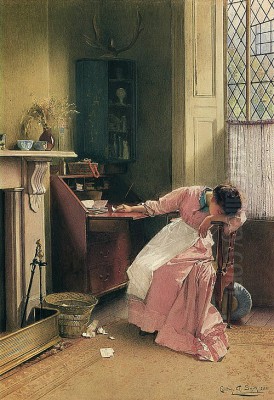
Carlton Alfred Smith (1853-1946) presents a fascinating, if somewhat perplexing, figure in the annals of late 19th and early 20th-century art. Information available about him suggests two distinct, and at times contradictory, artistic personas. One is a celebrated British watercolourist, renowned for his intimate and tender portrayals of English domestic life. The other is a distinguished French artist, a leader within the Bordeaux School, lauded for his landscapes and cityscapes, and honored by the French artistic establishment. This exploration will delve into both narratives, drawing upon the available information to paint as complete a picture as possible of this enigmatic artist, or perhaps, artists sharing a name and lifespan.
The British Chronicler of Hearth and Home
One prominent portrayal of Carlton Alfred Smith establishes him as a quintessential British artist, deeply embedded in the Victorian tradition of genre painting. His primary medium in this context was watercolour, a technique in which British artists had long excelled, from the topographical works of Paul Sandby to the romantic landscapes of J.M.W. Turner and the detailed naturalism of John Ruskin and the Pre-Raphaelites. Smith, however, carved his niche in the depiction of everyday life, focusing on the quiet, sentimental moments within the English household.
His works are characterized by a delicate touch, soft, harmonious colour palettes, and an atmosphere of warmth and serenity. He captured the nuances of family relationships, the innocence of childhood, and the gentle rhythms of domesticity in an era that highly valued such scenes. These paintings offered viewers a comforting and often idealized glimpse into the private lives of their contemporaries, resonating with the Victorian emphasis on family, morality, and sentiment.
Themes and Subjects in Smith's English Oeuvre
The thematic core of Smith's British work revolves around the family unit. He frequently depicted mothers and children, capturing moments of tenderness, instruction, or quiet companionship. Works such as Reprimand (1885) and Mother And Child (1886) are exemplary of this focus, showcasing his ability to convey emotion and narrative through subtle gestures and expressions. These paintings reflect a deep understanding and appreciation for the intimate bonds of family life.
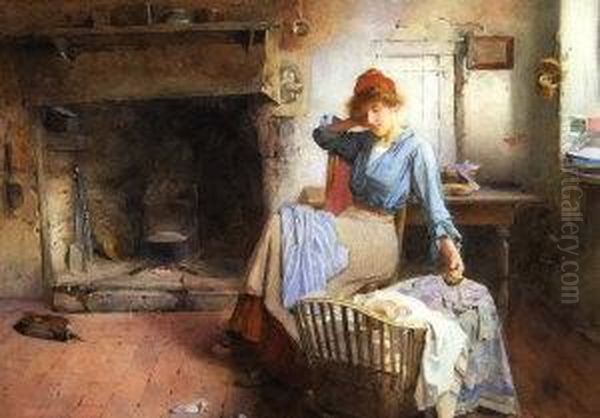
Beyond the mother-child dyad, Smith explored broader scenes of domestic activity and leisure. His canvases often feature cozy interiors, sunlit cottage gardens, and figures engaged in simple, everyday pursuits. These scenes are not grand historical statements or dramatic allegories, but rather quiet celebrations of the ordinary. They evoke a sense of peace and contentment, reflecting a longing for stability and pastoral charm that was prevalent in an increasingly industrialized and rapidly changing Britain. Artists like Frederick Daniel Hardy and Thomas Webster had earlier paved the way for such intimate interior scenes, finding a ready market among the burgeoning middle class.
Artistic Style and Technique: The Watercolourist
As a watercolourist, Carlton Alfred Smith demonstrated considerable skill. His technique involved careful layering of washes to achieve subtle gradations of tone and colour, creating a soft, luminous effect. His brushwork was typically fine and controlled, allowing for a high degree of detail in rendering figures, fabrics, and domestic settings. This attention to detail contributed to the realism of his scenes, making them relatable and engaging for his audience.
The preference for watercolour for such subjects was common in Britain. The Royal Watercolour Society and other similar institutions promoted the medium, and many artists found it perfectly suited for capturing the fleeting moments and delicate atmospheres of domestic life. Smith's style aligns with a broader Victorian aesthetic that valued craftsmanship, narrative clarity, and emotional accessibility. His contemporaries in British genre painting, though often working in oils, shared this interest in detailed, anecdotal scenes. Figures like William Powell Frith, with his sprawling contemporary panoramas like Derby Day or The Railway Station, or Luke Fildes, known for his poignant social realist works such as Applicants for Admission to a Casual Ward, represent different facets of this Victorian preoccupation with depicting contemporary life, albeit often with a more public or socially critical focus than Smith's intimate domesticity.
The French Connection: A Landscape Artist of Note
Contrasting with the image of the British domestic painter is the account of Carlton Alfred Smith as a significant French artist. According to this narrative, Smith was deeply involved in the French art world, particularly in the southwest region. He is described as an artist renowned for his depictions of forests, gardens, and urban landscapes, with a special mention of his finely tuned portrayals of the Bordeaux docks. This suggests an artist with a keen eye for atmosphere and the subtleties of light and colour in outdoor settings.
This French Carlton Alfred Smith is said to have achieved considerable recognition. In 1880, he reportedly succeeded Louis Auguin as the new leader of the Bordeaux School. Louis Auguin himself was a landscape painter, influenced by the Barbizon School artists like Jean-Baptiste-Camille Corot and Théodore Rousseau, known for their direct observation of nature. If Smith followed in this tradition, his work would likely have emphasized naturalism and plein air aesthetics, though perhaps with a regional Bordelais flavour.
Further accolades attributed to this French artist include a third-class medal from the Société des Artistes Français in 1888, and the prestigious Chevalier of the Legion of Honour in 1894. These are significant honours within the French art establishment, indicating an artist of considerable standing and official approval, akin to that received by successful Salon painters like William-Adolphe Bouguereau or Jean-Léon Gérôme, though their subject matter was vastly different.
The Bordeaux School and French Landscape Painting
The Bordeaux School, while perhaps not as internationally renowned as the Barbizon or Impressionist movements, represented a significant regional artistic current. If Carlton Alfred Smith was indeed its leader, he would have played a pivotal role in shaping its direction and promoting its artists. Landscape painting in France during this period was incredibly vibrant. The legacy of the Barbizon painters, who emphasized direct observation of nature and a romantic sensibility, was profound. Artists like Charles-François Daubigny, a key Barbizon figure, continued to influence younger generations.
Simultaneously, Impressionism, spearheaded by artists such as Claude Monet, Camille Pissarro, and Alfred Sisley, was revolutionizing the depiction of light and atmosphere, though its acceptance by official bodies like the Société des Artistes Français was slow. A landscape artist working in Bordeaux in the 1880s and 1890s would have been aware of these developments, even if their own style hewed to more traditional or regionally specific aesthetics. The mention of Smith's "finely tuned" depictions of Bordeaux docks suggests an interest in capturing the specific light and activity of a busy port, a theme also explored by Impressionists like Pissarro in port cities like Rouen or Le Havre, and earlier by artists like Eugène Boudin, a mentor to Monet.
Reconciling the Narratives: One Artist or Two?
The existence of these two distinct artistic profiles for an artist named Carlton Alfred Smith, sharing the same lifespan (1853-1946), is puzzling. The provided information itself highlights this contradiction, particularly regarding his birthplace and primary artistic output. It is possible that there were two artists of the same name and remarkably similar lifespans, one British and one French. Such coincidences, while rare, are not unheard of in art history.
Alternatively, it is conceivable that one artist had a remarkably diverse career, splitting his time and artistic focus between Britain and France. An artist might, for instance, have trained or worked in France, gaining recognition there for landscapes, while also maintaining a practice in Britain focused on more commercially popular domestic scenes. However, the leadership of a specific French regional school like Bordeaux and the reception of high national honors typically imply a deep and sustained commitment to the French art scene.
The information also notes a lack of direct records regarding Smith's teachers or students, and no specific collaborations or joint exhibitions are mentioned for the British persona. For the French persona, the succession of Louis Auguin is a significant connection. Without further, more definitive biographical data or a comprehensive catalogue raisonné that bridges these two artistic identities, the question remains open. The art market itself sometimes reflects this ambiguity, with works attributed to "Carlton Alfred Smith" occasionally surfacing that align with one or the other described specializations.
Artistic Milieu and Potential Influences
If we consider the British Carlton Alfred Smith, his work fits comfortably within the broader context of Victorian genre painting. Artists such as George Elgar Hicks, who painted scenes of everyday life like Woman's Mission, or Augustus Leopold Egg, known for his narrative triptychs depicting moral dramas, were his contemporaries. The public appetite for sentimental and anecdotal art was strong, fueled by publications like The Illustrated London News and the annual Royal Academy exhibitions. Smith's watercolours would have appealed to a middle-class clientele seeking pleasant, relatable art for their homes. His focus on motherhood and childhood also aligns with Victorian ideals of the sanctity of the home and the innocence of youth, themes also explored by artists like Frederick Morgan or Arthur John Elsley, though often with a more overtly sentimental or playful tone.
If we turn to the French Carlton Alfred Smith, his association with the Bordeaux School and landscape painting places him in a different, though equally rich, artistic environment. The influence of the Barbizon School would have been significant, with its emphasis on naturalism and the poetic qualities of the landscape. The rise of Impressionism would also have been a major factor in the French art world, challenging traditional approaches to light, colour, and subject matter. Artists like Henri Harpignies, a landscapist who bridged the Barbizon tradition with a lighter palette, or Léon-Augustin Lhermitte, known for his sympathetic portrayals of rural peasant life with a strong landscape element, were prominent figures during this period. Smith's focus on forests, gardens, and cityscapes, particularly the Bordeaux docks, suggests an engagement with the diverse visual character of his surroundings.
Notable Works and Their Characteristics
For the British Carlton Alfred Smith, specific titles like Reprimand (1885) and Mother And Child (1886) give us a clear indication of his thematic preoccupations. Other works attributed to him in this vein often carry titles that evoke domestic tranquility or childhood pastimes, such as In the Garden or Playtime. These paintings are generally characterized by their detailed rendering, soft lighting, and gentle emotional tone. The figures are typically well-dressed and situated in comfortable, orderly environments, reflecting an idealized vision of middle-class or genteel rural life.
For the French Carlton Alfred Smith, while specific titles of his landscapes or Bordeaux scenes are not as readily available in the summarized information, the description of his work as featuring "finely tuned" depictions of the Bordeaux docks implies a sophisticated handling of light, atmosphere, and the complex interplay of water, shipping, and architecture. His forest and garden scenes would likely have showcased a sensitivity to natural forms and the changing effects of season and weather, in line with the traditions of French landscape painting. The recognition he received suggests works of considerable technical merit and aesthetic appeal.
The Enduring Enigma and Legacy
The dual narrative surrounding Carlton Alfred Smith makes it challenging to define a single, cohesive legacy. If he was primarily the British watercolourist, his legacy lies in his charming and skillful contributions to Victorian genre painting. His works offer valuable insights into the domestic ideals and sentimental tastes of his era, preserving moments of quiet beauty and familial affection. He would be remembered as a competent and appealing artist within a well-established British tradition, alongside contemporaries like Myles Birket Foster, who also specialized in idyllic rural and domestic watercolour scenes.
If he was the French landscape artist and leader of the Bordeaux School, his legacy would be tied to the development of regional art in France and his contributions to the landscape tradition. His official honors would mark him as an artist of national importance in France. His work would be studied in the context of late 19th-century French realism and naturalism, perhaps showing a path distinct from the more radical innovations of Impressionism but nonetheless significant.
The possibility that these are two separate artists means that each would have his own distinct legacy within his respective national school. The lack of clear, integrated biographical information means that, for now, Carlton Alfred Smith remains something of an enigma. His name evokes images of both cozy English interiors and evocative French landscapes. Perhaps future art historical research will clarify this intriguing situation, definitively separating two careers or, more remarkably, uniting them into the story of one exceptionally versatile and bi-national artist. Until then, we are left to appreciate the distinct bodies of work attributed to him, each offering its own unique pleasures and insights into the artistic currents of the late 19th and early 20th centuries. The very existence of this ambiguity adds a layer of intrigue to an artist, or artists, whose work in either sphere demonstrates a dedicated and skilled hand.