Charles Harmony Harrison (1842-1902) stands as a significant figure in the lineage of English landscape painters, particularly renowned for his evocative watercolour depictions of the Norfolk and Suffolk countryside and coastline. Flourishing in the latter half of the Victorian era, Harrison's work captured the subtle beauties and atmospheric nuances of East Anglia, continuing and evolving the traditions established by the celebrated Norwich School of painters. His meticulous technique, combined with a sensitive eye for light and local character, secured him a respected place among his contemporaries and a lasting legacy for art enthusiasts and historians alike.
Early Life and Artistic Awakening
Born in Great Yarmouth, Norfolk, in 1842, Charles Harmony Harrison was immersed from a young age in the distinctive landscapes that would become the cornerstone of his artistic output. The sprawling Broads, the rugged coastline, and the pastoral inland scenes of East Anglia provided an inexhaustible source of inspiration. While detailed records of his formal artistic training are somewhat scarce, it is evident that he was a keen observer of nature and likely benefited from the rich artistic environment of Norfolk, which had already been established as a hub for landscape painting by the preceding generation.
Harrison's early development as an artist coincided with a period where watercolour painting was enjoying immense popularity in Britain. The medium, prized for its portability and its capacity for capturing transient effects of light and atmosphere, was perfectly suited to the kind of en plein air sketching and detailed studio work that landscape artists increasingly favoured. Harrison quickly demonstrated a remarkable proficiency in watercolour, developing a style characterized by careful draughtsmanship, delicate washes, and a keen understanding of colour harmony, which perhaps even his middle name, Harmony, presaged.
The Enduring Influence of the Norwich School
To understand Charles Harmony Harrison's artistic context, one must acknowledge the profound influence of the Norwich School of painters. Founded in the early 19th century, this was the first provincial art movement in Britain to gain national and international recognition. Its leading figures, John Crome (1768-1821) and John Sell Cotman (1782-1842), established a tradition of landscape painting that was deeply rooted in the observation of local scenery, drawing inspiration from the Dutch Golden Age masters as well as the natural beauty of Norfolk.
Other notable members of the early Norwich School included George Vincent (1796-c.1832), James Stark (1794-1859), and Joseph Stannard (1797-1830). These artists, through their paintings and etchings, celebrated the unassuming charm of the region – its heathlands, woodlands, rivers, and coastal views. By the time Harrison began his career, the initial force of the school had somewhat waned, but its principles and aesthetic preferences continued to resonate with a new generation of East Anglian artists. Harrison can be seen as one of the notable inheritors of this tradition, carrying its spirit into the later Victorian period. He, along with contemporaries like John Middleton (1827-1856), who died tragically young but was a brilliant watercolourist, and Henry Bright (1810-1873), helped to sustain the region's reputation for landscape art.
Artistic Style and Masterful Technique
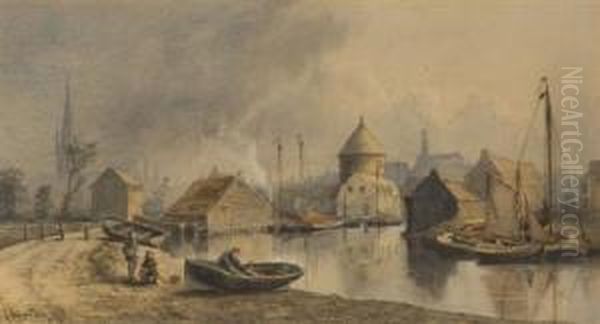
Charles Harmony Harrison's style is distinguished by its blend of topographical accuracy and poetic sensibility. He was a meticulous observer, and his works often provide a faithful record of specific locations. However, his paintings transcend mere illustration; they are imbued with a palpable sense of atmosphere, capturing the unique quality of light and weather conditions characteristic of East Anglia. His handling of watercolour was exceptionally skilled. He employed a range of techniques, from broad, transparent washes to build up skies and water, to fine, detailed brushwork for foliage, architectural elements, and figures.
His palette was typically subtle and naturalistic, reflecting the often-muted tones of the Norfolk landscape, but he was also capable of capturing the brilliance of a sunny day or the dramatic hues of a sunset over the Broads. Harrison had a particular talent for rendering water, whether the calm, reflective surfaces of the Broads, the gentle lapping of waves on the shore, or the more turbulent waters of the North Sea. The interplay of light on water, the reflections of reeds and trees, and the sense of depth and transparency are hallmarks of his best work. Figures, though often small in scale, are skillfully integrated into his landscapes, adding a sense of life and narrative interest without dominating the scene. These might be boatmen on the rivers, farmworkers in the fields, or families enjoying the seaside.
Key Themes and Cherished Subjects
The landscapes of Norfolk and Suffolk were Harrison's enduring muse. He painted the Norfolk Broads extensively, capturing the tranquil beauty of these unique wetlands with their reed-fringed waterways, windmills, and wherries. Works depicting scenes around Ormesby, Filby, and Rollesby Broads are numerous and highly sought after. These paintings often evoke a sense of peace and timelessness, reflecting a deep affection for the region's natural heritage.
Coastal scenes also formed a significant part of his oeuvre. The beaches, cliffs, and fishing villages of the Norfolk and Suffolk coasts provided rich subject matter. He painted views of Great Yarmouth, Gorleston, Lowestoft, and other coastal locations, often depicting fishing boats, piers, and the daily life of seaside communities. These works capture the bracing atmosphere of the coast and the maritime character of the region. Inland, Harrison found inspiration in the rolling countryside, quiet lanes, picturesque villages, and ancient churches of East Anglia. His depictions of rural life, with thatched cottages, grazing cattle, and meandering rivers, convey a romanticised yet authentic vision of the English countryside. Titles such as "A Suffolk Lane," "Carting Hay, Ormesby Broad," or "The Ferry, Reedham, Norfolk" give a clear indication of his preferred locales.
Notable Works and Their Characteristics
While Harrison produced a prolific body of work, certain paintings stand out as particularly representative of his skill and vision. For instance, "Beaching the Boats, Gorleston" showcases his ability to handle complex compositions with multiple figures and boats, set against a dynamic coastal backdrop. The rendering of the wet sand, the activity of the fishermen, and the quality of the seaside light are all masterfully executed.
Another example, "Cattle Watering in a Broadland Landscape," typifies his tranquil Broadland scenes. Here, the reflections in the still water, the lushness of the summer foliage, and the peaceful presence of the cattle create an idyllic image of rural Norfolk. The subtle gradations of green and blue, and the delicate rendering of the distant trees, demonstrate his command of watercolour. His depictions of specific locations, like "Gorleston Pier," often combine topographical accuracy with an atmospheric quality that elevates them beyond simple views. The structure of the pier, the movement of the waves, and the expansive sky are all treated with sensitivity and skill. Many of his works are simply titled with the location, such as "On the Yare" or "Near Beccles, Suffolk," allowing the scene itself to communicate its essence.
Exhibitions, Recognition, and Contemporaries
Charles Harmony Harrison achieved considerable recognition during his lifetime. He exhibited regularly at prestigious London venues, including the Royal Academy, the Royal Society of British Artists (RBA) on Suffolk Street, and the New Watercolour Society. His work was also frequently shown at provincial exhibitions, particularly in Norwich, where his paintings were well-received by local audiences familiar with the scenes he depicted. His inclusion in these exhibitions placed him alongside many of the leading artists of the day.
Within the specific sphere of East Anglian art, Harrison was a respected figure. He was a contemporary of other notable Norfolk painters such as Thomas Lound (1801-1861), though Lound was of an earlier generation, his influence persisted. Alfred Stannard (1806-1889), son of Joseph Stannard, and John Berney Crome (1794-1842), son of John Crome, also continued the Norwich School traditions, though their active periods overlapped more with Harrison's earlier years. Harrison's dedication to watercolour landscape also places him in the broader context of Victorian watercolourists like Myles Birket Foster (1825-1899), whose picturesque rural scenes were immensely popular, and Helen Allingham (1848-1926), known for her charming depictions of cottages and country gardens. While Harrison's style was perhaps more directly tied to the naturalism of the Norwich School than the sometimes more sentimentalised work of Birket Foster, they shared a common appreciation for the beauty of the British countryside. The towering figures of earlier British landscape art, J.M.W. Turner (1775-1851) and John Constable (1776-1837), had, of course, set a high bar for all subsequent landscape painters, and their influence, direct or indirect, permeated the artistic climate.
The Pre-Raphaelite Brotherhood, with artists like John Everett Millais (1829-1896) and William Holman Hunt (1827-1910), also had a significant impact on Victorian art with their emphasis on truth to nature and detailed observation, even if their subject matter and stylistic approach differed considerably from Harrison's. However, the general Victorian appreciation for detailed realism in art would have created a receptive environment for Harrison's carefully rendered landscapes. Another contemporary, Samuel David Colkett (1806-1863), also painted Norfolk scenes, further enriching the local artistic milieu.
Later Life and Enduring Legacy
Charles Harmony Harrison continued to paint throughout his life, remaining based primarily in Great Yarmouth and later in Suffolk. He maintained a consistent output of high-quality watercolours, his love for the East Anglian landscape undiminished. He passed away in 1902, leaving behind a substantial body of work that documents the region's natural beauty and rural character at a time when the traditional ways of life were beginning to change with the advance of industrialisation and modernity.
Today, Harrison's paintings are held in numerous public and private collections, including the Norwich Castle Museum & Art Gallery, which has an extensive collection of works by the Norwich School and its successors. His watercolours are prized for their technical accomplishment, their atmospheric charm, and their faithful depiction of a beloved region. They serve as both beautiful works of art and valuable historical records of the East Anglian landscape in the late 19th century. Art historians and collectors recognise him as one of the last significant exponents of the Norwich School tradition, a painter who skillfully adapted its principles to his own time and artistic vision. His work continues to appeal to those who appreciate the subtle beauties of the British landscape and the refined art of watercolour painting. The enduring popularity of his scenes of the Norfolk Broads, in particular, speaks to their timeless appeal and his ability to capture the unique spirit of place.
Conclusion: An Artist of Place and Atmosphere
Charles Harmony Harrison was, above all, an artist deeply connected to his native East Anglia. His life's work was a testament to his profound appreciation for its diverse landscapes, from the tranquil Broads and meandering rivers to the dynamic coastline and pastoral countryside. As a watercolourist, he demonstrated exceptional skill, mastering the medium to convey the nuanced effects of light, weather, and atmosphere that define the region. While he operated within the long shadow of the great figures of the Norwich School, such as Crome and Cotman, Harrison carved out his own distinct identity, producing a body of work that is both a continuation of that esteemed tradition and a personal expression of his artistic vision. His paintings offer a window into the Victorian perception of landscape, celebrating its picturesque qualities while remaining grounded in careful observation. For his dedication to his craft, his sensitive portrayal of East Anglia, and his contribution to the story of British watercolour painting, Charles Harmony Harrison rightly deserves his place as a respected and admired Victorian artist. His legacy is preserved in the delicate washes and intricate details of his watercolours, which continue to evoke the timeless beauty of the Norfolk and Suffolk landscapes.