Charles Joseph Beauverie: A Barbizon Master of Light and Landscape
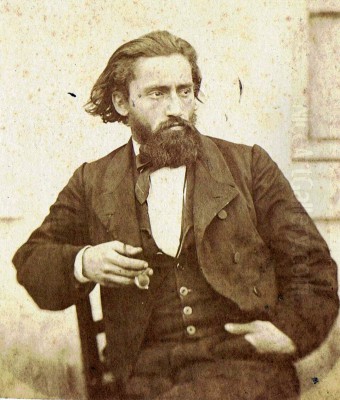
Charles Joseph Beauverie (1839-1924) stands as a significant, if sometimes overlooked, figure in the rich tapestry of 19th-century French art. A dedicated painter and etcher, Beauverie is primarily associated with the Barbizon School, a movement that revolutionized landscape painting by emphasizing direct observation of nature and a departure from idealized, classical scenes. His work is characterized by a profound sensitivity to the nuances of light, atmosphere, and the tranquil beauty of the French countryside, particularly the regions he frequented, such as the Forest of Fontainebleau, Auvers-sur-Oise, and later, the Forez region.
Early Life and Artistic Formation
Born in Lyon on September 17, 1839, Charles Joseph Beauverie's artistic journey began in a city with a strong artistic tradition. He initially pursued his studies at the École des Beaux-Arts de Lyon, an institution that provided a solid foundation in academic principles. However, like many aspiring artists of his generation, Beauverie was drawn to Paris, the undisputed center of the art world.
In Paris, he enrolled in the studio of Charles Gleyre, a Swiss-born painter who, despite his own academic leanings, taught a remarkable cohort of students who would later spearhead the Impressionist movement. Among Gleyre's pupils were Claude Monet, Pierre-Auguste Renoir, Alfred Sisley, and Frédéric Bazille. While Beauverie did not become an Impressionist himself, his time in Gleyre's atelier would have exposed him to rigorous training and the burgeoning avant-garde ideas circulating in Paris.
Another crucial influence during his formative years was Dr. Paul Gachet. Gachet, a physician and art patron, is famously remembered for his association with Vincent van Gogh during the latter's final months in Auvers-sur-Oise. However, Gachet was also a keen supporter of many artists and an amateur etcher himself. His encouragement and potential guidance likely played a role in developing Beauverie's interest in printmaking and his connection to the artistic circles that valued a more personal and direct engagement with subject matter.
The Enduring Influence of the Barbizon School
The Barbizon School, which flourished roughly from the 1830s to the 1870s, was pivotal in shaping Beauverie's artistic vision. Named after the village of Barbizon on the edge of the Forest of Fontainebleau, this group of artists sought to depict landscapes with a newfound realism and emotional depth. They rejected the historical and mythological subjects favored by the French Academy, turning instead to the humble beauty of rural France.
Key figures of the Barbizon School, whose work undoubtedly impacted Beauverie, include Théodore Rousseau, considered one of its founders, known for his melancholic and majestic forest scenes. Jean-François Millet, another leading member, focused on peasant life, imbuing his figures with a profound dignity. Jean-Baptiste-Camille Corot, while not strictly a Barbizon painter, shared their love for plein air painting and lyrical landscapes, often suffused with a silvery light.
Perhaps the most direct influence on Beauverie from this school was Charles-François Daubigny. Daubigny was renowned for his river scenes, often painted from his studio boat, "Le Botin." He had a remarkable ability to capture the fleeting effects of light and water, and his looser brushwork and emphasis on atmosphere prefigured Impressionism. Beauverie's own fascination with water reflections and the verdant banks of rivers clearly echoes Daubigny's preoccupations. Other notable Barbizon painters like Narcisse Virgilio Díaz de la Peña, with his richly textured forest interiors, Constant Troyon, known for his animal paintings within landscapes, and Jules Dupré, celebrated for his dramatic and often stormy depictions of nature, all contributed to the artistic environment that nurtured Beauverie.
Beauverie embraced the Barbizon ethos of painting directly from nature (en plein air), allowing him to capture the immediate sensations of light, color, and atmosphere. His landscapes are not merely topographical records but are imbued with a sense of place and a quiet, contemplative mood.
A Master of Landscape and Light
Charles Joseph Beauverie's oeuvre is dominated by landscapes. He possessed a keen eye for the subtle interplay of light and shadow, the way sunlight filters through leaves, or the myriad reflections on the surface of a tranquil pond or a slow-moving river. His paintings often depict the lush vegetation of the French countryside, rendered with a careful attention to detail that nonetheless avoids becoming overly photographic.
His palette, while generally naturalistic, could achieve a remarkable luminosity. He was particularly adept at capturing the specific atmospheric conditions of different times of day and seasons. Whether it was the crisp light of a spring morning, the hazy warmth of a summer afternoon, or the muted tones of autumn, Beauverie conveyed these with sensitivity and skill. His compositions are typically well-balanced, drawing the viewer into serene, pastoral scenes. He often favored views along riverbanks, forest paths, or quiet rural villages, finding beauty in the everyday aspects of the landscape.
His brushwork, while more controlled than that of the Impressionists, shows a certain freedom and texture that contributes to the vitality of his surfaces. He understood how to build up layers of paint to suggest the density of foliage or the transparency of water, demonstrating a sophisticated command of his medium.
Beauverie and Auvers-sur-Oise: A Confluence of Artists
Auvers-sur-Oise, a picturesque village on the banks of the Oise River, became an important artistic hub in the latter half of the 19th century, and Beauverie was among the many artists drawn to its charms. Daubigny had settled there, and his presence attracted other painters, including Corot, who often visited and painted in the area.
Beauverie's time in Auvers-sur-Oise placed him in a vibrant artistic milieu. He is known to have interacted with fellow artists such as Paul Jouanny, Léonide Bourges, and Pierre Emmanuel Damoye, the latter also a landscape painter influenced by the Barbizon tradition. This period was crucial for artistic exchange and the reinforcement of shared ideals regarding landscape painting.
Later, Auvers-sur-Oise would become famously associated with Impressionism and Post-Impressionism. Camille Pissarro worked there, and Paul Cézanne spent time painting alongside him. The village's most poignant artistic association is, of course, with Vincent van Gogh, who spent his last seventy days there under the care of Dr. Gachet, producing a torrent of masterpieces. While Beauverie's style remained rooted in the Barbizon tradition, his presence in Auvers during a period of such intense artistic activity underscores his connection to the evolving landscape of French art. His works from this area, such as Les Bords de l'Oise à Auvers, capture the specific character of the region that appealed to so many painters.
The Art of Etching: Capturing Nature in Line
Beyond his achievements in oil painting, Charles Joseph Beauverie was also a proficient and prolific etcher. Etching, a printmaking technique that allows for fine detail and expressive lines, experienced a revival in the 19th century, with many painters exploring its possibilities. Artists like Charles Meryon, with his haunting views of Paris, and Félix Bracquemond, a master technician who also helped popularize Japanese art, were prominent figures in this etching revival.
Beauverie's etchings often mirrored the subjects of his paintings: landscapes, river scenes, and rural motifs. He demonstrated a fine command of the etching needle, creating prints that were both delicate and strong. His etchings, such as Auvers-sur-Oise, la rue Rémy or Bords de l'Oise animés (1876), showcase his ability to translate the textures and atmosphere of nature into the linear medium of print. These works allowed for wider dissemination of his imagery and contributed to his reputation. Dr. Gachet, himself an amateur etcher who signed his prints "Paul van Ryssel," likely encouraged Beauverie in this pursuit. The medium suited the Barbizon artists' interest in capturing the specific character of a place and the subtle effects of light.
Life in Poncins: "Père Beauverie"
Later in his life, Charles Joseph Beauverie settled in Poncins, a village in the Forez region near the Loire River. He purchased a house there and became a well-integrated and respected member of the local community. This move did not diminish his artistic output; rather, the landscapes of the Forez provided new inspiration.
His connection with the local populace was warm and genuine. Villagers affectionately referred to him as "Père Beauverie" (Father Beauverie), a testament to his approachable nature and his simple way of life. He and his wife, Marie-Clotilde, were known to participate in village gatherings, further endearing them to their neighbors. It is said that he would occasionally hold impromptu exhibitions of his work at the market in nearby Feurs (or Feuilly, as mentioned in some sources, though Feurs is more prominent in the Forez region), sharing his art directly with the people of the region he had come to call home. This aspect of his life highlights a humility and a desire to connect with ordinary people, qualities that are often reflected in the unpretentious charm of his art.
Notable Works and Their Characteristics
Several works stand out in Charles Joseph Beauverie's oeuvre, exemplifying his style and thematic concerns.
Étang de Viveray (Viveray Lake), painted in 1880, is a significant example of his landscape painting. This large canvas, now housed in the Musée des Beaux-Arts de Tours, likely depicts a tranquil lake scene, showcasing his skill in rendering water, reflections, and the surrounding vegetation. The scale of the work suggests it was intended as a major statement piece, possibly for Salon exhibition. Such a work would have allowed him to fully explore the atmospheric effects and the immersive quality of a natural setting that were central to his art.
Escalier au Château de Laroche Lambert (Staircase at Château de Laroche Lambert) suggests an interest in picturesque architectural elements within a natural or historical setting. The Château de Laroche-Lambert, located in the Haute-Loire department, is a medieval fortress with later additions. A painting focusing on a staircase within such a structure would offer opportunities for interplay of light and shadow, texture of stone, and a sense of history, themes that resonated with the romantic sensibilities often underlying Barbizon art.
Les Bords de l'Oise à Auvers (The Banks of the Oise at Auvers) is a title that points directly to his time in the artistically fertile environment of Auvers-sur-Oise. Works with this theme would capture the gentle flow of the river, the lush greenery of its banks, and perhaps the characteristic poplar trees of the region. These scenes were favored by many artists, from Daubigny to Pissarro and Van Gogh, each interpreting the locale through their unique stylistic lens. Beauverie's versions would emphasize the peaceful, pastoral quality of the Oise valley.
His etchings, such as Auvers-sur-Oise, la rue Rémy and Bords de l'Oise animés, further demonstrate his commitment to capturing the essence of specific locales. The former would likely depict a village street scene, focusing on the rustic architecture and daily life, while the latter ("Animated Banks of the Oise") suggests the inclusion of figures or boats, adding a lively element to the river landscape.
Legacy and Historical Appreciation
Charles Joseph Beauverie passed away in Pons, Charente-Maritime, in 1924. While he may not have achieved the widespread fame of the leading Impressionists or the most celebrated Barbizon masters like Corot or Millet, his contribution to French landscape painting is undeniable. He is often categorized as a "petit maître" (minor master) of the Barbizon School, a term that, while acknowledging a secondary rank, also recognizes genuine talent and a significant body of work.
His paintings and etchings found their way into various public and private collections. The presence of his work in institutions like the Musée des Beaux-Arts de Tours and, historically, the South Kensington Museum in London (now the Victoria and Albert Museum) attests to the recognition he received during his lifetime and beyond. He regularly exhibited at the Paris Salon, the official art exhibition of the Académie des Beaux-Arts, which was the primary venue for artists to gain recognition and patronage.
Beauverie's art consistently reflects the core tenets of the Barbizon School: a deep love for nature, a commitment to truthful representation, and a sensitivity to the effects of light and atmosphere. He successfully captured the serene beauty of the French countryside, creating works that are both aesthetically pleasing and evocative of a particular time and place. His dedication to his craft, his skillful handling of both paint and the etching needle, and his ability to convey a quiet, contemplative mood ensure his place among the notable landscape artists of his generation.
In the broader narrative of art history, Beauverie and artists like him represent the vital continuation and dissemination of the Barbizon School's ideals. They helped to solidify landscape painting as a major genre and paved the way for subsequent movements, including Impressionism, which built upon the Barbizon painters' practice of outdoor painting and their focus on capturing fleeting moments. Artists like Adolphe Appian, a contemporary from Lyon also known for his landscapes and etchings, or Léon-Victor Dupré (brother of Jules Dupré), further illustrate the breadth of talent working within this landscape tradition. Even later artists, such as Henri Harpignies, who lived an exceptionally long life and bridged the Barbizon tradition with later styles, demonstrate the enduring appeal of naturalistic landscape painting.
Charles Joseph Beauverie's legacy lies in his honest and heartfelt depictions of the natural world. His art invites viewers to appreciate the subtle beauties of the French landscape, rendered with a skill and sensitivity that continue to resonate. He remains a testament to the enduring power of observing and interpreting nature through an artistic lens.