Charles Meer Webb stands as a notable, if sometimes overlooked, figure within the vibrant tapestry of 19th-century British art. A painter of considerable skill, he dedicated his career to the meticulous depiction of genre scenes and historical subjects, capturing moments of everyday life, quiet domestic drama, and evocative historical vignettes. His work, firmly rooted in the narrative traditions popular during the Victorian era, offers valuable insights into the tastes, preoccupations, and artistic currents of his time. While not an avant-garde revolutionary, Webb was a master craftsman whose paintings continue to charm and engage viewers with their detailed execution and storytelling prowess.
Early Life and Artistic Formation
Born in Britain in 1830, Charles Meer Webb emerged during a period of significant artistic activity and shifting aesthetics. The early to mid-19th century saw the Royal Academy of Arts as a dominant force, though challenges to its preeminence were beginning to surface with movements like the Pre-Raphaelite Brotherhood. For an aspiring artist like Webb, the path to a professional career typically involved rigorous training, often sought both domestically and on the Continent.
While specific details of his earliest training in England are not extensively documented in readily available sources, it is known that Webb, like many ambitious British artists of his generation, sought to broaden his artistic horizons by studying abroad. He is recorded as having spent time training in prominent artistic centers such as Berlin, Antwerp, and, significantly, Düsseldorf. The Düsseldorf Academy, in particular, was renowned throughout Europe for its emphasis on detailed realism, historical accuracy, and strong narrative content, often imbued with a sentimental or anecdotal quality. This "Düsseldorf School" of painting, whose leading figures included artists like Andreas Achenbach, Oswald Achenbach, Karl Friedrich Lessing, and Johann Wilhelm Schirmer, exerted a considerable influence on many international artists, and its impact can be discerned in Webb's meticulous technique and his penchant for storytelling.
His time in Antwerp would also have been formative. Antwerp, with its rich artistic heritage harking back to masters like Peter Paul Rubens and Anthony van Dyck, maintained a strong tradition of figure painting and historical subjects. Artists like Hendrik Leys, a prominent Belgian historical and genre painter, were influential in reviving a detailed, almost archaicizing style that drew on Northern Renaissance traditions, and it is plausible that Webb absorbed these influences, further refining his approach to historical genre.
Dominant Artistic Style and Thematic Concerns
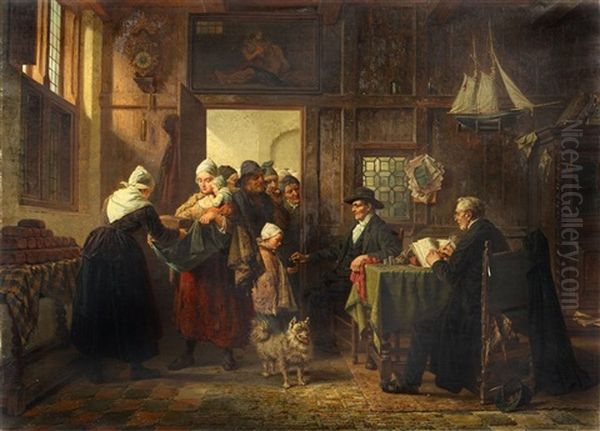
Charles Meer Webb’s artistic output is characterized by a commitment to representational accuracy, a keen eye for detail, and a strong narrative impulse. His style can be broadly categorized as Victorian genre painting, often with a historical inflection. He excelled in creating compositions that invite the viewer to decipher a story, to engage with the characters and their depicted circumstances. His canvases are typically filled with carefully rendered textures, costumes, and interior details that contribute to the overall atmosphere and verisimilitude of the scene.
A key characteristic of Webb's work is its accessibility. He often chose subjects that resonated with Victorian sensibilities: scenes of domestic life, moments of contemplation or decision, social interactions, and romanticized glimpses into the past. Unlike some of his contemporaries who tackled grand mythological or overtly moralizing themes on a monumental scale, Webb often focused on more intimate, human-scale narratives. His figures are usually portrayed with a degree of psychological insight, their expressions and postures conveying emotions that drive the story.
The influence of the Düsseldorf School is evident in the polished finish of his paintings and the clarity of his compositions. There is a certain precision in his brushwork that allows for the faithful representation of fabrics, furniture, and other accoutrements, which were important elements in establishing the setting and social context of his scenes. While primarily a realist, there are often romantic undertones in his historical pieces, evoking a sense of nostalgia or a fascination with bygone eras. This aligns well with the broader Victorian interest in history, literature, and the picturesque.
Analysis of Representative Works
Several key paintings exemplify Charles Meer Webb's style and thematic interests, showcasing his contribution to 19th-century art.
"The Search for the Alchemical Formula" (1858)
This relatively early major work demonstrates Webb's engagement with historical and somewhat esoteric themes. The painting depicts an alchemist, a figure often romanticized in the 19th century, engrossed in his mysterious pursuit. Webb masterfully creates an atmosphere of scholarly dedication and arcane knowledge. The alchemist is not portrayed as a charlatan, but rather as a dedicated, almost monkish figure, surrounded by the tools of his trade – retorts, crucibles, ancient tomes, and astrological charts. The lighting is often focused, highlighting the alchemist's face and hands, drawing the viewer into his concentrated effort. The meticulous rendering of the laboratory's clutter and the textures of aged materials showcases Webb's technical skill. This work taps into the Victorian fascination with the past, with science (even its more mystical precursors), and with figures of intense, solitary intellectual pursuit. There's a hint of the Gothic in the mood, a popular element in Victorian art and literature.
"Checkmate" (1864) (also known as "Die Schachpartie")
This painting is a quintessential example of Webb's genre work. It typically depicts two or more figures engaged in a game of chess, a popular subject for artists as it allows for the exploration of intellectual contest, psychological tension, and social interaction within a defined setting. In "Checkmate," Webb would have focused on the expressions of the players – the triumph of the victor, the contemplation or dismay of the loser – and the reactions of any onlookers. The setting, perhaps a comfortable bourgeois interior or a rustic tavern, would be rendered with his characteristic attention to detail, from the chessboard itself to the costumes and furnishings. Such scenes were popular because they were relatable, offering a narrative moment that viewers could easily understand and interpret. The game of chess itself often served as a metaphor for life's struggles, strategic thinking, or even romantic rivalries.
"The Unwelcome Letter" (1872)
Narrative paintings often revolved around the arrival of news, and "The Unwelcome Letter" is a prime example of this subgenre. Webb captures a moment of private drama, likely focusing on a central figure reacting to the contents of a letter. The "unwelcome" nature of the missive would be conveyed through the recipient's posture, facial expression, and perhaps the concerned or curious glances of other figures present. The setting – a well-appointed drawing-room or a more modest cottage interior – would provide clues about the social standing of the characters. Webb's skill would lie in creating a palpable sense of emotional tension and inviting the viewer to speculate on the letter's contents and its consequences. This type of painting appealed directly to the Victorian love for storytelling and sentiment. Artists like Augustus Egg, with his triptych "Past and Present," explored similar themes of domestic crisis, though often with a more overt moral message.
"Distributing Bread and Alms" (1879)
This work likely touches upon themes of charity and social responsibility, subjects that gained prominence in Victorian art as awareness of social inequalities grew. Webb might depict a benevolent figure, perhaps a member of the clergy or a wealthy benefactor, distributing aid to the needy. Such scenes could be both sentimental and subtly didactic, highlighting virtuous behavior. The portrayal of the recipients would be crucial, conveying their gratitude or hardship. Webb's detailed style would lend itself to depicting the varied textures of clothing – the finer garments of the giver versus the plainer attire of the receivers – and the architectural setting, perhaps a church doorway or a manor house gate. While not as starkly realist as the social commentary found in the works of artists like Luke Fildes (e.g., "Applicants for Admission to a Casual Ward") or Frank Holl, Webb's approach would likely be more picturesque and less confrontational, in line with much mainstream genre painting.
Webb in the Context of the Victorian Art World
To fully appreciate Charles Meer Webb's contribution, it's essential to place him within the broader context of the Victorian art world. This was an era of immense artistic production and public interest in art. The annual exhibitions at the Royal Academy in London were major social events, and genre painting was exceedingly popular with the burgeoning middle class, who sought art that was relatable, narrative, and often reflected their own values and aspirations.
Webb was a contemporary of many distinguished British artists. In the realm of genre painting, figures like William Powell Frith achieved enormous fame with sprawling, detailed canvases depicting modern life, such as "Derby Day" and "The Railway Station." While Webb's works were generally on a more intimate scale, he shared Frith's commitment to narrative clarity and detailed observation. Other notable genre painters included Thomas Faed, known for his scenes of Scottish rural life, and Erskine Nicol, who often depicted Irish subjects with a humorous or sentimental touch.
The Pre-Raphaelite Brotherhood, including Dante Gabriel Rossetti, John Everett Millais, and William Holman Hunt, offered a different artistic vision, initially characterized by its bright palette, meticulous detail inspired by early Renaissance art, and often complex symbolism drawn from literature and religion. While Webb's style was more aligned with academic traditions, the Pre-Raphaelites' emphasis on truth to nature and detailed rendering may have indirectly reinforced the general appreciation for meticulousness in art.
The high academic tradition was upheld by painters like Lord Frederic Leighton, Sir Lawrence Alma-Tadema, and Sir Edward John Poynter, who specialized in classical, historical, and mythological subjects, often on a grand scale. Webb's historical genre pieces, while sharing an interest in the past, were generally less grandiose and more focused on the everyday aspects of previous eras.
Webb's decision to study in Düsseldorf and Antwerp also connects him to important continental trends. The Düsseldorf School's influence was widespread, and many American artists, such as Emanuel Leutze (painter of "Washington Crossing the Delaware"), also trained there. The Belgian historical school, exemplified by Hendrik Leys, had a significant impact on historical painting throughout Europe. Webb's art, therefore, reflects a synthesis of British tastes and continental training, resulting in a style that was both accomplished and accessible. He exhibited his works at prominent venues, including the Royal Academy, the British Institution, and the Society of British Artists, indicating his active participation in the professional art world of his time.
Artistic Achievements and Historical Evaluation
Charles Meer Webb's artistic achievements lie in his consistent production of high-quality genre and historical paintings that appealed to the sensibilities of his era. He was a skilled draftsman and colorist, capable of creating convincing and engaging scenes filled with carefully observed details. His works successfully captured the Victorian appetite for narrative, providing viewers with stories, moments of human emotion, and glimpses into both contemporary and historical life.
While he may not be counted among the most innovative or revolutionary artists of the 19th century, his contribution to the rich field of Victorian genre painting is undeniable. His paintings serve as valuable historical documents, reflecting the social customs, interior designs, and fashions of the periods he depicted. Moreover, they offer insight into the artistic preferences of the Victorian public.
In terms of historical evaluation, Webb is recognized as a competent and respected painter within his specialization. His works continue to appear at auction, indicating a sustained, if modest, level of collector interest. Art historians appreciate his technical proficiency and his ability to craft compelling visual narratives. He successfully navigated the art market of his time, producing works that found an appreciative audience. His paintings, such as "The Search for the Alchemical Formula," "Checkmate," "The Unwelcome Letter," and "Distributing Bread and Alms," stand as testaments to his skill and his dedication to his craft.
It is important to note that the information provided in the initial query contained some conflicting details, particularly regarding a Charles Webb born in 1905 with a very different life story (an electrician interested in horse racing and poetry, possibly connected to the "Somerton Man" mystery). This individual is clearly distinct from Charles Meer Webb, the British painter born in 1830 and active throughout the mid to late 19th century. As an art historian, my focus remains on the latter, whose artistic career is well-established. There is no known record of Charles Meer Webb, the painter, having any direct artistic collaborations or specific master-pupil relationships beyond his formal training in academies like Düsseldorf.
Conclusion
Charles Meer Webb was a talented and diligent British painter who made a notable contribution to the field of Victorian genre and historical art. His works, characterized by meticulous detail, strong narrative content, and an understanding of human emotion, resonated with the tastes of his time and continue to offer engaging visual experiences. Trained in important continental art centers, he brought a polished technique to his depictions of everyday life, historical scenes, and moments of quiet drama. Through paintings like "The Search for the Alchemical Formula" and "Checkmate," he demonstrated his ability to create atmospheric and thought-provoking compositions. As a chronicler of the human condition within specific historical and social contexts, Charles Meer Webb holds a secure place in the annals of 19th-century British art, his paintings serving as charming and insightful windows into the Victorian world and its artistic preoccupations.