Christian Bogo (1892-1945) was a Danish painter whose artistic contributions, though perhaps not as globally renowned as some of his contemporaries, hold a significant place in the tradition of Danish maritime art. Active during a period of profound artistic and societal change, Bogo dedicated his talents to capturing the enduring relationship between Denmark and the sea. His works serve as visual testaments to the nation's rich seafaring heritage, depicting the majestic sailing ships and iconic coastal landmarks that defined Danish identity for centuries. This exploration delves into the life and work of Christian Bogo, placing him within the context of his artistic environment and examining his notable contributions, particularly his representative painting, "A Danish windjammer running past Kronborg Castle; and a Danish barque at sea."
The Artist's Life and Times
Born in Denmark in 1892, Christian Bogo came of age in an era where the echoes of the Danish Golden Age of painting still resonated, while new artistic currents from Europe were beginning to make their mark. The late 19th and early 20th centuries were a dynamic period for Danish art. Artists like the Skagen Painters, including P.S. Krøyer, Michael Ancher, and Anna Ancher, had already established a powerful tradition of depicting Danish light, landscapes, and coastal life with a naturalistic and often impressionistic flair. Concurrently, symbolist and more introspective artists like Vilhelm Hammershøi were exploring different facets of the Danish psyche and environment.
While specific details about Bogo's formal artistic training or early influences are not extensively documented in readily available sources, it is reasonable to assume he was well-aware of these prevailing artistic trends. His choice to specialize in marine painting suggests a deep personal connection to Denmark's maritime world, a subject with a long and venerable history in Danish art, dating back to masters like C.W. Eckersberg, often considered the father of the Danish Golden Age, who himself produced significant maritime pieces. Bogo's lifespan, concluding in 1945, meant his career spanned the interwar period, a time of further artistic experimentation across Europe, including movements like Expressionism, Surrealism, and the burgeoning abstract art, though his own work appears to have remained rooted in a more traditional, representational style.
The Call of the Sea: Bogo's Maritime Focus
Denmark, a nation of islands and extensive coastlines, has always had its destiny intertwined with the sea. From the Viking era to its later prominence as a mercantile and naval power, the sea has shaped Danish culture, economy, and identity. It is therefore no surprise that maritime themes have been a recurring and beloved subject in Danish art. Christian Bogo embraced this tradition, focusing his artistic gaze on the ships, harbors, and coastal scenes that were so integral to the Danish experience.
His paintings often featured the impressive windjammers and barques that were the workhorses of oceanic trade, even as steam power was becoming increasingly dominant during his lifetime. These sailing vessels, with their complex rigging and billowing sails, represented a romantic and adventurous past, a testament to human ingenuity and courage in the face of the elements. Bogo's dedication to this subject matter suggests an appreciation for both the aesthetic beauty of these ships and the historical narratives they embodied. His works were not merely depictions of vessels; they were evocations of an era and a way of life.
A Masterpiece in Focus: "A Danish windjammer running past Kronborg Castle; and a Danish barque at sea"
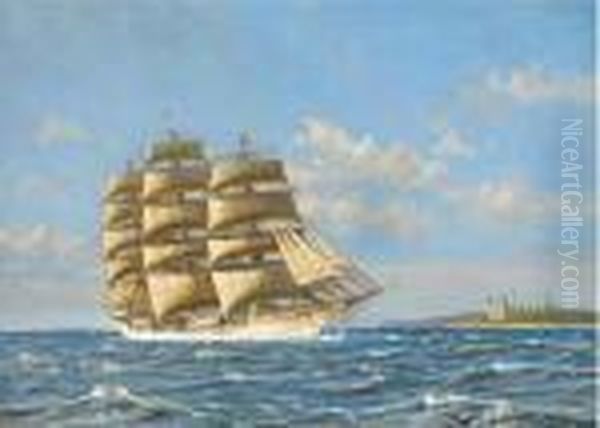
Among Christian Bogo's known works, "A Danish windjammer running past Kronborg Castle; and a Danish barque at sea" stands out as a significant representation of his artistic concerns and skills. While the exact year of its creation is not definitively recorded, the painting, an oil on canvas measuring approximately 27 x 38¾ inches (68.6 x 98.4 cm), encapsulates the essence of Danish maritime pride. The composition typically features a majestic windjammer, a large merchant sailing ship with multiple masts, navigating the waters near the iconic Kronborg Castle, while another vessel, a barque (a sailing ship with three or more masts, fore-and-aft rigged on the aftermost mast and square-rigged on all others), is depicted at sea.
The choice of Kronborg Castle as a backdrop is particularly resonant. Located in Helsingør (Elsinore), at the narrowest point of the Øresund strait between Denmark and Sweden, Kronborg is one of Northern Europe's most important Renaissance castles. Its strategic importance in controlling Baltic trade for centuries, coupled with its immortalization as Elsinore in William Shakespeare's "Hamlet," makes it a potent symbol of Danish history and culture. By placing a Danish windjammer in the foreground, sailing past this historic edifice, Bogo creates a powerful visual narrative linking Denmark's contemporary maritime prowess (of the age of sail) with its storied past.
The painting likely showcases Bogo's skill in rendering the dynamic movement of the sea, the play of light on water and sails, and the intricate details of the ships themselves. Marine painters must possess a keen understanding of naval architecture, wind dynamics, and atmospheric effects to convincingly portray their subjects. Bogo's work in this genre suggests such a mastery, capturing the grandeur of these vessels and the specific maritime environment of Denmark.
The Legends of Kronborg: A Castle of Myths and History
The inclusion of Kronborg Castle in Bogo's painting adds layers of cultural and historical depth. Beyond its real-world significance as a royal residence, fortress, and toll-collection point, Kronborg is steeped in legend. The most famous literary association is, of course, with Shakespeare's "Hamlet." Though it's unlikely Shakespeare ever visited Kronborg, his choice of "Elsinore" as the setting for his tragic masterpiece has forever linked the castle with the melancholic Danish prince. This literary connection draws millions of visitors and inspires countless artistic interpretations.
Another powerful legend associated with Kronborg is that of Holger Danske (Ogier the Dane), a mythical Danish hero. According to folklore, Holger Danske sleeps in the casemates beneath Kronborg Castle, his beard grown long and merged with the stone table before him. He is said to awaken and defend Denmark in its hour of greatest need. This legend, popularized by authors like Hans Christian Andersen in his fairy tales, imbues Kronborg with a sense of national guardianship and timeless vigilance. Bogo's painting, by featuring Kronborg, indirectly taps into these rich veins of myth and national identity, adding a layer of romanticism and historical weight to the maritime scene. The castle itself has undergone numerous transformations, from its medieval origins as Krogen in the 1420s, its Renaissance rebuilding by King Frederick II, to damage by fire and subsequent restorations, each phase adding to its complex history.
Artistic Style and Potential Influences
Based on the description of his representative work, Christian Bogo's artistic style appears to be rooted in realism, with a strong emphasis on accurate depiction and a sensitivity to atmosphere. This aligns with a long tradition of marine painting where fidelity to the subject – the ship, the sea, the sky – is paramount. His approach would likely have involved careful observation and a skilled handling of oil paint to capture the textures of canvas sails, the sheen of water, and the solidity of the ships' hulls.
While direct influences are speculative without more detailed biographical information, Bogo would have been working in an environment where the legacy of 19th-century marine specialists was still strong. Artists like Anton Melbye, another notable Danish marine painter from an earlier generation, had set high standards for the genre. Internationally, the dramatic seascapes of J.M.W. Turner or the meticulous ship portraits by various Dutch Golden Age masters had long established marine art as a significant field. While Bogo's style might not have shared the romantic turbulence of Turner or the luminous calm of some Dutch masters, he would have been part of this continuum.
It is also possible that he was influenced by the broader trends towards naturalism and plein air painting that characterized the late 19th century, even if his subjects were often grand vessels rather than intimate coastal scenes. The Skagen Painters, for instance, excelled at capturing the unique light of the Danish coast, and this sensitivity to atmospheric conditions is crucial for any successful marine artist. One could also consider the work of Norwegian painters like Edvard Munch, who, though known for his emotionally charged expressionism, also depicted coastal scenes, albeit with a vastly different stylistic approach, highlighting the diverse artistic explorations happening in Scandinavia during Bogo's active years.
Bogo and His Contemporaries: The Broader Artistic Landscape
Christian Bogo practiced his art during a period of immense artistic diversity. While he focused on a traditional genre, the art world around him was in flux. In France, Impressionism, pioneered by artists like Claude Monet and Camille Pissarro, had revolutionized the depiction of light and momentary effects. Post-Impressionism, with figures like Vincent van Gogh and Paul Cézanne, had pushed art in new subjective and structural directions. By the early 20th century, Fauvism, Cubism (with Pablo Picasso and Georges Braque), and Expressionism (with groups like Die Brücke in Germany) were challenging all traditional notions of representation.
In Denmark itself, alongside the continuing legacy of the Skagen school and the introspective works of Hammershøi, new modernizing trends were emerging. While Bogo's commitment to maritime realism might seem conservative in comparison to these avant-garde movements, it represented a continued engagement with a subject deeply meaningful to Danish identity. His work provided a sense of continuity and celebrated a tangible aspect of national heritage, which held its own value alongside more experimental art forms. His contemporaries in marine art in other countries, such as the American painter Winslow Homer, also brought a powerful realism and sense of the sea's raw nature to their work, though often with a focus on the human struggle against it. Russian-Armenian painter Ivan Aivazovsky, though slightly earlier, had set an almost impossibly high bar for dramatic and technically brilliant seascapes. Bogo's work would have existed within this broad international conversation about how to represent the sea and humanity's relationship with it.
The Enduring Legacy of Christian Bogo
Christian Bogo passed away in 1945. His body of work, though perhaps not voluminous or widely exhibited internationally compared to some of his more famous Danish contemporaries, remains a valuable contribution to Denmark's artistic heritage. His paintings serve as historical documents, capturing the likeness of ships that have long since vanished from the seas. More importantly, they evoke the spirit of Denmark's maritime age, a period of adventure, commerce, and national pride tied to the ocean.
His art appeals to those with an appreciation for skilled representational painting, a love for maritime history, and an interest in Danish culture. Works like "A Danish windjammer running past Kronborg Castle; and a Danish barque at sea" continue to resonate, offering a glimpse into a world where the horizon was a call to adventure and the wind was a source of power. While art history often focuses on radical innovators, artists like Christian Bogo play a crucial role in preserving and celebrating specific cultural narratives and aesthetic traditions. His dedication to depicting the ships and seascapes of his homeland ensures that this vital aspect of Danish identity remains visually alive for future generations.
In a world increasingly dominated by rapid technological change, Bogo's paintings offer a moment of reflection on a different era of human endeavor and a timeless connection to the elemental power and beauty of the sea. His contribution, focused and sincere, enriches the tapestry of Danish art, reminding us of the enduring allure of the maritime world and the artists who have sought to capture its soul on canvas.