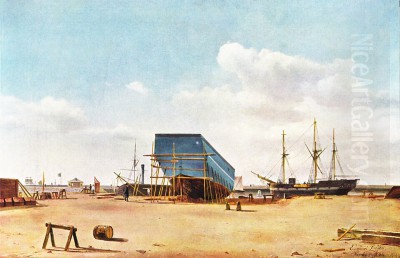
Emanuel Larsen (1823-1859) stands as a significant, albeit sometimes underappreciated, figure within the illustrious Danish Golden Age of painting. Active during a period of profound national and artistic flourishing in Denmark, Larsen carved a distinct niche for himself as a master of marine art. His canvases, often imbued with a subtle romanticism and a keen observation of atmospheric effects, capture the multifaceted relationship between Denmark and the sea. Though his life was tragically short, his artistic output reflects a deep sensitivity to the maritime world, building upon the foundational principles of his esteemed teacher, Christoffer Wilhelm Eckersberg, while simultaneously forging his own path towards a more dynamic and evocative portrayal of naval scenes and coastal landscapes. This exploration delves into the life, artistic milieu, signature style, and enduring legacy of Emanuel Larsen, a painter whose works continue to resonate with their luminous depiction of the sea's enduring allure.
Early Life and Artistic Awakening in Copenhagen
Born in Copenhagen on September 15, 1823, Carl Frederik Emanuel Larsen entered a world where Danish art was on the cusp of, or already deeply immersed in, its "Golden Age." This period, roughly spanning the first half of the 19th century, witnessed an extraordinary efflorescence of creativity in Denmark, particularly in painting, literature, and philosophy. The young Larsen grew up in a capital city that was the vibrant heart of this cultural renaissance. It was an environment ripe with artistic ferment, driven by a burgeoning sense of national identity and a desire to depict the unique character of Danish life and landscape.
Larsen's artistic inclinations led him to the prestigious Royal Danish Academy of Fine Arts (Det Kongelige Danske Kunstakademi) in Copenhagen. Founded in 1754, the Academy was the crucible for artistic talent in Denmark. Here, students received rigorous training in drawing from plaster casts, then from live models, and eventually progressed to painting. The curriculum was heavily influenced by neoclassical ideals, emphasizing clarity, order, and technical proficiency. It was within these hallowed halls that Larsen would encounter the most influential figure in his artistic development: Christoffer Wilhelm Eckersberg.
Under the Aegis of Eckersberg: The Father of Danish Painting
Christoffer Wilhelm Eckersberg (1783-1853) is widely regarded as the "Father of Danish Painting" and was a pivotal professor at the Academy during Larsen's formative years. Eckersberg's impact on his students, and indeed on the entire trajectory of Danish art, cannot be overstated. He championed a new approach based on direct observation of nature, meticulous attention to detail, and a clear, almost scientific, rendering of reality. He encouraged his students to paint outdoors (en plein air), a revolutionary concept at the time, and to study the effects of light and atmosphere with precision.
Larsen absorbed Eckersberg's teachings profoundly. The emphasis on accurate depiction, particularly of complex structures like ships, is evident in Larsen's work. Eckersberg himself was no stranger to marine subjects, having painted detailed views of ships and harbors. He instilled in his pupils a respect for craftsmanship and an understanding of perspective and composition that provided a solid foundation for their individual artistic explorations. Many of the leading lights of the Danish Golden Age, including Wilhelm Bendz, Christen Købke, Martinus Rørbye, Constantin Hansen, Wilhelm Marstrand, Jørgen Roed, P.C. Skovgaard, and Johan Thomas Lundbye, benefited from Eckersberg's tutelage, each developing unique styles while sharing a common grounding in his principles. Emanuel Larsen was part of this distinguished cohort, specializing in a genre that held particular significance for a maritime nation like Denmark.
The Danish Golden Age: A Confluence of Art and National Identity
To fully appreciate Emanuel Larsen's contribution, it is essential to understand the broader context of the Danish Golden Age. This era was marked by a surge in national consciousness, partly fueled by political and economic challenges, including the Napoleonic Wars, the loss of Norway in 1814, and state bankruptcy. Paradoxically, these adversities seemed to galvanize a cultural introspection and a celebration of Danish identity. Artists turned their gaze inward, finding inspiration in the Danish landscape, its people, and its history.
The Golden Age painters sought to capture the "Danishness" of their surroundings. This often translated into idyllic depictions of everyday life, serene landscapes bathed in a characteristic Nordic light, and portraits that conveyed psychological depth. While painters like Christen Købke focused on intimate cityscapes and portraits, P.C. Skovgaard and Johan Thomas Lundbye became renowned for their evocative portrayals of the Danish countryside, often imbued with a sense of national romanticism. Wilhelm Marstrand excelled in genre scenes and historical paintings, capturing the vibrancy of Roman life as well as Danish folk traditions. Martinus Rørbye, an inveterate traveler, brought back exotic scenes but also painted quintessential Danish views. Within this rich tapestry, marine painting played a vital role, reflecting Denmark's historical and ongoing reliance on the sea for trade, defense, and sustenance.
Larsen's Artistic Voice: Realism Tinged with Romanticism
While firmly rooted in Eckersberg's principles of realism and meticulous observation, Emanuel Larsen's marine paintings often exhibit a more pronounced romantic sensibility and a greater interest in atmospheric effects than those of his master. Eckersberg's marine works, while technically brilliant, can sometimes feel coolly objective. Larsen, on the other hand, infused his scenes with a palpable sense of mood and atmosphere, whether it was the tranquil calm of a moonlit harbor or the dramatic tension of ships navigating choppy waters.
His brushwork, while precise in the rendering of ships and rigging, could also be more fluid and suggestive when depicting water and sky. He displayed a remarkable ability to capture the play of light on the waves, the subtle gradations of color in a sunset or dawn sky, and the ethereal glow of moonlight on the sea. This sensitivity to the ephemeral qualities of light and weather distinguished his work and aligned him with the broader Romantic movement that was sweeping across Europe, which saw artists like Britain's J.M.W. Turner and Germany's Caspar David Friedrich explore the sublime and emotional power of nature. While Larsen's romanticism was perhaps more restrained than that of Turner or the Russian marine master Ivan Aivazovsky, it was nonetheless a defining characteristic of his style.
Larsen's compositions are typically well-balanced, often featuring a strong diagonal element created by the line of ships or the coastline. He paid close attention to the accurate portrayal of different types of vessels, from small fishing boats to large merchant ships and naval frigates, demonstrating a thorough knowledge of maritime architecture. This technical accuracy, inherited from Eckersberg, lent credibility to his scenes, while his atmospheric handling imbued them with life and emotion.
Signature Works: Capturing the Soul of the Sea
Emanuel Larsen's oeuvre, though curtailed by his early death, includes several paintings that exemplify his distinct approach to marine art. These works showcase his technical skill, his sensitivity to light and atmosphere, and his ability to evoke the diverse moods of the sea.
One of his most celebrated paintings is "Seascape with Sailing Ships in the Moonlight off Kronborg Castle" (Udsigt fra Kronborg i måneskin med sejlskibe), created in 1847. This evocative nocturnal scene depicts sailing ships navigating the Øresund strait under a luminous moon, with the imposing silhouette of Kronborg Castle – the setting of Shakespeare's Hamlet – visible in the distance. The painting masterfully captures the serene yet mysterious atmosphere of the night sea, the moonlight casting silvery reflections on the water and highlighting the sails of the ships. The inclusion of Kronborg adds a layer of historical and national resonance, making it a quintessential Danish Golden Age work.
Another significant piece is "American Merchant Ship in the Harbour of Marseilles" (En amerikansk købmandskonnert i havnen i Marseille) from 1853. This work likely reflects Larsen's own travels or at least his awareness of international maritime trade. The painting demonstrates his skill in depicting a bustling harbor scene, with careful attention to the details of the American vessel and the surrounding port architecture. The clear Mediterranean light in such a scene would have offered a different challenge and opportunity compared to the softer Nordic light he was accustomed to.
"Seascape with Sailing Ships by Night in Lamplight" (Søstykke med sejlskibe om natten i lampelys), also from 1853, further highlights Larsen's fascination with nocturnal scenes and artificial light sources. The interplay of the warm lamplight from the ships or shore with the cool darkness of the sea and sky creates a dramatic and intimate atmosphere. Such works showcase his ability to move beyond straightforward depictions into more complex and emotionally charged representations.
Other notable works include views of the Danish coasts, such as "Ships off the coast of Stevns" (Skibe ud for Stevns Klint) and "View from Kullen in stormy weather" (Udsigt fra Kullen i stormvejr), which demonstrate his capacity to portray the sea in its more turbulent moods, capturing the power of wind and waves. These paintings often convey the vulnerability of ships against the forces of nature, a recurring theme in marine art.
Travels and Expanding Horizons
Like many artists of his time, Emanuel Larsen sought to broaden his artistic experience through travel. While detailed records of all his journeys are not exhaustive, it is known that he traveled and exhibited his works. The input provided mentions travels to England, France, Belgium, and the Netherlands. Such journeys were common for Danish Golden Age artists, who often went on "grand tours" or study trips to Italy, France, Germany, and other European centers of art.
Exposure to different artistic traditions and landscapes would undoubtedly have enriched Larsen's perspective. In the Netherlands, he would have encountered the rich legacy of 17th-century Dutch Golden Age marine painters like Willem van de Velde the Elder and Younger, Ludolf Bakhuizen, and Jan van de Cappelle, whose mastery of light, atmosphere, and realistic ship portrayal set a high bar for subsequent generations. In England, the dramatic seascapes of J.M.W. Turner were revolutionizing marine painting with their emphasis on color, light, and sublime power. In France, artists like Claude Joseph Vernet had earlier established a strong tradition of marine painting. While direct influences are sometimes hard to pinpoint, the broader European artistic currents, particularly the Romantic engagement with nature and the continued importance of realism in marine art, would have resonated with Larsen's own inclinations.
His painting "American Merchant Ship in the Harbour of Marseilles" suggests either a visit to the Mediterranean or a keen interest in such international ports, perhaps fueled by sketches or accounts from fellow artists or mariners. These experiences and exposures would have allowed him to compare different maritime environments and lighting conditions, further honing his skills in capturing the diverse character of the sea.
Contemporaries and the Danish Marine Painting Scene
Emanuel Larsen was not the only Danish artist specializing in marine subjects during the Golden Age. The sea was a popular and important theme, and several of his contemporaries also made significant contributions to the genre. Among the most prominent were Anton Melbye (1818-1875) and Carl Frederik Sørensen (often cited as Frederik Sørensen, 1818-1879).
Anton Melbye, a close contemporary, was known for his dramatic and often stormy seascapes. He traveled extensively, including to the Mediterranean and the West Indies, and his works often possess a more overtly Romantic and theatrical quality than Larsen's. Melbye's paintings frequently depict ships battling fierce gales or navigating through dramatic cloud-filled skies, emphasizing the sublime power and danger of the ocean.
Carl Frederik Sørensen was another highly regarded marine painter. His works often focused on specific Danish coastal locations, naval battles, or ship portraits. He, too, was adept at capturing atmospheric conditions and the realistic depiction of ships, and his paintings were popular for their patriotic and historical themes. He served as a professor at the Academy after Eckersberg.
Comparing Larsen to these contemporaries, one might say that Larsen often struck a balance between Melbye's dramatic romanticism and Sørensen's detailed, sometimes more illustrative, approach. Larsen's strength lay in his subtle evocation of mood and his nuanced handling of light, particularly in his quieter, more contemplative scenes, though he was also capable of depicting more dynamic maritime activity. Other Eckersberg students, like Carl Dahl (1812-1865), also contributed to marine painting, though perhaps not as exclusively as Larsen, Melbye, and Sørensen. The presence of these talented artists created a vibrant and competitive marine painting scene in Denmark, pushing each other to refine their skills and develop their individual styles.
A Premature End and Lasting Legacy
Emanuel Larsen's promising career was tragically cut short. He died in Copenhagen on September 24, 1859, at the young age of 36. This premature death undoubtedly limited the full development of his artistic potential and the size of his oeuvre. Had he lived longer, he might have navigated the transition from the Golden Age's classicizing romanticism to the later 19th-century movements like Realism and Impressionism, which were beginning to take hold elsewhere in Europe.
Despite his relatively brief career, Emanuel Larsen left a significant mark on Danish art. He is recognized as one of the key marine painters of the Danish Golden Age, a period that remains a high point in the nation's cultural history. His works are prized for their technical skill, their sensitive portrayal of light and atmosphere, and their authentic depiction of maritime life. He successfully built upon the rigorous training he received from Eckersberg, infusing it with a personal, often poetic, vision.
His paintings are held in important Danish museum collections, including the Statens Museum for Kunst (National Gallery of Denmark) in Copenhagen, and continue to be admired for their beauty and historical significance. They serve as valuable records of Denmark's maritime heritage, capturing the ships, coastlines, and seascapes that were so integral to the nation's identity and economy.
In the broader narrative of 19th-century European marine painting, Larsen represents a distinctively Danish contribution. While perhaps not as internationally renowned during his lifetime as some of his more widely traveled contemporaries or those from larger artistic centers, his work embodies the unique qualities of the Danish Golden Age: a harmonious blend of meticulous observation, technical refinement, and a deeply felt connection to the national landscape and character. His legacy lies in his ability to convey not just the appearance of the sea and ships, but also their soul, capturing moments of serene beauty, quiet industry, and the enduring human engagement with the vast and ever-changing maritime world.
Conclusion: A Luminous Chapter in Danish Art
Emanuel Larsen's life and work offer a fascinating window into the world of 19th-century Danish marine painting. As a student of the great Christoffer Wilhelm Eckersberg, he inherited a tradition of precision and keen observation. Yet, he was not merely an imitator. Larsen developed a distinctive style characterized by its atmospheric depth, its nuanced depiction of light, and a subtle romanticism that imbued his seascapes with emotion and poetry. His depictions of moonlit harbors, bustling ports, and ships navigating the Danish waters are more than just accurate representations; they are evocative portrayals of a nation's intimate relationship with the sea.
Though his career was brief, Emanuel Larsen's contribution to the Danish Golden Age is undeniable. Alongside contemporaries like Anton Melbye and Carl Frederik Sørensen, he helped to define marine painting in Denmark, creating works that continue to captivate viewers with their technical brilliance and their sensitive portrayal of the maritime realm. His paintings remain a testament to his talent and a luminous chapter in the rich history of Danish art, reminding us of the enduring power of the sea to inspire and the artist's unique ability to capture its myriad moods.