Christopher H. Shearer stands as a significant, if sometimes overlooked, figure in the annals of American landscape painting. Born in Reading, Pennsylvania, on May 18, 1846, and passing away in the same town in 1926, Shearer dedicated his life to capturing the pastoral beauty of his native Berks County and the diverse terrains of Europe. His prolific output and dedication to his craft positioned him as one of Berks County's most active and respected artists, leaving behind a legacy of works that continue to enchant viewers with their serene and meticulous depictions of the natural world.
Early Life and Artistic Awakenings in Reading
The seeds of Christopher H. Shearer's artistic journey were sown in his hometown of Reading. From a young age, he exhibited a keen interest in the visual arts. His formal training began under the tutelage of local artists Francis D. Devlan and J. Heyl. These initial studies provided him with a foundational understanding of technique and composition, crucial for his later development. The supportive environment of his family, particularly his father, played a pivotal role. Recognizing his son's burgeoning talent, Shearer's father assisted him in constructing a studio in the backyard of their home, an area affectionately known by some as "Shearer-town." This dedicated space allowed the young artist to hone his skills and begin developing his unique vision.
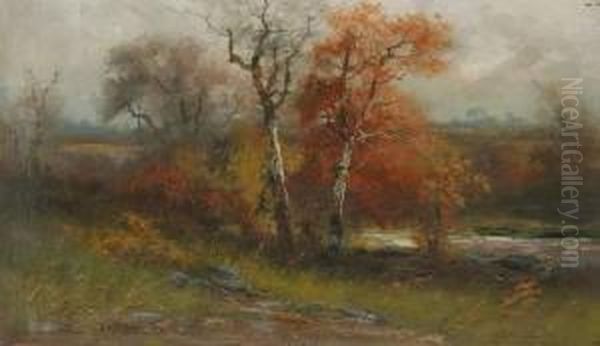
By 1864, at the age of eighteen, Shearer had already produced his first painting, marking the official commencement of a long and fruitful career. His talent was evident early on, and by the age of twenty-one, he had established his own professional studio in Reading. This venture proved successful, with Shearer finding a ready market for his evocative landscapes. His early works predominantly focused on the familiar and beloved scenery of Berks County, capturing its rolling hills, meandering creeks, and the distinct atmospheric qualities of the Pennsylvanian countryside. This deep connection to his local environment would remain a constant throughout his career, even as his artistic horizons expanded.
European Sojourn: Düsseldorf and Munich Influences
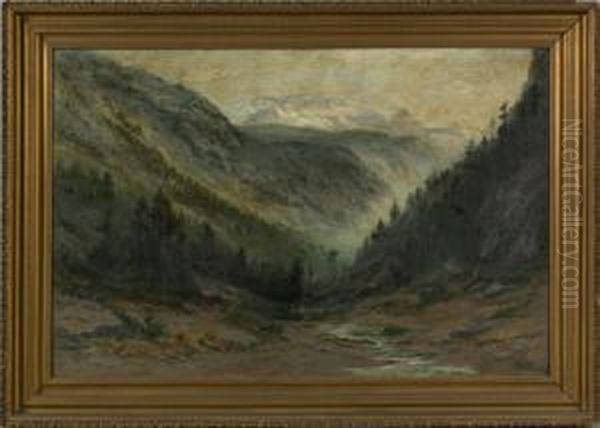
Like many ambitious American artists of the 19th century, Shearer recognized the importance of European study to further refine his technique and broaden his artistic perspective. He embarked on a journey to Europe, immersing himself in the rich artistic traditions of Germany. His primary destinations were Düsseldorf and Munich, two of the most important centers for art education at the time. The Düsseldorf Academy, in particular, was a magnet for international students, including many Americans such as Albert Bierstadt, Worthington Whittredge, and Emanuel Leutze, who had earlier absorbed its meticulous, detailed, and often narrative-driven style.
In Düsseldorf, Shearer would have been exposed to the prevailing trends of the Düsseldorf School of painting, known for its emphasis on fine detail, realistic rendering, and often dramatic or sublime landscapes. Artists like Andreas Achenbach and Oswald Achenbach were leading figures, whose influence extended far beyond Germany. Shearer's dedication and skill were recognized during his time there, culminating in him receiving a prestigious gold medal from the Düsseldorf Academy, a testament to his talent and hard work.
His studies also took him to Munich, another vibrant artistic hub. The Munich School, while also grounded in realism, often encouraged a more painterly approach, with bolder brushwork and a greater emphasis on capturing light and atmosphere, influenced by artists like Wilhelm Leibl. Prominent American artists like Frank Duveneck and William Merritt Chase were also associated with the Munich School around this period. Shearer's time in these German cities undoubtedly enriched his artistic vocabulary, allowing him to synthesize European techniques with his American sensibilities.
Return to America: A Master of Berks County Landscapes
Upon his return from Europe, Shearer brought with him a refined technique and a broadened artistic vision, yet his heart remained tethered to the landscapes of his youth. He re-established himself in Reading and became one of the most prolific painters of Berks County scenery. His European experiences informed his work, lending a greater sophistication to his compositions and a more nuanced understanding of light and color. However, he never lost the direct, honest portrayal of nature that characterized his earlier pieces.
Shearer's paintings of Berks County are celebrated for their tranquility and their faithful depiction of specific locales. He had an intimate knowledge of the region, from the gentle flow of its creeks to the seasonal transformations of its woodlands. His style, while rooted in realism, often possessed a lyrical quality, inviting viewers to share in his appreciation for the quiet beauty of the Pennsylvanian countryside. He was not alone in celebrating the American landscape; the Hudson River School, with artists like Thomas Cole, Asher B. Durand, and Frederic Edwin Church, had earlier established a grand tradition of American landscape painting, and later movements like Luminism, exemplified by Fitz Henry Lane and Martin Johnson Heade, explored the subtle effects of light and atmosphere. Shearer's work, while perhaps more localized, shared this national pride in the American environment.
Signature Works and Public Recognition
Christopher H. Shearer's dedication and talent did not go unnoticed. A pivotal moment in his career came with the Philadelphia Centennial Exposition of 1876. This grand international fair, celebrating the 100th anniversary of American independence, was a major showcase for American art and industry. Shearer submitted several works, and two paintings, in particular, garnered significant acclaim: "Schwartzbach" (sometimes recorded as "Schwarmbach") and "Maiden Creek." These pieces, likely depicting scenes familiar to him from Berks County or his European travels, were highly praised for their technical skill and evocative beauty.
The success at the Centennial Exposition solidified Shearer's reputation as a leading landscape painter. His works were sought after by collectors and admired by the public. While specific titles of a vast oeuvre can be difficult to catalogue comprehensively, these two paintings stand as documented examples of his recognized masterpieces. His body of work, however, is extensive, comprising numerous views of Berks County's pastoral scenes, its waterways like the Schuylkill River and Tulpehocken Creek, and charming European vistas remembered from his studies abroad. He captured the essence of different seasons, the play of light at various times of day, and the enduring character of the land.
His style can be seen as aligning with the broader trends of 19th-century realism, but with a personal touch that avoided the overtly dramatic in favor of a more contemplative and intimate portrayal of nature. He shared a kinship with the American Barbizon School painters like George Inness and William Morris Hunt, who, influenced by French artists like Jean-Baptiste-Camille Corot and Jean-François Millet, emphasized mood, atmosphere, and a more subjective response to the landscape.
The Artist as Naturalist: A Deeper Connection to Nature
Beyond his easel, Christopher H. Shearer possessed a profound and multifaceted interest in the natural world. He was an avid and knowledgeable collector of butterflies, moths, and other insects. This was not merely a casual hobby; Shearer approached entomology with scientific rigor, meticulously recording and drawing his specimens. This passion for the minute details of nature undoubtedly informed his artistic practice.
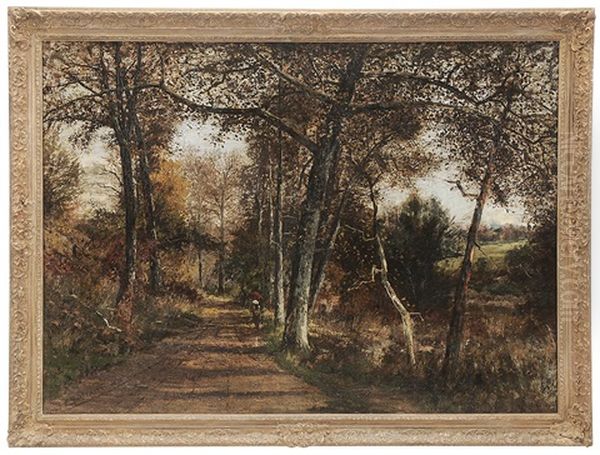
His keen observational skills, honed by studying the intricate patterns on a butterfly's wing or the delicate structure of a beetle, would have translated directly into his landscape painting. It likely contributed to the precision in his depiction of foliage, the textures of bark and stone, and the overall botanical accuracy in his scenes. This dual identity as both artist and naturalist suggests a holistic appreciation for the environment, where scientific inquiry and artistic expression were complementary, rather than separate, pursuits. Such detailed observation was a hallmark of many 19th-century artists, including figures like John James Audubon, whose ornithological illustrations blurred the lines between art and science.
This deep engagement with the natural world also speaks to a broader cultural current of the time. The 19th century saw a surge in popular interest in natural history, fueled by scientific exploration and a romantic appreciation for the wilderness. Shearer's pursuits placed him within this tradition, where the artist's eye and the scientist's scrutiny worked in tandem to understand and celebrate the complexities of nature.
Personal Glimpses and Artistic Community
While much of Christopher H. Shearer's public record focuses on his artistic achievements, some fragments offer glimpses into his personality and broader interests. There are mentions of his involvement in musical endeavors, including the creation of a song titled "Loco Man," suggesting a creative spirit that extended beyond the visual arts. Accounts also hint at a sense of humor, as reportedly evidenced in an "Essay Mr. Shearer," where he narrated stories with a light touch, even while claiming the absence of jokes.
Regarding his working habits, particularly during travels, it's suggested he maintained certain personal rules, such as a degree of discretion about his exact whereabouts. This might reflect a desire for focused work or simply a private nature. While the provided information does not detail specific collaborations or rivalries with other painters, the art world of the 19th century was a relatively interconnected community. Artists often studied together, exhibited in the same venues, and were aware of each other's work. Shearer's studies in Düsseldorf and Munich would have placed him in direct contact with a diverse group of international artists.
Back in Pennsylvania, he was a prominent figure in the local art scene of Reading and Berks County. He would have been a contemporary of other Pennsylvanian artists, though specific interactions are not detailed in the provided snippets. The artistic landscape of Pennsylvania was rich, with Philadelphia serving as a major art center, home to institutions like the Pennsylvania Academy of the Fine Arts, which nurtured talents such as Thomas Eakins and Mary Cassatt (though their styles and subjects differed greatly from Shearer's).
Legacy and Enduring Appeal
Christopher H. Shearer passed away in 1926, leaving behind an extensive body of work that serves as a lasting testament to his skill and his love for the landscapes he depicted. His paintings are held in various public and private collections, not only in the United States but also reportedly in Canada, Australia, and Germany. This international presence speaks to the universal appeal of his art.
In Berks County, he is remembered as one of its foremost artistic sons. His works provide a valuable historical record of the region's appearance in the late 19th and early 20th centuries, capturing a sense of place that resonates even today. His dedication to depicting his local environment contributed to a regional artistic identity, much like other artists who became associated with specific locales, such as Winslow Homer with the coast of Maine.
The enduring appeal of Shearer's art lies in its quiet beauty, its technical proficiency, and its sincere appreciation for the natural world. In an increasingly fast-paced and industrialized world, his paintings offer moments of calm and reflection, inviting viewers to pause and appreciate the subtle splendors of the landscape. He successfully bridged the detailed realism of the Düsseldorf tradition with a more personal, atmospheric approach, creating a style that was both accomplished and accessible. His contributions enrich the narrative of American landscape painting, highlighting the importance of regional artists who, while perhaps not always in the national spotlight, played a crucial role in shaping the country's artistic heritage. His work continues to be valued by collectors and art historians for its intrinsic beauty and its representation of a significant period in American art.