Cuthbert Edmund Swan (1870-1931) stands as a significant, if sometimes overlooked, figure in the realm of British animal painting, particularly celebrated for his masterful depictions of large feline species. Born into an artistic lineage, Swan carved his own niche, combining meticulous observation with a profound empathy for his subjects, leaving behind a body of work that continues to captivate audiences with its vitality and realism. His career spanned a dynamic period in art history, yet he remained steadfast in his commitment to representational art, focusing his considerable talents on capturing the power, grace, and spirit of the animal kingdom.
Early Life and Artistic Foundations
Cuthbert Edmund Swan was born on January 11, 1870, in Ballyragget, County Cork, Ireland. While his roots were Irish, his formative years and much of his professional life would be centered in England. The Swan family was already steeped in artistic tradition, a factor that undoubtedly played a pivotal role in shaping young Cuthbert's aspirations. His primary education was received at Seaford College in Sussex, England, a preparatory school that would have provided a solid academic grounding.
Following his schooling in Sussex, Cuthbert, alongside his brother Edwin Swan, who also pursued an artistic career, made the pivotal decision to further their studies in Paris. The French capital was, at the time, the undisputed epicenter of the art world, attracting aspiring artists from across the globe. They enrolled in the Académie Julian, one of the most prestigious independent art schools in Paris. Founded by Rodolphe Julian in 1867, the Académie Julian offered an alternative to the more rigid, state-run École des Beaux-Arts. It was known for its progressive teaching methods, allowing students greater freedom and access to live models. Many renowned artists, including Henri Matisse, Pierre Bonnard, and Édouard Vuillard, passed through its studios, highlighting its importance in late 19th and early 20th-century art education. For Cuthbert and Edwin, this period in Paris would have been immensely formative, exposing them to diverse artistic influences and rigorous training in drawing and painting.
The Paternal Influence: John Macallan Swan
One cannot discuss Cuthbert Edmund Swan's artistic journey without acknowledging the profound influence of his father, John Macallan Swan (1847-1910). The elder Swan was a highly respected painter and sculptor, an elected member of the Royal Academy of Arts (R.A.), and particularly renowned for his depictions of wild animals, especially large cats. John Macallan Swan was a meticulous observer, famously spending countless hours at the London Zoo, sketching and studying the anatomy, movement, and behavior of animals like lions, tigers, and leopards. His dedication to anatomical accuracy and his ability to convey the raw power and majesty of these creatures earned him critical acclaim.
Cuthbert inherited not only his father's passion for animal subjects but also his methodical approach to study. The London Zoo became a familiar haunt for Cuthbert as well, providing an invaluable open-air studio where he could observe his subjects firsthand. This direct engagement with live animals was crucial to the realism and vitality that characterized his work. He learned from his father the importance of understanding the underlying structure – the musculature and skeletal framework – to convincingly portray an animal in motion or repose. This familial artistic apprenticeship provided Cuthbert with a strong foundation upon which to build his own distinct style. While he followed in his father's thematic footsteps, Cuthbert developed his own nuances in technique and interpretation.
Forging an Independent Path: Specialization and Early Career
After their studies in Paris, Cuthbert and Edwin Swan returned to London, initially settling in Camden Town. This area, with its bohemian atmosphere, was home to many artists, including figures like Walter Sickert, who was a leading member of the Camden Town Group, and Lucien Pissarro, son of the Impressionist Camille Pissarro. While Swan's style was more traditional than that of many of his Camden contemporaries, the vibrant artistic environment would have been stimulating.
Cuthbert's early career also reportedly included stints as a sailor and a scene painter. These experiences, though perhaps not directly related to his later specialization, would have broadened his horizons and provided practical skills. The discipline of scene painting, for instance, requires an understanding of perspective and large-scale composition, while a life at sea offers unique observational opportunities.
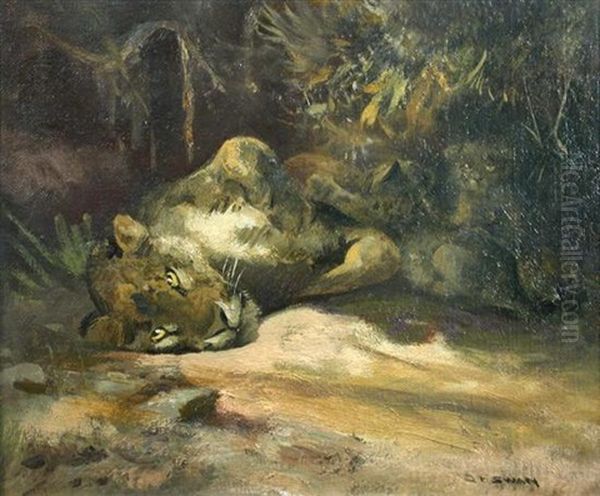
However, it was the animal world, particularly the great cats, that truly captured his artistic imagination. He dedicated himself to becoming a specialist in this genre. His commitment to authenticity led him to seek out opportunities for close study. A significant period in his career involved working at the Beijing Zoo (then likely known by a different name under Western influence or local administration). Here, he immersed himself in the study and painting of large felines, with a particular focus on leopards. This experience in China would have provided him with unique subjects and a different cultural context, further enriching his understanding and portrayal of these animals.
The Animalier Tradition in Context
Cuthbert Edmund Swan's work firmly places him within the "animalier" tradition, a genre of art depicting animals that gained particular prominence in the 19th century. French artists like Antoine-Louis Barye were pioneers, creating dramatic bronze sculptures of animals in combat. In painting, Rosa Bonheur achieved international fame for her realistic and empathetic portrayals of animals, notably "The Horse Fair." In Britain, Sir Edwin Landseer was a dominant figure in the mid-19th century, his paintings of dogs, stags, and other animals often imbued with sentimental or anthropomorphic qualities, appealing greatly to Victorian sensibilities.
By the time Cuthbert Swan was active, the animalier tradition was well-established. Artists like Briton Rivière, a contemporary of John Macallan Swan, also specialized in animal subjects, often with narrative or historical themes. Arthur Wardle was another prominent British contemporary known for his paintings of wild and domestic animals, particularly big cats and terriers, exhibiting a similar dedication to anatomical accuracy and spirited portrayal. Swan's contribution to this tradition lay in his focused, almost portrait-like approach to his feline subjects, emphasizing their individual character and inherent dignity rather than placing them in overly dramatized or sentimentalized scenarios.
A Teacher of His Craft: The Central School of Arts and Crafts
Cuthbert Edmund Swan's expertise did not go unnoticed in educational circles. He became a respected animal painting teacher at the Central School of Arts and Crafts in London. Founded in 1896 by the London County Council, the Central School was a key institution in the Arts and Crafts movement, emphasizing the importance of practical skills and good design. Its curriculum was diverse, covering everything from silversmithing and stained glass to illustration and painting.
Swan's role as an instructor of animal painting underscores his recognized mastery in the field. He would have guided students in the techniques of observing and rendering animal forms, likely emphasizing the importance of anatomical study and direct sketching from life, principles he himself adhered to rigorously. The Central School of Arts and Crafts later evolved to become the Central Saint Martins College of Arts and Design, part of the University of the Arts London, maintaining its reputation as a leading art and design institution. Swan's tenure there contributed to the education of a new generation of artists, passing on the specialized knowledge he had cultivated.
Exhibitions and Recognition: The Public Eye
A significant measure of an artist's success during this period was their acceptance into major juried exhibitions. Cuthbert Edmund Swan achieved considerable recognition in this regard. He was a regular exhibitor at the prestigious Royal Academy of Arts in London. The Royal Academy's Summer Exhibition was, and remains, a major event in the British art calendar. Records indicate that Swan exhibited an impressive 66 works at the RA throughout his career. This consistent presence speaks volumes about the quality of his art and its appeal to the selection committees and the public.
His works were also shown at the Royal Institute of Oil Painters (ROI), another important exhibiting society in London, and at the Paris Salon. The Paris Salon, though its dominance was being challenged by independent exhibitions, was still a significant venue for international artists. To have work accepted in these esteemed institutions was a mark of professional achievement.
Swan's paintings found their way into public collections as well. The Birmingham Museum and Art Gallery and the Llandudno Museum are noted as holding examples of his work, and other museums in London also acquired his pieces. This acquisition by public institutions further cemented his reputation and ensured the preservation of his art for future generations. He spent a significant portion of his life residing in Hampstead, London, a leafy suburb popular with artists and intellectuals, where he likely completed many of his notable canvases.
Key Themes and Subjects: The Majesty of Big Cats
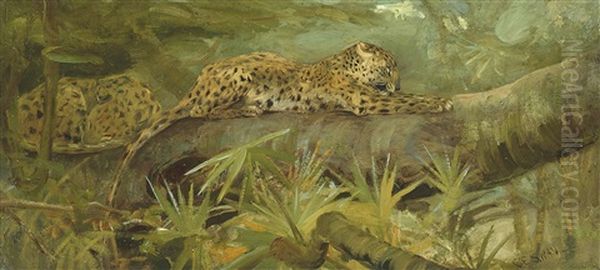
The recurring and dominant theme in Cuthbert Edmund Swan's oeuvre is the portrayal of large wild cats. Lions, leopards, jaguars, pumas, and tigers were his favored subjects. He was not merely interested in a generic representation; rather, he sought to capture the specific essence of each species and, often, the individuality of a particular animal. His paintings often depict these creatures in moments of quietude, intense watchfulness, or playful interaction, rather than solely focusing on the ferocity of the hunt.
His time spent at zoos, particularly the London Zoo and the Beijing Zoo, was instrumental. These institutions provided him with the opportunity for sustained observation, allowing him to study the subtle shifts in posture, the texture of fur, the glint in an eye, and the powerful musculature that defined these animals. He was adept at conveying their lithe movements, their capacity for sudden bursts of energy, and their regal bearing. Works often featured titles that were straightforwardly descriptive, such as studies of lions or leopards, indicating a focus on the animal itself as the primary subject of artistic inquiry.
Notable Works: A Glimpse into Swan's Menagerie
While a comprehensive catalogue of his 66 Royal Academy exhibits and other works is extensive, several titles and known pieces offer insight into his artistic output.
_Leopards at Rest_: This oil painting, measuring 9½ x 20 inches (24.1 x 50.8 cm) and signed "C.E. Swan" in the lower right, exemplifies his intimate portrayals. One can imagine a composition focusing on the relaxed yet alert forms of leopards, perhaps reclining on a rock or amidst foliage, their spotted coats rendered with care and attention to the play of light and shadow.
_Kaa and Bagheera_: This title is particularly intriguing as it directly references characters from Rudyard Kipling's The Jungle Book – Kaa the python and Bagheera the black panther. This suggests that Swan, like many artists of his time, sometimes drew inspiration from contemporary literature, using his animal painting skills to bring well-loved fictional characters to life. It highlights an ability to blend naturalistic portrayal with narrative elements.
_Stalking the Bengal Tiger_: A work executed in watercolour and pastel, measuring 52 x 25 cm (20½ x 9¾ inches), this piece would have showcased his versatility across different media. The combination of watercolour and pastel can create rich textures and vibrant colours, well-suited to depicting the lush environment and the striking patterns of a tiger. The theme of "stalking" implies a moment of suspense and focused predatory intent.
Royal Academy Exhibits: Among his many submissions to the Royal Academy were pieces such as _The Duke – A Study of a Lion_, _Jaguars at Play_, and _Puma and Cubs_. These titles further illustrate his dedication to the feline world. "The Duke" suggests a portrait of a specific, perhaps well-known, lion at a zoo, emphasizing its noble character. "Jaguars at Play" and "Puma and Cubs" point to his interest in capturing the animals in more naturalistic, interactive moments, showcasing their agility and familial bonds.
_Panther and python_: Another work that likely drew from the drama of the wild, or perhaps again from literary sources like The Jungle Book, depicting a tense encounter between two powerful creatures.
These works, whether depicting animals in repose, at play, or in moments of tension, consistently demonstrate Swan's deep understanding of their anatomy and behavior, rendered with a skilled hand.
Artistic Style and Techniques
Cuthbert Edmund Swan's artistic style was firmly rooted in realism. He eschewed the emerging modernist trends of his time, such as Cubism or Fauvism, preferring instead to create faithful and detailed representations of his subjects. His primary goal was to capture the living essence of the animals he painted. This involved meticulous attention to anatomical accuracy, the texture of fur, the play of light on form, and the characteristic expressions and postures of each species.
He was proficient in several media, primarily oil paint, watercolour, and pastels.
Oil paints allowed him the richness of colour, the ability to build up layers (glazing and impasto), and the blending capabilities necessary for rendering the subtle modulations of fur and muscle. Many of his major exhibition pieces, like Leopards at Rest, were likely oils.
Watercolours offered a different quality – transparency, luminosity, and the potential for more fluid, spontaneous effects. This medium would have been excellent for field sketches and for works where a lighter touch was desired.
Pastels, with their vibrant, powdery pigments, allowed for rich, velvety textures and directness of application. Swan often combined watercolour and pastel, as seen in Stalking the Bengal Tiger, a technique that can yield uniquely textured and luminous results, with the watercolour providing a base wash and the pastels adding highlights, depth, and textural detail.
His compositions were generally focused and uncluttered, ensuring the animal subject remained the clear focal point. Backgrounds, while present, were often secondary, serving to contextualize the animal rather than compete with it for attention. The true artistry lay in his ability to make these creatures appear alive on the canvas, conveying a sense of their weight, movement, and inner spirit.
The London Art World: Contemporaries and Connections
Cuthbert Edmund Swan operated within a vibrant and evolving London art scene. His father, John Macallan Swan R.A., was a prominent figure, and Cuthbert would have benefited from these connections. His brother, Edwin Swan, was his fellow student and artist, providing a close familial artistic bond.
Beyond his family, he was part of a broader community of artists. As mentioned, his time in Camden Town would have brought him into contact with members of the Camden Town Group, such as Walter Sickert, known for his urban scenes and muted palettes, and Spencer Gore. While their artistic aims and styles differed significantly from Swan's, the exchange of ideas within such artistic hubs was inevitable. Lucien Pissarro, son of the Impressionist Camille Pissarro and an accomplished painter and printmaker in his own right, was also part of this milieu.
Within the specific field of animal painting, Swan's contemporaries included Arthur Wardle (1860-1949), who, like Swan, was renowned for his paintings of big cats and dogs, often exhibiting a similar vigorous realism. Briton Rivière (1840-1920) was another established animal painter, though often incorporating more narrative or allegorical elements. The legacy of earlier animal painters like Sir Edwin Landseer (1802-1873) still loomed large, having popularized animal subjects with the British public. One might also consider the influence of French animaliers like Rosa Bonheur (1822-1899), whose international success demonstrated the appeal of skillfully rendered animal subjects. Even the great academic painter Jean-Léon Gérôme, who taught at the École des Beaux-Arts and was also a teacher at Académie Julian during some periods, was known for his meticulous Orientalist scenes that often included powerful depictions of lions and other animals. The landscape and animal painter Henry John Boddington (though from an earlier generation, active mid-19th century) represents a lineage of British artists interested in naturalistic portrayal. The Scottish artist Thomas Faed (1826-1900), known for his genre scenes, was part of the broader Royal Academy exhibiting world that Swan also inhabited.
Swan's adherence to realism placed him in a more traditional camp compared to the avant-garde movements gaining traction. However, the continued popularity of his work and his regular inclusion in major exhibitions indicate that there remained a strong public and institutional appreciation for well-executed representational art, especially in a popular genre like animal painting.
Later Years and Enduring Legacy
Cuthbert Edmund Swan spent much of his adult life in Hampstead, London, continuing to paint and exhibit. He passed away in 1931. His legacy is that of a dedicated and highly skilled animal painter who brought a particular sensitivity and accuracy to his depictions of large felines. He successfully carried on the artistic tradition of his father while establishing his own reputation as a master of the genre.
His works continue to be appreciated for their technical skill and their ability to convey the character and vitality of his animal subjects. The fact that his paintings were acquired by public museums ensures their accessibility to future generations. In the art market, his works periodically appear at auction, often fetching respectable prices, which indicates a sustained interest among collectors of traditional British art and animal paintings. For instance, Stalking the Bengal Tiger was noted to have an auction estimate of £300-£500, a reflection of its market value.
Cuthbert Edmund Swan may not be as widely known today as some of his more modernist contemporaries, but within the specialized field of animal art, he remains an important figure. He represents a lineage of artists who believed in the power of direct observation and skilled draftsmanship to capture the beauty and spirit of the natural world. His focused dedication to the feline form resulted in a body of work that is both aesthetically pleasing and a valuable record of these magnificent creatures as seen through the eyes of a sympathetic and talented artist.
Conclusion
Cuthbert Edmund Swan's life was one of quiet dedication to his artistic calling. From his early education in England and Paris to his immersive studies in zoos as far-flung as Beijing, he honed his craft with diligence. Influenced by his accomplished father, John Macallan Swan, he nevertheless developed his own distinct voice within the animalier tradition. His numerous exhibitions at the Royal Academy and other prestigious institutions attest to the high regard in which his work was held during his lifetime. As a painter, and as a teacher at the Central School of Arts and Crafts, he contributed significantly to the field of animal art in Britain. His legacy endures in the collections that house his work and in the continued appreciation for his ability to capture, with such precision and empathy, the wild majesty of the great cats.