Edith Berkeley White (1855-1946) stands as a significant, if sometimes underappreciated, figure in American art, particularly celebrated for her exquisite floral still lifes and evocative California landscapes. Active during a transformative period in American art history, she navigated the shifting tides from Victorian sensibilities to the burgeoning influences of Impressionism and regionalism, carving out a distinct niche with her delicate yet vibrant portrayals of nature. Her work, characterized by meticulous detail, a refined color palette, and a deep appreciation for botanical accuracy, offers a window into the artistic currents and cultural values of the late 19th and early 20th centuries.
Early Life and Artistic Awakening
Born on a farm in Le Claire, Scott County, Iowa, on May 17, 1855, Edith White's early life was rooted in the American heartland. Her parents were Stephen White and Sarah M. (nee Washburn) White. The family's subsequent move to California in 1860, when Edith was still a young child, proved to be a pivotal moment, immersing her in the unique and inspiring landscapes that would later feature prominently in her art. They settled initially in the Napa Valley before moving to San Francisco. This West Coast environment, with its diverse flora and dramatic scenery, undoubtedly nurtured her nascent artistic inclinations.
Details about her earliest artistic training are somewhat sparse, but it is known that she demonstrated a talent for drawing and painting from a young age. The cultural environment of San Francisco, a burgeoning metropolis even then, would have offered more opportunities for artistic exposure than rural Iowa. It was a city increasingly conscious of its cultural identity, fostering a community of artists and writers.
Formal Training and Influences
White's formal art education began at Mills Seminary (now Mills College) in Oakland, California, where she studied from 1871 to 1874. Mills was one of the pioneering institutions for women's higher education on the West Coast and offered a solid grounding in the arts. Following her time at Mills, she enrolled at the prestigious California School of Design in San Francisco (later known as the Mark Hopkins Institute of Art and eventually the San Francisco Art Institute). This institution was the leading art school in the region, and studying there placed her at the center of California's artistic development.
At the School of Design, she studied under notable figures such as Virgil Williams, a respected painter and the school's director, who emphasized academic drawing and traditional techniques. Perhaps more significantly, she also received instruction from Raymond Dabb Yelland, a British-born artist known for his luminous coastal scenes and landscapes, whose influence can be discerned in White's handling of light and atmosphere. Another important mentor was William Keith, the celebrated Scottish-American landscape painter often associated with Tonalism and the Barbizon School. Keith's romantic and spiritual approach to landscape painting, and his rich, often moody, color palettes, likely resonated with White, even as she developed her own distinct style.
Furthering her studies, White traveled to New York City to attend the Art Students League, a progressive institution that offered an alternative to the more conservative National Academy of Design. The Art Students League was a crucible for new ideas, and many prominent American artists, including William Merritt Chase and Childe Hassam, were associated with it. This exposure to the East Coast art scene would have broadened her artistic horizons considerably.
A Flourishing Career: Specializing in Florals
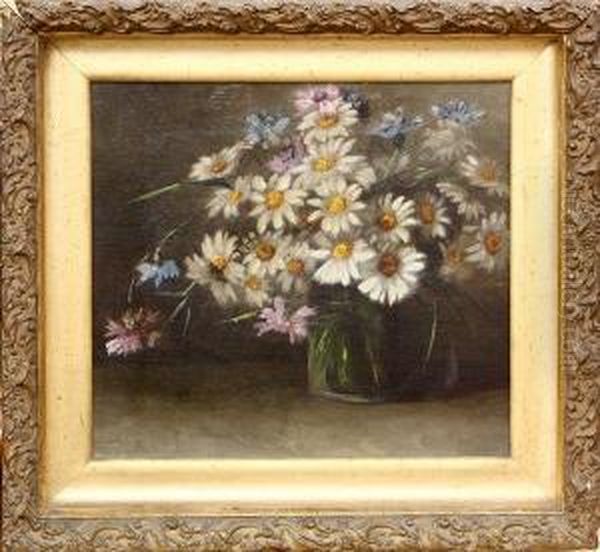
Upon returning to California, Edith White established herself as a professional artist. While she painted landscapes and portraits, she became particularly renowned for her floral still lifes. Roses, chrysanthemums, fuchsias, poppies, and lilacs bloomed under her brush with remarkable vitality and precision. Her floral compositions were not merely decorative; they were intimate studies of form, color, and texture, imbued with a sensitivity that suggested a deep personal connection to her subjects.
Her technique was characterized by a careful, almost botanical, accuracy, yet it avoided a dry, scientific rendering. Instead, she managed to capture the ephemeral beauty and delicate essence of each flower. Her use of color was sophisticated, often employing a rich but controlled palette that allowed the natural hues of the blossoms to shine. The play of light on petals and leaves was a consistent feature, lending her still lifes a sense of depth and realism. Works simply titled "Roses," "Chrysanthemums," or "Still Life with Fuchsias" became her hallmark.
These floral paintings found a receptive audience in Victorian and Edwardian era America, where flowers held complex symbolic meanings and were a popular subject in both fine art and decorative arts. Artists like Martin Johnson Heade had earlier established a tradition of intricate floral and hummingbird paintings, and later, figures like Maria Oakey Dewing would also gain fame for their floral works, though often with a more ethereal, Tonalist quality. White's approach, while sharing a love for botanical detail, often possessed a more direct and vibrant naturalism.
California Landscapes and Coastal Scenes
Beyond her celebrated florals, Edith White was also an accomplished landscape painter. The diverse California environment, from its rolling hills and majestic mountains to its picturesque coastline, provided ample inspiration. She painted scenes of the Monterey Peninsula, the Sierra Nevada foothills, and the areas around San Francisco Bay. These works often captured the unique light and atmosphere of the California landscape, sometimes showing the influence of Impressionism in their brighter palettes and looser brushwork, though she generally retained a strong sense of form and structure.
Her landscapes, like her still lifes, were characterized by careful observation and a desire to convey the specific character of the place. She was part of a generation of California artists, including her teacher William Keith, and contemporaries like Thomas Hill and Albert Bierstadt (though Bierstadt was more associated with the grand, panoramic views of the earlier Hudson River School tradition), who were instrumental in defining a visual identity for the American West. Other California landscape painters of her era or slightly later, who contributed to this regional school, included Guy Rose and William Wendt, key figures in California Impressionism.
Exhibitions and Recognition
Edith White was an active participant in the art world of her time. She exhibited her work regularly and widely, gaining recognition for her skill. Her paintings were shown at the California State Fair, where she won several awards, and at the Mechanics' Institute Fairs in San Francisco, which were important venues for showcasing art and industry on the West Coast. She also exhibited with the San Francisco Art Association, a leading arts organization that played a crucial role in promoting local artists.
Her work was included in major national and international expositions, such as the World's Columbian Exposition in Chicago in 1893, a landmark event that brought American art to global attention. Participation in such an event was a significant achievement and indicated her standing among her peers. She also exhibited at the Panama-Pacific International Exposition in San Francisco in 1915, another pivotal event for California artists.
While perhaps not achieving the same level of national fame as some of her male contemporaries or East Coast counterparts like Mary Cassatt or Cecilia Beaux, Edith White was a respected and successful artist within her region and beyond. Her ability to sustain a long career as a professional artist at a time when it was still challenging for women to do so is a testament to her talent and determination.
Artistic Style and Context
Edith White's style can be broadly categorized as Realist, with elements of Impressionism becoming more apparent in her later work, particularly in her landscapes. Her meticulous attention to detail, especially in her floral still lifes, aligns with the Realist tradition. However, her sensitivity to light and color, and her ability to capture the fleeting beauty of her subjects, also connect her to the broader Impressionist movement that was gaining traction in America during her career.
She was contemporary with the American Impressionists like Childe Hassam, John Henry Twachtman, and J. Alden Weir, who adapted French Impressionist principles to American subjects and sensibilities. While White may not have fully embraced the broken brushwork or avant-garde color theories of the more radical Impressionists, the movement's emphasis on capturing momentary effects of light and atmosphere undoubtedly influenced her.
In the realm of still life painting, she can be compared to artists like William Merritt Chase, who was also a master of the genre, though Chase's style was often more bravura and painterly. Emil Carlsen, another contemporary, was known for his refined and Tonalist still lifes. White's work, while sharing their dedication to the genre, maintained its own distinct character, often more intimate and focused on the specific beauty of individual blooms.
Her connection to California also places her within the context of a developing regional art scene. Artists like Grace Carpenter Hudson, known for her sensitive portrayals of Pomo Indian children, and Evelyn McCormick, who painted California missions and landscapes, were her contemporaries, contributing to the rich artistic tapestry of the state. The artistic community in California was vibrant, with figures like Arthur Mathews and Lucia Mathews championing the "California Decorative Style," a regional variation of the Arts and Crafts movement.
Later Years and Legacy
Edith White continued to paint and exhibit throughout her life. She maintained studios in various locations, including San Francisco and later in Southern California, in Pasadena and Point Loma, near San Diego. Her move to Point Loma in the early 20th century is noteworthy, as she became associated with the Theosophical Society community there, known as Lomaland. She served as an art instructor at the Raja Yoga Academy, part of the Theosophical Society, from 1902 for several years, contributing to the artistic and cultural life of that unique utopian community. This period may have introduced a more spiritual or symbolic dimension to her work, though her primary focus remained the faithful representation of natural beauty.
She passed away in Berkeley, California, on January 10, 1946, at the age of 90, leaving behind a substantial body of work. While she may not have been a radical innovator, Edith White was a highly skilled and dedicated artist who made a significant contribution to American art, particularly in the genres of floral still life and California landscape painting.
Her legacy lies in the beauty and technical proficiency of her paintings, which continue to be admired by collectors and art enthusiasts. Her work provides valuable insight into the artistic tastes and cultural milieu of her time. As a successful woman artist in an era largely dominated by men, she also serves as an important figure in the history of women in American art, alongside other pioneering women like Lilian Westcott Hale or Ellen Day Hale.
Representative Works
Identifying specific, universally acclaimed "masterpieces" for Edith White can be challenging, as many of her works were titled generically based on their subject matter. However, her oeuvre is consistently strong in its depiction of certain themes. Her representative works are best understood through these recurring subjects:
Floral Still Lifes: This is her most celebrated category. Paintings titled "Roses," "Chrysanthemums," "Still Life with Mixed Flowers," "California Poppies," and "Lilacs" are exemplary. These works showcase her meticulous detail, vibrant yet controlled color, and ability to capture the essence of each bloom. A piece like "Still Life with Roses and Basket" would be typical, often featuring flowers arranged naturally, sometimes in simple vases or baskets, against subtle backgrounds.
California Landscapes: Works depicting the California coast, such as "Coastal Scene, Monterey," or views of the rolling hills and valleys, like "California Landscape with Oaks," represent this aspect of her art. These often show a sensitivity to the unique light and atmosphere of the region.
Fruit Still Lifes: Occasionally, she also painted still lifes with fruit, such as "Still Life with Grapes and Peaches," demonstrating her versatility within the still life genre.
Her paintings are held in various private collections and some public institutions, particularly in California. The quality and charm of her work ensure its enduring appeal.
Conclusion: An Enduring Appreciation
Edith Berkeley White was an artist of considerable talent and dedication. Her floral still lifes are among the finest produced in America during her time, and her landscapes offer a loving portrayal of her adopted state of California. She successfully navigated the evolving art world of the late 19th and early 20th centuries, creating a body of work that is both aesthetically pleasing and historically significant. While art historical narratives sometimes overlook artists who did not align with avant-garde movements, a closer examination reveals figures like White whose consistent quality and regional importance enriched the broader story of American art. Her paintings remain a testament to her skill, her love of nature, and her enduring place in the canon of American women artists. Her work invites viewers to appreciate the subtle beauty of the natural world, rendered with a delicate and knowing hand.