Georg Eduard Otto Saal: A German Romantic's Journey Through Nature
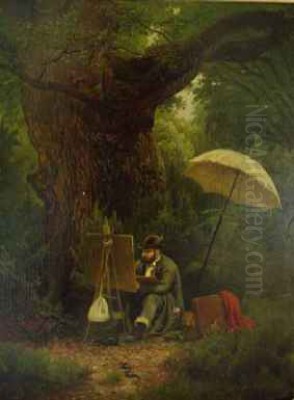
Georg Eduard Otto Saal (1818-1870) stands as a significant, if sometimes overlooked, figure in the rich tapestry of 19th-century German landscape painting. His life and work trace a fascinating trajectory from the high ideals of German Romanticism, deeply rooted in the dramatic and the sublime, towards a more nuanced and observational approach influenced by the burgeoning realism of the Barbizon School. Known particularly for his evocative depictions of Norwegian scenery, Saal's canvases capture both the grandeur of the natural world and a subtle, poetic intimacy. His artistic journey reflects the broader shifts occurring in European art during his lifetime, as artists sought new ways to engage with and represent the world around them.
Early Life and Artistic Awakening in Koblenz
Born in Koblenz in 1818, Georg Eduard Otto Saal's early life was set against the backdrop of a region rich in history and natural beauty. His father served as a municipal clerk, providing a stable, if not overtly artistic, environment. However, the young Saal's artistic inclinations found early encouragement. He received his initial instruction in drawing and painting from Conrad Zick, a local artist in Koblenz. While Zick may not be a household name on the international art scene like some of Saal's later influences, such foundational training was crucial in honing the young artist's observational skills and technical abilities.
A particularly formative experience during Saal's youth was his involvement in the reconstruction of Stolzenfels Castle, a magnificent medieval fortress overlooking the Rhine near Koblenz. This ambitious project, initiated by Crown Prince Frederick William of Prussia (later King Frederick William IV), was a significant undertaking of the Romantic era, spearheaded by the renowned architect Karl Friedrich Schinkel. Working on the restoration, even in a minor capacity, would have immersed Saal in the Romantic fascination with the medieval past and the picturesque, ideas that would deeply inform his later landscape work. The dramatic setting of the Rhine gorge itself, with its castles, ruins, and forests, undoubtedly provided ample inspiration.
The Düsseldorf Academy and Formative Influences
Seeking to further his artistic education, Georg Eduard Otto Saal enrolled at the prestigious Düsseldorf Academy of Arts, where he studied from 1842 to 1846. The Düsseldorf Academy, under the directorship of Wilhelm von Schadow, was one of the most influential art schools in Europe at the time, renowned for its emphasis on detailed realism, historical subjects, and, significantly, landscape painting. Schadow, himself a prominent painter associated with the Nazarene movement before his Düsseldorf tenure, fostered an environment that valued technical skill and a serious approach to art.
At the Academy, Saal would have been exposed to the teachings and works of leading figures of the Düsseldorf School of painting. Artists like Andreas Achenbach and his brother Oswald Achenbach were celebrated for their dramatic and meticulously rendered landscapes, often depicting stormy seas or majestic Alpine scenes. Johann Wilhelm Schirmer, another key professor, was instrumental in establishing landscape painting as a major genre at the Academy, encouraging students to study nature directly. Carl Friedrich Lessing, known for his historical and romantic landscapes, also contributed to the prevailing artistic climate. Saal's time in Düsseldorf was crucial in refining his technique and shaping his artistic vision, instilling in him a commitment to capturing the intricacies of the natural world.
Following his academic training, Saal embarked on study trips to various German regions, including the Eifel Mountains, the Lahn River valley, and the Black Forest. These excursions were essential for an aspiring landscape painter, allowing him to observe diverse terrains, atmospheric conditions, and light effects firsthand. This practice of direct observation, combined with the Romantic sensibilities cultivated earlier, laid the groundwork for his mature style.
The Allure of the North: Norwegian Landscapes
A defining aspect of Georg Eduard Otto Saal's oeuvre is his profound engagement with the landscapes of Norway. He made several trips to the country, drawn by its wild, untamed beauty – its dramatic fjords, towering mountains, cascading waterfalls, and dense forests. These Nordic scenes provided him with subjects that perfectly aligned with the Romantic era's fascination with the sublime and the awe-inspiring power of nature. His Norwegian landscapes are characterized by their panoramic scope, meticulous attention to detail, and often, a dramatic use of light and shadow to heighten the emotional impact.
Among his most celebrated works from this period is "The Approaching Storm." This painting, true to its title, likely captures the tense, charged atmosphere preceding a tempest, a common Romantic motif used to explore themes of nature's power and human vulnerability. Another key work, and one that exemplifies his skill, is "Verma Waterfalls: Study." This piece, now in the collection of the Nationalmuseum in Stockholm, showcases Saal's ability to render the dynamic energy of rushing water and the rugged textures of rock formations. He employed atmospheric perspective effectively, creating a sense of depth and vastness, drawing the viewer into the scene. His technique often involved concise, rapid brushstrokes that, while detailed, also conveyed a sense of immediacy and illusionistic depth.
Saal was not alone in his artistic exploration of Norway. The Norwegian painter Johan Christian Dahl, who spent much of his career in Dresden and was a close associate of Caspar David Friedrich, was a pioneer in depicting his homeland's landscapes and greatly influenced German Romantic painters. Hans Gude, another prominent Norwegian artist who also taught at the Düsseldorf Academy for a time, further popularized Norwegian scenery. Peder Balke, a more enigmatic Norwegian contemporary, captured the Arctic's stark, dramatic beauty with a unique, almost visionary style. Saal's contributions fit within this broader interest in the Nordic wilderness, offering his distinct interpretation of its powerful allure.
Romantic Ideals and Royal Patronage
Saal's work from his early and middle periods firmly aligns with the tenets of German Romanticism. This artistic and intellectual movement, which flourished in the late 18th and early 19th centuries, emphasized emotion, individualism, the glorification of the past and nature, and a preference for the medieval over the classical. In landscape painting, this translated into a desire to convey not just the physical appearance of a scene, but also its spiritual or emotional essence. Artists like Caspar David Friedrich, perhaps the most iconic German Romantic painter, imbued their landscapes with symbolic meaning and a sense of melancholic contemplation. Carl Blechen, another contemporary, brought a more painterly and sometimes unsettling dynamism to his Romantic landscapes.
Saal's detailed yet evocative depictions of nature, particularly his dramatic Norwegian scenes, resonated with these Romantic ideals. His ability to capture the "poetry" of a landscape, its inherent mood and character, was highly valued. This skill and vision did not go unnoticed. In a significant recognition of his talent, Saal was appointed court painter to King Ludwig II of Bavaria. Ludwig II, the "Swan King" or "Fairy Tale King," was himself a quintessential Romantic figure, known for his eccentricities, his passionate patronage of Richard Wagner, and his construction of fantastical castles like Neuschwanstein, Linderhof, and Herrenchiemsee. To serve such a monarch, whose own aesthetic sensibilities were deeply ingrained in Romanticism, was a testament to Saal's artistic standing.
This royal patronage would have provided Saal with a degree of financial security and prestige, allowing him to continue his artistic pursuits. It also underscores the cultural importance of landscape painting during this period, seen not merely as decorative but as a means of expressing national identity, spiritual longing, and a profound connection to the natural world.
A Shift in Style: The Influence of Barbizon
Later in his career, Georg Eduard Otto Saal's artistic style underwent a noticeable evolution, reflecting a broader shift in European art away from the high drama of Romanticism towards a more direct and unembellished engagement with nature. This change was significantly influenced by his encounters with the work of the Barbizon School painters in France. He is known to have traveled to the Forest of Fontainebleau, the area south of Paris that gave the school its name.
The Barbizon School, active from roughly the 1830s to the 1870s, included artists such as Jean-Baptiste-Camille Corot, Théodore Rousseau, Jean-François Millet, Charles-François Daubigny, and Narcisse Virgilio Díaz de la Peña. These painters rejected the idealized landscapes of academic tradition and instead focused on painting directly from nature (en plein air, or at least making oil sketches outdoors), capturing the specific light and atmosphere of a location. They often depicted humble rural scenes, peasant life, and the quiet beauty of the forest, emphasizing a truthful and unpretentious representation.
Under this influence, Saal began to simplify his technique. While his earlier works were characterized by meticulous detail, his later paintings show a broader handling of paint and a greater emphasis on overall atmospheric effect, what has been described as a "flat airiness." His subjects also became more modest, moving away from the overtly sublime and dramatic towards more intimate and tranquil scenes. A work like "Path near Fontainebleau" likely reflects this later phase, showcasing a more subdued palette and a focus on the play of light through trees or the quietude of a woodland path. This stylistic development demonstrates Saal's responsiveness to contemporary artistic currents and his willingness to adapt and grow as an artist. It also positions him as a transitional figure, bridging the gap between German Romanticism and the emerging Realist tendencies that would pave the way for Impressionism.
Artistic Techniques and Vision
Throughout his career, Georg Eduard Otto Saal demonstrated a remarkable technical facility. His early training instilled a strong foundation in drawing and composition, which remained evident even as his style evolved. In his Romantic phase, particularly in his Norwegian landscapes, Saal excelled at creating a sense of grandeur and depth. He skillfully used atmospheric perspective, where distant objects are rendered with less detail and a bluer, lighter tone, to convey vast distances. His depiction of water, whether the crashing torrents of a waterfall or the reflective surface of a fjord, was particularly adept, capturing its movement and translucency.
Saal's use of light was often dramatic, with strong contrasts between illuminated areas and deep shadows, enhancing the three-dimensionality of his scenes and contributing to their emotional impact. His brushwork, while capable of rendering fine detail, could also be surprisingly concise and efficient, achieving a high degree of illusionism without becoming overly labored. This ability to balance detailed observation with a broader, more painterly effect was a hallmark of his best work.
Even in his later, Barbizon-influenced period, when his technique became more simplified, Saal's underlying skill in composition and his sensitivity to light and atmosphere remained. The shift was more towards a different kind of truthfulness – less about capturing every minute detail and more about conveying the overall impression and mood of a scene. His palette might have become more muted, his subjects less overtly spectacular, but his commitment to capturing the essence of the landscape endured. He sought to create a believable and immersive experience for the viewer, inviting them to step into the world he depicted on canvas.
Comparisons and Contemporaries in the Wider Art World
Placing Georg Eduard Otto Saal within the broader context of 19th-century European art reveals interesting connections and distinctions. While firmly rooted in the German tradition, his work shares affinities with landscape painters from other nations. His detailed realism and love for dramatic natural scenery can be compared to aspects of the Hudson River School in America, with artists like Albert Bierstadt (who, incidentally, also studied in Düsseldorf) and Frederic Edwin Church painting the vast, untamed landscapes of the New World with a similar sense of awe and meticulousness.
Within Germany, his contemporaries Ernst Fries and Carl Morgenstern, also landscape painters, explored different facets of nature. Fries was known for his Italianate landscapes, often imbued with a classical serenity, while Morgenstern, after early Romantic influences, developed a freer, more atmospheric style, particularly in his depictions of southern European light. While the provided information doesn't suggest direct collaboration or intense rivalry with these specific figures, they represent the diverse approaches to landscape painting prevalent at the time. Wilhelm von Kobell, another significant German painter active slightly earlier but whose influence persisted, was renowned for his luminous depictions of Bavarian landscapes, often featuring cattle and a clear, almost crystalline light, offering a different flavor of German landscape art.
Saal's later engagement with the Barbizon School connects him to a pivotal movement that challenged academic conventions and paved the way for Impressionism. While Saal himself did not become an Impressionist, his adoption of a more direct, observational approach and a simplified technique shows an awareness of these progressive tendencies. Artists like Claude Monet and Camille Pissarro would take the Barbizon painters' commitment to plein air painting and the study of light to revolutionary new conclusions.
Legacy and Enduring Appeal
Georg Eduard Otto Saal passed away in Baden-Baden in 1870, leaving behind a significant body of work that chronicles his artistic journey and reflects the changing tides of 19th-century art. While he may not be as widely known today as some of his more famous contemporaries like Caspar David Friedrich or the leading figures of the Barbizon or Impressionist movements, his contributions to German landscape painting are undeniable. His works are held in various public and private collections, with "The Verma Waterfalls: Study" in the Nationalmuseum, Stockholm, being a notable example.
His legacy lies in his ability to capture the majestic beauty of the natural world, particularly the dramatic landscapes of Norway, with both technical skill and genuine feeling. He successfully navigated the transition from the high ideals of Romanticism to a more observational, proto-Realist approach, demonstrating an artistic adaptability. His paintings offer a window into the 19th-century fascination with nature, seen as a source of spiritual solace, national pride, and profound aesthetic experience. For art historians and enthusiasts, Saal's work provides valuable insight into the Düsseldorf School, the enduring appeal of Nordic scenery, and the complex interplay of artistic influences that characterized European art in his time.
Conclusion: A Painter of Nature's Poetry
Georg Eduard Otto Saal's artistic career was a dedicated exploration of the natural world. From his early immersion in the Romantic atmosphere of Koblenz and the rigorous training of the Düsseldorf Academy to his transformative encounters with the wild landscapes of Norway and the innovative spirit of the Barbizon painters, Saal consistently sought to convey the power and poetry of nature. His representative works, such as "The Approaching Storm," "Verma Waterfalls: Study," and "Path near Fontainebleau," illustrate the evolution of his style and his mastery of landscape painting.
He remains a compelling figure, an artist who could render the sublime grandeur of a mountain vista with the same conviction as the quiet intimacy of a forest path. His journey reflects a broader artistic quest in the 19th century: to find new and authentic ways to represent the world, moving from the idealized and symbolic towards a more direct and personal engagement with reality, all while retaining a deep appreciation for the inherent beauty and emotional resonance of the landscape. Georg Eduard Otto Saal's paintings continue to speak to us of this enduring human connection to the natural world.