Giovanni Battista Filosa: An Italian Master Between Romanticism and Modernity
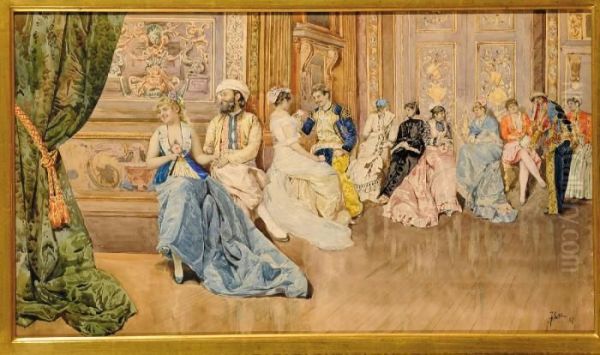
Giovanni Battista Filosa (1850-1935) stands as a significant, if sometimes overlooked, figure in Italian art during a period of profound transformation. Active from the latter half of the 19th century into the early 20th century, Filosa's artistic journey navigated the currents of late Romanticism while engaging with the nascent stirrings of Impressionism and the innovative techniques of Divisionism. His oeuvre, characterized by evocative landscapes, intimate genre scenes, and a deep connection to his native region, particularly Castellammare di Stabia, earned him recognition both within Italy and on the broader European art market. This exploration delves into his life, his artistic development, the cultural milieu in which he worked, his notable creations, and his place among the diverse talents of his era.
The Italian Artistic Landscape in Filosa's Time
To fully appreciate Giovanni Battista Filosa's contributions, it is essential to understand the complex artistic environment of Italy during his lifetime. The unification of Italy (the Risorgimento), largely completed by 1871, brought with it a surge in national consciousness, which also permeated the arts. However, Italy's art scene remained diverse, with strong regional schools and a tension between academic traditions and new, more experimental approaches.
The mid-19th century was still heavily influenced by Neoclassicism and Romanticism. Romanticism, in particular, with its emphasis on emotion, individualism, the sublime power of nature, and often a nostalgic look at the past or folk traditions, found fertile ground in Italy. Artists like Francesco Hayez (1791-1882), though an earlier figure, had set a precedent for historical Romanticism and portraiture that resonated for decades. The depiction of everyday life, or genre scenes, also gained prominence, often imbued with a romantic sensibility.
Concurrently, a move towards Realism was taking shape. In Italy, this manifested most notably in the Macchiaioli movement, primarily active in Florence from the 1850s and 1860s. Artists like Giovanni Fattori (1825-1908), Silvestro Lega (1826-1895), and Telemaco Signorini (1835-1901) rejected the polished finish of academic art, advocating for painting en plein air (outdoors) and using "macchie" (patches or spots of color) to capture the immediate effects of light and shadow. While distinct from French Impressionism, the Macchiaioli shared a similar desire for direct observation and a more truthful representation of reality, often focusing on landscapes, rural life, and scenes of contemporary Italian life, including military subjects related to the Risorgimento.
By the time Filosa was establishing his career, French Impressionism, which had its first major group exhibition in 1874, began to exert its influence across Europe. Italian artists, some of whom, like Giuseppe De Nittis (1846-1884) and Federico Zandomeneghi (1841-1917), spent considerable time in Paris, absorbed these new ideas. They brought back an interest in capturing fleeting moments, the play of light, and contemporary urban or leisure scenes, adapting these to an Italian context.
Towards the end of the 19th century and into the early 20th, Divisionism (or Divisionismo in Italian) emerged as a distinctly Italian response to Neo-Impressionism (Pointillism). Pioneered by artists such as Giovanni Segantini (1858-1899), Gaetano Previati (1852-1920), Angelo Morbelli (1853-1919), and Giuseppe Pellizza da Volpedo (1868-1907), Divisionism involved applying separate strokes or dots of pure color to the canvas, relying on the viewer's eye to optically mix them. While technically similar to French Pointillism (as seen in the work of Georges Seurat and Paul Signac), Italian Divisionism often carried stronger symbolic, social, or spiritual undertones, particularly in the works of Segantini and Pellizza da Volpedo.
Filosa's career spanned this dynamic period, and his work reflects an intelligent synthesis of these evolving artistic currents.
Filosa's Life and Artistic Development
Giovanni Battista Filosa was born in 1850 and passed away in 1935. While specific details about his early training are not extensively documented in readily available sources, his strong connection to Castellammare di Stabia, a coastal town near Naples, is evident. This region, with its stunning natural beauty, bustling fishing communities, and vibrant local culture, would become a recurring and defining subject in his art. Naples, a major artistic center with a long-standing Royal Academy of Fine Arts (Accademia di Belle Arti di Napoli), was a hub for artistic training and innovation. It is highly probable that Filosa received his formal artistic education there or was significantly influenced by its artistic milieu. The Neapolitan school of painting in the 19th century was known for its strong tradition of Realism and landscape painting, with artists like Domenico Morelli (1823-1901) and later Antonio Mancini (1852-1930) achieving international fame.
Filosa's artistic style is primarily described as Romantic, yet he was clearly receptive to the innovations around him. His Romanticism is not of the grand historical or overtly dramatic kind, but rather a more intimate, lyrical appreciation for nature and the human element within it. He depicted the landscapes and the daily lives of the people of Castellammare di Stabia – the peasants, the fisherfolk – with a sensitivity that elevated the ordinary to the poetic.
His engagement with Impressionistic principles can be seen in his handling of light and atmosphere, particularly in his watercolors and some oil paintings. There's a freshness and immediacy in these works, suggesting an interest in capturing the transient effects of weather and time of day. Furthermore, his proximity to Divisionist techniques indicates an awareness of contemporary color theory and a willingness to experiment with how color could be used to create vibrancy and luminosity. It's important to note that for many Italian artists of this period, these "isms" were not always adopted wholesale but were often selectively integrated into their existing artistic frameworks. Filosa seems to have adeptly woven these influences into his fundamentally Romantic outlook.
His success extended beyond local appreciation, as his works found their way into the European market. This suggests a level of professional acumen and an ability to connect with dealers and collectors. His participation in exhibitions and the appearance of his works in prominent auction houses like Galleria Pananti Casa d'Aste, Pandolfini Casa d'Aste, and Gregory's further attest to his standing in the art world of his time.
Key Themes and Subjects in Filosa's Art
The soul of Giovanni Battista Filosa's art lies in his profound connection to his homeland. Castellammare di Stabia, nestled on the Bay of Naples, provided an inexhaustible source of inspiration. His paintings often celebrate the natural beauty of this coastal region, from its sun-drenched shores to its verdant hillsides.
A significant theme is the depiction of local life, particularly the activities of fisherfolk and peasants. Works like Raccoglitrici di arselle (Clam Gatherers) and Il ritorno dalla pesca (The Return from Fishing) are not merely documentary; they are imbued with a sense of dignity and an appreciation for the timeless rhythms of labor connected to the sea and land. These genre scenes often possess a narrative quality, inviting the viewer to contemplate the lives and experiences of the figures portrayed.
Landscapes, both pure and those incorporating human activity, form a cornerstone of his output. Paesaggio con case (Landscape with Houses) and paintings specifically titled Castellammare di Stabia showcase his ability to capture the unique character of the local scenery. These works likely varied from broad, panoramic views to more intimate depictions of specific locales, rendered with attention to atmospheric conditions and the interplay of light and color.
His watercolors, such as Scena galante (Gallant Scene) and Sulla terrazza (On the Terrace), demonstrate his facility with this medium. Watercolor allows for a spontaneity and translucency that can be particularly effective for capturing light and atmosphere, qualities that align with Impressionistic sensibilities. The Scena galante suggests an interest in more traditional, perhaps slightly anachronistic, romantic themes, showcasing a versatility in his subject matter.
Notable Works
While a comprehensive catalogue raisonné might be elusive, several works are consistently cited as representative of Filosa's talent and thematic concerns.
_Castellammare di Stabia_: This title likely refers to several works, but one notable oil painting, measuring 99 x 135 cm and signed and dated 1908, is a prime example of his mature style. It encapsulates his dedication to his hometown, likely depicting a characteristic view of the town, its harbor, or the surrounding landscape. Such a work would showcase his skill in composition, his use of color to evoke the Mediterranean light, and his ability to convey the unique atmosphere of the location.
_Raccoglitrici di arselle_ (Clam Gatherers): This watercolor (47.5 x 37.7 cm) is a quintessential example of his genre scenes. It would depict figures, likely women, engaged in the traditional activity of gathering clams along the shore. Beyond the picturesque, such a scene would offer Filosa an opportunity to explore human posture, the textures of the coastal environment, and the subtle play of light on water and sand. The choice of watercolor suggests a desire for freshness and immediacy.
_Il ritorno dalla pesca_ (The Return from Fishing): An oil painting (99 x 135 cm), this work tackles a classic theme in maritime art. It would likely feature fishing boats returning to harbor, perhaps at dusk or dawn, with figures of fishermen and possibly their families awaiting them. This subject allows for dramatic possibilities in terms of light and shadow, the rendering of the sea, and the depiction of human toil and anticipation. The larger scale suggests it was intended as a significant exhibition piece.
_Paesaggio con case_ (Landscape with Houses): This oil painting (22.5 x 33 cm) indicates his interest in more intimate landscape compositions. It would focus on the vernacular architecture of the region, nestled within the natural environment. Such works often highlight the harmonious relationship between human habitation and the landscape.
_Scena galante_ (Gallant Scene): A watercolor (45.5 x 30 cm), this piece points to a different facet of Filosa's interests. "Gallant scenes," often associated with 18th-century Rococo art (think Jean-Antoine Watteau), depict elegant figures in leisurely, often amorous, pursuits. Filosa's interpretation would be filtered through a 19th-century Romantic lens, perhaps with a touch of nostalgia or idealized charm.
_Sulla terrazza_ (On the Terrace): This watercolor (600 x 450 mm) suggests a scene of leisure, possibly overlooking a scenic view, a common motif in Impressionist and Post-Impressionist art. Terraces offer a vantage point, a liminal space between domesticity and the wider world, and are ideal settings for capturing figures in relaxed poses, bathed in natural light.
The creation dates for some of these works are cited in sources with inconsistencies (some even pre-dating his birth, which are clearly clerical errors referring to catalogue numbers or other data). However, the consistent mention of these titles across various auction records and art historical databases confirms their importance within his body of work, all created during his active period from roughly the 1870s to the 1930s. The 1908 date for the large Castellammare di Stabia oil painting provides a firm anchor for his mature period.
Filosa in the Context of His Contemporaries
Giovanni Battista Filosa worked during a vibrant period for Italian art, and his stylistic choices place him in dialogue with numerous contemporaries. While direct records of his personal interactions with other specific artists are not detailed in the provided information, we can situate him within broader artistic currents.
His Romantic leanings and focus on regional landscapes and genre scenes connect him to a tradition that continued throughout the 19th century. Artists like Filippo Palizzi (1818-1899), another Neapolitan painter, were renowned for their realistic yet sympathetic depictions of rural life and animals. The interest in the daily lives of ordinary people was a widespread theme, treated with varying degrees of realism or romanticism by artists across Italy.
His engagement with Impressionistic light and atmosphere, particularly in his watercolors, aligns him with Italian artists who responded to French Impressionism. While not a core member of the Macchiaioli, their emphasis on plein air painting and capturing the effects of light certainly created a conducive environment for such explorations. Artists like Francesco Paolo Michetti (1851-1929), from the Abruzzo region, also combined a powerful realism in depicting local customs and landscapes with a vibrant, light-filled palette that sometimes approached Impressionistic effects.
The influence of Divisionism on Filosa is particularly intriguing. While he may not have been a doctrinaire Divisionist, his adoption of some of its techniques suggests an artist keen to explore modern approaches to color and form. He would have been aware of the leading figures of Italian Divisionism, such as Giovanni Segantini, whose Alpine landscapes and symbolic peasant scenes achieved international acclaim; Gaetano Previati, known for his flowing lines and often mystical or historical subjects; Angelo Morbelli, who often depicted social themes and the elderly with poignant sensitivity using Divisionist techniques; and Giuseppe Pellizza da Volpedo, whose iconic Il Quarto Stato (The Fourth Estate) is a masterpiece of social realism rendered in the Divisionist style. Another artist who explored Divisionism, often with a Symbolist bent, was Plinio Nomellini (1866-1943). Filosa's application of these principles would likely have been more focused on enhancing the luminosity and vibrancy of his landscapes and genre scenes rather than the overt social or symbolic content seen in some of the more prominent Divisionists.
The broader European context also included artists like the Spanish painter Joaquín Sorolla (1863-1923), whose sun-drenched beach scenes and depictions of Spanish life share a similar vibrancy and focus on light that one might find in Filosa's more Impressionistically inclined works. While a direct link is not implied, it highlights a shared European artistic interest in capturing the brilliance of Mediterranean light and local life.
Legacy and Conclusion
Giovanni Battista Filosa's career (1850-1935) successfully navigated a period of significant artistic change in Italy. He remained rooted in a Romantic sensibility, particularly in his choice of subject matter and his empathetic portrayal of the people and landscapes of Castellammare di Stabia. Yet, he was not immune to the innovations of his time, selectively incorporating elements of Impressionism and Divisionism to enrich his visual language. This ability to synthesize tradition with modernity allowed him to create a body of work that was both appealing to contemporary audiences and enduring in its artistic merit.
His paintings serve as a valuable visual record of a specific time and place, capturing the essence of life in coastal Southern Italy at the turn of the 20th century. Beyond their documentary value, however, they resonate with a lyrical quality and a genuine affection for his subjects. The fact that his works were successfully marketed in Italy and across Europe speaks to their quality and appeal.
While perhaps not as widely known today as some of the leading figures of the major Italian movements of his era, Giovanni Battista Filosa remains an important artist for understanding the nuances of Italian art in the late 19th and early 20th centuries. He represents a significant cohort of talented painters who, while not always at the vanguard of radical innovation, produced work of high quality that reflected the complex interplay of enduring traditions and emerging artistic ideas. His art invites us to appreciate the beauty of the everyday, the richness of regional culture, and the subtle ways in which an artist can absorb and reinterpret the diverse influences of their time. His legacy is preserved in his evocative canvases and watercolors, which continue to find appreciation in collections and at auction, a testament to his skill and enduring artistic vision.