Louis Alexandre Dubourg: A Norman Realist at the Dawn of Impressionism
Louis Alexandre Dubourg (1825-1891) stands as a fascinating, if somewhat understated, figure in the rich tapestry of 19th-century French art. Primarily active in the picturesque Norman port town of Honfleur, Dubourg carved out a distinct artistic identity characterized by a steadfast commitment to realism, a nuanced understanding of color, and a profound connection to his local environment. While perhaps not achieving the global renown of some of his contemporaries who frequented the same coastal landscapes, Dubourg's work offers a valuable lens through which to view the artistic ferment of his time, particularly the currents that would lead to the revolutionary movement of Impressionism. His "poetics of moderation," a term aptly describing his balanced approach, underscores an artist dedicated to the truthful and sensitive depiction of the world around him.
The Allure of Normandy: A Crucible for Artistic Innovation
The Normandy coast, with its dramatic cliffs, ever-changing skies, and bustling maritime life, became a magnet for artists throughout the 19th century. Before the advent of widespread railway travel, its relative proximity to Paris made it an accessible escape for painters seeking respite from the urban environment and fresh, inspiring subject matter. The quality of light in Normandy, often filtered through moist sea air, offered unique challenges and opportunities for capturing atmospheric effects – a pursuit that would become central to the Impressionist ethos.
Honfleur, in particular, emerged as a significant artistic hub. Its charming old harbor, timber-framed houses, and vibrant fishing industry provided endless visual stimuli. It was here, amidst the salt-laden air and the cries of gulls, that artists congregated, exchanged ideas, and forged new paths. This environment was crucial for Dubourg, who not only lived and worked in Honfleur but also absorbed its spirit into the very fabric of his art. He was a true painter of his terroir, deeply embedded in the local scene and its visual rhythms.
Dubourg's Artistic Formation and the Honfleur Circle
Born in 1825, Louis Alexandre Dubourg came of age during a period of significant artistic transition in France. The Neoclassical and Romantic traditions still held sway in the official Salon, but a growing movement towards Realism, championed by artists like Gustave Courbet, was challenging academic conventions. This new approach emphasized the depiction of everyday life and ordinary people, rendered with unvarnished truthfulness.
Dubourg's artistic development was undoubtedly shaped by this broader shift, but more specifically by his immersion in the artistic life of Honfleur. He became closely associated with Eugène Boudin (1824-1898), a native of Honfleur and a pivotal figure in the development of plein air (outdoor) painting. Boudin, often dubbed the "King of Skies," was a master at capturing the fleeting effects of light and atmosphere on the Normandy coast. His influence on the young Claude Monet (1840-1926) is well-documented, with Monet crediting Boudin for opening his eyes to the possibilities of painting directly from nature.
Dubourg, Boudin, and another notable painter, Adolphe-Félix Cals (1810-1880), even shared a studio in Honfleur for a time. Cals, older than Dubourg and Boudin, was known for his sensitive, often melancholic, depictions of peasant life and coastal scenes, rendered with a delicate touch and subtle palette. This collaborative environment fostered a spirit of experimentation and mutual learning. The Dutch painter Johan Barthold Jongkind (1819-1891), another crucial precursor to Impressionism, also frequented Honfleur and was admired by this circle for his bold, expressive handling of paint and his ability to capture the essence of a scene with remarkable vivacity. Jongkind himself reportedly spoke of Dubourg with respect, acknowledging his honesty as a man and his merit as a painter.
While Dubourg may not have embraced the full-blown Impressionistic style that Monet and others would later pioneer, his association with these artists and his commitment to direct observation placed him firmly within this progressive milieu. He shared their interest in capturing the authentic character of the Norman landscape and its inhabitants.
The "Poetics of Moderation": Dubourg's Distinctive Style
Dubourg's art is often described as embodying a "poetics of moderation." This suggests an approach that, while rooted in careful observation and a realist's eye for detail, avoided overt drama or sentimentality. Instead, his paintings convey a quiet dignity, a deep appreciation for the subtleties of light and color, and an honest portrayal of his chosen subjects.
His realism was not the stark, sometimes confrontational, realism of Courbet, but rather a more intimate and lyrical interpretation of the world. He possessed a keen ability to observe and translate the nuances of color, particularly the often-muted tones of the Normandy coast. His brushwork, while precise, could also exhibit a certain boldness, suggesting an artist confident in his ability to capture the essence of a form or texture.
The subjects of Dubourg's paintings were drawn directly from his surroundings in Honfleur and the broader Norman region. Maritime scenes, harbor views, local markets, and the daily lives of fisherfolk feature prominently in his oeuvre. These were not idealized or romanticized depictions but rather grounded representations of a working community and its relationship with the sea. He sought to capture the specific character of Honfleur – its light, its architecture, its people – with fidelity and sensitivity.
Representative Works: Glimpses into Dubourg's World
Several of Louis Alexandre Dubourg's known works provide insight into his artistic preoccupations and stylistic approach. Each painting serves as a window onto the Norman life he so meticulously observed.
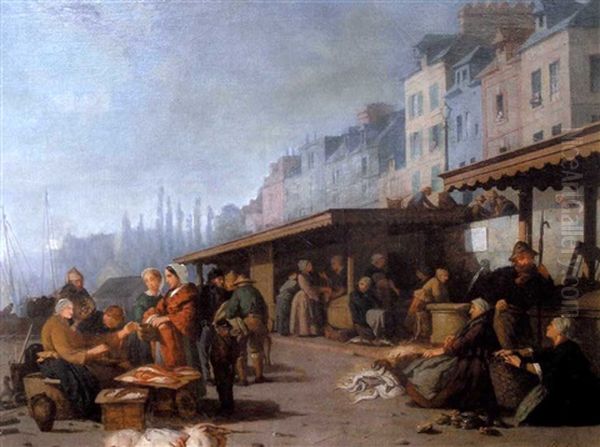
Honfleur, le Marché aux Poissons (Honfleur, The Fish Market) is a prime example of his engagement with local life. One can imagine a bustling scene, filled with the vibrant activity of vendors and customers, the glistening scales of fresh fish, and the characteristic architecture of Honfleur forming the backdrop. Such a subject would have allowed Dubourg to showcase his skills in figure painting, still life, and the creation of a lively, atmospheric composition. The dimensions (65 x 81 cm) suggest a significant canvas, capable of accommodating a rich narrative.
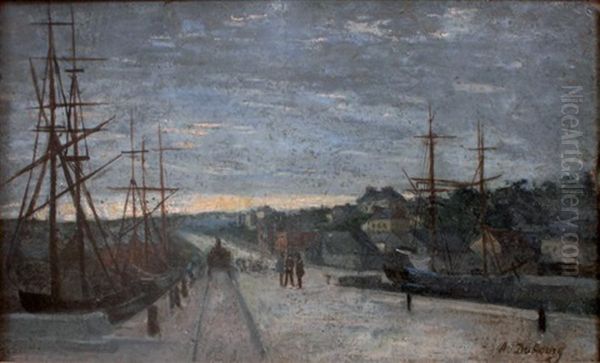
Honfleur, vue du port au chemin (Honfleur, View of the Port from the Road), a smaller oil painting (29 x 44.5 cm), likely captures a specific vista of the harbor, perhaps emphasizing the interplay of boats, water, and the surrounding townscape. The title suggests a particular viewpoint, inviting the viewer to share the artist's perspective. This work would demonstrate his ability to handle landscape elements and the unique light conditions of a coastal port.
Deux singes sur la pêre à Fonteux (Two Monkeys on the Fishing Pier at Fonteux), an oil on canvas measuring 31 x 38 cm, presents a more unusual and intriguing subject. While "pêre" likely means "pêcherie" (fishery or fishing spot) rather than "père" (father), the inclusion of monkeys is curious for a Norman scene. It might allude to exotic pets brought in by sailors, or perhaps it's a more whimsical, allegorical piece. Regardless, it points to Dubourg's willingness to explore diverse themes within his realist framework.
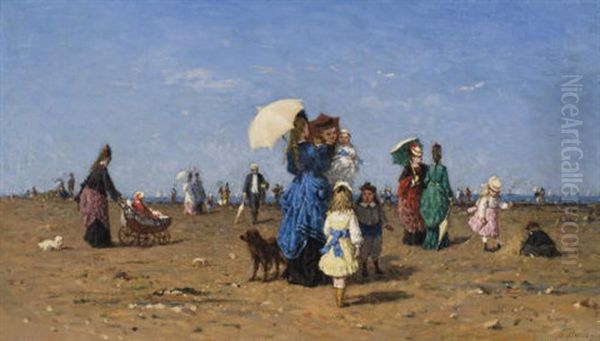
Honfleur, la plage (The Beach at Honfleur), painted in 1869, would have offered Dubourg an excellent opportunity to explore the expansive skies and shifting sands of the Normandy coast, a subject beloved by Boudin and the burgeoning Impressionists. This work, created at a time when Impressionism was on the cusp of its formal emergence, would be particularly interesting to analyze for its handling of light, color, and atmosphere.
Other notable works further illustrate his dedication to the Norman coast: Le quai de Villerville (The Quay at Villerville) and Femmes ramassant des huîtres sur la plage de Honfleur (Women Gathering Oysters on the Beach at Honfleur). Villerville, another charming coastal town near Honfleur, provided similar picturesque motifs. The depiction of women gathering oysters speaks to his interest in the daily labor of the local populace, a common theme in Realist art. These paintings would showcase his ability to integrate figures naturally within their environment, capturing their characteristic activities and postures.
These works, taken together, paint a picture of an artist deeply attuned to his environment, skilled in capturing its visual and social textures, and committed to a truthful yet poetic representation of reality.
Dubourg in the Wider Artistic Milieu of 19th-Century France
To fully appreciate Dubourg's position, it's essential to consider the broader artistic landscape of his time. The mid-19th century was a period of intense artistic debate and innovation. The Barbizon School, with artists like Jean-Baptiste-Camille Corot (1796-1875), Charles-François Daubigny (1817-1878), and Jean-François Millet (1814-1875), had already championed landscape painting and the depiction of rural life, often working directly from nature in the Forest of Fontainebleau. Their emphasis on capturing the mood and atmosphere of a landscape, rather than just its topographical details, was a significant step towards Impressionism. Daubigny, known for his studio boat from which he painted river scenes, was particularly influential on the younger generation, including Monet.
The Realist movement, spearheaded by Gustave Courbet (1819-1877), as mentioned, insisted on the depiction of contemporary subjects without idealization. His famous "Paviilon du Réalisme" in 1855, set up in defiance of the official Salon, was a landmark event. While Dubourg's realism was perhaps less overtly political than Courbet's, he shared the commitment to observing and recording the tangible world.
As the 1860s progressed, the artists who would form the core of the Impressionist group began to coalesce. Camille Pissarro (1830-1903), Alfred Sisley (1839-1899), Berthe Morisot (1841-1895), and Pierre-Auguste Renoir (1841-1919), along with Monet, sought to capture the fleeting moment, the "impression" of light and color on the senses. They employed broken brushwork, a brighter palette, and often painted en plein air to achieve this. While Dubourg did not fully adopt these techniques, his focus on accurate observation of color and light, and his association with key precursors like Boudin and Jongkind, place him in the lineage that made Impressionism possible.
Other artists active in Trouville and along the Normandy coast during Dubourg's time included Jules Achille Noël (1815-1881) and Charles Louis Mozin (1799-1862), both known for their maritime scenes. Noël, in particular, was a prolific painter of coastal views, often imbued with a romantic sensibility. Mozin, an earlier figure, was one of the first to popularize Trouville as an artistic subject. The presence of such artists further underscores the vibrancy of the Norman artistic scene. One might also consider the work of Stanislas Lépine (1835-1892), a friend of Corot and an artist who, like Dubourg, painted sensitive, atmospheric views, often of Paris and Normandy, bridging the gap between the Barbizon School and Impressionism. Even Edgar Degas (1834-1917), though primarily a figure painter and urban chronicler, produced some remarkable early landscapes, showing the pervasive interest in this genre.
Dubourg's artistic journey unfolded against this backdrop of established traditions, revolutionary movements, and a shared fascination with the visual possibilities of the French landscape, particularly the Normandy coast. He was part of a generation that questioned academic norms and sought new ways of seeing and representing the world.
The Question of Formal Affiliations
The available information does not suggest that Louis Alexandre Dubourg was formally affiliated with any specific, rigidly defined art group or organization in the way that, for example, the Impressionists later organized their own independent exhibitions. His collaborations, such as sharing a studio with Boudin and Cals in Honfleur, seem to have been more informal arrangements born out of shared artistic interests and geographical proximity.
The "Honfleur School" (École de Honfleur) or "Saint-Siméon School" (referring to the Ferme Saint-Siméon, an inn where artists gathered) are terms often used to describe the loose congregation of artists working in and around Honfleur. This was not a formal institution with a manifesto or membership rules, but rather a descriptive label for a community of practice. Dubourg was undoubtedly a key member of this informal circle, contributing to and benefiting from the creative energy it generated. His commitment to Honfleur as his primary base of operations further solidifies his place within this local artistic tradition.
His artistic practice, characterized by its realism and keen observation, aligned with the broader trends of the time but maintained an individual character. He appears to have been an artist who pursued his own vision, informed by his peers but not subsumed by any single dominant style.
Legacy and Lasting Significance
Louis Alexandre Dubourg passed away in 1891, the same year as Jongkind. By this time, Impressionism had run its course as a unified movement, and Post-Impressionist trends were already well underway. While Dubourg may not have achieved the widespread fame of some of his contemporaries during his lifetime or in subsequent art historical narratives, his contribution remains significant.
His importance lies in several areas. Firstly, he is a key representative of the Honfleur artistic community, a vital crucible for the development of modern French landscape painting. His work provides a valuable record of this specific place and time, rendered with an artist's sensitivity and skill.
Secondly, his "poetics of moderation" – his blend of realism, careful color observation, and unpretentious subject matter – offers a distinct artistic voice. He demonstrates that significant art can arise from a quiet, dedicated engagement with one's immediate surroundings. His paintings are a testament to the beauty and interest to be found in the everyday.
Thirdly, and perhaps most importantly in the broader sweep of art history, Dubourg, alongside figures like Boudin and Jongkind, played a role in paving the way for Impressionism. His commitment to painting from direct observation, his interest in capturing the nuances of light and atmosphere, and his focus on contemporary life and landscape all align with the foundational principles of the Impressionist movement. While he may be considered a pre-Impressionist or an early Impressionist sympathizer rather than a core member, his work forms part of the essential groundwork upon which that revolutionary style was built.
The artists who gathered in Honfleur, including Dubourg, created an environment where new ideas about art could be explored. They challenged the conventions of the Salon and embraced the direct experience of nature as a primary source of inspiration. Dubourg's paintings, with their honest and insightful depictions of Norman life and landscapes, are a valuable part of this legacy. They remind us that artistic revolutions are often built upon the dedicated work of many individuals, some of whom may not achieve headline status but whose contributions are nonetheless integral to the unfolding story of art.
In conclusion, Louis Alexandre Dubourg was more than just a provincial painter. He was an artist of integrity and skill, deeply connected to his Norman roots, and a participant in one ofthe most exciting periods of artistic innovation in French history. His works deserve continued attention for their intrinsic quality and for the light they shed on the artistic currents that transformed European painting in the 19th century. His legacy is one of quiet dedication, keen observation, and a profound, if understated, poetry found in the faithful depiction of the world he knew and loved.