The Victorian era in Britain was a period of immense industrial change, scientific discovery, and a burgeoning middle class with a keen interest in the natural world. This fascination manifested in various ways, from amateur botany and entomology to a deep appreciation for art that captured the beauty of flora and fauna. Within this cultural milieu, Harry Bright (1846-1895) carved a distinct niche for himself as a talented painter, particularly celebrated for his exquisite and lively depictions of birds. Though perhaps not as widely known today as some of his bombastic contemporaries, Bright’s work offers a charming and insightful window into the Victorian appreciation for nature's delicate details.
The Scant Details of a Quiet Life
Biographical information on Harry Bright, the avian specialist, is somewhat scarce, a common fate for artists who did not aggressively seek the limelight of major academies or become embroiled in public artistic movements. He was born in 1846 and passed away in 1895, his life spanning a significant portion of Queen Victoria's reign. This period saw the flourishing of natural history illustration and painting, driven by both scientific inquiry and a romantic sensibility towards the wild.
It is crucial to distinguish this Harry Bright from other notable figures, including a contemporary American baseball figure, Harry James Bright (born 1929), and, more significantly in art historical terms, Henry Bright (1810/1814–1873), a prominent landscape artist associated with the Norwich School. The shared surname and artistic profession have occasionally led to conflation of their achievements. However, the Harry Bright of our focus dedicated his primary artistic energies to the world of birds, rendered with a sensitivity and precision that defined his unique contribution.
Artistic Focus: The Intricate World of Birds
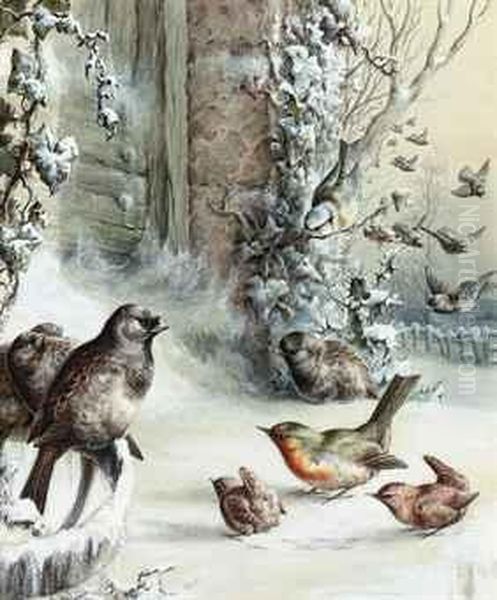
Harry Bright's reputation rests firmly on his skill as a watercolorist, though he also worked in oils and produced illustrations. His specialty was the portrayal of birds, particularly small British songbirds, depicted in their natural habitats. He possessed a keen eye for ornithological detail, capturing not just the plumage and form of his subjects, but also their characteristic poses and the subtle nuances of their interaction with the environment. His birds are not mere static specimens; they are vibrant, living creatures, often shown perched on blossoming branches, amidst winter foliage, or engaged in the daily dramas of their lives.
This focus aligns perfectly with the Victorian era's burgeoning interest in ornithology. Illustrated bird books were immensely popular, and artists who could accurately and aesthetically render avian subjects found a ready audience. Bright’s work would have appealed to both the scientifically-minded observer and the art lover who appreciated the decorative qualities of such paintings. His ability to convey the delicacy of feathers, the glint in a bird's eye, and the texture of bark or leaves set his work apart.
Key Works and Signature Style
One of Harry Bright's representative works, explicitly mentioned in records, is a pair of watercolors titled Finches and a bluetit on winter branches, created in 1884. This title itself evokes the essence of his art: specific species observed in a particular seasonal context. Such works demonstrate his meticulous attention to detail – the subtle coloration of the finches, the cheerful blue and yellow of the bluetit, and the stark, yet beautiful, forms of branches in winter. The choice of watercolor as a primary medium was well-suited to capturing the delicate translucency of feathers and the fleeting effects of light in nature.
Beyond individual paintings, Harry Bright also contributed to the world of illustrated books, a significant avenue for artists in the 19th century. He published Birds and Blossom in 1879, a title that perfectly encapsulates his dual interest in avian life and its botanical surroundings. Later, in 1896 (published posthumously), came The ABC of Pretty Birds, suggesting an educational or children's audience, aiming to instill an appreciation for ornithology from a young age. These publications would have allowed his art to reach a wider public than gallery exhibitions alone.
The Victorian Artistic Landscape: Contemporaries and Influences
To fully appreciate Harry Bright's contribution, it's helpful to consider him within the broader context of Victorian art. The era was rich with artists depicting the natural world. While Bright focused on birds, landscape painting was at its zenith. Figures like John Ruskin, the influential critic, championed "truth to nature," a principle that resonated with many artists, including the Pre-Raphaelite Brotherhood. Artists such as John Everett Millais, William Holman Hunt, and Dante Gabriel Rossetti, though known for different subjects, shared an emphasis on detailed observation that Bright, in his own sphere, also embodied.
In the specific field of bird illustration and painting, Bright had notable contemporaries. Archibald Thorburn (1860-1935) became one of Britain's most celebrated wildlife artists, particularly for his depictions of game birds and waterfowl, often in dramatic settings. Joseph Wolf (1820-1899), German-born but working extensively in Britain, was another highly respected bird and animal painter, known for his scientific accuracy and artistic skill. Earlier, the monumental work of John James Audubon (1785-1851) in America had set a high bar for ornithological art.
The tradition of detailed watercolor painting of natural subjects was also strong. Artists like Myles Birket Foster (1825-1899) captured idyllic rural scenes with meticulous detail, while Helen Allingham (1848-1926) was beloved for her charming depictions of cottages and gardens, often featuring floral abundance that would have complemented Bright’s own interest in "blossom." The rise of chromolithography also allowed for wider dissemination of colored illustrations, fueling public appetite for such works.
The Matter of Henry Bright and the Norwich School
It is important to address the achievements sometimes mistakenly attributed to Harry Bright (1846-1895) that more accurately belong to Henry Bright (1810/1814–1873). Henry Bright was a significant landscape painter, a generation older than Harry. He was associated with the later phase of the Norwich School of painters, a regional school that included luminaries like John Crome (1768-1821) and John Sell Cotman (1782-1842), known for their depictions of the Norfolk landscape.
Henry Bright was indeed a versatile artist, proficient in oils, watercolors, pastels, and chalks. He was known to have sketched outdoors with the great J.M.W. Turner (1775-1851), a testament to his standing. Henry Bright was also an influential teacher, counting many royal and aristocratic students among his pupils. He published several drawing manuals, such as Bright’s Drawing Book and Bright’s Graduated Tint Studies, which were part of a wider 19th-century trend for instructional art books. Furthermore, Henry Bright was innovative in the realm of art materials, collaborating on the manufacture of colored crayons and later launching his own brand, "Bright’s Superior Coloured Crayons." His works are held in prestigious collections, including the British Museum, Victoria and Albert Museum, and Tate Britain.
These accomplishments – the association with Turner and the Norwich School, the extensive teaching career, the publication of drawing manuals, and the innovation in art materials – belong to Henry Bright. Harry Bright, the avian artist, appears to have had a more focused, perhaps quieter, career centered on his specialized subject matter.
Exhibitions, Collections, and Market Reception
Information regarding Harry Bright's (1846-1895) exhibition history is not as extensive as that for more prominently acclaimed artists of his time. It is noted that he may not have exhibited widely in the major public venues. However, this does not necessarily reflect a lack of success. Many Victorian artists found a strong market through private sales, dealers, and commissions, particularly for subjects like bird paintings that were popular for domestic interiors. The quality and charm of his work suggest that he would have found appreciative patrons. His published books, Birds and Blossom and The ABC of Pretty Birds, also served as a form of public exposure and dissemination of his art.
In contrast, Henry Bright (1810/1814–1873) did exhibit more widely, including at the Royal Academy and the British Institution, and as mentioned, his works are found in numerous public collections. This difference in public profile further underscores the distinct careers of the two artists. For Harry Bright the bird painter, his legacy is perhaps more intimately tied to the specific appeal of his chosen subject and the delicate skill with which he rendered it.
Artistic Style and Thematic Consistency
Harry Bright's style can be characterized by its detailed realism, combined with a gentle, almost affectionate, portrayal of his subjects. He avoided the grandiosity or overt sentimentality that could sometimes pervade Victorian art. Instead, his focus was on the accurate yet aesthetically pleasing representation of birds within their natural settings. The "contemporary traditional" label, if applied, would speak to his grounding in established techniques of representation while focusing on subjects of enduring appeal.
His understanding of light and shadow, crucial for any realist painter, allowed him to give form and volume to his subjects. The textures of feathers, the smoothness of an egg, the roughness of bark – all were rendered with a careful hand. His compositions were typically balanced and harmonious, designed to showcase the bird and its immediate environment effectively. The thematic consistency of his work – the unwavering focus on birds and their habitats – allowed him to develop a high degree of expertise and a recognizable artistic voice within this specialized genre.
Other artists of the period who explored natural themes with a similar dedication to detail, even if their subjects varied, include William Henry Hunt (1790-1864), known for his highly detailed still lifes of fruit, flowers, and birds' nests, often in watercolor. The meticulousness of such work resonated with the Victorian appreciation for both scientific accuracy and the beauty of the commonplace. Even in landscape, artists like Benjamin Williams Leader (1831-1923) brought a detailed, almost photographic, clarity to their scenes, reflecting a broader trend towards verisimilitude.
Legacy: A Quiet Charm
Harry Bright (1846-1895) may not have been a revolutionary figure in the annals of art history, nor did he engage in the avant-garde movements that were beginning to stir towards the end of his life. His contribution lies in his dedicated and skillful portrayal of a specific, beloved aspect of the natural world. In an age fascinated by ornithology, he provided images that were both informative and aesthetically delightful.
His work, particularly his watercolors of small British birds, continues to appeal to those who appreciate fine draftsmanship, delicate coloring, and a genuine affection for the subject matter. His published books, Birds and Blossom and The ABC of Pretty Birds, played a role in popularizing ornithological knowledge and fostering an appreciation for nature, especially among younger audiences.
While the grand narratives of art history often focus on groundbreaking innovators or leaders of major schools, the fabric of art is also woven with the contributions of artists like Harry Bright. These are the painters who, with skill and dedication, capture specific facets of the world around them, creating works that offer enduring pleasure and a valuable record of the aesthetic sensibilities of their time. His legacy is one of quiet charm, technical proficiency, and a heartfelt engagement with the avian wonders of the British countryside. In a world increasingly disconnected from nature, Bright's paintings serve as a gentle reminder of its intricate beauty.