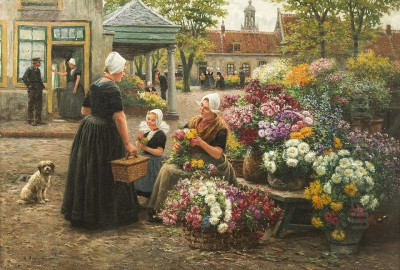
Henri Houben stands as a significant figure in Belgian art during the late nineteenth and early twentieth centuries. Born Georges Hendrik Houben, but known professionally as Henri, his life spanned a period of rich artistic development in Europe. Active primarily as a painter of landscapes, portraits, and genre scenes, Houben combined meticulous observation inherited from Belgian Realism with an increasing sensitivity to light and atmosphere, echoing the broader Impressionist movement. His long tenure as an influential professor at the prestigious Royal Academy of Fine Arts in Antwerp further cemented his legacy, shaping generations of artists. This exploration delves into the life, work, and artistic milieu of Henri Houben, placing him within the vibrant context of Belgian art history.
Early Life and Artistic Awakening in Antwerp
Henri Houben was born in Antwerp, Belgium, in 1858. His early life was touched by the arts, though initially through music rather than painting. His father was reportedly a violinist, and Henri himself initially pursued music, becoming a violin teacher at the Antwerp Conservatory of Music. This background perhaps instilled in him a sense of discipline and structure that would later inform his visual art. However, the powerful draw of the visual arts, particularly painting, eventually redirected his path.
In 1877, at the age of nineteen, Houben made the decisive move to enroll at the Royal Academy of Fine Arts in Antwerp. This institution was a cornerstone of artistic training in Belgium, boasting a rich history and a faculty of respected artists. His admission marked the formal beginning of his journey as a painter, immersing him in the academic traditions and contemporary currents that shaped Belgian art at the time. The training would provide him with the technical foundation upon which he would build his distinct artistic voice.
Tutelage under Karel Verlat and the Antwerp Academy
During his studies at the Antwerp Academy, Henri Houben had the distinct advantage of learning from Karel Verlat (1824-1890). Verlat was a highly esteemed painter and a dominant figure at the Academy, known for his powerful Realism, dramatic historical scenes, and masterful animal paintings. His teaching emphasized strong draftsmanship, anatomical accuracy, and a commitment to depicting subjects with truthfulness, albeit often with a sense of grandeur or narrative intensity.
Studying under Verlat undoubtedly provided Houben with a rigorous grounding in academic technique. Verlat's influence can be discerned in the solidity and careful construction found in many of Houben's works, particularly his genre scenes and portraits. The emphasis on observation and realistic representation formed a crucial part of Houben's artistic DNA. Other artists who passed through the Antwerp Academy around this period, absorbing its influences, included figures like Evert Pieters and Jan Van Beers, each developing their own paths but sharing a common academic heritage.
Emergence as a Painter: Realism and Genre Scenes
Following his training, Henri Houben established himself as a professional artist. He gravitated towards subjects drawn from everyday life, becoming particularly noted for his genre scenes. These works often depicted domestic interiors, rural life, and the quiet dignity of ordinary people engaged in their daily tasks. His painting Zeeland Peasant Family Interior, dated 1891, is a prime example of this focus. Such works capture intimate moments, often imbued with a sense of warmth and tranquility.
Houben's approach during this period was largely rooted in Realism. He rendered figures and settings with careful attention to detail, texture, and form. His compositions were often thoughtfully arranged, balancing figures within their environment to create a harmonious and believable scene. This dedication to depicting the realities of contemporary life connected him to a broader movement in Belgian art, which included prominent figures like Constantin Meunier (1831-1905), known for his sculptures and paintings of industrial workers, and Charles Degroux (1825-1870), an earlier pioneer of social realism in Belgium.
Exploring Light and Landscape: Impressionist Influences
While Realism formed the bedrock of his art, Henri Houben's work, especially his landscapes, increasingly showed an engagement with the principles of Impressionism and its Belgian variant, Luminism. He developed a keen sensitivity to the effects of light and atmosphere, moving beyond purely descriptive representation to capture the fleeting qualities of the natural world. His brushwork often became looser and more expressive in his landscapes, and his palette brightened considerably compared to the more somber tones sometimes found in 19th-century Realism.
His travels likely played a role in this evolution. A documented trip to Spain in 1921, undertaken with fellow Belgian artist Jan van Puyenbroeck (1887-1972), exposed him to the intense light and vibrant colours of the south. The painting Garden Scene in Granada, also from 1921, exemplifies this phase. It depicts a sun-drenched courtyard filled with colourful flowers, showcasing a brighter palette and a focus on capturing the brilliance of Mediterranean light. This interest in light aligned him with Belgian Luminist painters like Emile Claus (1849-1924), a leading figure known for his sun-dappled landscapes of the Leie region, although Houben generally maintained a more structured composition than Claus.
The Campine Region and the Mol School
A significant portion of Houben's landscape work focused on the Campine (Kempen) region of Belgium, an area of heathland, woods, and sandy soils east of Antwerp. This region attracted numerous artists drawn to its unique natural beauty and rural character. Houben is sometimes associated with the Mol School (Molse School), an informal grouping of artists who worked in and around the town of Mol in the Campine.
While not a rigidly defined movement, the artists connected to Mol shared an interest in depicting the local landscape and its inhabitants. Houben's paintings of the Campine often capture its specific atmospheric conditions – the hazy light, the textures of the sandy ground, the rustic charm of its farms and villages. His work in this area sits alongside that of other artists captivated by the region, such as Jakob Smits (1855-1928), another major figure associated with the Mol School, though Smits developed a highly personal, almost mystical style distinct from Houben's more direct approach.
Portraiture: Capturing Character
Alongside landscapes and genre scenes, Henri Houben was also an accomplished portrait painter. His portraits, like his genre works, were typically characterized by a realistic approach, aiming to capture not just the physical likeness but also the personality and presence of the sitter. He often employed a solid technique, paying close attention to facial features, clothing textures, and the interplay of light and shadow to model form effectively.
His sitters likely included members of Antwerp's society, fellow artists, and perhaps family members. While perhaps less revolutionary than the Symbolist portraits being created by contemporaries like Fernand Khnopff (1858-1921), Houben's portraiture provided a valuable contribution to the genre in Belgium. His work offered a more traditional, yet sensitive, portrayal of individuals, standing alongside the society portraits of artists like Alfred Stevens (1823-1906), who achieved international fame, albeit working primarily in Paris.
A Pillar of the Antwerp Academy: The Professor
In 1885, Henri Houben's connection to the Royal Academy of Fine Arts in Antwerp deepened significantly when he was appointed as a professor of painting. This was a prestigious position, reflecting the respect he had earned as an artist. Remarkably, he held this teaching post for nearly half a century, continuing to instruct students until his death in 1931. This long tenure made him a central figure at the Academy for decades.
His role as an educator was profoundly influential. Over his 46 years of teaching, Houben guided countless aspiring artists, imparting the technical skills and artistic principles he had mastered. While specific names of all his prominent students may not be widely documented, the sheer length of his service ensures he played a significant role in shaping the subsequent generation of Antwerp painters. He carried forward the academic traditions inherited from figures like Nicaise de Keyser (1813-1887) and Henri Leys (1815-1869), who had been dominant forces at the Academy earlier, while also incorporating his own evolving understanding of light and realism.
Contextualizing Houben: Belgian Art at the Turn of the Century
Henri Houben worked during a dynamic period in Belgian art history. The late 19th and early 20th centuries saw the flourishing of various movements. Realism continued to be a strong force, but Impressionism (often termed Luminism in Belgium) gained significant ground, emphasizing light and contemporary life. Symbolism also emerged as a major trend, exploring dreams, myths, and psychological states, with Brussels becoming a key center. Avant-garde groups like Les XX (Les Vingt) and its successor La Libre Esthétique showcased progressive art, featuring artists like James Ensor (1860-1949) and Théo van Rysselberghe (1862-1926), the latter a key proponent of Pointillism.
Houben navigated this complex landscape primarily within the realms of Realism and a Belgian interpretation of Impressionism. He did not align himself with the more radical avant-garde movements like Ensor or the intense psychological explorations of Symbolists like Léon Spilliaert (1881-1946). Instead, his art represented a continuation and subtle modernization of established traditions, focusing on craftsmanship, observation, and an appreciation for the beauty found in everyday reality and the natural landscape. He remained somewhat closer in spirit to artists who balanced tradition and modernity, perhaps like the later Fauvist-influenced works of Rik Wouters (1882-1916), though Wouters' style was ultimately bolder and more expressive. The painter Anna Boch (1848-1936), a member of Les XX and collector, represents another facet of the era's engagement with Impressionism and Post-Impressionism.
Technique and Style Evolution
Henri Houben's technique evolved throughout his career but consistently demonstrated a high level of skill. His early works show the tight, controlled brushwork typical of academic Realism. Figures are solidly modeled, and textures are rendered with precision. The palette in these earlier pieces often relies on careful tonal gradations, sometimes leaning towards the darker, more somber hues associated with 19th-century interiors or the 'Grey School' influence seen in Dutch painting.
As he matured, particularly in his landscapes and outdoor scenes, his brushwork often became looser and more visible. He applied paint more thickly in places (impasto) to capture the texture of foliage or the sparkle of light on water. His palette brightened significantly, incorporating purer colours to convey the effects of sunlight and atmosphere. This shift reflects his engagement with Impressionist ideas, focusing less on minute detail and more on the overall visual sensation. However, he rarely dissolved form completely, generally retaining a strong sense of structure and drawing beneath the more painterly surface.
Legacy and Recognition
Henri Houben died in 1931, leaving behind a substantial body of work and a significant legacy as both a painter and an educator. His paintings captured aspects of Belgian life and landscape during a period of transition, blending the solidity of Realism with the atmospheric concerns of Impressionism. His dedication to his craft and his long service at the Antwerp Academy ensured his influence extended beyond his own canvases.
His works can be found in various Belgian museums and private collections, appreciated for their technical skill, sensitive observation, and often tranquil beauty. While perhaps not as internationally renowned as some of his more avant-garde Belgian contemporaries like Ensor or Magritte (who emerged later), Houben holds a respected place within the narrative of Belgian art. He represents an important strand of painters who adapted traditional skills to engage with modern sensibilities, particularly the effects of light and the depiction of everyday life. His contribution lies in his consistent artistic production and his vital role in nurturing artistic talent in Antwerp for almost five decades.
Conclusion: An Enduring Presence in Belgian Art
Henri Houben's career exemplifies the path of an artist deeply rooted in the traditions of his training yet open to the evolving artistic currents of his time. From his beginnings as a musician to his long and influential tenure as a professor at the Antwerp Academy, his life was dedicated to the arts. As a painter, he excelled in capturing the nuances of Belgian landscapes, the intimacy of domestic interiors, and the character of his portrait sitters. His skillful blend of Realist foundations with Impressionist-inspired light and colour created a body of work that is both accomplished and accessible. Mentioning him alongside contemporaries like Karel Verlat, Emile Claus, Constantin Meunier, Jan van Puyenbroeck, Jakob Smits, and within the broader context of figures such as James Ensor, Théo van Rysselberghe, Alfred Stevens, Fernand Khnopff, Rik Wouters, and Anna Boch, helps to situate his specific contribution. Henri Houben remains a noteworthy figure, representing a significant aspect of Belgian painting at the turn of the twentieth century – an artist committed to observation, craftsmanship, and the enduring beauty of the visible world.