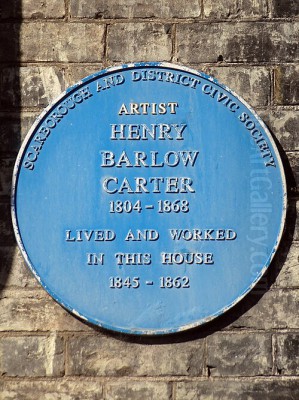
Henry Barlow Carter stands as a significant, if sometimes overlooked, figure in the rich tapestry of 19th-century British watercolour painting. Active during a period of profound artistic and social change, Carter carved a niche for himself with his evocative depictions of the English coastline, particularly the dramatic vistas of Yorkshire. His work, deeply influenced by the titans of his era, reflects both the prevailing Romantic sensibilities and a personal, meticulous observation of the natural world. This exploration delves into the life, art, and context of Henry Barlow Carter, a painter whose legacy is intrinsically linked to the sea, the moors, and the burgeoning appreciation for watercolour as a serious artistic medium.
Early Life and Artistic Genesis
The precise birth year of Henry Barlow Carter has been subject to some discussion among art historians. While some earlier accounts suggested 1795, the more widely accepted and corroborated date of birth is 1804. He was born in Scarborough, a town that would later become central to his artistic identity. His early life, like that of many artists of the period, is not exhaustively documented, but it is clear that his artistic inclinations emerged at a young age.
Carter's formal artistic journey is noted to have begun around 1824. This was a pivotal time in British art. The towering figure of Joseph Mallord William Turner (J.M.W. Turner) was already a dominant force, revolutionizing landscape painting with his dramatic use of light, colour, and atmospheric effects. Turner's influence on a generation of younger artists, including Carter, cannot be overstated. Carter, like many of his contemporaries, was captivated by Turner's ability to convey the sublime power and ephemeral beauty of nature, particularly in his marine subjects and turbulent skies.
It was under this broad, inspiring shadow of Turner and the burgeoning Romantic movement that Carter began to hone his skills, choosing watercolour as his primary medium. He started exhibiting his works, gaining recognition by showing at prestigious venues such as the Royal Academy in London and the Society of British Artists. These exhibitions were crucial for an artist's career, providing visibility and opportunities for patronage.
A Move to Yorkshire and Domestic Life
In 1830, a significant chapter in Carter's life began when he moved to Hendon, a part of Scarborough in Yorkshire. This relocation was not merely a change of address but a profound immersion into the landscapes that would define his oeuvre. The rugged Yorkshire coast, with its fishing villages, dramatic cliffs, and ever-changing weather, provided an inexhaustible source of inspiration.
Shortly after his move, Carter married Eliza. Their union would produce a son, Henry Vandyke Carter. The choice of "Vandyke" as a middle name is intriguing and often thought to be a tribute by Eliza to the great Flemish Baroque painter Sir Anthony Van Dyck, indicating a household where art was deeply appreciated. This son would go on to achieve considerable fame in his own right, not as a painter, but as a medical doctor and a pioneer in tropical epidemiology, notably providing the anatomical illustrations for the first edition of the seminal medical text, Gray's Anatomy. This connection highlights a fascinating intersection of art and science within the Carter family.
Artistic Style: Capturing the Coastal Spirit
Henry Barlow Carter's artistic style is firmly rooted in the British landscape tradition, with a particular emphasis on marine subjects and coastal scenery. His medium of choice was watercolour, which he handled with considerable skill and sensitivity. He was adept at capturing the nuanced interplay of light and atmosphere, a hallmark of the Romantic approach to landscape.
His works often depict the bustling activity of harbours, the resilience of fishing boats against stormy seas, and the tranquil beauty of coastal churches nestled within the landscape. He was a keen observer of detail, meticulously rendering the rigging of ships, the texture of stone, and the subtle gradations of colour in the sky and water. This attention to detail did not, however, detract from the overall mood and emotional impact of his scenes. Instead, it grounded his Romantic visions in a tangible reality.
The influence of J.M.W. Turner is palpable in Carter's treatment of light and atmosphere, especially in his more dramatic seascapes. Like Turner, Carter sought to convey the power and majesty of nature, the drama of storms, and the ethereal quality of light breaking through clouds. However, Carter's work often retained a slightly more topographical precision compared to Turner's later, more abstract, and visionary pieces. Other contemporaries who excelled in watercolour and marine subjects, such as Clarkson Stanfield and the earlier Richard Parkes Bonington, also contributed to the artistic environment in which Carter worked, each bringing their unique perspectives to the depiction of sea and shore.
Representative Works: Windows into Carter's World
Several key works exemplify Henry Barlow Carter's artistic preoccupations and stylistic strengths. Among his most celebrated paintings are those depicting Scarborough and its environs.
Fishing Boat Returning to Scarborough Harbour: This title, and variations thereof, represents a recurring theme in Carter's work. Such scenes allowed him to explore the relationship between humanity and the sea, capturing the daily life and inherent dangers faced by fishing communities. The compositions often feature dynamic arrangements of boats, figures, and architectural elements, all unified by his skillful handling of light and water.
Returning to Harbour in Stormy Weather: A more dramatic iteration of the harbour theme, this subject showcases Carter's ability to convey the turbulence of the sea and the resilience of seafarers. The agitated brushwork, darker palette, and emphasis on wind and waves would evoke the sublime power of nature, a central tenet of Romanticism.
A Country Church: While renowned for his coastal scenes, Carter also painted rural landscapes, including depictions of local churches. These works often possess a serene and picturesque quality, reflecting a quieter, more pastoral aspect of the English countryside. They demonstrate his versatility and his eye for architectural detail within a natural setting.
Staithes Harbour and Fishing Boats Unloading at the Cliff Foot: Staithes, another iconic Yorkshire coastal village, provided rich subject matter for Carter. Paintings with this title would capture the unique topography of Staithes, with its tightly packed houses clinging to the cliffs, and the bustling activity of its fishing industry. These works are valuable not only as artistic achievements but also as historical records of a way of life.
These paintings, and others like them, are characterized by their atmospheric depth, careful composition, and an evident affection for the Yorkshire coast. They contributed significantly to the visual identity of Scarborough as a burgeoning seaside resort and remain an important part of its cultural heritage.
The Golden Age of British Watercolour
Henry Barlow Carter was working during what is often termed the "Golden Age of British Watercolour," a period roughly spanning the late 18th and much of the 19th century. This era saw watercolour evolve from a medium primarily used for topographical records, preparatory sketches, or by amateur artists, into a highly respected and expressive art form in its own right.
Several factors contributed to this flourishing. Technical innovations led to a wider range of stable and brilliant pigments, as well as improved paper quality. The development of portable watercolour boxes made it easier for artists to work en plein air (outdoors), directly capturing the fleeting effects of light and weather.
Artists like J.M.W. Turner and Thomas Girtin were pioneers in elevating the status of watercolour. Girtin, though his career was tragically short, demonstrated the medium's potential for rich tonality and atmospheric breadth. Turner, of course, pushed the boundaries of watercolour to unprecedented levels of luminosity and expressive power. Other key figures who shaped this Golden Age include John Sell Cotman, known for his bold, flat washes and strong sense of design; David Cox, celebrated for his vigorous, breezy landscapes; Peter De Wint, master of broad, transparent washes depicting the English countryside; and Samuel Palmer, whose mystical, intensely personal visions of a pastoral ideal were often rendered in watercolour and gouache.
The establishment of societies dedicated to watercolour painting, such as the Society of Painters in Water Colours (founded in 1804, later the Royal Watercolour Society), provided exhibition venues and fostered a sense of community among watercolourists. These societies played a crucial role in promoting the medium and educating public taste. Carter's participation in exhibitions at the Royal Academy and the Society of British Artists placed him within this dynamic and evolving artistic landscape. His work contributed to the diverse output of this era, showcasing the medium's suitability for capturing the specific character of the British coastline.
Collaborations and the Scarborough Art Scene
In Scarborough, Henry Barlow Carter was not an isolated figure. He was part of a local artistic and intellectual milieu. A significant collaboration was with Solomon Wilkinson Theakston, a prominent figure in Scarborough as a bookseller, stationer, printer, and proprietor of a circulating library and newsroom, which later expanded to include an art gallery.
Around 1840, Theakston published Theakston's Guide to Scarborough, a popular guidebook for visitors to the increasingly fashionable resort town. This guide was notably illustrated with twenty-two engravings based on original drawings by Henry Barlow Carter. The engravings were executed by an artist named Sleigh. Such guidebooks were common in the Victorian era, and illustrations played a vital role in attracting tourists and conveying the scenic charms of a location. Carter's detailed and picturesque views were perfectly suited for this purpose.
Theakston also published other prints after Carter's designs, such as Sixteen Views of Scarborough (engraved by Sleigh) and Four Views of Scarborough (lithographed by Day & Haghe). These prints made Carter's imagery accessible to a wider audience and further cemented his reputation as the visual chronicler of Scarborough. The collaboration with engravers like Sleigh and lithographers like Day & Haghe was typical for the period, as printmaking was the primary means of mass-reproducing images before the advent of photography became widespread. Artists like Edward Finden and William Finden were renowned for their skillful engravings after Turner and other leading painters, demonstrating the importance of this collaborative relationship.
Carter's circle of friends in Scarborough also included the miniature painter Edward Henry Wehnert, indicating a supportive network of local artists. This local scene, with figures like Theakston fostering both literature and art, provided a conducive environment for Carter's work to flourish and reach the public.
The Carter Family: A Legacy of Art and Science
The Carter family presents an interesting blend of artistic and scientific talent. As mentioned, Henry Barlow Carter's son, Henry Vandyke Carter (1831-1897), achieved considerable distinction in the field of medicine. After studying medicine in London, H.V. Carter travelled to India, where he made significant contributions to the study of tropical diseases, including leprosy and mycetoma (a fungal disease also known as "Madura foot").
His most widely known contribution, however, came early in his career when, as a young medical student and demonstrator of anatomy at St George's Hospital, London, he provided the intricate and precise illustrations for the first edition of Henry Gray's Anatomy, Descriptive and Surgical, published in 1858. These illustrations were lauded for their clarity and accuracy and were instrumental to the book's enduring success. The artistic skill evident in these medical drawings perhaps owed something to the environment of visual acuity and draftsmanship fostered by his father.
The naming of Henry Vandyke Carter, with "Vandyke" likely chosen by his mother Eliza in homage to Sir Anthony Van Dyck, underscores the family's appreciation for art history. Van Dyck, the celebrated Flemish court painter to King Charles I, was renowned for his elegant portraits and his profound influence on British portraiture. This familial nod to a past master adds another layer to the artistic connections surrounding Henry Barlow Carter.
Rumors and Realities: The Naval Service Question
A persistent rumor or anecdotal suggestion surrounding Henry Barlow Carter's life is that he may have served in the Royal Navy. However, thorough research and available biographical information have not yielded any concrete evidence to substantiate this claim. It is possible that this notion arose from a confusion with other family members or contemporaries.
For instance, it is documented that an uncle of Henry Barlow Carter, also named Henry Barlow, had a notable maritime career. This elder Henry Barlow served in the East India Company's marine service and was involved in a significant naval engagement against a French squadron in the China Seas. Such family histories can sometimes become conflated over time.
Without definitive records, the assertion of Henry Barlow Carter's own naval service remains in the realm of speculation. His artistic output, firmly focused on the coastline and maritime life as observed from the shore or from coastal vessels, does not necessarily imply a formal career as a naval seaman. Many artists of the period, including Turner himself, undertook voyages and spent considerable time at sea to study its moods and effects, without being enlisted servicemen. Carter's profound connection to the sea was primarily that of an artist deeply observant of its character and its interaction with the land and its people.
Later Life and Enduring Legacy
Henry Barlow Carter continued to paint and reside in Scarborough for much of his life. He passed away in 1868, leaving behind a substantial body of work that documents the Yorkshire coast with sensitivity and skill. His paintings are held in various public and private collections, particularly in Yorkshire, where institutions like the Scarborough Art Gallery hold significant examples of his art.
His legacy is multifaceted. Firstly, he is remembered as a skilled watercolourist who contributed to the rich tradition of British landscape painting during its Golden Age. His works are admired for their atmospheric qualities, their detailed observation, and their evocative portrayal of coastal life. Artists like John Constable, with his deep love for the English countryside, and William Blake, with his visionary Romanticism, represent different facets of the era's artistic spirit, and Carter's work finds its place within this broad spectrum, particularly aligned with the picturesque and the maritime sublime.
Secondly, Carter's work serves as an invaluable historical record. His depictions of Scarborough, Whitby, Staithes, and other coastal locations capture these places as they were in the mid-19th century, before significant modern development. They offer glimpses into the fishing industry, the architecture, and the social fabric of these communities.
Thirdly, through his collaborations on illustrated guidebooks and prints, Carter played a role in shaping the public perception and popularization of the Yorkshire coast as a destination for tourism and artistic pilgrimage. His images helped to define the visual identity of these locations for a wider audience.
While perhaps not achieving the same level of international fame as some of his contemporaries like Turner or later figures such as the Pre-Raphaelites (Dante Gabriel Rossetti, John Everett Millais, William Holman Hunt), who were forging new artistic paths towards the latter part of Carter's life, Henry Barlow Carter remains a respected and important regional artist. His dedication to his chosen subject matter and his mastery of the watercolour medium ensure his enduring place in the annals of British art.
Conclusion: A Master of the Yorkshire Coast
Henry Barlow Carter was an artist deeply attuned to the rhythms and beauty of the natural world, particularly the dynamic interface of land and sea along the Yorkshire coast. Working within the flourishing tradition of British watercolour painting and influenced by the Romantic sensibilities of his time, he created a body of work that is both aesthetically pleasing and historically significant. His meticulous technique, combined with an ability to capture atmospheric effects and the character of coastal life, distinguishes his art.
From his early exhibitions at the Royal Academy to his long and productive career centered in Scarborough, Carter dedicated himself to portraying the landscapes he knew and loved. His collaborations with publishers like Theakston helped to disseminate his vision, while his personal life, including the notable achievements of his son, Henry Vandyke Carter, adds further dimensions to his story. Though questions like his rumored naval service may remain unanswered, his artistic contributions are clear and tangible. Henry Barlow Carter's paintings continue to offer a compelling window onto the maritime heritage and scenic splendor of 19th-century Yorkshire, securing his position as a noteworthy figure in British art history.