Herbert Hughes-Stanton: A Luminous Vision of the British Landscape
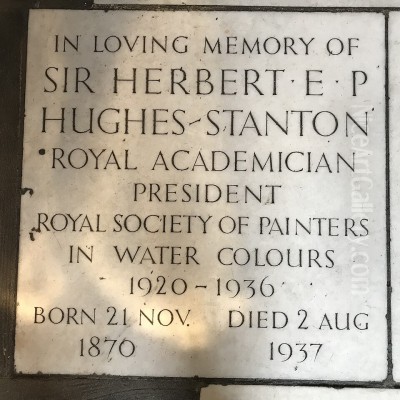
Herbert Hughes-Stanton (1870–1937) stands as a distinguished figure in the annals of British art, celebrated primarily for his evocative landscape paintings in both oil and watercolour. Active during a transformative period in European art, from the late Victorian era through to the interwar years, Hughes-Stanton carved a niche for himself with his sensitive portrayals of the natural world, particularly the varied terrains of Great Britain and the atmospheric vistas of France. His work, characterized by a profound understanding of light and a subtle, harmonious palette, earned him considerable acclaim during his lifetime, including prestigious awards and regular exhibitions at leading art institutions. This exploration delves into the life, art, and enduring legacy of a painter who dedicated his career to capturing the soul of the landscape.
Early Life and Artistic Genesis
Born in Chelsea, London, in 1870, Herbert Hughes-Stanton was immersed in an artistic environment from a young age. His father, William Hughes, was a painter known for his still-life compositions. This familial connection to the arts likely provided an early stimulus for Herbert's own creative inclinations. While detailed records of his formal artistic training are not extensively documented, suggesting he may have been largely self-taught or received foundational guidance from his father, his eventual mastery of technique speaks to a dedicated and rigorous personal study of painting.
The London of Hughes-Stanton's formative years was a vibrant artistic hub. The influence of earlier British landscape masters like John Constable and J.M.W. Turner was still pervasive, while new movements and ideas from continental Europe, such as Impressionism, were beginning to permeate the British art scene. Artists like Philip Wilson Steer, a leading British Impressionist, were reinterpreting landscape painting with a new emphasis on light and transient effects. It was within this dynamic milieu that Hughes-Stanton began to develop his own artistic voice, one that would ultimately blend traditional sensibilities with a fresh, personal vision.
Development of a Distinctive Landscape Style
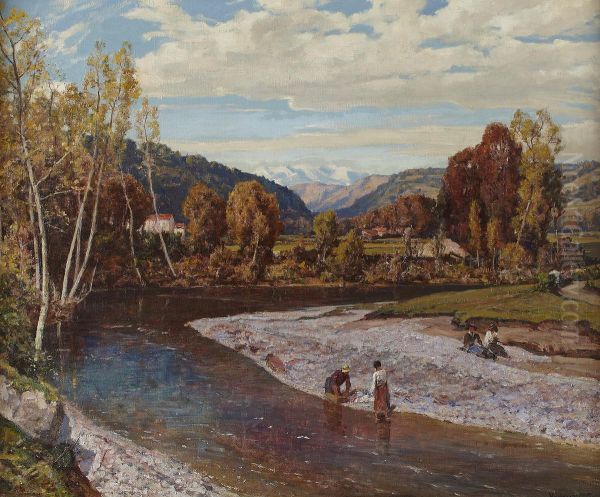
Herbert Hughes-Stanton's primary domain was landscape painting. He worked proficiently in both oil and watercolour, demonstrating a versatility that allowed him to capture a wide range of atmospheric conditions and textural details. His style is often characterized by its lyrical quality, a gentle romanticism that eschews overt drama for a more contemplative engagement with nature. He possessed a keen eye for the subtleties of the British countryside, from the rolling hills and verdant pastures to the dramatic coastlines.
A significant aspect of his work is his treatment of light. Hughes-Stanton was adept at rendering the diffused light of an English morning, the golden glow of a late afternoon, or the silvery sheen of a moonlit scene. His palette, while often restrained, was capable of great nuance, employing soft greens, blues, ochres, and greys to build up harmonious compositions. He was particularly drawn to coastal scenes, where the interplay of land, sea, and sky offered endless possibilities for artistic exploration.
One of his most notable representative works is the oil painting titled Studland Bay. This piece, depicting the famous sandy beach in Dorset, exemplifies his ability to capture the expansive beauty of the English coast. The painting likely showcases his skill in rendering the vastness of the sky, the texture of the sand dunes, and the gentle lapping of waves, all imbued with a characteristic atmospheric depth. Such works demonstrate not only his technical proficiency but also his deep affection for the landscapes he chose to portray.
Exhibitions, Accolades, and Recognition
Hughes-Stanton's talent did not go unnoticed by the art establishment of his time. He became a regular exhibitor at some of London's most prestigious venues. From 1887, his works were shown at The Grosvenor Gallery, a significant alternative exhibition space that had been established by Sir Coutts Lindsay and played an important role in promoting Aestheticism and artists who felt constrained by the Royal Academy.
A decade later, from 1897, Hughes-Stanton also began exhibiting at The Royal Academy of Arts itself. To be accepted at the Royal Academy's Summer Exhibition was, and remains, a mark of significant achievement for any British artist. His consistent presence there over the years underscores the respect he commanded within the mainstream art world. Artists like Sir Alfred East, another prominent landscape painter of the era and a Royal Academician, would have been among his contemporaries exhibiting in similar circles.
His reputation extended beyond British shores. Hughes-Stanton achieved notable success in France, a country he visited frequently. His participation in the Paris Salon, the official art exhibition of the Académie des Beaux-Arts, culminated in him being awarded Gold Medals in both 1907 and 1908. These accolades were highly significant, as the Paris Salon was arguably the most important art exhibition in the world at that time, attracting artists internationally. This recognition in Paris placed him in the company of esteemed international artists and solidified his standing as a landscape painter of considerable merit. The period between 1908 and 1914 also saw him "serving in France," though the precise nature of this service (whether artistic, diplomatic, or otherwise related to cultural exchange) is not fully detailed in readily available sources, it points to a deep engagement with the country.
Hughes-Stanton the Printmaker and Illustrator
Beyond his celebrated work in oil and watercolour, Herbert Hughes-Stanton also distinguished himself as a printmaker, particularly in the medium of woodcut. This aspect of his oeuvre reveals a different facet of his artistic personality, one that embraced the graphic potential of bold lines and contrasting forms. His woodcuts are noted for their highly abstract qualities and a strong sense of rhythm, characteristics that set them apart from the more naturalistic style of his paintings.
Interestingly, his woodcut style is said to have been influenced by the dramatic and elongated forms of El Greco, the 16th-century Spanish master. This suggests a broad range of artistic interests and a willingness to draw inspiration from diverse historical sources. His approach to woodcut also bore similarities to the work of his wife, Gertrude Hermes (1901-1983), who was herself a highly accomplished and influential printmaker, particularly known for her wood engravings. Their shared medium might suggest a collaborative artistic environment or mutual influence. Other notable British printmakers of the period, such as Frank Brangwyn and William Nicholson, were also exploring the expressive possibilities of woodcuts and other print techniques, contributing to a revival of the medium.
Hughes-Stanton also applied his artistic talents to book illustration. He created illustrations for several literary works, including editions of Goethe's Faust and W.H. Hudson's Birds, Beasts and Flowers. Illustrating such classic and contemporary texts required a sensitive interpretation of the written word and an ability to translate narrative and poetic themes into visual form. This work further demonstrates his versatility and his engagement with the broader cultural landscape of his time.
Specific examples of his prints that have appeared in the art market include The Ship, a woodcut dated 1931, and Two Figures, another woodcut dated 1938. The latter date, if accurate for a work by Herbert Hughes-Stanton himself, would suggest it was perhaps a posthumous printing or an edition released shortly after his death in 1937, or that the attribution or dating in some records might warrant further scrutiny.
The London Art Scene and Contemporaries
Herbert Hughes-Stanton was active during a period of rich artistic activity in London. The late 19th and early 20th centuries saw a confluence of established traditions and emerging modernist impulses. While the Royal Academy upheld more conservative values, institutions like the New English Art Club (NEAC), founded in 1886, provided a platform for artists influenced by French Impressionism and Post-Impressionism. Key figures associated with the NEAC included Walter Sickert, who would later become a central figure in the Camden Town Group, and the aforementioned Philip Wilson Steer.
Among his direct contemporaries in the field of landscape painting was Sir Edwin Herbert Pelham Hughes (often listed as Hughes, Sir Edwin Herbert Pelham). Born in Chelsea, like Hughes-Stanton, Sir Edwin Hughes was a painter of the British School and a member of the Royal Society of British Artists. He, too, focused on landscapes, creating works in watercolour and oil that depicted scenes across Britain, France, and Scotland. His paintings, such as Haslemere from Hindhead and Mountain in Wales, would have shared exhibition spaces with Hughes-Stanton's, catering to a similar public appreciation for landscape art. While there is no specific record of direct collaboration or intense rivalry between Herbert Hughes-Stanton and Sir Edwin Hughes, they operated within the same artistic circles and contributed to the vitality of British landscape painting.
The source material also mentions a "Graner" or "Granger" as a contemporary active in London, further noting that "Granger" is a name derived from French. This reference likely points, perhaps with some geographical imprecision in the source's contextualization as a London contemporary, to Ernst Graner (1865-1943), an Austrian painter. Ernst Graner was renowned for his detailed watercolour views of Vienna, capturing its famous landmarks such as the Vienna Fire Station, Prince Eugene's Palace, and St. Stephen's Cathedral. While an Austrian artist focused on Viennese scenes would not typically be considered a direct London contemporary in the same vein as Sir Edwin Hughes, his inclusion in the source material highlights the interconnectedness of the European art world, where artists' reputations could cross borders.
Other prominent British landscape painters active during parts of Hughes-Stanton's career include George Clausen, known for his rustic scenes and plein-air approach; Henry Herbert La Thangue, associated with the Newlyn School and later developing his own style of light-filled naturalism; Stanhope Forbes, a foundational figure of the Newlyn School who emphasized realistic depictions of rural life and landscape; Arnesby Brown, celebrated for his pastoral scenes often featuring cattle; David Murray, a prolific Scottish landscape painter; and Lamorna Birch, who captured the beauty of the Cornish coast. Even artists more famous for other genres, like John Singer Sargent, occasionally turned their hand to landscape with remarkable effect. These artists, each with their unique style, collectively shaped the landscape of British art in this era.
International Exposure and Influences
Hughes-Stanton's frequent visits to France and his success at the Paris Salon indicate a significant international dimension to his career. France, at the turn of the 20th century, was the undisputed center of the avant-garde. The legacy of the Barbizon School, with painters like Jean-Baptiste-Camille Corot and Théodore Rousseau who emphasized direct observation of nature, had profoundly influenced landscape painting across Europe. Impressionism, pioneered by artists such as Claude Monet and Camille Pissarro, had revolutionized the depiction of light and atmosphere.
While Hughes-Stanton's style did not fully embrace the broken brushwork or high-keyed palette of French Impressionism in its purest form, his sensitivity to atmospheric effects and his nuanced use of colour suggest an awareness and absorption of these continental developments. His time in France would have exposed him directly to these artistic currents, as well as to the works of Post-Impressionist painters like Paul Cézanne or Georges Seurat, who were exploring new ways of structuring pictorial space and applying colour.
His service in France from 1908 to 1914, whatever its exact nature, would have further deepened his connection to the country and its culture. This period coincided with the rise of Cubism and Fauvism, radical movements that were reshaping the very definition of art. While Hughes-Stanton remained committed to a more representational mode of landscape painting, his experiences abroad undoubtedly enriched his artistic perspective and contributed to the sophistication of his work.
Market Presence and Art Historical Standing
Herbert Hughes-Stanton's works were evidently well-received during his lifetime, as indicated by his exhibition record and awards. In terms of his market presence after his death, his paintings and prints continue to appear at auction. While the provided information does not detail specific high-value sales for his major oil paintings or watercolours, it does offer glimpses into the market for his prints.
For instance, his woodcut The Ship (1931) was offered at Dominic Winter Auctioneers with an estimate of £100-£150. Another woodcut, Two Figures (dated 1938), appeared at Parker Fine Art Auctions with an estimate of £150-£250. These figures, while modest compared to major works by more globally renowned artists, indicate a consistent level of interest among collectors of British prints and works from this period. The value of his larger oil paintings and significant watercolours would likely command higher prices, dependent on factors such as size, subject matter, condition, and provenance.
Art historically, Herbert Hughes-Stanton is regarded as a skilled and sensitive interpreter of the British and French landscapes. He belonged to a generation of artists who, while aware of modernist innovations, largely continued to work within established traditions of landscape painting, refining them with a personal vision. His contribution lies in his ability to convey the poetic essence of place, capturing the subtle moods and enduring beauty of the natural world. His works are held in various collections, and his presence in the exhibition records of institutions like The Royal Academy and The Grosvenor Gallery (even if these primarily signify exhibition rather than permanent acquisition for all works) attests to his significance within the artistic fabric of his time.
Legacy and Conclusion
Herbert Hughes-Stanton passed away in 1937, leaving behind a substantial body of work that celebrates the enduring allure of the landscape. His paintings and prints serve as a testament to a career dedicated to observing and interpreting the natural world with both technical skill and heartfelt sensitivity. He successfully navigated the British art world, gaining recognition at home and abroad, and contributed to the rich tradition of landscape painting that has long been a hallmark of British art.
His art offers a tranquil yet profound engagement with nature, characterized by its atmospheric depth, harmonious colour, and lyrical compositions. While perhaps not a radical innovator in the vein of some of his more avant-garde contemporaries, Hughes-Stanton excelled in his chosen field, creating works of lasting beauty and appeal. He remains an important figure for those who appreciate the nuanced and evocative portrayal of landscape, a British master whose luminous visions of meadows, coasts, and skies continue to resonate with viewers today. His legacy is that of an artist deeply connected to the environments he depicted, translating his perceptions into art that speaks of the quiet majesty and poetic charm of the world around us.