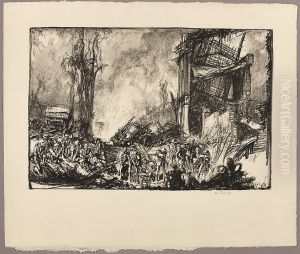
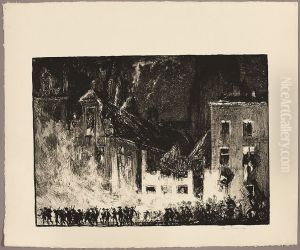
Sir Frank William Brangwyn was a versatile British artist, painter, water colorist, engraver, illustrator, and progressive designer. Born in Bruges, Belgium, on May 12, 1867, to a Welsh father and an English mother, Brangwyn moved to England as a child. He demonstrated his artistic talents early on and was apprenticed to the renowned artist William Morris at the age of 15. Brangwyn learned various crafts under Morris's tutelage but was primarily influenced by his approach to design and decoration.
Brangwyn's career was marked by its diversity; his works included large-scale paintings, murals, prints, and illustrations, as well as designs for furniture, ceramics, and stained glass. One of his most notable achievements was the creation of the murals for the Great Hall of the Rockefeller Center in New York, although these were later destroyed. Another significant project was his series of panels for the House of Lords in London, which was intended to commemorate the First World War; however, they were considered too vibrant and colorful and were ultimately rejected.
Beyond these ventures, Brangwyn was also known for his depictions of industrial landscapes and scenes of daily life, often characterized by a robust use of color and a dynamic composition. His style was eclectic, drawing from Impressionism, Realism, and the Arts and Crafts movement. He was an official war artist during World War I, which influenced some of his later works.
Brangwyn received many honors throughout his career, including a knighthood in 1941. Despite his achievements and the acclaim he garnered during his lifetime, his work fell out of favor following his death on June 11, 1956. In recent years, however, there has been a resurgence of interest in his work, with art historians and collectors recognizing the significance of his contributions to 20th-century art and design.