Hermann Wilhelm Benjamin Eschke (1823-1900) stands as a significant figure in 19th-century German art, renowned both for his evocative landscape and marine paintings and for his influential role as an art educator. Born in Berlin on May 6, 1823, and passing away in the same city on January 15, 1900, Eschke's life and career were intrinsically linked to the artistic developments of his time, particularly the flourishing of landscape painting that sought to capture the unique character of the German terrain and its surrounding seas. His legacy is twofold: a substantial body of work that continues to be appreciated for its atmospheric depth and technical skill, and a generation of artists he mentored, many of whom went on to achieve considerable fame.
Early Life and Artistic Formation
Hermann Eschke's artistic journey began in his native Berlin, a city rapidly growing in cultural and political importance. He enrolled at the prestigious Berlin Academy of Art (Königlich Preußische Akademie der Künste) from 1841 to 1848. During this formative period, he would have been exposed to the prevailing academic traditions, but also to the burgeoning Romantic and Realist movements that were reshaping European art. A key figure at the Berlin Academy during this era was the landscape painter Wilhelm Schirmer, known for his idealized historical landscapes and his emphasis on careful observation of nature. While direct tutelage details can be elusive, the environment Schirmer fostered would have undoubtedly influenced young artists like Eschke.
Following his studies in Berlin, Eschke sought to broaden his artistic horizons by traveling to Paris, where he stayed from 1849 to 1850. This was a pivotal experience, as Paris was then a crucible of artistic innovation. He encountered the works of the Barbizon School painters, such as Jean-Baptiste-Camille Corot, Théodore Rousseau, and Jean-François Millet. These artists championed a move away from idealized studio compositions towards a more direct and truthful depiction of nature, often working en plein air (outdoors) to capture the fleeting effects of light and atmosphere. This exposure to Plenairmalerei and the Barbizon ethos of realistic yet poetic landscape painting left an indelible mark on Eschke's developing style. He also undertook further study trips, including to the Riviera and the Pyrenees, which further enriched his visual vocabulary.
Artistic Style and Thematic Focus
Upon his return to Germany, Eschke established himself as a prominent painter of landscapes and, notably, seascapes. His works primarily depict the natural scenery of Germany, from the rugged coastlines of the Baltic and North Seas, including the island of Rügen with its iconic chalk cliffs, to the serene forests and majestic mountains of the German interior. He also painted scenes from his travels, including Norwegian fjords and Welsh coastal views.
Eschke's style is characterized by a harmonious blend of Romantic sensibility and Realist observation. His paintings often evoke a deep, contemplative atmosphere, achieved through a masterful handling of light and shadow. He was particularly adept at capturing the nuanced effects of light at different times of day and under various weather conditions – the glint of sunlight on water, the soft glow of dusk over a forest, or the dramatic interplay of storm clouds and breaking waves. This sensitivity to atmospheric conditions lent his works a profound emotional resonance, aligning him with the later phases of Romanticism that sought to convey the subjective experience of nature.
While Romantic in feeling, Eschke's work was also grounded in careful naturalistic detail. His depictions of geological formations, foliage, and maritime elements were based on keen observation. This naturalism was likely reinforced by his Parisian experiences and the growing influence of Realism across Europe. He avoided overt sentimentality, instead allowing the inherent beauty and power of the landscape itself to speak to the viewer.
Marine Paintings: A Defining Genre
Hermann Eschke gained particular acclaim for his marine paintings. He possessed a profound understanding of the sea in all its moods, from tranquil calm to tempestuous fury. His seascapes often feature dramatic coastlines, lighthouses standing as solitary sentinels against the elements, and ships navigating challenging waters. These works are not merely topographical records but are imbued with a sense of the sublime, capturing the awe-inspiring and sometimes perilous relationship between humanity and the vastness of the ocean.
His ability to render the transparency and movement of water, the texture of waves, and the subtle gradations of color in the sky and sea set him apart. Works depicting the shores of Rügen, such as "Leuchtturm auf Kap Arkona" (Lighthouse on Cape Arkona) or "Kreidefelsen auf Rügen" (Chalk Cliffs on Rügen), are exemplary of his skill in this genre, showcasing both his technical prowess and his deep connection to these iconic German landscapes. These coastal scenes often carry a patriotic undertone, celebrating the natural beauty of the German nation, a sentiment common in the art of the 19th century.
Notable Works
While a comprehensive catalogue of Eschke's oeuvre is extensive, several works are frequently cited as representative of his style and thematic concerns. Beyond the general themes of German landscapes, specific titles help illuminate his contributions.
His painting "A Market Day in Newlyn" indicates his travels and exhibitions abroad, as it was shown at the Royal Academy in London. Newlyn, in Cornwall, England, was becoming an important artists' colony in the late 19th century, known for its plein air painters focusing on local fishing life. Eschke's interest in such a subject aligns with his broader European artistic awareness.
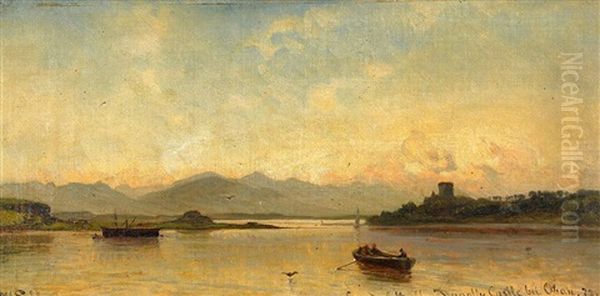
"Dunolly Castle bei Oban" (Dunolly Castle near Oban) points to his travels in Scotland and his interest in picturesque historical sites integrated into dramatic landscapes, a common theme in Romantic painting. The depiction of castles often carried connotations of history, endurance, and the passage of time.
Other significant works often include titles such as:
"Stürmische See bei Rügen" (Stormy Sea near Rügen): Highlighting his mastery of dramatic marine scenes.
"Westküste von Norwegen" (West Coast of Norway): Showcasing his Scandinavian subjects.
"Der Hafen von Swinemünde" (The Port of Swinemünde): Demonstrating his interest in maritime activity and coastal towns.
"Mondschein über der Ostsee" (Moonlight over the Baltic Sea): Indicating his exploration of nocturnal scenes, a popular Romantic motif.
These titles, and the works they represent, underscore Eschke's dedication to capturing the diverse beauty of Northern European landscapes and seascapes, with a particular focus on dramatic light and atmosphere.
The Educator: A Pivotal Role in Berlin
In 1855, Hermann Eschke opened his own studio in Berlin, which soon became a highly respected training ground for aspiring artists. His reputation as both a skilled painter and an effective teacher grew, and he became a central figure in the Berlin art scene. He was appointed a professor at the Berlin Academy of Art in 1881, a testament to his standing in the artistic community.
Eschke's teaching methods likely emphasized the importance of direct observation from nature, a principle he would have absorbed from the Barbizon School and his own practice. He encouraged his students to develop a strong foundation in drawing and to cultivate a sensitivity to light, color, and atmosphere. His success as an educator is evident in the number of his pupils who went on to achieve significant careers. He fostered an environment that, while rooted in academic principles, was open to the evolving trends in landscape and marine painting.
Distinguished Pupils and Their Trajectories
Hermann Eschke's influence extended significantly through his students, many of whom became notable painters in their own right, each developing individual styles yet often reflecting foundational aspects of their master's teachings.
Louis Douzette (1834-1924) is perhaps one of Eschke's most famous pupils. Douzette began his career under Eschke's guidance and later became a professor at the Berlin Academy himself. He became particularly renowned for his atmospheric nocturnal landscapes, especially moonlit scenes, earning him the moniker "Moonlight Douzette." This focus on specific, often melancholic, light effects can be seen as an extension of Eschke's own interest in late Romantic mood painting and atmospheric depth.
Albert Bierstadt (1830-1902), though primarily associated with the American Hudson River School and his grandiose depictions of the American West, also studied with Eschke in Berlin for a period. While Bierstadt's later style evolved significantly, the foundational training in landscape painting and the emphasis on capturing nature's grandeur, which Eschke would have imparted, likely played a role in his artistic development before he went on to study in Düsseldorf with artists like Andreas Achenbach and Karl Friedrich Lessing.
Walter Moras (1856-1925) was another prominent student. Eschke encouraged Moras to travel and engage in plein air painting, advice that profoundly shaped Moras's art. Moras became known for his realistic depictions of the Brandenburg March and forest interiors, often with a focus on winter scenes and subtle light. He also reportedly experimented with incorporating photographic techniques into his painting process, reflecting an engagement with new technologies that was becoming more common among artists of the period.
Ernst Karl Eugen Körner (1846-1927) entered Eschke's studio in 1861 and received a significant portion of his artistic education there, specializing in landscape and architectural views, particularly of Orientalist subjects from his travels in Egypt and the Near East. While his subject matter diverged, the grounding in landscape principles from Eschke would have been crucial.
Alexander Kircher (1867-1939), primarily known as a marine and naval painter, also studied under Eschke at the Berlin Academy. Kircher's dramatic depictions of ships and naval battles share a lineage with Eschke's own mastery of marine subjects, albeit with a different thematic focus.
Poppe Folkerts (1875-1949) began his artistic career under Eschke's guidance before continuing his studies at the Berlin Academy and later in Düsseldorf. He became known for his paintings of the North Sea coast and island life, particularly of Norderney, echoing Eschke's dedication to German coastal scenery.
Walter Leistikow (1865-1908), a key figure in the Berlin Secession movement, studied with Eschke from 1883 to 1885. Although Leistikow later developed a more stylized, Symbolist-influenced approach to landscape, his early training with Eschke would have provided a solid foundation in the observation and depiction of nature. Leistikow, along with Max Liebermann and Lovis Corinth, became a leading force in modernizing German art, moving away from the more traditional approaches.
Other students who benefited from Eschke's tutelage include Carl Saltzmann (1847-1923), who became a noted marine painter and accompanied Prince Heinrich of Prussia on voyages, and Oscar Eschke (1851-1892), his son, who also became a landscape and marine painter. The success of these and other students underscores Eschke's significant impact as an educator.
Exhibitions, Recognition, and Later Career
Throughout his career, Hermann Eschke regularly exhibited his works in Berlin and other German cities, as well as internationally. His participation in exhibitions at the London Royal Academy of Arts, as evidenced by "A Market Day in Newlyn," demonstrates his ambition to reach a wider audience. He received various accolades and honors for his contributions to German art.
His studio in Berlin remained a hub of artistic activity, and he continued to paint and teach into his later years. His dedication to his craft and his students cemented his reputation as a respected elder statesman of the Berlin art world. The fact that he was born and died in Berlin, and spent the majority of his career there, highlights his deep connection to the city and its artistic life.
Eschke's Place in 19th-Century German Art
Hermann Eschke operated within a vibrant and evolving German art scene. The 19th century saw the rise of distinct regional schools, with the Düsseldorf School of painting, known for its detailed and often narrative landscapes (with figures like Andreas Achenbach and Oswald Achenbach), being particularly prominent. While Berlin's art scene was also thriving, it perhaps had a slightly different character, with figures like Adolph Menzel representing a powerful Realist current.
Eschke's work, with its blend of Romantic atmosphere and Realist observation, found a comfortable niche. He was less overtly dramatic or narrative than some Düsseldorf painters, and less focused on urban or historical genre scenes than Menzel. Instead, he carved out a distinct identity as a specialist in German coastal and forest landscapes, imbued with a quiet dignity and profound appreciation for natural beauty. His influence was perhaps most keenly felt through his teaching, shaping a generation of painters who would carry landscape and marine traditions into the early 20th century, even as newer movements like Impressionism and Symbolism began to take hold.
Legacy and Conclusion
Hermann Eschke's legacy is multifaceted. As a painter, he left behind a significant body of work that captures the distinctive character of German and other Northern European landscapes and seascapes. His paintings are valued for their technical skill, their atmospheric depth, and their sincere engagement with the natural world. They represent an important strand of late Romantic and Realist landscape painting in Germany.
As an educator, his impact was arguably even more profound. Through his long tenure as a professor and his private studio, he mentored a remarkable number of artists who went on to achieve their own successes. He instilled in them a respect for nature, a commitment to observational skill, and an understanding of how to convey mood and atmosphere in their work.
While perhaps not as revolutionary as some of his contemporaries who spearheaded avant-garde movements, Hermann Eschke played a crucial role in maintaining and developing the tradition of landscape and marine painting in 19th-century Germany. His dedication to his art, his country's scenery, and his students ensures his enduring place in the annals of German art history. His works continue to be sought after by collectors and are represented in various public and private collections, serving as a testament to his lasting appeal.