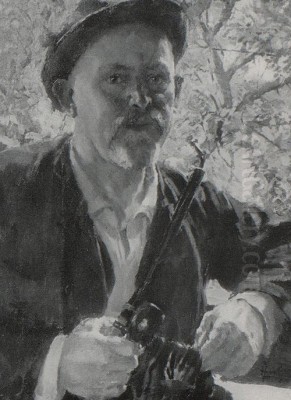
Hermann Groeber (1865-1935) stands as a significant figure in German art at the turn of the 20th century, particularly associated with the vibrant Munich art scene. A respected painter and influential professor, Groeber navigated the currents of late academic realism, Impressionism, and the early stirrings of modernism, leaving a legacy both through his own canvases and the generations of students he mentored. His work, characterized by a robust application of paint, a keen sensitivity to light and color, and a deep connection to the Bavarian landscape, offers a fascinating window into a pivotal era of artistic transition.
Early Life and Artistic Foundations in Munich
Born in Wartenberg, which was then part of the Austrian Empire (now Stráž pod Ralskem in the Czech Republic), on July 17, 1865, Hermann Groeber's artistic destiny would unfold primarily in Munich, the bustling art capital of Germany. He gravitated towards this center of artistic innovation and tradition for his formal training. Groeber enrolled at the prestigious Academy of Fine Arts in Munich (Akademie der Bildenden Künste München), a bastion of academic excellence that had trained many of Germany's leading artists.
At the Academy, Groeber studied under several influential masters who shaped his early development. Among his professors were Nikolaus Gysis (1842-1901), a prominent Greek-German painter of the Munich School known for his historical and genre scenes; Ludwig von Löfftz (1845-1910), celebrated for his meticulous technique and his role as a teacher to many, including Lovis Corinth; and Wilhelm von Diez (1839-1907), who encouraged a painterly approach and an appreciation for the Old Masters, particularly Dutch 17th-century art. This rigorous academic grounding provided Groeber with a strong command of drawing, composition, and traditional painting techniques, which would serve as a solid foundation for his later explorations into more modern idioms.
The Munich art scene in the late 19th century was a dynamic environment. While the Academy upheld traditional values, new artistic currents were emerging. The influence of French Impressionism was beginning to be felt, and artists were increasingly interested in plein air painting and capturing the fleeting effects of light and atmosphere. Figures like Wilhelm Leibl (1844-1900), with his powerful realism and focus on everyday subjects, had already established a strong counterpoint to more idealized academic art, paving the way for a greater naturalism.
The Rise of the Munich Secession and Groeber's Role
As Groeber matured as an artist, he became part of a generation eager to break free from the more conservative constraints of the established art institutions. This desire for artistic renewal culminated in the formation of the Munich Secession in 1892. Hermann Groeber was a founding member of this influential group, which sought to create new exhibition opportunities independent of the official Salon and to promote a broader range of artistic styles, including Impressionism, Symbolism, and Art Nouveau.
The Munich Secession was a pivotal moment in German art history, signaling a shift towards modernism. Groeber found himself in the company of other progressive artists who would become leading names in German art. Key figures involved in or associated with the Secession movement included Franz von Stuck (1863-1928), known for his Symbolist and mythological paintings and later a colleague of Groeber's at the Academy; Wilhelm Trübner (1851-1917), a prominent exponent of German Impressionism; Max Liebermann (1847-1935), Lovis Corinth (1858-1925), and Max Slevogt (1868-1932), who together formed the triumvirate of German Impressionism, though Liebermann and Corinth were more closely associated with the Berlin Secession. Other notable Munich Secessionists included Fritz von Uhde (1848-1911), who blended Impressionistic techniques with religious themes, and Bruno Piglhein (1848-1894). Groeber's involvement underscored his commitment to artistic innovation and his place within the avant-garde of his time.
A Distinguished Academic Career
Alongside his painting career, Hermann Groeber became a highly respected and influential educator. His deep understanding of art, combined with his practical skills, made him a sought-after teacher. In 1907, he was appointed as a lecturer for nude painting at the Munich Academy of Fine Arts, a testament to his mastery of figurative art. His dedication and talent as an educator were further recognized in 1911 when he was promoted to a full professorship at the Academy.
Groeber was described by contemporaries as a "deeply rooted scholar and excellent teacher." He maintained his professorship for many years, shaping the development of numerous young artists. His teaching emphasized a strong foundation in drawing and an understanding of anatomy, crucial for figurative work, but he also encouraged his students to develop their own individual styles. He was known for his ability to impart not just technical skills but also a profound appreciation for the artistic process.
In addition to his role at the Academy, Groeber also ran a private painting school in Munich. This allowed him to work more closely with a select group of students, offering intensive instruction. While many of these private students remained relatively unknown, their identities have sometimes been pieced together from photographs found in Groeber's estate, offering glimpses into this more intimate aspect of his teaching practice. His dual role as an Academy professor and a private tutor extended his influence considerably within the Munich art world.
Artistic Style: Impressionism and the "Chiemsee-Maler"
Hermann Groeber's artistic style is most closely aligned with German Impressionism. He was particularly renowned for his landscapes and, to a lesser extent, his portraits and genre scenes. A hallmark of his work is its vibrant color palette and his ability to capture the interplay of light and shadow with expressive, often broad, brushstrokes. He possessed a remarkable sensitivity to the nuances of the natural world, and his landscapes often convey a strong sense of atmosphere and place.
Groeber was a prominent member of the "Chiemsee-Maler" (Chiemsee Painters), a loose group of artists who were drawn to the picturesque scenery of Lake Chiemsee and its surrounding Bavarian countryside. This region, with its expansive waters, rolling hills, and charming villages, provided endless inspiration for plein air painting. Like the French Impressionists at Barbizon or Giverny, the Chiemsee painters sought to capture the immediate sensory experience of nature. Groeber's Chiemsee landscapes are characterized by their fresh, spontaneous quality and their rich, harmonious colors. Other artists associated with painting in this region, though not all strictly "Chiemsee-Maler" in the same vein or period, included Josef Wopfner (1843-1927), who was an earlier key figure in depicting the Chiemsee area.
While Impressionism formed the core of his style, some of Groeber's earlier works also show an awareness of, or perhaps contributed to, the currents that would lead to German Expressionism. This can be seen in the boldness of his color choices and the expressive energy of his brushwork, though he never fully embraced the more radical distortions and emotional intensity of the Expressionists like Ernst Ludwig Kirchner or Emil Nolde. His art remained rooted in a more naturalistic observation, albeit one filtered through an Impressionistic sensibility.
Representative Works and Thematic Focus
Several works stand out in Hermann Groeber's oeuvre, showcasing his artistic strengths. One of his most recognized paintings is Ruderer (The Rower), completed in 1911. This oil on canvas, measuring 139 x 166 cm and housed in the Neue Pinakothek in Munich, depicts a muscular figure rowing, a dynamic composition that highlights Groeber's skill in rendering the human form in action and his ability to capture the play of light on water and skin. The painting combines academic solidity in the figure with an Impressionistic treatment of the surrounding environment.
Another important insight into his working process and artistic interests is provided by his Kleines Skizzenbuch (Small Sketchbook) from 1895. This sketchbook contains approximately 80 pencil drawings, many of them dated and signed. Such sketchbooks are invaluable for understanding an artist's observational skills, their compositional thinking, and the subjects that caught their eye. For Groeber, these sketches likely served as preparatory studies for larger paintings or as exercises in capturing fleeting moments and details from life.
His landscapes, particularly those of the Bavarian Alps and the Chiemsee region, form a significant part of his output. These works are celebrated for their atmospheric depth, their nuanced depiction of changing weather conditions, and their vibrant, yet harmonious, color schemes. He excelled at portraying the textures of nature – the roughness of rock, the foliage of trees, the reflective surface of water – all rendered with a confident and painterly touch.
Students and Enduring Legacy
As an influential professor at the Munich Academy and through his private school, Hermann Groeber mentored a considerable number of artists. His impact as a teacher was profound, and several of his students went on to achieve recognition in their own right.
Among his notable students was Hermann Otto Hoyer (1893-1968). Hoyer, who later became known for his war paintings and work during the Nazi era, studied under Groeber. Interestingly, Hoyer also studied with Franz von Stuck and Carl von Marr (1858-1936), another prominent Munich academic painter and a contemporary of Groeber, who also taught at the Academy. This connection highlights the interconnectedness of the Munich art scene, where students often learned from multiple masters. The provided information suggests Hoyer studied at a "Monaco Art Academy" between 1919 and 1925 where Groeber taught; this might refer to a specific period of Groeber's teaching activity or a particular institution, though his primary base was Munich.
Thomas Baumgartner (1892-1962) was another artist who benefited from Groeber's tutelage. Baumgartner became known for his landscapes and still lifes, and his work often reflects the Impressionistic influences he would have absorbed from Groeber. Karl Häuser (1903-1993) is also mentioned as being influenced by Groeber, indicating that Groeber's teaching legacy extended to artists who came to prominence later in the 20th century.
Groeber's legacy lies not only in his own artistic output but also in his contribution to art education in Munich. He helped to bridge the gap between 19th-century academic traditions and the emerging modern art movements, fostering a generation of artists equipped with strong technical skills yet open to new forms of expression.
The "Hermann Graebe" Confusion: A Point of Clarification
It is important to address a potential point of confusion that arises from the similarity of names. The provided information alludes to a "Hermann Graebe" who was involved in controversy as a perjurer and was condemned in Germany. This individual is distinct from Hermann Groeber, the artist. Such coincidences in names can sometimes lead to misattributions or misunderstandings, but the historical record for Hermann Groeber, the painter and professor, focuses on his artistic and academic achievements. There is no indication that Hermann Groeber, the artist, was involved in the controversies associated with Hermann Graebe.
Market Reception and Historical Evaluation
Hermann Groeber's works have maintained a steady presence in the art market, and he is recognized as an important representative of German Impressionism. His paintings appear in auctions, often fetching respectable prices that reflect his skill and historical significance. For instance, a work by Groeber reportedly sold for €34,290 in a 2019 auction, significantly exceeding its pre-sale estimate, indicating a strong collector interest. Auction catalogs, such as those from Neumeister, have featured his works among important Impressionist and modern art pieces.
Historically, Groeber is valued for his role within the Munich School and the Munich Secession. His contributions as a landscape painter, particularly his association with the Chiemsee-Maler, are well-regarded. He is seen as an artist who successfully synthesized academic training with Impressionistic sensibilities, creating a body of work that is both technically accomplished and aesthetically pleasing. His long tenure as a professor at the Munich Academy further solidifies his importance, as he directly influenced the course of art in one of Germany's leading artistic centers. While perhaps not as internationally famous as the leading French Impressionists or the most radical German Expressionists, Hermann Groeber holds a secure and respected place in the narrative of German art. His dedication to both his own art and the education of others ensured that his influence would be felt long after his death in Gstadt am Chiemsee on June 24, 1935.
Conclusion: A Harmonizer of Tradition and Modernity
Hermann Groeber's career spanned a period of profound change in the art world. He began his training when academic realism held sway, witnessed the rise of Impressionism and Art Nouveau, and saw the explosive emergence of Expressionism and other avant-garde movements. Throughout these transformations, Groeber carved out a distinct artistic identity, rooted in the traditions of the Munich School yet open to the innovations of Impressionism.
As a founding member of the Munich Secession, he championed artistic freedom and new modes of expression. As a professor at the Munich Academy, he instilled in his students a respect for craftsmanship and a keen observational skill, while encouraging their individual artistic journeys. His paintings, particularly his luminous landscapes of the Bavarian countryside and Lake Chiemsee, continue to be admired for their vibrant color, confident brushwork, and evocative atmosphere. Hermann Groeber remains a key figure for understanding the evolution of German art from the late 19th to the early 20th century, a dedicated artist and teacher who successfully harmonized the enduring values of tradition with the invigorating spirit of modernity.