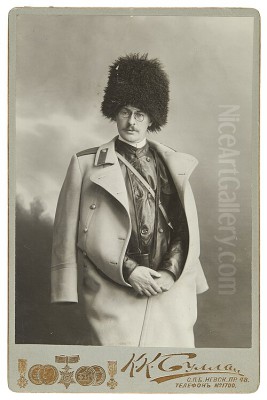
Hugo Backmansson stands as a distinctive figure in the annals of Finnish art, a man whose life and career were uniquely bifurcated between the disciplined world of military service and the expressive realm of painting. Born in an era of burgeoning national identity and artistic exploration in Finland, Backmansson carved a niche for himself not only as a skilled portraitist and chronicler of military life but also as a pioneer, being the first Finn to receive formal training in the demanding genre of battle painting. His journey took him from the cadet schools of Finland to the prestigious art academies of Russia and the vibrant artistic hubs of Paris and Munich, equipping him with a diverse skill set that he applied with diligence throughout his long career. His legacy is preserved in his canvases, which offer insights into the societal echelons of his time, the stark realities of conflict, and the exotic allure of distant lands.
Early Life and Formative Influences
Hugo Vilhelm Backmansson was born on April 5th or, according to some records, April 17th, 1860, in Paimio, Finland, which was then an autonomous Grand Duchy within the Russian Empire. He was the fifth child of Karl Backman, a tax official, and Sofia Backman. This familial background, while not directly artistic, likely provided a stable environment that allowed for the pursuit of diverse interests. Finland during Backmansson's youth was experiencing a cultural awakening, with artists and intellectuals striving to define a unique Finnish identity, often looking to folklore, nature, and historical narratives for inspiration. This cultural ferment would undoubtedly have formed part of the backdrop to his early development.
His formal education took a path that would define his dual career. He attended the Hamina Cadet School (Haminan kadettikoulu), a significant military institution in Finland. It was here that his artistic inclinations began to merge with his military training. The discipline and observational skills honed in a military context would later prove beneficial in his artistic endeavors, particularly in his detailed renderings of figures and scenes. Even during his military education, the call of art was strong.
The Dual Path: Military Officer and Aspiring Artist
Upon graduating from the Hamina Cadet School in 1899, an event marked by the completion of an artwork titled "A Guide," Backmansson embarked on a career as an officer in the Izmailovsky Regiment, one of the oldest and most distinguished regiments of the Imperial Russian Guard. However, his passion for art led him to simultaneously pursue formal artistic training. He enrolled in the Imperial Academy of Arts in St. Petersburg, a preeminent institution that had nurtured many of Russia's finest artists.
At the Academy, Backmansson studied under notable figures such as Pavel Petrovich Chistyakov (P. Chistakov) and Pavel Osipovich Kovalevsky (P. Kovalevsky). Chistyakov was a highly influential teacher, known for his rigorous pedagogical methods emphasizing drawing, anatomy, and perspective. His students included luminaries of Russian art like Ilya Repin, Valentin Serov, Vasily Surikov, and Mikhail Vrubel. Learning under Chistyakov would have provided Backmansson with a strong academic foundation. Kovalevsky, on the other hand, was a renowned battle painter, and his tutelage was crucial in shaping Backmansson's specialization in this genre. This direct mentorship in battle painting was a pioneering step for a Finnish artist.
His artistic education was not confined to Russia. Backmansson sought to broaden his horizons by undertaking further studies in Paris and Munich, the two major art capitals of Europe at the time. In Paris, he would have been exposed to the lingering influence of Academic art, championed by artists like Jean-Léon Gérôme (also known for his Orientalist and historical scenes) and William-Adolphe Bouguereau, as well as the revolutionary currents of Impressionism and Post-Impressionism, with artists like Claude Monet, Edgar Degas, and Paul Cézanne reshaping the artistic landscape. Munich, with its own strong academic tradition and burgeoning Secession movements, would have offered further perspectives. These European sojourns enriched his palette and technique, allowing him to absorb diverse influences while refining his own style.
The Artist in Uniform: Chronicling Conflict
Hugo Backmansson holds the distinction of being the first Finnish artist to receive specialized training in battle painting. This genre, requiring not only artistic skill but also a keen understanding of military tactics, equipment, and the human drama of conflict, found a dedicated practitioner in him. His military background provided him with an insider's perspective, lending authenticity to his depictions.
His first documented experience in applying these skills came during the Russo-Japanese War (1904-1905). In 1904, he was on the Korean front, where he made his initial attempts at capturing the raw immediacy of warfare on canvas. This experience was formative, providing him with firsthand material and the challenges of working under duress. Following this, from late 1905 to early 1906, Backmansson participated in an exhibition in Turku, Finland, showcasing works derived from his experiences in the Russo-Japanese War.
During World War I, Backmansson was actively involved as a military painter. He served as an aide-de-camp to a brigadier general, a position that would have given him access to various fronts and strategic operations. His role was to document the war, creating a visual record of events, personnel, and the atmosphere of the conflict. While specific titles of works from this exact period are not always exhaustively listed in general summaries, his commitment to this role was unwavering. After the war and Finland's declaration of independence in 1917, Backmansson joined the nascent Finnish army, continuing his dual role as an officer and an artist. One notable work from this later period reflecting his military themes is "Jääkäriveriluutnantti Rainer Mandelin" (1925), depicting a scene related to the Finnish Jäger Movement, which played a crucial role in Finland's fight for independence. His work in this area can be seen in the tradition of other great battle painters, such as the aforementioned Pavel Kovalevsky in Russia or earlier masters like Horace Vernet in France.
Orientalism and Travels: Expanding Artistic Vistas
Like many European artists of the 19th and early 20th centuries, Hugo Backmansson was drawn to the perceived exoticism and vibrant cultures of North Africa. This fascination gave rise to a significant body of work in the Orientalist style. His travels to the region provided him with a wealth of new subjects, from bustling marketplaces and serene desert landscapes to portraits of local inhabitants. These works were characterized by a keen observation of detail, a rich color palette, and an attempt to capture the unique light and atmosphere of these lands.
His Orientalist paintings found appreciation, and many were exhibited and collected in Paris and other European art centers. This genre allowed him to explore different compositional challenges and color harmonies compared to his military scenes or formal portraits. His engagement with Orientalism places him in the company of artists like Jean-Léon Gérôme, Eugène Delacroix, and the Finnish artist Akseli Gallen-Kallela, who also undertook journeys that influenced his art, albeit often with a focus on more symbolic or ethnographic interpretations. Backmansson's approach seems to have been more aligned with the descriptive realism often found in academic Orientalism.
His travels were not limited to North Africa. He is also known to have journeyed with the Finnish sociologist, philosopher, and photographer Edvard Westermarck, particularly on expeditions to Spain. Westermarck was a pioneering anthropologist, and their travels together suggest a shared interest in observing and documenting different cultures, albeit through their respective mediums of social science and visual art. These experiences further broadened Backmansson's worldview and provided fresh inspiration for his artistic output.
Master of Portraiture: Capturing Individuals and Groups
While his battle paintings and Orientalist scenes formed important parts of his oeuvre, Hugo Backmansson was also a highly accomplished portraitist. He possessed a talent for capturing not only the likeness of his sitters but also their character and social standing. His portraits ranged from individual commissions to complex group compositions.
He was sought after to paint significant figures in Finnish society. Among his notable individual portraits are those of Edwin Linkomies, a classical philologist who later became Prime Minister of Finland, and Kaarlo Juho Ståhlberg or Juho Kusti Paasikivi (the provided text mentions "Kaarlo Paasikivi" as Prime Minister and President, likely referring to J.K. Paasikivi, and "Kaarlo Weihenstochk" which might be a misspelling or a less universally known figure, or perhaps "Edvard Linkomaa" is a variant of Edwin Linkomies). He also painted Torsten Kari, a linguist. These commissions underscore his standing within the Finnish establishment and his ability to create dignified and insightful representations of prominent personalities. His style in these portraits often leaned towards a traditional, realistic approach, focusing on clear delineation of features and a sober palette, befitting the status of his subjects. This approach was common among established portraitists of the era, such as his Finnish contemporary Albert Edelfelt, known for his elegant portraits, or international figures like John Singer Sargent.
One of his most celebrated works is the group portrait "The Twelve Ophthalmologists" (Finnish: "12 silmää" or "Kaksitoista silmälääkäriä"), completed in 1923. This painting depicts the founding members of the Finnish Ophthalmological Society gathered around a green table, seemingly in discussion or contemplation. The work is remarkable for its skillful handling of a complex multi-figure composition. Each of the twelve individuals is rendered with distinct personality, yet they form a cohesive group, their interaction subtly suggested. The painting was commissioned to commemorate the 50th anniversary of the Helsinki University Eye Clinic and has remained a significant piece in its collection, currently housed at the Helsinki University Hospital's emergency eye clinic. This work demonstrates Backmansson's ability to manage the dynamics of group portraiture, a challenging subgenre mastered by artists like Rembrandt van Rijn with "The Night Watch" or, closer to his time, by artists depicting corporate or academic groups.
His proficiency in group portraiture also led to him being chosen to paint the leadership team of the University of Helsinki, further cementing his reputation as a chronicler of Finnish institutional life. These group portraits served not only as artistic endeavors but also as historical documents, preserving the likenesses of key figures for posterity.
Backmansson in the Context of Finnish and European Art
Hugo Backmansson's career spanned a period of significant artistic transformation in Finland and across Europe. When he began his studies, the dominant forces were still largely academic realism and national romanticism. In Finland, artists like Albert Edelfelt were achieving international recognition with a style that blended realism with impressionistic touches and often depicted Finnish life and landscapes. Akseli Gallen-Kallela was a leading figure of National Romanticism, drawing heavily on the Finnish national epic, the Kalevala. Eero Järnefelt was another prominent realist, known for his portraits and depictions of Finnish nature, while Pekka Halonen captured the essence of the Finnish landscape with a lyrical sensitivity.
Backmansson, with his academic training in St. Petersburg and his exposure to Parisian and Munich art scenes, navigated these currents. His work, particularly his portraiture and battle scenes, largely adhered to a realistic tradition, emphasizing accurate representation and skilled draughtsmanship. This was in line with the training he received from Chistyakov and Kovalevsky. While he may not have embraced the more radical avant-garde movements like Cubism or Fauvism that emerged during his mature career, his work remained relevant and respected.
His connection to the Strindberg Art Salon in Helsinki, where he participated in private exhibitions, indicates his engagement with the contemporary art scene in Finland. This salon was an important venue for artists to showcase their work and for art patrons to discover new talents.
Internationally, his battle painting aligned with a long tradition, and his Orientalist works were part of a broader European fascination with non-Western cultures. While perhaps not as stylistically innovative as some of his contemporaries like Helene Schjerfbeck, who evolved a highly personal and modernist style, Backmansson's contribution lay in his solid craftsmanship, his unique specialization in battle painting for a Finnish artist, and his role as a portrayer of significant individuals and institutions. His work provides a valuable visual record of his time, reflecting both Finnish society and broader European artistic trends.
Later Life and Enduring Legacy
Hugo Backmansson continued to be an active artist throughout much of his life. His dual identity as a military officer and a painter remained a defining characteristic. He passed away on November 19, 1953, in Helsinki, leaving behind a substantial body of work.
His legacy is multifaceted. As a military officer, he served his country through several periods of conflict and transition. As an artist, he contributed significantly to Finnish portraiture and was a pioneer in battle painting within the Finnish context. His works are held in various collections, including the Helsinki University Hospital and likely other national and private collections in Finland and abroad.
"The Twelve Ophthalmologists" remains a key example of his skill in group portraiture and a testament to a specific moment in Finnish medical history. His portraits of national figures preserve the likenesses of individuals who shaped Finland's development. His battle paintings offer a Finnish perspective on conflicts that were pivotal in the nation's journey to independence and its early years. The Orientalist works reflect a broader European cultural current and showcase his versatility.
Hugo Backmansson's life and art offer a fascinating study of an individual who successfully navigated two demanding professions. He bridged the worlds of military discipline and artistic expression, creating a legacy that speaks to his dedication, skill, and unique position in Finnish art history. His paintings continue to be valued for their historical insights, their technical proficiency, and their honest depiction of the people and events that shaped his era. He stands as a testament to the enduring power of art to document, interpret, and commemorate the human experience, whether on the battlefield, in the halls of academia, or in distant, sun-drenched lands.