Isaac Sailmaker, a name perhaps not as universally recognized as some of his contemporaries, holds a pivotal position in the annals of British art history. Born in the Dutch Republic in 1633, a period when Dutch maritime power and art were at their zenith, Sailmaker would later cross the North Sea to England, where he is widely acclaimed as the "Father of English Marine Painting." His long life, spanning until 1721, allowed him to witness and contribute to the nascent stages of a genre that would come to define a significant aspect of British artistic identity. This exploration delves into the life, work, and enduring legacy of Isaac Sailmaker, examining his artistic style, his significant commissions, the context of his era, and his interactions with and influence upon the artistic landscape of his time.
Early Life and Dutch Artistic Currents
Isaac Sailmaker, originally Scheepmaker, was born into a world where the sea was not just a geographical feature but the very lifeblood of the nation. The Dutch Golden Age of painting was in full swing, and marine art was a particularly vibrant and popular genre. Artists like Hendrick Cornelisz Vroom, often considered one of the founders of Dutch marine art, had already established a tradition of depicting seascapes, naval battles, and ship portraits with remarkable skill. Following Vroom, painters such as Jan Porcellis and Simon de Vlieger pushed the boundaries of atmospheric realism, capturing the subtle nuances of light, water, and sky.
While specific details of Sailmaker's early training in the Netherlands remain somewhat obscure, it is inconceivable that he would not have been immersed in this rich artistic environment. The meticulous rendering of ships, the dynamic portrayal of water, and the dramatic interplay of elements that characterized Dutch marine painting would have formed the bedrock of his artistic understanding. Artists like Jan van de Cappelle, known for his serene and luminous estuary scenes, and Ludolf Bakhuysen, famed for his dramatic portrayals of rough seas and stormy skies, were either established or rising figures during Sailmaker's formative years. This milieu undoubtedly shaped his approach to composition, detail, and the thematic concerns of maritime art. His decision to later emigrate to England suggests an ambition to find new patrons and perhaps a less crowded artistic field in his chosen specialization.
Arrival in England and Cromwellian Patronage
The exact date of Sailmaker's arrival in England is not definitively recorded, but it is known that he was active there during the Commonwealth period. This was a tumultuous time in British history, following the English Civil War and the execution of King Charles I. Oliver Cromwell, as Lord Protector, recognized the importance of naval power, and it is documented that Sailmaker received commissions from him. One notable instance was his engagement to paint a view of the fleet before Mardyck, near Dunkirk, a strategic port captured by Anglo-French forces.
This patronage from Cromwell is significant. It indicates that Sailmaker had, relatively early in his English career, gained access to the highest echelons of power. His Dutch background, with its strong tradition of marine painting, would have made him a valuable asset in a country that was increasingly asserting its own maritime strength but lacked a comparable indigenous school of marine artists. At this point, English painting was still heavily reliant on foreign talent, particularly from the Low Countries. Artists like Sir Anthony van Dyck had dominated portraiture in the preceding decades, but specialized marine painting was less developed. Sailmaker, therefore, found a niche where his skills were in demand. His works from this period likely served not only as artistic representations but also as visual records of naval power and state events.
The Restoration and the Rise of Marine Art in England
With the Restoration of the monarchy in 1660, King Charles II brought with him a taste for the arts, heavily influenced by his time in exile on the continent, particularly in the Netherlands and France. This period saw a renewed flourishing of artistic patronage. For marine art, this was a particularly auspicious time. Charles II was an enthusiastic sailor and understood the symbolic power of a strong navy. He actively encouraged marine painting, and this era saw the arrival of other prominent Dutch marine artists in England.
Most notably, Willem van de Velde the Elder and his son, Willem van de Velde the Younger, were invited to England by Charles II around 1672-73. They were granted a royal pension and a studio in the Queen's House at Greenwich. The Van de Veldes were masters of the genre, the Elder renowned for his detailed "pen paintings" (grisailles) of naval battles, often sketched from life, and the Younger for his sublime oil paintings that combined accuracy with profound artistry. Their arrival undoubtedly raised the standard and profile of marine painting in England, but it also presented formidable competition for artists like Sailmaker. While the Van de Veldes enjoyed premier royal patronage, Sailmaker continued to work, carving out his own space within the burgeoning field. His style, though perhaps perceived by some as less polished or sophisticated than that of the Van de Veldes, possessed a distinct character that appealed to a range of patrons.
Sailmaker's Artistic Style and Technique
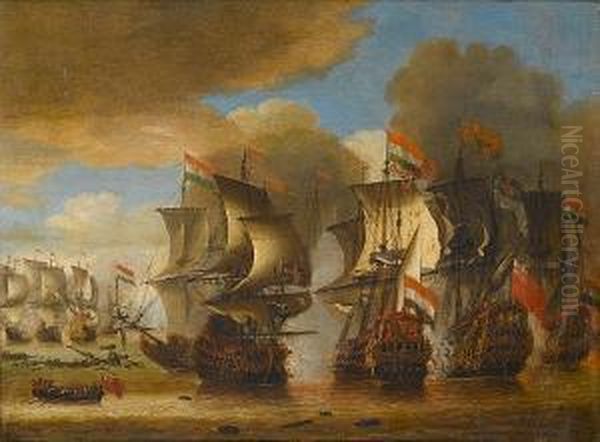
Isaac Sailmaker's artistic style is characteristic of the early Baroque period in marine painting, often described as having a "pageant" quality. This implies a focus on the grandeur and formal presentation of ships, often depicted in relatively calm waters, allowing for detailed renderings of their hulls, rigging, and ornamentation. His works are less about the turbulent drama of the sea, as seen in later Romantic painters like J.M.W. Turner (who was, incidentally, greatly influenced by Willem van de Velde the Younger), and more about the accurate and impressive portrayal of specific vessels or maritime scenes.
A distinctive feature sometimes noted in Sailmaker's technique, particularly in his depiction of gilded details on ships, was his use of raised, almost globular applications of gold paint. This differed from the flatter application of metallic paint often employed by his contemporaries and gave a particular texture and prominence to these decorative elements. His drawing of ships, while perhaps not possessing the almost photographic precision of the younger Van de Velde, was nonetheless careful and informative, providing valuable visual records of the naval architecture of the period. He often depicted ships in profile or three-quarter view, emphasizing their scale and structure. The overall effect is one of clarity and a certain charming directness, sometimes described as slightly archaic or primitive compared to the sophisticated realism of the leading Dutch masters, but this very quality lends his work a unique historical appeal. His palette was generally robust, with clear delineations and a good sense of light, though perhaps without the subtle atmospheric effects achieved by artists like Jan van de Cappelle or Simon de Vlieger.
Representative Works: Documenting Naval Power and Landmarks
Several key works are associated with Isaac Sailmaker, illustrating his thematic concerns and artistic contributions. Among his most famous, though perhaps anachronistically titled in some later attributions, are depictions related to the Henri Grâce à Dieu, or Great Harry. This was King Henry VIII's flagship, a vessel of immense historical importance. While the original ship was long gone by Sailmaker's time, paintings of it, likely based on earlier prints or descriptions, served as powerful symbols of England's long-standing naval heritage. Sailmaker's versions capture the imposing, castle-like structure of this early Tudor warship.
Another significant subject for Sailmaker was the Eddystone Lighthouse. He is known to have painted several views of this vital navigational aid off the coast of Plymouth. The original Eddystone Lighthouse, designed by Henry Winstanley (who was also an artist and engraver), was a marvel of engineering for its time, completed in 1698 but destroyed in the Great Storm of 1703. Sailmaker's depictions of the lighthouse, such as "A View of the First Eddystone Lighthouse," are invaluable historical documents, offering some of the few contemporary visual records of Winstanley's innovative structure. These paintings highlight Sailmaker's role not just as a ship painter but also as a chronicler of important maritime infrastructure.
He also produced numerous paintings simply titled "An English Man-of-War," such as one dated 1707. These ship portraits, often commissioned by captains or owners, showcased the specific details of individual vessels, their flags, and their armaments. These works underscore his consistent engagement with the Royal Navy and the merchant marine, providing a visual catalogue of British sea power during a period of its significant expansion. Other works attributed to him include general sea pieces, depictions of royal yachts, and coastal views, all contributing to the visual culture of a nation increasingly defined by its relationship with the sea.
Challenges in Attribution and Artistic Identity
One of the challenges in studying Isaac Sailmaker's oeuvre is the issue of attribution. Like many artists of his time, he did not consistently sign his works. This has led to scholarly debate and occasional misattributions over the centuries. The identification of his hand often relies on stylistic analysis, comparison with known works, and occasionally, documentary evidence. For instance, an engraving by Henry Winstanley of his own Eddystone Lighthouse is noted as being after a painting by "Isaac Sailmaker Denizen," providing a firm link for that subject.
The presence of the highly esteemed Van de Veldes in England from the 1670s onwards undoubtedly presented a competitive challenge. Their royal appointments and sophisticated style might have overshadowed artists like Sailmaker in certain circles. However, Sailmaker's career was remarkably long, and he continued to produce work well into the early 18th century, suggesting a sustained demand for his particular skills. His longevity meant he outlived many of his contemporaries, including both Willem van de Velde the Elder and Younger. This persistence speaks to his resilience and the enduring appeal of his art, perhaps to a broader clientele that included naval officers, ship owners, and merchants who appreciated his direct and informative style. His Dutch origins, combined with his long English career, place him in a unique position as a transitional figure, bridging the dominant Dutch tradition and the emerging English school of marine painting.
Contemporaries and the Wider Artistic Milieu
Beyond the towering figures of the Van de Veldes, Sailmaker operated within a broader artistic context that included other marine painters and artists whose work touched upon maritime themes. In the Netherlands, artists like Abraham Storck continued the tradition of detailed ship paintings and views of bustling harbors, and his work was also known in England. Jeronymus van Diest was another Dutch marine painter who worked in England. Later, in the early 18th century, English-born artists began to make their mark.
Peter Monamy, born in London around 1681, is often considered one of the first native-born English marine painters of significance. He was clearly influenced by the Dutch tradition, particularly the Van de Veldes, but also developed his own style. Monamy would have been a younger contemporary of Sailmaker, and it's plausible that Sailmaker's long presence helped create a receptive environment for marine art that benefited the next generation. Samuel Scott, another important English marine painter, began his career somewhat later, flourishing from the 1720s onwards. Scott, known for his views of the Thames and naval actions, further developed the English school, moving towards a more topographical and sometimes more dramatic style. Charles Brooking, a brilliant but short-lived talent, emerged in the mid-18th century, producing works of exquisite delicacy and atmospheric effect, again building on the foundations laid by earlier artists. The influence of Dutch painters like Ludolf Bakhuysen, with his dramatic seas, also persisted in the collective artistic consciousness. Even portraitists like Sir Godfrey Kneller, the leading painter in England during the latter part of Sailmaker's life, operated in a courtly environment that valued representations of national strength, including naval prowess.
Later Career and Enduring Legacy
Isaac Sailmaker continued to paint into his old age, reportedly active even in his eighties. He died in London on June 28, 1721, and was buried at St George the Martyr, Southwark. His death occurred just as a new generation of English marine painters was beginning to emerge. While he may not have achieved the same level of fame or artistic refinement as the Van de Veldes, his contribution was crucial. He was one of the very first specialist marine painters to establish a long-term career in England, effectively laying the groundwork for the genre's future development.
His designation as the "Father of English Marine Painting" is a testament to this pioneering role. He helped to popularize marine subjects among English patrons and demonstrated that there was a viable market for such art. His paintings, with their careful attention to nautical detail, serve as important historical documents, offering insights into the ships, naval practices, and maritime landmarks of his time. They capture a sense of the pride and importance attached to seafaring in late 17th and early 18th century Britain. While later artists would bring new levels of sophistication, drama, and atmospheric subtlety to marine painting, Sailmaker's straightforward, diligent, and often charming depictions provided an essential starting point. His works are found in major collections, including the National Maritime Museum in Greenwich, a fitting repository for the art of a man who dedicated his life to chronicling the maritime world.
Conclusion: A Foundational Figure
Isaac Sailmaker stands as a significant, if sometimes underappreciated, figure in the history of British art. His journey from the art-rich environment of the Dutch Republic to the burgeoning maritime nation of England positioned him to play a foundational role in the development of English marine painting. For over half a century, he documented England's ships, its naval endeavors, and its coastal features, from the era of Cromwell through to the early Hanoverian period. His style, rooted in Dutch traditions but adapted to English tastes and requirements, provided a vital link and a starting point for a genre that would later produce some of Britain's most celebrated artists.
While he faced competition from illustrious contemporaries like the Van de Veldes, Sailmaker's persistence, longevity, and the distinct appeal of his work ensured his continued relevance. His paintings of iconic vessels like the Great Harry and structures like the Eddystone Lighthouse are more than just artistic endeavors; they are valuable historical records. As the "Father of English Marine Painting," Isaac Sailmaker's legacy is not merely in the canvases he left behind, but in the tradition he helped to establish, a tradition that would continue to evolve and flourish, reflecting Britain's enduring connection to the sea. His work invites us to look closer at the early stages of this genre, appreciating the dedication and skill of an artist who truly anchored marine painting in the English artistic consciousness.