Jacob de Roore: A Flemish Master of Decorative and Historical Painting
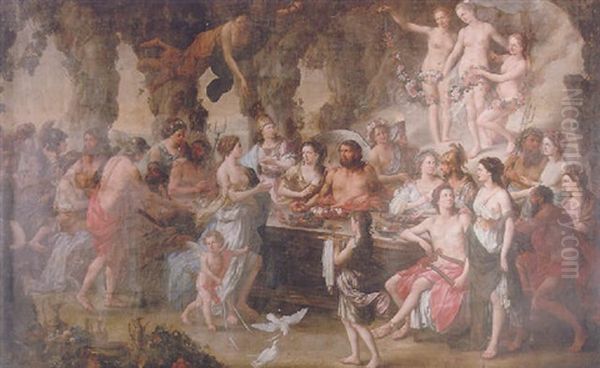
The annals of art history are filled with figures whose contributions, while significant in their time, may fade from broader public consciousness only to be rediscovered and re-evaluated by later generations. Jacob de Roore, also known by the Gallicized form Jacques Ignatius de Roore, stands as one such artist. A Flemish painter active primarily during the late Baroque and early Rococo periods, with tendencies that foreshadowed Neoclassicism, De Roore carved a niche for himself, particularly in the realm of decorative and historical painting, leaving an indelible mark on the artistic landscape of both the Southern Netherlands and the Dutch Republic.
It is important at the outset to clarify potential confusions surrounding the name "Jacob de Roore." The information provided references at least two distinct individuals. The primary subject of this article is the painter Jacob de Roore (1686–1747). However, mention was made of a Jacob De Roore from Kortrijk, described as a teacher and municipal official, known for his piety and eloquence. Furthermore, a Jacob de Roore was noted as a religious martyr, executed in Bruges during the religious upheavals of the 1560s. While these individuals share a name, their lives and historical contexts are vastly different. This article will focus exclusively on Jacob de Roore, the artist whose life spanned from 1686 to 1747.
Early Life and Artistic Formation in Antwerp
Jacob de Roore was born in Antwerp in 1686, a city that, even in the late 17th century, still basked in the afterglow of its Golden Age, largely defined by the monumental legacy of Peter Paul Rubens, Anthony van Dyck, and Jacob Jordaens. Growing up in such an environment, rich with artistic stimuli and a strong tradition of painterly excellence, would undoubtedly have shaped young De Roore's aspirations and early artistic sensibilities. Antwerp was a hub of artistic guilds and workshops, and it is highly probable that De Roore received his initial training within this structured system, apprenticing under a recognized master.
While specific details of his tutelage are not extensively documented in the provided information, the quality and nature of his later work suggest a thorough grounding in the fundamentals of drawing, composition, and color theory, characteristic of the Antwerp school. This tradition emphasized dynamic compositions, rich palettes, and often, grand historical or mythological narratives, all of which would become hallmarks of De Roore's own oeuvre. The influence of the towering figures of Flemish Baroque, particularly Rubens, with his dramatic flair and mastery of the human form, can be discerned as an undercurrent in De Roore's approach to historical and allegorical subjects.
A Career Unfolding: Antwerp and the Dutch Republic
Jacob de Roore's career was not confined to his native Antwerp. He also spent significant periods working in the Dutch Republic, particularly in prominent cities such as Amsterdam and The Hague. This movement between the Southern Netherlands (Flanders) and the Northern Netherlands (the Dutch Republic) was not uncommon for artists of the period, seeking patronage and new opportunities. The Dutch Republic, despite its own distinct artistic traditions, often welcomed Flemish artists, whose style could bring a different flavor to decorative projects.
In the Dutch Republic, De Roore became known for his large-scale decorative paintings, often designed as integral parts of interior architectural schemes. These could include ceiling paintings, wall panels, and overdoor pieces, transforming private residences and public buildings into immersive visual experiences. His work in this domain often featured complex allegorical, mythological, or biblical scenes, executed with a finesse that appealed to the sophisticated tastes of his patrons. The demand for such decorative programs was a feature of the era, as wealthy merchants and civic institutions sought to display their status and cultural refinement through art.
One of the notable aspects of De Roore's career was his involvement in creating decorative schemes for significant public venues. His work often required him to adapt his style to the specific requirements of the space and the thematic program desired by the commissioners. This versatility was a key to his success as a decorative painter.
Major Works and Thematic Concerns
Jacob de Roore's body of work, though perhaps not as widely known today as some of his contemporaries, includes several significant pieces that highlight his skill and artistic vision. His subjects were often drawn from classical mythology, biblical narratives, and allegorical concepts, reflecting the prevailing tastes of the 18th century.
A prominent commission mentioned was a series of decorative paintings centered on the story of Pandora, created in the 1740s for the "Nieuwen Schouwburg" (New Theatre) in Amsterdam. The Pandora myth, with its themes of curiosity, consequence, and the human condition, offered rich visual possibilities that De Roore would have exploited to create compelling narrative scenes. Such public commissions were prestigious and allowed artists to showcase their talents on a grand scale. The collaboration with Jan van Gool, who is noted to have made watercolor copies of De Roore's designs for these theatre decorations, underscores the multi-stage process often involved in such large projects, from initial design to final execution and subsequent documentation.
Among his easel paintings, "Pallas Athene in het atelier van Prometheus" (Pallas Athene in the Workshop of Prometheus) is a noteworthy example, currently housed in the Rijksmuseum, Amsterdam. This work, executed in watercolor, oil, and pencil, depicts a classical mythological scene, likely showcasing De Roore's ability to handle complex figural compositions and convey narrative depth. The choice of Pallas Athene, goddess of wisdom and crafts, and Prometheus, the creator of mankind, is typical of the era's fascination with classical learning and allegory. The style would likely combine Baroque dynamism with an emerging clarity that hinted at Neoclassical ideals.
Another significant religious work attributed to him is "Jeroboam Sacrificing to the Idols." This Old Testament subject, depicting the Israelite king Jeroboam's apostasy, was a theme that allowed for dramatic portrayal and moral instruction. Artists like De Roore would have focused on the emotional intensity of the scene, the divine retribution, and the intricate details of costume and setting. Such paintings were popular for both private contemplation and, in some contexts, for church decoration, though the latter was more common in Catholic Flanders than in the predominantly Protestant Dutch Republic.
He is also credited with a piece titled "Overvloed en putti" (Abundance and Putti), painted for the Antwerp City Hall. This type of allegorical work, often featuring personifications of virtues or beneficial concepts surrounded by playful cherubs (putti), was standard for civic buildings, intended to convey prosperity and good governance.
De Roore's involvement in restoring or reworking existing pieces, such as truncating a painting and adding the figure of Vulcan, indicates a practical aspect of his career. Artists were sometimes commissioned to alter or "improve" older works to fit new tastes or spaces, a practice common before modern conservation ethics were established.
Artistic Style: Baroque Foundations and Neoclassical Stirrings
Jacob de Roore's artistic style is primarily rooted in the late Baroque tradition. His compositions are often characterized by a sense of dynamism, elaborate figural arrangements, and a rich, often warm, color palette. He demonstrated a strong command of anatomy and an ability to depict expressive figures, essential for the historical and mythological narratives he favored. The influence of Flemish Baroque masters, particularly in the robust modeling of forms and the dramatic use of light and shadow (chiaroscuro), is evident.
However, working in the first half of the 18th century, De Roore's art also shows tendencies that align with the emerging Rococo sensibility, particularly in the elegance and grace of some of his figures and the decorative quality of his work. More significantly, elements in his paintings can be seen as precursors to Neoclassicism. This is apparent in his choice of classical subjects, a growing emphasis on clarity in composition, and a certain restraint that tempered Baroque exuberance. The "Pallas Athene in het atelier van Prometheus," for instance, would likely exhibit a more ordered composition and a focus on idealized forms, characteristic of the burgeoning Neoclassical movement that would fully flower in the latter half of the 18th century with artists like Jacques-Louis David.
His decorative works, designed to harmonize with architectural settings, would have required a keen sense of spatial organization and an ability to create illusionistic effects. The grand interior scenes he depicted often aimed to evoke a sense of solemnity and mystery, blending religious or mythological gravitas with opulent visual display.
Connections and Collaborations: A Network of Artists
An artist's career is rarely forged in isolation, and Jacob de Roore was part of a vibrant artistic milieu. The provided information highlights several connections and collaborations.
His association with Gerard Hoet (I) (1648–1733) is significant. Hoet, a Dutch Golden Age painter from The Hague, was also an art dealer and connoisseur. Such connections were vital for artists in terms of securing commissions, selling works, and staying informed about artistic trends. Hoet's sons, Gerard Hoet II and Hendrick Hoet, also became painters, and the family circle likely provided a supportive network.
The collaboration with Jan van Gool (1685–1763) on the Nieuwen Schouwburg decorations is a clear instance of professional interaction. Van Gool, himself a painter of animals and landscapes, is perhaps best known today for his biographical work, "De nieuwe Schouburg der Nederlantsche kunstschilders en schilderessen" (The New Theatre of Netherlandish Painters and Paintresses), a key source for 18th-century Dutch art history. His role in creating watercolor records of De Roore's designs speaks to the importance of preserving and disseminating artistic concepts.
The mention of Andries Cornelis Lens (1739–1822) in connection with promoting Neoclassicism is interesting, though requires careful chronological consideration. De Roore passed away in 1747, when Lens was merely a child. It is more likely that De Roore's work exhibited early Neoclassical tendencies that were part of a broader shift in artistic taste, a shift that Lens would later champion more fully in Antwerp. Perhaps De Roore's paintings served as an influential example for the younger generation that included Lens, or they moved in similar intellectual circles that were beginning to embrace classical ideals. Lens became a pivotal figure in establishing Neoclassicism in Antwerp, advocating for a return to classical principles as taught at academies.
The influence of earlier masters like Peter Paul Rubens (1577–1640) and Rembrandt van Rijn (1606–1669) is noted, which is natural. Rubens was the colossus of Flemish Baroque, and his impact on subsequent generations of Flemish painters, including De Roore, was profound, especially in historical and mythological painting. Rembrandt, though a Dutch artist with a distinct style, represented a pinnacle of psychological depth and dramatic lighting that resonated across the Netherlands.
Other artists whose work De Roore might have been aware of, or who worked in similar genres, include Gerard de Lairesse (1641–1711), a Flemish-born painter who became highly influential in Amsterdam with his classicizing decorative schemes and art theory. De Lairesse's "Groot Schilderboek" (Great Book of Painting) was a cornerstone for academic art in the Netherlands. For decorative ceiling and wall paintings, artists like Jacob de Wit (1695–1754) in Amsterdam were direct contemporaries, famous for his "witjes" (grisailles imitating stucco reliefs) and colorful ceiling pieces. In The Hague, painters like Philip van Dijk (1683-1753) and Nicolaes Verkolje (1673-1746) were also active, often working for the court and wealthy patrons, producing refined historical and genre scenes. The mention of Juriaan Andriessen (1742–1819) as a possible influence on "Pallas Athene in het atelier van Prometheus" is chronologically problematic if De Roore died in 1747, as Andriessen would have been a child. It's possible there's a misunderstanding, or perhaps Andriessen later copied or was inspired by De Roore's work. However, if De Roore's work was in watercolor, it might have been compared to later watercolorists like Andriessen. The reference to Melchior d'Hondecoeter (1636-1695), the famous bird painter, suggests De Roore might have incorporated elements or styles from various specialists if a commission required it, or that his decorative schemes sometimes included animal motifs in the style of Hondecoeter.
Later Years, Death, and Legacy
Jacob de Roore continued his artistic practice until his death in 1747. The provided information does not specify the cause of his death or any particular historical events directly surrounding it, other than the general artistic and societal currents of the mid-18th century. The earlier reference to a Jacob de Roore being executed in the 1560s due to religious persecution during the Reformation pertains to a different individual from a much earlier historical period and should not be conflated with the painter's life or death.
Following his death, like many artists of his era whose style fell out of fashion with the rise of full-blown Neoclassicism and later Romanticism, Jacob de Roore's reputation experienced a period of relative obscurity. The grand decorative schemes he created were often subject to changing tastes, sometimes being painted over, altered, or dismantled.
However, the 20th century saw a renewed scholarly interest in artists who did not fit neatly into the most famous categories of art history. Through dedicated research, archival work, and sometimes, the physical rediscovery or restoration of his works (as hinted by the archaeological finds mentioned in the provided text), art historians began to piece together a more complete picture of De Roore's contributions. This reassessment has helped to place him more accurately within the trajectory of 18th-century art, recognizing his role as a skilled practitioner of decorative and historical painting who navigated the stylistic transitions from late Baroque towards Neoclassicism.
His works serve as important documents of the artistic tastes and cultural aspirations of his time. They reflect the enduring appeal of classical mythology and biblical narratives, as well as the desire for opulent and intellectually engaging interior decoration in both civic and private spheres.
Conclusion: An Artist Reconsidered
Jacob de Roore (1686–1747) emerges as a talented and versatile Flemish painter whose career successfully bridged the artistic worlds of Antwerp and the Dutch Republic. He excelled in creating large-scale decorative programs and easel paintings that drew upon the rich traditions of historical, mythological, and allegorical subject matter. His style, rooted in the dynamism of the Flemish Baroque, also incorporated the elegance of the Rococo and exhibited clear leanings towards the emerging Neoclassical aesthetic.
While perhaps not achieving the household-name status of a Rubens or a Rembrandt, De Roore's contributions were significant within his context. He was a respected craftsman who fulfilled important commissions, collaborated with other artists, and contributed to the visual culture of the early to mid-18th century. His works, such as the Pandora series for the Nieuwen Schouwburg, "Pallas Athene in het atelier van Prometheus," and "Jeroboam Sacrificing to the Idols," stand as testaments to his skill and artistic vision.
The rediscovery and ongoing study of artists like Jacob de Roore enrich our understanding of the complexities and nuances of art history, reminding us that the artistic landscape is composed of many vital talents who collectively shaped the visual world we inherit. He remains a figure worthy of attention for his role in the continuing evolution of painting in the Low Countries during a period of significant stylistic transition.