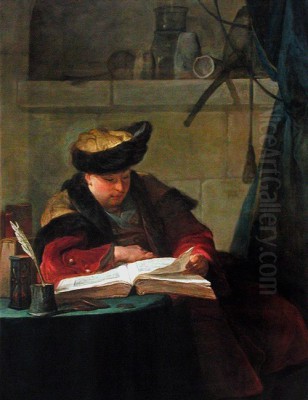
Jacques André Joseph Aved, a prominent figure in eighteenth-century French art, carved a distinguished career as a painter, primarily celebrated for his insightful and meticulously rendered portraits. Flourishing during the Rococo period, Aved's work offers a fascinating window into the society of his time, capturing the likenesses of the burgeoning middle class, influential financiers, fellow artists, and even international diplomats. His style, deeply informed by Dutch realism yet infused with French elegance, set him apart from some of his more flamboyant contemporaries and established him as a master of character portrayal.
Early Life and Formative Influences
Born on January 12, 1702, in Douai, a town in northern France that had relatively recently become part of the French kingdom, Jacques André Joseph Camelot, who later adopted the surname Aved (sometimes d'Aved), was destined for a life in the arts. His father was a physician, but an uncle, a captain in the Dutch Guard, took him in after he was orphaned as a child. This familial connection led him to Amsterdam, a vibrant artistic hub. In Amsterdam, Aved is believed to have received early training from an artist named Picard. While details of this "Picard" are somewhat scarce, the prominent engraver and painter Bernard Picart was highly active in Amsterdam during this period and could well have been an influential figure for the young Aved.
The Dutch artistic environment, with its strong tradition of realistic portraiture championed by masters like Rembrandt van Rijn and Frans Hals in the previous century, undoubtedly left an indelible mark on Aved. The Dutch emphasis on capturing individual character, meticulous attention to detail in fabrics and textures, and a certain unvarnished honesty in depiction would become hallmarks of Aved's mature style. This grounding in Dutch naturalism provided a solid foundation that he would later blend with Parisian sophistication.
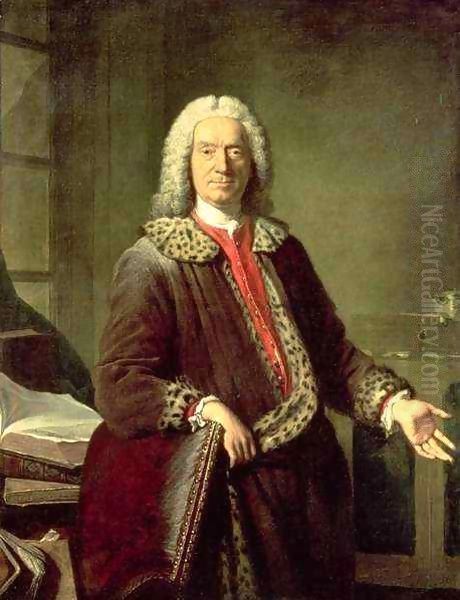
After his formative years in Amsterdam, Aved moved to Paris in 1721. There, he entered the studio of Alexis Simon Belle, a respected portrait painter who enjoyed royal patronage and was known for his elegant depictions of the aristocracy. Under Belle, Aved would have honed his skills in the prevailing French style, learning the conventions of courtly portraiture and the refined techniques favored in the capital. This dual apprenticeship, first in the realistic milieu of Amsterdam and then in the more polished environment of Paris, equipped Aved with a versatile skill set.
Ascent in the Parisian Art World
Aved quickly established himself in Paris. His talent did not go unnoticed, and on November 21, 1734, he was officially received (reçu) as a full member of the prestigious Académie Royale de Peinture et de Sculpture. His reception piece was a portrait of the painter Jean-François de Troy, a significant artist in his own right, known for his historical and genre scenes. Membership in the Academy was a crucial step for any ambitious artist in France, granting official recognition, access to royal commissions, and the right to exhibit at the Salon.
From 1737 until 1759, Aved regularly exhibited his works at the Paris Salon, the official art exhibition of the Academy. These exhibitions were major cultural events, drawing large crowds and critical attention. Aved's portraits were generally well-received, admired for their lifelike quality and the dignity with which he imbued his sitters. He developed a clientele that included not only the nobility but also, significantly, members of the increasingly influential bourgeoisie – financiers, merchants, lawyers, and intellectuals. This alignment with the rising middle class was characteristic of a shift in patronage during the 18th century.
His studio became a notable meeting place, and Aved himself was known for his affable nature, though he was not without a sharp wit. He was also an astute collector of art, amassing a significant collection that included works by his contemporaries, such as Jean-Siméon Chardin, and Old Masters, particularly Dutch and Flemish painters, reflecting his enduring admiration for the Northern European tradition. His collection also reportedly included pieces by the great Baroque master Charles Le Brun.
Artistic Style and Characteristics
Aved's artistic style is a compelling synthesis of Dutch realism and French Rococo grace. While the Rococo era, dominated by artists like François Boucher and Jean-Honoré Fragonard, is often associated with lightheartedness, mythological themes, and decorative exuberance, Aved's portraiture maintained a more grounded and psychologically astute approach.
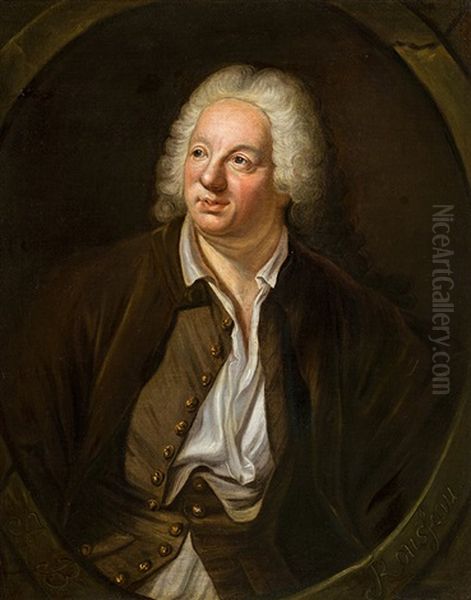
His debt to Dutch art is evident in the meticulous rendering of details. He paid close attention to the textures of fabrics – the sheen of silk, the richness of velvet, the intricate patterns of lace – and the specific attributes of his sitters. Unlike some of his contemporaries who might idealize their subjects to fit a fashionable type, Aved sought to capture a true likeness, revealing character through subtle expressions and naturalistic poses. His handling of light and shadow was skillful, modeling faces and forms with a gentle chiaroscuro that lent them solidity and presence. The skin tones in his portraits are often praised for their naturalism, with careful attention to the nuances of flesh, the delicate rendering of hands, and even the subtle indication of fingernails and joints.
However, Aved was not merely a transplant of Dutch style onto French soil. His works possess an undeniable French elegance and refinement. His compositions are typically well-balanced, often favoring three-quarter length poses that allow for the inclusion of hands and contextual elements. While detailed, his portraits avoid a sense of clutter; there is a clarity and order that speaks to French classical traditions. His color palettes, though rich, tend to be more subdued and harmonious than the brighter, more pastel-oriented schemes of some high Rococo painters. He created an atmosphere of calm dignity, reflecting the status and self-assurance of his sitters.
Aved also demonstrated a keen ability to incorporate symbolic elements that would subtly inform the viewer about the sitter's profession, interests, or status. Books, documents, quills, or specific items of attire could all play a role in constructing the persona presented in the portrait. This approach was common in portraiture, but Aved handled it with a naturalness that integrated these elements seamlessly into the overall composition.
Notable Works and Subjects
Throughout his career, Aved painted a wide array of individuals, creating a gallery of 18th-century French society. Several of his works stand out for their artistic merit and historical significance.
Portrait of Mehmed Said Efendi, Ambassador of the Sublime Porte (1742)
One of Aved's most celebrated and visually striking works is the Portrait of Mehmed Said Efendi, the Ottoman ambassador to the court of Louis XV. Painted in 1742 and now housed in the Palace of Versailles, this portrait is a magnificent example of "turquerie," the contemporary European fascination with Ottoman culture. Aved depicts the ambassador in sumptuous traditional Turkish attire, including a large turban and a fur-lined robe. The attention to the intricate details of the costume is remarkable. Said Efendi is shown seated, holding a long pipe, with an expression of dignified composure. The painting not only captures the likeness of an important diplomat but also serves as a document of cultural exchange and the exotic allure of the East in 18th-century France. The work showcases Aved's skill in rendering diverse textures and his ability to convey a sense of gravitas.
Portrait of Jean-Gabriel du Theil at the Signing of the Treaty of Vienna (c. 1738-1740)
This imposing portrait depicts Jean-Gabriel du Theil, a French diplomat, at a significant moment in his career. The painting is notable for its rich detail, particularly in the rendering of du Theil's elaborate, gold-embroidered diplomatic attire. He is shown seated at a desk, quill in hand, with documents before him, signifying his official duties. The work conveys a sense of authority and intellectual acuity. Interestingly, this painting has an unusual anecdote attached to it. It is sometimes referred to as a "haunted" artwork. According to legend, the figure of du Theil was once observed by museum staff seemingly stepping out of the painting to look at his own portrait before disappearing. While likely apocryphal, such stories add a layer of intrigue to the artwork's history.
Portrait of William IV, Prince of Orange (c. 1751)
Aved also undertook commissions for foreign nobility. His portrait of William IV, Prince of Orange, Stadtholder of the Netherlands, demonstrates his international reputation. In this work, Aved skillfully portrays the Prince with an air of quiet authority. A particularly charming detail in some versions or related studies is the inclusion of the Prince's servant, Jean Rabo, depicted respectfully attending his master. This inclusion of a secondary figure, rendered with sensitivity, adds a narrative and humanizing element to the formal portrait, a practice sometimes seen in Dutch group portraiture. This commission highlights Aved's continued connection to the Netherlands and his ability to satisfy the demands of high-ranking patrons.
Portrait of Count Carl Gustaf Tessin (c. 1739-1740)
Count Carl Gustaf Tessin was a Swedish aristocrat, diplomat, and prominent art collector who served as Sweden's ambassador to Paris from 1739 to 1742. Aved painted Tessin's portrait during this period, and it was exhibited at the Paris Salon of 1740. Tessin was a significant figure in the Parisian art world, acquiring numerous works by contemporary French artists, including Chardin and Boucher, for the Swedish royal collection. Aved's portrait of Tessin captures the likeness of this influential connoisseur and patron, reflecting the cosmopolitan nature of the art market and diplomatic circles in 18th-century Paris.
Portraits of Artists and Intellectuals
Aved was also sought after by his peers and by leading intellectuals. He painted a sensitive portrait of the celebrated playwright and satirist Prosper Jolyot de Crébillon. Perhaps one of his most notable portraits in this category is that of the philosopher Jean-Jacques Rousseau. Capturing the likeness of such a prominent and often controversial thinker required a nuanced approach, and Aved's portrayal would have contributed to Rousseau's public image. These portraits of cultural figures underscore Aved's position within the intellectual and artistic circles of his time.
Relationships with Contemporaries
Aved was an active participant in the Parisian art scene and had notable interactions with several of his contemporaries. His relationship with Jean-Siméon Chardin, one of the greatest still-life and genre painters of the 18th century, is particularly well-documented. Aved and Chardin were friends, and Aved was a great admirer and collector of Chardin's work.
An often-recounted anecdote illustrates their dynamic. When Chardin began to venture into figure painting, Aved reportedly teased him, suggesting that painting human figures was a far more challenging endeavor than depicting "cakes and sausages." While perhaps intended as a lighthearted jibe, it may have spurred Chardin, who famously responded by presenting two remarkable figure paintings, demonstrating his mastery in this new genre as well. Despite this teasing, their mutual respect was evident. Chardin, in turn, painted a striking portrait of Aved, capturing his friend with a direct and unpretentious gaze. This exchange highlights the collegial, sometimes competitive, but ultimately supportive environment among artists.
Aved's circle would have included many other prominent artists of the Rococo period. He would have known and exhibited alongside portraitists like Jean-Marc Nattier, famous for his idealized and mythological portraits of court ladies, and Louis Tocqué, another highly regarded portrait painter known for his robust and characterful depictions. Maurice Quentin de La Tour, the preeminent pastel portraitist, was a dominant figure whose vibrant and psychologically penetrating works were highly acclaimed. While Aved worked in oils, the emphasis on capturing character was a shared concern.
His style can be contrasted with the more overtly decorative and sensual works of François Boucher or the later, more dynamic and intimate scenes of Jean-Honoré Fragonard. Aved's approach to portraiture offered a more sober and realistic alternative to the often mythologized or highly embellished styles favored by some court painters. He maintained a connection to the earlier tradition of grand manner portraiture exemplified by Hyacinthe Rigaud and Nicolas de Largillière, but he adapted it to a more intimate scale and a less overtly hierarchical presentation, particularly when depicting his bourgeois clients. Other contemporaries in portraiture included Jean-Baptiste Perronneau, a rival to La Tour in pastels but also an accomplished oil painter, and later figures like Élisabeth Vigée Le Brun, whose career began as Aved's was ending but who continued the tradition of elegant and insightful portraiture into the Neoclassical era.
Later Years and Legacy
Jacques André Joseph Aved continued to paint and exhibit successfully throughout the 1740s and 1750s. His reputation as a skilled and reliable portraitist ensured a steady stream of commissions. He was not only a painter but also an art dealer and expert, his connoisseurship valued by collectors. His own extensive art collection, which was sold after his death, provided further evidence of his deep engagement with the art of his time and of the past.
Aved passed away in Paris on March 4, 1766. He left behind a significant body of work that provides invaluable documentation of French society during the reign of Louis XV. His portraits are more than mere likenesses; they are nuanced character studies that reflect the aspirations, status, and personalities of his sitters.
His legacy lies in his successful fusion of Dutch realism with French Rococo elegance. He demonstrated that portraiture could be both truthful and refined, capturing the individuality of his subjects without sacrificing artistic grace. While perhaps not as revolutionary as some of his contemporaries, Aved was a master of his craft, and his works remain highly regarded for their technical skill, psychological depth, and historical importance. He provided a distinct voice in the diverse chorus of 18th-century French painting, and his portraits continue to engage viewers with their quiet dignity and compelling human presence. His influence can be seen in the continued appreciation for realistic and character-driven portraiture that persisted alongside more idealized trends. Artists like Adélaïde Labille-Guiard, who also emphasized strong characterization in her portraits, followed in a tradition that valued the kind of insightful depiction Aved championed.
In conclusion, Jacques André Joseph Aved stands as a significant figure in the history of French portraiture. His journey from Douai, through the formative artistic environment of Amsterdam, to a successful career in the heart of Paris, reflects a dedication to his art and an ability to synthesize diverse influences into a distinctive personal style. His portraits of diplomats, financiers, artists, and aristocrats offer a rich tapestry of 18th-century life, rendered with a skill and sensitivity that ensure his enduring relevance.