Jacques Guiaud (1810-1876) stands as a significant, if sometimes overlooked, figure in nineteenth-century French art. A versatile artist, he excelled as both a painter and an engraver, leaving behind a rich oeuvre that primarily captured the landscapes, bustling cityscapes, and pivotal historical moments of his era. His meticulous attention to detail, combined with a keen sense of atmosphere, allowed him to create works that are not only aesthetically pleasing but also serve as valuable visual documents of a transformative period in French, and indeed European, history. Born in Chambéry, Savoy, which was then part of the Kingdom of Sardinia before its later annexation by France, Guiaud's artistic journey would lead him to become a quintessential Parisian artist, deeply engaged with the visual narration of his adopted city and nation.
Early Artistic Formation and Influences
The foundation of Jacques Guiaud's artistic career was laid early, initially under the tutelage of his father. This familial introduction to art was common in the era, often providing the first spark of inclination and basic skills. To formalize his training and immerse himself in the academic traditions that dominated French art at the time, Guiaud later moved to Paris. There, he entered the prestigious École des Beaux-Arts, the leading art institution in France, which shaped generations of artists.
At the École, Guiaud studied under notable masters, including Léon Cogniet (1794-1880). Cogniet was a highly respected painter of historical and portrait subjects, known for works like "Tintoretto Painting His Dead Daughter" (1843) and for his role as an influential teacher. His instruction would have emphasized strong draughtsmanship, compositional rigor, and the grand themes of history painting, which were held in high esteem by the Academy. Guiaud also studied under a figure named Guépin, likely Jean-Baptiste-Joseph Guépin, a lesser-known but competent instructor of the period. This academic grounding provided Guiaud with the technical proficiency and artistic vocabulary prevalent in the official art world. Interestingly, Guiaud also obtained an architect's degree, a qualification that perhaps honed his understanding of perspective, urban structure, and spatial representation, skills clearly evident in his later cityscapes and architectural renderings.
Artistic Style and Thematic Concerns
Jacques Guiaud's artistic output is characterized by its diversity in subject matter and medium, yet unified by a consistent dedication to realistic representation and atmospheric sensitivity. He was adept in oil painting, watercolor, and engraving, each medium allowing for different expressions of his artistic vision.
Mastery of Landscape and Seascape
A significant portion of Guiaud's work is dedicated to landscapes and seascapes. His paintings often depict serene coastal towns, tranquil countryside views, and dramatic maritime scenes. Works like Bei Nizza (1852), an oil painting capturing a view near Nice, showcase his ability to render the specific light and character of the Mediterranean coast. His watercolors, such as the Malta Harbour Scene (created sometime between 1810-1876), demonstrate a particular finesse. Watercolor allowed him a fluidity and transparency ideal for capturing the ephemeral qualities of light on water and the subtle gradations of the sky. These works often evoke a sense of calm and picturesque beauty, aligning with a Romantic sensibility for nature that was still prevalent, even as Realism gained traction. His approach to landscape can be seen in dialogue with contemporaries like Jean-Baptiste Camille Corot (1796-1875), whose poetic landscapes were highly influential, or even the more structured views of artists from the Barbizon School such as Théodore Rousseau (1812-1867) and Charles-François Daubigny (1817-1878), though Guiaud's style often retained a more polished, detailed finish.
The Urban Chronicler
Guiaud was a keen observer of urban life and architecture. His cityscapes, particularly of Paris, are remarkable for their detail and historical value. He documented the evolving face of the capital during a period of immense change, including the Haussmannian transformations. His architectural training likely contributed to his skill in depicting complex urban perspectives and grand edifices. Beyond Paris, he also created views of other cities, as evidenced by his two large engravings, Hamburg Exchange (Exterior and Interior). These prints would have appealed to a growing bourgeois audience interested in depictions of commerce and civic pride. His urban scenes share a documentary spirit with artists like the Italian Giuseppe De Nittis (1846-1884), who also captured the vibrant life of Paris, or the earlier, more romanticized Parisian views of artists like François-Marius Granet (1775-1849).
Depicting History in the Making
Perhaps Guiaud's most enduring legacy lies in his historical paintings, which often recorded contemporary or near-contemporary events with a journalist's eye for detail and a painter's sense for drama. He lived through a tumultuous era in French history, encompassing the July Monarchy, the Second Republic, the Second Empire, and the early years of the Third Republic, including the Franco-Prussian War and the Paris Commune. His works frequently engage with these significant national moments. This focus on contemporary history painting was a popular genre, with artists like Horace Vernet (1789-1863) and Paul Delaroche (1797-1856) achieving great fame for their dramatic reconstructions of past and present events. Guiaud’s contributions are particularly valuable for their immediacy and often unique perspectives.
Key Works and Collaborations
Several of Jacques Guiaud's works stand out for their artistic merit and historical significance. These pieces showcase his range as an artist and his engagement with the defining events and locales of his time.
The Return of Napoleon's Ashes (Napoleon’s Funeral)
One of Guiaud's most celebrated works is his depiction of the "retour des cendres," the return of Napoleon I's remains to Paris on December 15, 1840. This was an event of immense national significance, orchestrated by King Louis-Philippe to bolster patriotic sentiment. Guiaud captured the solemn grandeur of the funeral procession, often choosing a panoramic or slightly elevated viewpoint, possibly from a hot-air balloon as some accounts suggest, to encompass the scale of the crowds and the ceremonial cortege passing through iconic Parisian locations like the Place de la Concorde. The painting, likely a large watercolor, is noted for its meticulous detail, capturing the uniforms, the funerary car, and the atmosphere of public mourning and spectacle. This work places him in the tradition of artists documenting major state occasions, a practice that had a long history in French art.
Departure of Léon Gambetta
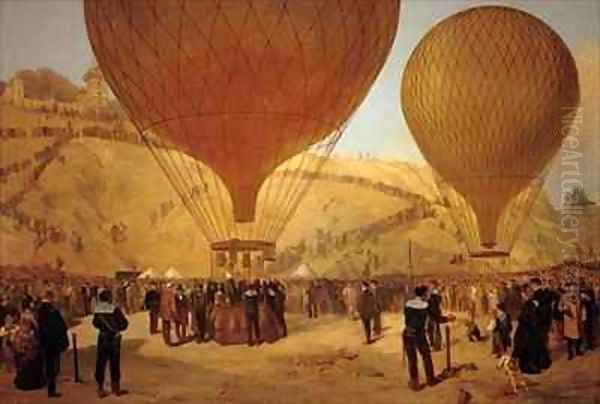
Another critical historical event immortalized by Guiaud, in collaboration with Jules Didier (1831-1914), is The Departure of Gambetta. This painting depicts Léon Gambetta, a key figure in the Government of National Defence, escaping besieged Paris on October 7, 1870, via the hot-air balloon "Armand-Barbès" from the Place Saint-Pierre in Montmartre. The purpose of his daring escape was to rally resistance in the provinces against the Prussian invaders during the Franco-Prussian War. The painting captures the drama and urgency of the moment, with the balloon ascending against a backdrop of the city. The collaboration with Didier, an artist also known for historical and military scenes, was fruitful, combining their talents to produce impactful visual narratives.
Ovations to the Statute of the City of Strasbourg
Also created with Jules Didier around 1871, this work likely refers to the outpouring of patriotic feeling and sorrow following the loss of Alsace and Lorraine (including Strasbourg) to Germany after the Franco-Prussian War. The statue of Strasbourg in the Place de la Concorde in Paris became a focal point for mourning and patriotic demonstrations. This painting would have resonated deeply with contemporary audiences, reflecting a shared sense of national loss and a desire for future reclamation.
Malta Harbour Scene
This watercolor, dating from his active period (1810-1876), highlights Guiaud's skill in capturing maritime environments. The choice of Malta, a historically significant Mediterranean port, suggests his travels or interest in picturesque and strategically important locations. Watercolors like this demonstrate his ability to convey the clarity of Mediterranean light and the bustling activity of a port, with delicate washes and precise linework.
Bei Nizza
This 1852 oil painting, translating to "Near Nice," is an example of his landscape work in a different medium. It would have captured the scenic beauty of the French Riviera, a popular destination for artists and travelers. Such works catered to a taste for picturesque landscapes that offered an escape from urban life or commemorated travels.
Other notable works include Vue de Villefranche, another coastal scene, and engravings like the aforementioned Hamburg Exchange series, which showcased his technical skill in printmaking and his interest in depicting centers of commerce and civic life. He also painted scenes related to the fall of the Second Empire and the Paris Commune, such as The Palace after the last meeting of the National Assembly, providing visual testimony to these turbulent political transitions.
The Artistic Milieu: Paris in the Nineteenth Century
Jacques Guiaud operated within a vibrant and rapidly evolving Parisian art world. The nineteenth century saw the dominance of the Académie des Beaux-Arts and the annual Salon, which was the primary venue for artists to exhibit their work and gain recognition. Guiaud, with his academic training under Cogniet, would have been well-versed in the expectations of the Salon. His historical paintings, in particular, aligned with the hierarchy of genres that placed history painting at the apex.
He was a contemporary of major figures across various movements. While the Romanticism of Eugène Delacroix (1798-1863) was a powerful force in the earlier part of Guiaud's career, Realism, championed by Gustave Courbet (1819-1877), gained prominence by mid-century, advocating for the depiction of ordinary life and unidealized subjects. Guiaud's work, with its meticulous detail and focus on contemporary events, shares some affinities with Realism, though it often retains a degree of romantic or picturesque sensibility, especially in his landscapes.
His cityscapes of Paris were created during the monumental urban renewal project led by Baron Haussmann under Napoleon III (1853-1870). This transformation, which created the wide boulevards and grand buildings characteristic of modern Paris, provided new subjects for artists. Guiaud's depictions of Paris contribute to the visual record of this changing city, alongside artists like Charles Meryon (1821-1868), whose etchings captured a more melancholic and gothic vision of "Old Paris" as it disappeared, or later, Jean Béraud (1849-1935) and Giuseppe De Nittis, who famously depicted the bustling social life on Haussmann's new boulevards.
Furthermore, the latter part of Guiaud's career coincided with the emergence of Impressionism. Artists like Claude Monet (1840-1926), Camille Pissarro (1830-1903), and Edgar Degas (1834-1917) were challenging academic conventions with their focus on capturing fleeting moments, the effects of light and atmosphere, and scenes of modern life, often painted en plein air. While Guiaud's style remained largely within the bounds of academic realism and detailed observation, the artistic ferment around him, with its emphasis on capturing the contemporary world, undoubtedly formed part of the broader cultural context in which he worked. His choice to depict events like Gambetta's balloon escape shows an engagement with the "modern" and the newsworthy, a concern shared, albeit expressed differently, by the Impressionists.
His collaborations, particularly with Jules Didier, were not uncommon in the 19th century, especially for large-scale historical or panoramic works where different artists might specialize in figures, landscapes, or architectural elements. This practice allowed for the efficient production of complex compositions.
Legacy and Conclusion
Jacques Guiaud died in Paris in 1876. His legacy is that of a skilled and diligent artist who served as a visual chronicler of his times. His works are valued not only for their artistic qualities—his fine draughtsmanship, his competent handling of oil and watercolor, and his skill as an engraver—but also for their historical content. Paintings like The Return of Napoleon's Ashes and The Departure of Gambetta are important visual documents that bring to life pivotal moments in French history. His cityscapes provide a window into nineteenth-century urban environments, particularly Paris during its Haussmannian transformation.
While he may not have achieved the revolutionary fame of some of his contemporaries like Courbet or the Impressionists, Guiaud carved out a respectable career, producing a body of work that was appreciated in his lifetime and continues to be of interest to art historians and social historians alike. His paintings and engravings are held in various public collections, including the Musée Carnavalet in Paris, which is dedicated to the history of the city, a fitting repository for an artist who so keenly observed and recorded its life and times.
In summary, Jacques Guiaud was more than just a painter of picturesque scenes or historical events. He was an artist deeply embedded in the fabric of nineteenth-century France, using his considerable talents to capture its landscapes, its urban transformations, and its dramatic national narrative. His work offers a detailed and often evocative glimpse into an era of profound change, securing his place as a noteworthy contributor to the rich tapestry of French art. His dedication to recording the world around him, from the grandeur of state funerals to the specifics of a bustling harbor, provides a lasting testament to his skill and his era.