Henri Courvoisier-Voisin: A Swiss Artist Navigating Revolutionary Times
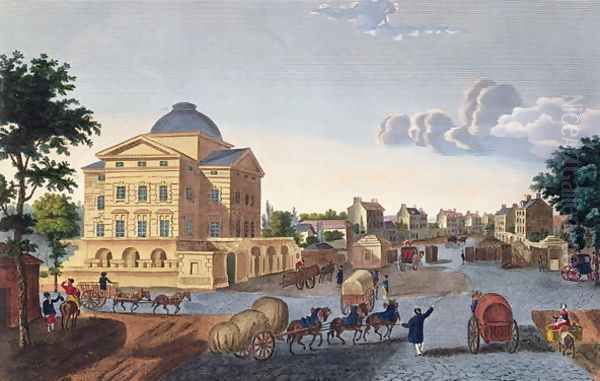
Henri Courvoisier-Voisin (1757-1830) stands as an intriguing, if sometimes enigmatic, figure in late 18th and early 19th-century European art. A Swiss national by birth, his career traversed the realms of painting, engraving, and etching, leaving behind a body of work primarily celebrated for its landscape depictions. His life and art were shaped by rigorous training, a sojourn in the artistic crucible of Paris, the political tumult of the French Revolution, and a persistent, if occasionally problematic, engagement with diverse artistic and even scientific pursuits. Understanding Courvoisier-Voisin requires navigating not only his known biography and oeuvre but also the complexities of attribution that have sometimes clouded his legacy.
Early Life and Artistic Foundations in Switzerland
Born on November 12, 1757, in La Chaux-de-Fonds, Switzerland, Henri Courvoisier-Voisin emerged from a region renowned for its craftsmanship, particularly in watchmaking – an industry demanding precision and meticulous attention to detail. This environment may well have fostered an early appreciation for fine, detailed work, a quality often evident in the graphic arts. His formal artistic training commenced in 1771 when he entered the workshop of Charles-Louis Leschot. At the time, Leschot was considered the preeminent engraver in La Chaux-de-Fonds, and under his tutelage, Courvoisier-Voisin would have received a thorough grounding in the demanding techniques of engraving.
This apprenticeship would have involved learning to incise designs onto metal plates, mastering the use of burins and other specialized tools, and understanding the intricacies of printmaking. Engraving was a highly valued skill, crucial for the dissemination of images, from fine art reproductions to book illustrations and decorative motifs. The Swiss artistic scene of this period, while perhaps not as dominant as that of Paris or Rome, had its own distinct character, with artists like Jean-Étienne Liotard (1702-1789) achieving international fame for his portraits, and landscape painters such as Caspar Wolf (1735-1783) pioneering the depiction of the sublime Alpine scenery. Courvoisier-Voisin's initial training would have placed him within this tradition of skilled Swiss artistry.
Parisian Sojourn and Academic Development
Seeking to broaden his artistic horizons, Courvoisier-Voisin made the pivotal move to Paris in 1778. The French capital was, then as now, a major center of the art world, and he enrolled in the prestigious Académie des Beaux-Arts to study painting. This transition from the focused craft of engraving to the broader discipline of painting marked a significant step in his development. The Académie, with its structured curriculum based on drawing from casts, life models, and the study of Old Masters, would have exposed him to the dominant artistic theories and practices of the era.
His time in Paris coincided with a period of stylistic transition. The Rococo frivolity associated with artists like Jean-Honoré Fragonard (1732-1806) was ceding ground to the more austere and morally serious Neoclassical style, championed by figures such as Jacques-Louis David (1748-1825). While David's major revolutionary works were yet to come, his influence was beginning to be felt. Courvoisier-Voisin would also have been aware of established landscape and genre painters, perhaps encountering the picturesque ruins of Hubert Robert (1733-1808) or the dramatic seascapes of Claude Joseph Vernet (1714-1789). This immersion in the Parisian art scene undoubtedly refined his painterly skills and expanded his thematic repertoire.
Return to Switzerland and Focus on Graphic Arts
In 1784, Courvoisier-Voisin returned to his native Switzerland, specifically to La Chaux-de-Fonds. Having augmented his engraving skills with formal training in painting, he now dedicated himself primarily to the teaching and creation of copperplate engravings and etchings. Etching, a process using acid to bite lines into a metal plate, offered a freer, more painterly line than the often more laborious process of engraving. His focus on these media suggests a continued passion for the graphic arts, perhaps finding in them a suitable vehicle for his artistic expression, particularly in landscape.
His reputation grew, and he became known for his landscape works, especially his watercolor etchings. This technique, likely referring to hand-colored etchings or aquatints (an etching process that creates tonal areas), allowed for a combination of linear precision and delicate color, well-suited to capturing the nuances of light and atmosphere in landscapes. Works from this period include Première vue de La Chaux de Fond (1787) and Neuchâtel vue du Crêt (1790), demonstrating his early commitment to depicting his native Swiss scenery. These pieces would have appealed to a growing market for picturesque views, a taste also catered to by contemporaries like the Swiss watercolorist Abraham-Louis-Rodolphe Ducros (1748-1810), known for his Italianate landscapes.
The French Revolution and its Impact
Courvoisier-Voisin was reportedly an enthusiast of the French Revolution, a period of profound social and political upheaval that began in 1789. He became an active member of patriotic associations, indicating a strong engagement with the revolutionary ideals of liberty, equality, and fraternity. The Revolution had a complex impact on artists: some, like David, became deeply involved in its political machinery, while others found their patronage systems disrupted or their personal safety threatened.
As the Revolution radicalized, particularly during the Reign of Terror, Courvoisier-Voisin evidently felt endangered. This led him to relocate to Bienne (Biel in German), another Swiss town, seeking refuge from the potential perils. This period of displacement, while challenging, did not necessarily halt his artistic activities, though it may have shifted his focus or limited his opportunities for a time. His political engagement reflects a man connected to the intellectual and social currents of his era, extending beyond the confines of his studio.
Diverse Interests and "Unrealistic Projects"
Beyond his primary artistic pursuits, Courvoisier-Voisin was a man of varied, and sometimes unconventional, interests. The provided information notes his involvement in "some unrealistic projects, for example, the construction of a submarine." While details on this venture are scarce, it paints a picture of an inventive, perhaps even eccentric, mind, willing to explore ideas beyond the traditional scope of an artist. This era, the late 18th and early 19th centuries, was a time of significant scientific and technological advancement, and it's not entirely surprising that an individual with a background in precise crafts like engraving might be drawn to mechanical or engineering challenges.
He also reportedly focused on "some strange projects aimed at preventing natural disasters" after his move to Bienne. Again, specifics are lacking, but this suggests a humanitarian or civic-minded concern, coupled with an inventive spirit. These endeavors, however practical or impractical they may have been, add another layer to our understanding of Courvoisier-Voisin as a multifaceted individual.
The Challenge of Attribution: Henri Courvoisier-Voisin vs. Pierre Courvoisier
A significant aspect of Henri Courvoisier-Voisin's art historical profile is the confusion that has sometimes arisen with a contemporary French painter, Pierre Courvoisier (variously cited as 1756-1804 or 1756-1833). Pierre Courvoisier was a landscape painter active in Paris in the early 19th century. Due to the similarity in names and their contemporaneous activity in landscape painting, some works initially attributed to the Swiss Henri Courvoisier-Voisin have, upon further scholarly investigation, been reassigned to his French namesake.
This issue of attribution is not uncommon in art history, especially for artists who were not of the absolute first rank of fame or whose oeuvres were not exhaustively cataloged during their lifetimes. It underscores the importance of careful connoisseurship and documentary research. For instance, a colored lithograph titled Procession before the relics established by the missionaries at Mont Valérien, near Paris has been associated with the name Courvoisier, and such Parisian scenes might easily be subject to this confusion. Disentangling their respective bodies of work remains an ongoing task for art historians specializing in this period. It is crucial to approach attributions with a critical eye, especially when dealing with artists whose careers might overlap in time, place, or subject matter.
Notable Works and Thematic Range
Despite the attribution challenges, a number of works are more securely associated with Henri Courvoisier-Voisin, showcasing his skill in landscape and cityscape. His oeuvre demonstrates a geographical breadth, encompassing Swiss, French, and even Russian scenes.
His Swiss landscapes, such as Première vue de La Chaux de Fond (1787) and Neuchâtel vue du Crêt (1790), highlight his early focus on his homeland. These works, likely etchings or hand-colored prints, would have contributed to the burgeoning genre of picturesque travel views.
His time in Paris and his continued connections there are evidenced by works like Vue de l'Opéra par Henri Courvoisier-Voisin (1815). The Paris Opera was a prominent landmark and a popular subject for artists. Another Parisian scene mentioned is Barrier du Roule, depicting one of the toll gates of Paris, which were architecturally significant structures designed by Claude Nicolas Ledoux (1736-1806) – themselves subjects of artistic interest.
Perhaps most surprisingly, Courvoisier-Voisin also produced views of Russia. These include:
École des cadets et pont sur le Néva (Cadet School and bridge on the Neva, St. Petersburg), dated circa 1810.
View of the mountains of ice during the Carnival in Moscow, also circa 1810.
View from the Kremlin to Zamoscowre District (Moscow), dated circa 1790-1800.
These Russian views are particularly noteworthy. It's unclear whether Courvoisier-Voisin traveled to Russia himself or worked from sketches or paintings by other artists. The late 18th and early 19th centuries saw increased European interest in Russia, and artists like Fyodor Alekseyev (1753-1824) were producing vedute (detailed city views) of St. Petersburg and Moscow. Courvoisier-Voisin's Russian scenes, likely etchings, would have catered to this curiosity. The depiction of ice mountains during a Moscow carnival suggests an interest in exotic customs and atmospheric conditions, characteristic of the Romantic sensibility that was beginning to emerge.
He is also noted for engravings related to the French theatre, though specific titles are not readily available. This aligns with a common practice for engravers to produce prints of popular actors, stage designs, or theatrical scenes, a field where artists like Jean-Michel Moreau le Jeune (1741-1814) excelled in France.
Artistic Style and Techniques
Courvoisier-Voisin was primarily a graphic artist, excelling in engraving and etching, often enhanced with watercolor. His style, as can be inferred from the titles and dates of his works, likely balanced topographical accuracy with a picturesque sensibility. The term "watercolor etchings" suggests a desire to combine the linear qualities of printmaking with the tonal and chromatic possibilities of watercolor. This could involve hand-coloring individual prints or using techniques like aquatint to create tonal washes directly on the printing plate, a method popularized by artists such as Jean-Baptiste Le Prince (1734-1781).
His landscapes would have aimed to capture the specific character of a place, whether the familiar environs of La Chaux-de-Fonds, the urban grandeur of Paris, or the distant vistas of Moscow. In this, he followed a long tradition of landscape art, stretching back to masters like Claude Lorrain (1600-1682) and Nicolas Poussin (1594-1665), whose idealized landscapes set a standard, but also evolving towards the more direct observation seen in the work of artists like Pierre-Henri de Valenciennes (1750-1819), a pioneer of open-air oil sketching. Courvoisier-Voisin's work seems to sit at a crossroads, utilizing the reproductive capacity of printmaking to disseminate views that were both informative and aesthetically pleasing.
Courvoisier-Voisin in Context: Contemporaries and Influences
To fully appreciate Henri Courvoisier-Voisin, it's helpful to place him within the broader artistic currents of his time. His training under Leschot rooted him in a tradition of skilled Swiss craftsmanship. His Parisian studies at the Académie exposed him to Neoclassicism, but his focus on landscape and printmaking suggests an affinity with other traditions as well.
The late 18th century saw a surge in the popularity of landscape prints. The Italian master Giovanni Battista Piranesi (1720-1778), with his dramatic views of Rome, had a profound impact on how ancient and modern cities were depicted and perceived through prints. While Courvoisier-Voisin's style was likely less monumental than Piranesi's, the Italian's success demonstrated the market for evocative architectural and landscape views.
In France, artists like Hubert Robert and Claude Joseph Vernet were highly successful landscape painters whose works were often disseminated through engravings. The development of new printmaking techniques, like aquatint, expanded the expressive possibilities for artists working in landscape. Courvoisier-Voisin's "watercolor etchings" fit into this trend of creating more painterly and atmospheric prints.
His engagement with Russian themes connects him to a wider European fascination with distant lands. Artists and explorers were venturing further afield, and their visual records were eagerly consumed by the public, often through the medium of prints.
The political context of the French Revolution also shaped the careers of many artists. While some, like David, thrived by aligning themselves with the new regime, others, like Elisabeth Vigée Le Brun (1755-1842), were forced into exile. Courvoisier-Voisin's move to Bienne reflects the personal impact such political turmoil could have. His contemporary, the Swiss artist Sigmund Freudenberger (1745-1801), was known for his genre scenes, often depicting Swiss life, which were also popularized through prints.
Exhibitions and Legacy
Information regarding specific exhibitions of Courvoisier-Voisin's work during his lifetime is somewhat limited, though it's noted his work was mentioned in an 1815 exhibition catalog. This suggests he was actively presenting his art to the public. More recently, his works continue to appear on the art market, indicating an enduring, if specialized, interest. For example, his Russian views, École des cadets et pont sur le Néva and View of the mountains of ice during the Carnival in Moscow, were featured in an auction on October 29, 2022. Such sales help to keep an artist's name and work in circulation and can sometimes lead to new scholarly attention.
The legacy of Henri Courvoisier-Voisin is that of a skilled and versatile artist who navigated a period of significant artistic and political change. His contributions lie primarily in the realm of landscape prints, where he captured views of Switzerland, France, and Russia with a keen eye for detail and atmosphere. The confusion with Pierre Courvoisier highlights the challenges of art historical research but also underscores the need for continued study to clarify the oeuvres of artists like him.
He remains a testament to the many talented individuals who contributed to the rich tapestry of European art in the late 18th and early 19th centuries. While perhaps not achieving the household-name status of some of his more famous contemporaries like Francisco Goya (1746-1828) in Spain or J.M.W. Turner (1775-1851) in England, who were also pushing the boundaries of landscape and printmaking, Courvoisier-Voisin played his part in documenting and interpreting the world around him through his chosen media. His diverse interests, from patriotic associations to submarine design, further paint a portrait of a man engaged with the multifaceted developments of his era. His work merits appreciation for its technical skill and its window onto the landscapes and artistic practices of his time.