James Crawford Thom stands as a notable figure in nineteenth-century American art, a painter whose career bridged the artistic currents of both the New World and the Old. Born into an era of burgeoning national identity and artistic exploration in the United States, Thom's work reflects a deep appreciation for the natural world and the quiet dignity of everyday life, themes that resonated strongly with audiences on both sides of the Atlantic. His journey as an artist took him from the nascent art schools of New York to the prestigious ateliers of Paris and the exhibition halls of London, ultimately shaping a style that blended American sensibilities with European academic training and the burgeoning plein air aesthetics of the Barbizon School.
Early Life and Artistic Awakening
James Crawford Thom was born in New York City on March 22, 1835. His artistic inclinations may well have been inherited; his father, James Thom (1802-1850), was a sculptor of some renown, known for his stone carvings. The elder Thom, originally from Scotland, had achieved fame for his sculptures of characters from Robert Burns's poems, such as "Tam O'Shanter" and "Souter Johnnie." This familial connection to the arts likely provided an encouraging environment for young James's burgeoning talents. His mother was Jessie Thom (1821-1868).
Though born in the bustling metropolis of New York, a significant portion of Thom's formative years was spent on a farm near Ramapo, in Rockland County, New York, close to the New Jersey border. This rural upbringing would prove to be a profound and lasting influence on his artistic vision. The landscapes, the changing seasons, and the daily rhythms of farm life imprinted themselves on his young mind, providing a rich wellspring of subject matter that he would return to throughout his career. This early immersion in nature undoubtedly laid the groundwork for his later success as a landscape and genre painter.
Formal Training: America and the Parisian Crucible
Recognizing his calling, Thom sought formal artistic training. In 1853, he enrolled at the prestigious National Academy of Design in New York City. Founded in 1825 by artists like Samuel F.B. Morse, Asher B. Durand, and Thomas Cole, the National Academy was the premier institution for art education in America at the time. Here, Thom would have been exposed to the prevailing artistic trends, particularly the burgeoning Hudson River School, which celebrated the grandeur and romantic beauty of the American landscape. Artists like Durand, one of the Academy's leading figures, championed direct observation of nature, a principle that Thom would later embrace.
However, like many ambitious American artists of his generation, Thom understood that a European sojourn was essential for refining his skills and broadening his artistic horizons. Paris, the undisputed art capital of the world in the nineteenth century, beckoned. He traveled to France, where he sought instruction from some of the most respected and influential artists of the day.
His roster of teachers in Paris is impressive and indicative of the diverse influences he absorbed. He studied with Thomas Couture, a prominent academic painter known for his historical subjects and his influential teaching methods. Couture's atelier attracted many American students, and his emphasis on sound draftsmanship and compositional structure would have provided Thom with a strong technical foundation.
Thom also studied under Henri Picou, another academic painter who specialized in mythological and allegorical scenes, often characterized by their graceful figures and refined execution. Exposure to such academic masters ensured Thom was well-versed in traditional techniques.
Perhaps most significantly for his later development, Thom became a pupil of Pierre Édouard Frère. Frère was a highly regarded genre painter, celebrated for his sympathetic and often sentimental depictions of peasant life, particularly scenes involving children. His work was immensely popular in both France and England, and his influence on Thom's choice of subject matter and his tender portrayal of rural figures is clearly discernible. Frère was a central figure in the Ecouen school of painters, a colony of artists who, like those of Barbizon, focused on rural themes.
Crucially, Thom also studied with the legendary Camille Corot. Corot was a pivotal figure in French landscape painting, admired for his poetic, light-filled canvases that bridged Neoclassicism and the emerging Impressionist sensibility. He was a leading member of the Barbizon School, a group of painters who rejected academic conventions in favor of direct observation of nature, often painting en plein air (outdoors) in the Forest of Fontainebleau. Other key figures of the Barbizon school included Jean-François Millet, known for his dignified portrayals of peasant laborers, Théodore Rousseau, a master of dramatic forest scenes, and Charles-François Daubigny, who often painted tranquil river views from his studio boat. Thom's association with Corot would have immersed him in this ethos of capturing the fleeting effects of light and atmosphere. An interesting anecdote from this period notes that in 1853, Thom was living in Ecouen, a village near Paris favored by artists (including Frère), at 13 rue de Paris, and was said to have traveled with Corot.
Another curious detail from his time in France is that in an 1861 census, he was reportedly recorded as "Croquefort," likely a phonetic misunderstanding or misspelling of "Crawford" by a French census taker, a small but amusing testament to the expatriate experience.
The London Years
After his formative studies in France, James Crawford Thom's career took him across the English Channel. In 1866, he moved to London, a vibrant artistic center in its own right. During his time in England, he achieved a measure of success, exhibiting his works at the prestigious Royal Academy of Arts. The Royal Academy was the British equivalent of the French Salon, and acceptance into its exhibitions was a significant mark of professional recognition.
His paintings, likely featuring the landscapes and genre scenes he had honed in France and America, would have found an appreciative audience in Victorian England, where there was a strong appetite for narrative paintings and depictions of rural life. The influence of artists like Frère, whose work was already popular in Britain, would have served him well. He would have been exhibiting alongside prominent British artists of the era, such as members of the Pre-Raphaelite Brotherhood like Dante Gabriel Rossetti or John Everett Millais, or popular Victorian narrative painters like William Powell Frith.
Return to America and Mature Career
In 1873, Thom returned to the United States, bringing with him a wealth of European experience and a refined artistic sensibility. He settled initially in New York City but later established himself in New Jersey, first in the village of Old Bridge and eventually in Atlantic Highlands. His American career saw him actively exhibiting his work at major institutions, including his alma mater, the National Academy of Design, as well as the Pennsylvania Academy of the Fine Arts in Philadelphia and the Art Institute of Chicago.
His style during this period continued to reflect his diverse training. The influence of the Hudson River School, with its emphasis on detailed realism and the celebration of American scenery, remained a strong undercurrent in his landscapes. However, his European experiences, particularly his contact with Corot and the Barbizon painters, imbued his work with a softer, more atmospheric quality and a focus on the poetic moods of nature, rather than just its topographical accuracy. This distinguished his work from some of the more grandiose and panoramic canvases of earlier Hudson River School painters like Albert Bierstadt or Frederic Edwin Church. Thom's landscapes were often more intimate, capturing the quiet beauty of the countryside he knew well.
His genre scenes, depicting everyday life, particularly children at play or engaged in simple rural tasks, clearly show the enduring impact of Pierre Édouard Frère. These works were characterized by their charm, gentle sentiment, and careful observation of human character. He shared this interest in genre subjects with American contemporaries like Eastman Johnson and Winslow Homer, though Thom's approach was often less rugged and more idyllic than Homer's, and perhaps more closely aligned with the European genre traditions.
Artistic Style and Representative Works
James Crawford Thom's artistic style is best characterized as a blend of the Hudson River School's detailed naturalism and the Barbizon School's atmospheric lyricism, applied to both landscape and genre subjects. He possessed a keen eye for detail, a strong sense of composition, and a subtle understanding of light and color.
One of his notable works is "Winter in Old Bridge". This painting, likely depicting the New Jersey village where he resided, exemplifies his ability to capture the specific character of a place and a season. Such winter scenes were popular, allowing artists to explore the subtle harmonies of a muted palette and the graphic beauty of snow-covered forms. One can imagine children playing in the snow, a common motif in his work, perhaps inspired by Frère, set against the backdrop of a quintessential American village.
Another representative work mentioned is "Feeding the Chickens". This title immediately evokes a charming rural genre scene, a subject that would have appealed to contemporary tastes for idyllic portrayals of country life. Such paintings often focused on the innocence of childhood or the simple virtues of agrarian existence. Thom's skill would lie in rendering the figures with sympathy and the setting with convincing detail, from the texture of the chickens' feathers to the rustic environment of the farmyard.
"Circus Scene" suggests a departure into a more animated and perhaps narrative subject. Circuses were a popular form of entertainment in the 19th century, and a painting depicting such a scene would offer opportunities for lively compositions, diverse characters, and vibrant colors. This indicates Thom's versatility beyond quiet landscapes and domestic genre.
His landscapes often featured the gentle, rolling hills, woodlands, and waterways of New Jersey and the surrounding regions. He was adept at capturing the changing light of day, from the soft glow of morning to the warm hues of late afternoon. His figures, whether central to a genre scene or incidental elements in a landscape, were typically rendered with care and a sense of individual character. He was not generally a painter of the sublime, dramatic wilderness in the vein of Thomas Moran or the aforementioned Bierstadt, but rather found beauty in the more settled, pastoral landscapes. His work often shared a kinship with later Hudson River School painters like Sanford Robinson Gifford, who was known for his luminist effects, or George Inness, who, like Thom, absorbed Barbizon influences to create more subjective and poetic landscapes.
Personal Life and Later Years
James Crawford Thom's personal life saw him marry twice. His first wife was Louise Giles (born 1841). After her passing, he married Sarah Bloodgood in 1884. He was a father, with at least two daughters, Ada and Blanche, mentioned in records. These familial connections likely reinforced his interest in domestic and child-centered themes in his art.
He spent his later years in New Jersey, a state whose landscapes he frequently depicted. After living in Old Bridge, he eventually settled in Atlantic Highlands, a coastal town overlooking Sandy Hook Bay. This location would have offered new scenic possibilities, from coastal views to the activities of a seaside community.
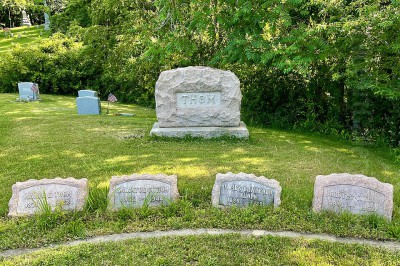
James Crawford Thom passed away on February 16, 1898, in Atlantic Highlands, New Jersey. He was laid to rest in the Chestnut Hill Cemetery, a historic cemetery located in East Brunswick, New Jersey, not far from Old Bridge where he had previously lived.
Legacy and Art Historical Significance
James Crawford Thom occupies a respected place in the annals of 19th-century American art. While perhaps not as widely known today as some of the leading figures of the Hudson River School or the American Impressionists who followed, his contributions were significant. He was part of a generation of American artists who sought to reconcile their native artistic traditions with the sophisticated training and diverse influences of Europe.
His primary legacy lies in his sensitive and skilled portrayal of American landscapes and rural life. He successfully adapted the principles of the Hudson River School to more intimate, pastoral scenes, often infused with the atmospheric qualities and poetic sentiment of the Barbizon School. His connection with Corot, in particular, was crucial in shaping this aspect of his work.
His genre paintings, especially those featuring children, reflect the Victorian era's interest in themes of innocence, domesticity, and the charm of simple country living. In this, he followed in the footsteps of his teacher Pierre Édouard Frère, translating a popular European genre for an American audience.
Thom's works are held in various public and private collections, including the Smithsonian American Art Museum, a testament to his recognized skill and historical importance. His paintings serve as valuable visual documents of 19th-century American rural life and landscape, rendered with a technical proficiency and an artistic sensibility that appealed to his contemporaries and continues to be appreciated today.
He represents an important transitional figure, an artist who absorbed the lessons of the established Hudson River School, enriched his practice with European academic and Barbizon influences, and contributed to the evolving landscape of American art in the latter half of the 19th century. His dedication to capturing the beauty of his surroundings and the quiet moments of human experience ensures his enduring, if modest, place in art history. His career demonstrates the increasing cosmopolitanism of American artists and their engagement with international art movements, paving the way for the even more diverse artistic expressions of the 20th century.