Louis Remy Mignot: A Transatlantic Life in Landscape
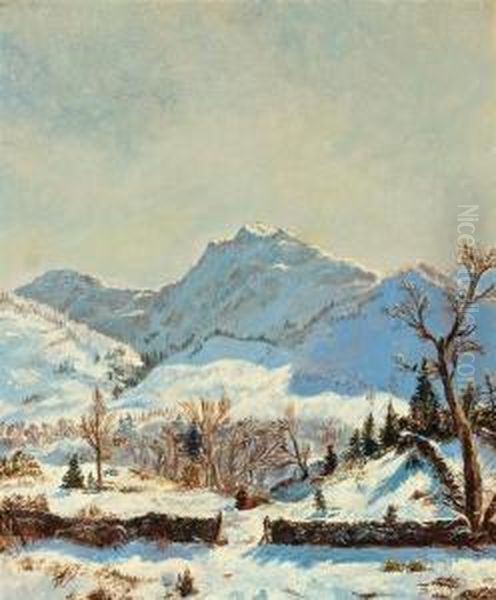
Louis Remy Mignot (1831-1870) stands as a fascinating, if sometimes overlooked, figure in the pantheon of 19th-century American art. A Southerner by birth, with European training and a career that spanned continents, Mignot developed a distinctive landscape style that blended the meticulous observation of the Hudson River School with a romantic sensibility and a unique mastery of light and atmosphere. His relatively short life was marked by significant artistic achievements, influential friendships, and the profound impact of personal and national upheaval. This exploration delves into the life, art, and legacy of a painter whose work continues to captivate with its poetic beauty and technical brilliance.
Early Life and European Apprenticeship
Louis Remy Mignot was born on February 3, 1831, in Charleston, South Carolina. His family were of French Huguenot descent, a heritage that perhaps instilled in him a certain cosmopolitan outlook. Charleston, a prominent Southern city, offered some cultural amenities, but for an aspiring artist with serious ambitions, Europe was the ultimate destination for formal training. Recognizing his talent and passion, Mignot, at the young age of seventeen, around 1848, embarked on a journey to the Netherlands.
He settled in The Hague, a city with a rich artistic tradition, and enrolled to study under Andreas Schelfhout (1787-1870). Schelfhout was a highly respected Dutch landscape painter, known for his meticulously rendered winter scenes, coastal views, and woodland interiors, often evoking the spirit of the 17th-century Dutch Golden Age masters like Jacob van Ruisdael. Under Schelfhout's tutelage, Mignot would have honed his technical skills, particularly in drawing, composition, and the precise depiction of natural elements. Schelfhout was a popular teacher, and his studio attracted numerous students, some of whom, like Mignot, went on to achieve considerable recognition. Among Schelfhout's other pupils were notable figures such as Johan Barthold Jongkind, Charles Leickert, and Nicolaas Roosenboom, indicating the quality of instruction Mignot received. This European grounding provided Mignot with a strong technical foundation that would serve him well throughout his career.
Return to America and the Hudson River School
Around 1850, Mignot returned to the United States, choosing New York City as his new base of operations. The city was rapidly becoming the epicenter of the American art world, and it was here that Mignot became associated with the Hudson River School. This was not a formal institution but rather a group of like-minded landscape painters inspired by the writings of Ralph Waldo Emerson and Henry David Thoreau, and the artistic precedents set by painters like Thomas Cole and Asher B. Durand. They sought to capture the grandeur and beauty of the American wilderness, often imbuing their works with a sense of awe and a spiritual connection to nature.
Mignot quickly established himself within this vibrant artistic community. He opened a studio in the famed Tenth Street Studio Building, a hub for many prominent artists of the day. His colleagues and friends included key figures of the Hudson River School, such as Frederic Edwin Church, John Frederick Kensett, Sanford Robinson Gifford, Jervis McEntee, and Worthington Whittredge. Mignot's work from this period often depicted the landscapes of New York State, New England, and other parts of the American Northeast, rendered with the detailed realism characteristic of the school. However, even in these early American works, his unique sensitivity to atmospheric effects and his nuanced color palette began to set him apart.
The Pivotal South American Expedition
A defining moment in Mignot's career came in 1857 when he embarked on an expedition to South America, specifically Ecuador, in the company of the already renowned landscape painter Frederic Edwin Church. Church had previously traveled to South America in 1853, inspired by the writings of the Prussian naturalist and explorer Alexander von Humboldt, whose "Cosmos" urged artists to travel and depict the diverse landscapes of the tropics. This second journey, with Mignot, was to prove immensely fruitful for both artists.
For Mignot, the experience of the equatorial landscape was transformative. The lush, exotic vegetation, the dramatic mountain ranges of the Andes, the vibrant colors, and the intense, humid atmosphere provided a wealth of new subject matter. He and Church sketched extensively, gathering visual material that would fuel their studio productions for years to come. Mignot’s South American paintings are among his most celebrated, showcasing his ability to capture the unique light and atmospheric conditions of the tropics. He masterfully conveyed the steamy haze, the brilliant sunsets, and the dense, verdant jungles, often creating scenes of breathtaking beauty and romantic allure. This journey solidified his reputation and broadened his artistic horizons significantly, moving his work beyond the typical subjects of the Hudson River School.
Artistic Style: Light, Color, and Atmosphere
Louis Remy Mignot's artistic style is characterized by its delicate handling of light, sophisticated color harmonies, and an exceptional ability to render atmospheric effects. While he shared the Hudson River School's commitment to detailed observation of nature, his approach was often more poetic and evocative than purely topographical. He was particularly adept at depicting the subtle gradations of light at dawn or dusk, creating scenes suffused with a soft, opalescent glow. His skies are often dramatic and expressive, playing a crucial role in setting the mood of the painting.
His palette was distinctive, often employing subtle mauves, pinks, and lavenders alongside rich greens and earthy browns. This nuanced use of color contributed to the dreamlike, almost ethereal quality found in many of his best works. Mignot was a master of depicting foliage, rendering it with a feathery touch that conveyed both its density and its delicacy. Whether painting the misty swamps of the American South, the crisp air of a winter landscape, or the humid jungles of Ecuador, he demonstrated an uncanny ability to capture the specific character of the environment. Some art historians have linked his work to Luminism, a sub-movement within the Hudson River School characterized by its emphasis on concealed brushwork, serene light, and tranquil, reflective water, though Mignot's style often possessed a more overtly romantic and sometimes dramatic flair than typical Luminist works by artists like Fitz Henry Lane or Martin Johnson Heade.
Representative Works
Mignot produced a significant body of work during his relatively brief career. Among his most important and representative paintings is Lagoon of the Guayaquil, Ecuador (c. 1863, Detroit Institute of Arts). This painting, a product of his South American travels, exemplifies his skill in capturing the lush tropical environment and the hazy, moisture-laden atmosphere. The scene is bathed in a warm, diffused light, with meticulously rendered vegetation framing a serene lagoon. The painting evokes a sense of exoticism and romantic beauty, characteristic of his tropical landscapes.
Another notable work is View from Hoboken into the Hudson River, New York (date unknown), which showcases his ability to depict more familiar North American scenes with equal sensitivity. His snow scenes, likely influenced by his training with Schelfhout, are also highly regarded for their delicate rendering of light and texture. Works such as Winter Scene demonstrate his versatility and his capacity to find beauty in diverse natural settings. He also painted scenes from the Southern United States, reflecting his origins, and later, landscapes from England. His collaboration with Frederic Church on paintings based on Church's sketches, such as those related to Church's monumental The Heart of the Andes, further highlights his skill and his close association with leading figures of his time. For instance, Mignot is known to have worked on versions or studies related to Church's grand compositions, sometimes focusing on specific atmospheric or foliage details that complemented Church's broader vision.
The Civil War and Relocation to England
The outbreak of the American Civil War in 1861 profoundly impacted Mignot's life and career. As a Southerner by birth and sympathy, his position in New York City, a staunchly Unionist stronghold, became increasingly untenable. The war divided the nation and the artistic community alike. Faced with social and political pressures, Mignot made the difficult decision to leave the United States.
In 1862, he sailed for England, settling in London. This move marked a new chapter in his life, but also distanced him from the American art scene where he had achieved considerable success. In London, Mignot continued to paint, exhibiting his works at prestigious venues such as the Royal Academy. He painted English landscapes, but also continued to produce South American scenes based on his earlier sketches, which found an appreciative audience in Victorian England, a society fascinated by the exotic and the far-flung corners of the British Empire and the world. His style, with its romantic sensibility and refined technique, resonated with certain aspects of Victorian taste. He would have been aware of prominent British artists of the era, such as the Pre-Raphaelites like Dante Gabriel Rossetti and John Everett Millais, or the great J.M.W. Turner, whose atmospheric effects might have found an echo in Mignot's own work, though Mignot's style remained distinctly his own. James McNeill Whistler, another American expatriate, was also active in London during this period, though their artistic circles may not have significantly overlapped.
Collaborations and Contemporaries
Throughout his career, Mignot engaged with his contemporaries, both through friendship and artistic collaboration. His most significant artistic partnership was undoubtedly with Frederic Edwin Church. Their joint expedition to Ecuador was a testament to their mutual respect and shared artistic goals. They collaborated on certain projects, and Church's influence, particularly his ambition and his interest in grand, panoramic landscapes, was certainly felt by Mignot. However, Mignot maintained his own distinct artistic voice, often favoring more intimate and poetic interpretations of nature compared to Church's epic canvases.
In New York, Mignot was part of a close-knit community of artists. He shared studio space and friendships with painters like Jervis McEntee and Worthington Whittredge. These interactions would have fostered a stimulating environment of shared ideas and mutual support. There are accounts of Mignot collaborating with other artists as well; for instance, it is noted that he sometimes painted figures into his landscapes, or worked with figure painters like Eastman Johnson, where one might paint the landscape and the other the figures, a common practice in the 19th century to leverage individual strengths. Such collaborations underscore the collegial nature of the art world at the time, even amidst underlying professional competition.
Anecdotes, Character, and Challenges
Mignot was described by contemporaries as a refined and amiable gentleman. His Southern heritage and Catholic faith were important aspects of his identity. Some scholars have suggested that a certain melancholy or romantic wistfulness in his work might be linked to his personal temperament and perhaps his experiences as a Southerner during a tumultuous period in American history.
His decision to leave America during the Civil War was a significant turning point. While it allowed him to continue his career in a more stable environment, it also contributed to his relative obscurity in American art history for a period after his death. His work, particularly his tropical scenes, sometimes faced mixed critical reception. While many admired their beauty and technical skill, some critics occasionally found their exoticism or dramatic effects to be verging on the "ludicrous" or overly sentimental, a common critique leveled at highly romantic or theatrical art in an era that was also beginning to see the stirrings of realism and later, impressionism.
Later Years, Untimely Death, and Legacy
Louis Remy Mignot's time in England was productive, but his life was tragically cut short. He contracted smallpox (some sources say pneumonia or a similar acute illness) and died in Brighton, England, on September 22, 1870, at the young age of 39. His early death deprived the art world of a unique and evolving talent.
For many years after his death, Mignot's work fell into relative obscurity, particularly in the United States. The prevailing tastes in American art shifted, and the contributions of artists who had spent significant time abroad, or whose careers were interrupted, were sometimes overlooked. However, the late 20th century saw a resurgence of interest in 19th-century American art, and Mignot's work began to be re-evaluated. A pivotal moment in this rediscovery was the 1996 retrospective exhibition, "Louis Remy Mignot: A Southern Painter Abroad," organized by the North Carolina Museum of Art. This exhibition, along with accompanying scholarship, brought his achievements to a wider audience and helped to re-establish his reputation as one of the most gifted and original landscape painters of his generation.
Art historians now recognize Mignot as an important transitional figure, bridging American and European artistic traditions. His unique synthesis of Hudson River School naturalism with a deeply personal romanticism, his mastery of light and atmosphere, and his evocative depictions of diverse landscapes mark him as a significant contributor to 19th-century art.
Mignot in Public Collections and the Art Market
Today, Louis Remy Mignot's paintings are held in the collections of major American museums, a testament to his rediscovered importance. Institutions that house his work include the Metropolitan Museum of Art in New York, the Brooklyn Museum, the North Carolina Museum of Art (which holds a significant collection), the Detroit Institute of Arts, the de Young Museum in San Francisco, the Princeton University Art Museum, and the Greenville County Museum of Art in South Carolina, among others.
His works also appear on the art market, where they command respectable prices, reflecting the increased appreciation for his skill and rarity. For example, a painting titled Snow Scene reportedly sold for $475,000. Another work depicting an Ecuadorian landscape achieved $120,000. In a 2011 auction, a landscape measuring 22 x 36 inches sold for an impressive $516,000. These figures indicate a strong collector interest and affirm his place among the significant American painters of his era.
Conclusion: A Singular Vision
Louis Remy Mignot's career, though brief, was rich with artistic exploration and achievement. From the formal training grounds of The Hague to the vibrant art scene of New York, the exotic jungles of Ecuador, and the established artistic circles of London, Mignot absorbed diverse influences while forging a highly personal style. His ability to infuse meticulously observed landscapes with a palpable sense of atmosphere and poetic emotion remains his most enduring legacy. He was a painter who could capture both the grandeur of nature and its subtle, fleeting moods, leaving behind a body of work that continues to enchant and inspire. As an artist who navigated multiple cultural contexts and responded with sensitivity to the varied landscapes he encountered, Louis Remy Mignot holds a unique and increasingly appreciated place in the story of American and transatlantic art.