James Walsham Baldock: A Victorian Chronicler of the English Landscape
James Walsham Baldock (1822-1898) emerges from the annals of British art history as a dedicated painter of the English countryside, its denizens, and particularly its sylvan landscapes. Active during the vibrant and multifaceted Victorian era, Baldock's work offers a window into the artistic tastes and pastoral affections of his time. While perhaps not achieving the towering fame of some of his contemporaries, his contributions to landscape and animal painting merit closer examination, reflecting a persistent strand of naturalism and a deep appreciation for the specific character of the British Isles.
Early Life and Artistic Formation
Born in Yorkshire in 1822, a county renowned for its dramatic dales and moors that have inspired artists for centuries, James Walsham Baldock's early life set him on a path connected to the land. He was reportedly adopted by his grandfather, a farmer in Worksop, Nottinghamshire. This upbringing in a rural environment, close to the agricultural rhythms and the untamed beauty of areas like the nearby Sherwood Forest, likely provided a foundational influence on his artistic sensibilities.
The mid-19th century, when Baldock would have been developing his artistic skills, was a period of significant artistic ferment. The Royal Academy of Arts in London was the dominant institution, though its traditionalism was increasingly challenged. The legacy of Romantic landscape painters like John Constable and J.M.W. Turner still loomed large, having revolutionized the way British scenery was perceived and depicted. Constable, with his commitment to the Suffolk countryside and his fresh, naturalistic approach, and Turner, with his sublime, atmospheric visions, had irrevocably altered the landscape genre. Concurrently, the Pre-Raphaelite Brotherhood, formed in 1848 by artists such as Dante Gabriel Rossetti, John Everett Millais, and William Holman Hunt, was advocating for a return to the detail, intense color, and complex compositions of Quattrocento Italian art, often applied to literary, religious, and moralizing subjects, but also influencing landscape with its emphasis on truth to nature.
While specific details of Baldock's formal artistic training remain somewhat elusive, it is probable that he was largely self-taught or received instruction from regional masters. His chosen subjects – landscapes, equestrian scenes, and portraiture – were popular and marketable genres. The skills required, particularly in accurate draughtsmanship for animal anatomy and an eye for the nuances of light and foliage, would have been honed through diligent observation and practice.
The Artistic Milieu of Victorian Britain
To understand Baldock's career, one must consider the broader artistic landscape of Victorian Britain. This era saw an explosion in art production and consumption, fueled by a growing middle class with disposable income and a desire to adorn their homes. Landscape painting, in particular, resonated deeply, offering depictions of a cherished national identity rooted in the countryside, even as industrialization was rapidly transforming other parts of the nation.
Artists like Benjamin Williams Leader, known for his serene and meticulously detailed views of the English and Welsh countryside, achieved immense popularity. John Linnell, older than Baldock but active well into the Victorian period, was celebrated for his rich, pastoral scenes, often imbued with a poetic or biblical sentiment. The tradition of animal painting also flourished, with Sir Edwin Landseer becoming a national icon for his sentimental and anthropomorphic depictions of animals, particularly stags and dogs. Earlier figures like George Stubbs, with his unparalleled anatomical studies of horses, had laid a strong foundation for equestrian art, a genre that continued to be in demand, supported by a landed gentry passionate about hunting and racing. John Frederick Herring Sr. was another prominent painter of horses and rural scenes, whose work enjoyed widespread appeal.
It was within this context that Baldock operated. His focus on specific locales, such as Sherwood Forest, and his depictions of landowners with their prized animals, catered to a taste for both the picturesque and the personal.
Baldock's Artistic Focus: Landscapes and Sylvan Scenes
James Walsham Baldock's primary artistic endeavor appears to have been landscape painting, with a particular affinity for woodland scenes. His works often convey a quiet, observational naturalism, seeking to capture the specific character of the trees, the quality of light filtering through leaves, and the textures of the forest floor. This approach aligns with a broader Victorian interest in the detailed study of nature, influenced in part by scientific advancements and the writings of figures like John Ruskin, who famously urged artists to go to nature "rejecting nothing, selecting nothing, and scorning nothing."
The Allure of Sherwood Forest
Several of Baldock's known works are explicitly tied to Sherwood Forest in Nottinghamshire, a place steeped in legend and natural beauty. This ancient woodland, famously associated with Robin Hood, held a powerful allure for the Victorian imagination, symbolizing a wilder, more romantic past.
His painting, Birches in Sherwood Forest, recorded as exhibited and sold in 1878 for the sum of 21 guineas, suggests a specific engagement with the arboreal life of this renowned location. Birch trees, with their slender, silvery trunks and delicate foliage, offer a distinct visual appeal, and Baldock's choice to depict them indicates an eye for the varied character of the forest. Another work, Near Cockglode, Sherwood Forest, also dated 1878 and sold for the same price, further underscores his exploration of this area. An 1881 exhibition in London featured his Early Autumn: Sherwood Forest, indicating a continued fascination with the seasonal changes within this iconic landscape.
These depictions of Sherwood Forest would have resonated with contemporary audiences familiar with its literary and historical associations. Baldock's contribution was to provide tangible, visual representations of this cherished part of England's natural heritage. His approach seems less about grand, romanticized vistas and more about capturing the intimate, tangible reality of the forest.
Equestrian Portraits and Country Life
Beyond pure landscapes, Baldock also engaged with a genre that combined portraiture, animal painting, and landscape: the equestrian portrait or "conversation piece" set in a country estate. This was a well-established tradition in British art, catering to landowners who wished to have their status, property, and prized animals recorded for posterity.
A significant example of this is his 1854 painting, Arch Hall of the Master and His Wife and Two Sons on Horseback. This work, also sometimes referred to as The Untriumphal Arch or simply Arch Hall, depicts Samuel Garnett, the owner of Arch Hall, with his family. The painting likely shows them on the grounds of their estate, with the "Arch Hall" itself, perhaps a notable feature of the property or a local landmark, in the background. The inclusion of mature trees and the depiction of the family on horseback speaks to the conventions of this genre, emphasizing land ownership, lineage, and the leisurely pursuits of the country gentry. Such paintings were not merely decorative; they were statements of social standing and familial pride.
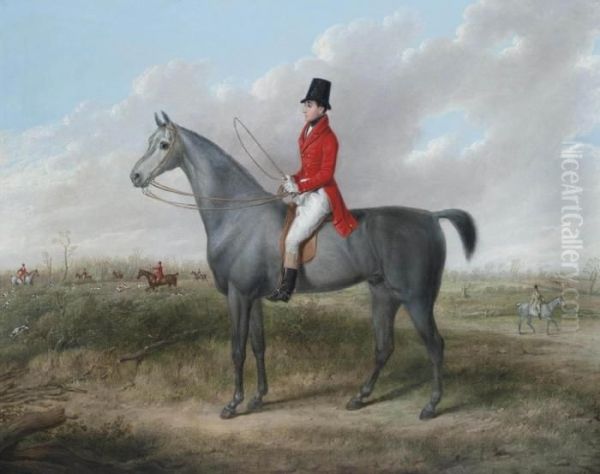
Another work, A Gentleman on His Grey Hunter, A Hunt Beyond, further illustrates Baldock's skill in this area. This painting, which fetched £2,750 at a 2012 auction, captures the dynamism of the hunt and the prized status of the hunter horse. The depiction of the "grey hunter" would have required careful attention to equine anatomy and conformation, qualities highly valued by patrons of such art. The "hunt beyond" suggests a narrative element, placing the gentleman within the context of a popular and socially significant rural activity.
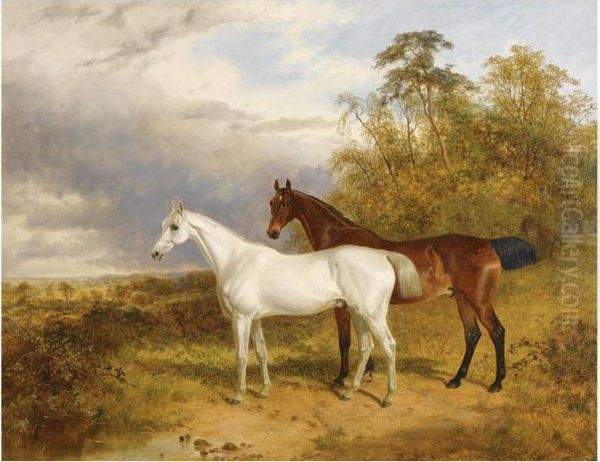
His painting A Bay and Grey Horse in a Landscape also points to his capabilities as an animal painter, focusing on the forms and characteristics of the horses themselves, set against a backdrop that provides context and atmosphere. This tradition of animal painting, as mentioned, had strong roots in British art, with artists like James Ward, a contemporary of the Romantic period but whose influence extended, known for his powerful depictions of animals and rustic scenes. Thomas Stringer, an earlier artist, also specialized in sporting and animal subjects, contributing to the lineage Baldock was part of.
Artistic Style and Technique
Based on the titles and descriptions of his works, James Walsham Baldock primarily worked in oils. His style appears to be rooted in the British tradition of naturalistic landscape painting. This implies a careful observation of nature, attention to detail in rendering foliage, animal anatomy, and the effects of light and atmosphere.
In his landscapes, particularly those of Sherwood Forest, one might expect a focus on the textures of bark, the patterns of leaves, and the interplay of light and shadow within the woodland interior. The titles Birches in Sherwood Forest and Early Autumn: Sherwood Forest suggest a sensitivity to the specific characteristics of different tree species and the changing seasons.
For his equestrian portraits and scenes like Arch Hall, Baldock would have combined his landscape skills with the ability to capture a likeness in human portraiture and to render horses with accuracy and vitality. The composition of such works often aimed to balance the figures with their setting, creating a harmonious depiction of country life. The success of these paintings depended on satisfying the patron's desire for a recognizable portrait of themselves, their family, and their prized animals, all set within a pleasing representation of their estate or a typical countryside scene.
While not explicitly associated with any radical artistic movements, Baldock's work would have benefited from the general Victorian appreciation for detailed representation. Unlike the Impressionists who were beginning to emerge in France during the latter part of Baldock's career, focusing on fleeting moments and the subjective experience of light, British landscape painting of this period, for the most part, retained a more descriptive and detailed character. Artists like Myles Birket Foster, though working primarily in watercolor, gained immense popularity for his charming and highly detailed depictions of rustic English cottages and countryside, reflecting a widespread taste for the picturesque and the meticulously rendered.
Exhibitions and Recognition
The available information indicates that James Walsham Baldock did achieve a degree of public visibility through exhibitions. His works were reportedly shown at prestigious venues such as the Royal Academy of Arts and the Royal Watercolour Society (though his primary medium seems to have been oil, he might have also worked in watercolor or exhibited in mixed shows). The Walker Art Gallery in Liverpool is also mentioned as a venue where his art was displayed.
Exhibiting at the Royal Academy was a significant mark of professional standing for an artist in Victorian Britain. The annual Summer Exhibition was a major event in the London social calendar, and having work accepted and well-hung could greatly enhance an artist's reputation and sales prospects. The fact that his paintings like Birches in Sherwood Forest and Near Cockglode, Sherwood Forest were sold from exhibitions in 1878, and Early Autumn: Sherwood Forest was exhibited in London in 1881, demonstrates that he was an active participant in the art market of his time.
The sale price of 21 guineas for his Sherwood Forest paintings in 1878 provides a tangible measure of his market value during his lifetime. While not commanding the astronomical sums of some of the era's superstars, this was a respectable price, indicating a steady demand for his particular style and subject matter. The later auction price of £2,750 in 2012 for A Gentleman on His Grey Hunter, A Hunt Beyond shows a continued, albeit niche, interest in his work among collectors of British traditional art.
Baldock in the Context of His Contemporaries
Placing James Walsham Baldock alongside his contemporaries helps to delineate his specific contribution. He was not a radical innovator in the vein of Turner, nor did he engage with the high moral or literary themes of many Pre-Raphaelites. His focus was more aligned with the numerous artists who catered to the Victorian love for the native landscape and the pursuits of country life.
His depictions of Sherwood Forest can be seen as part of a broader artistic engagement with specific, historically resonant British landscapes. While perhaps not imbuing them with the same epic grandeur as some, his work offered a more direct, observational approach. In the realm of equestrian and animal art, he followed in the tradition of artists who combined anatomical accuracy with a pleasing compositional sense, serving a clientele that valued these qualities.
Compared to an artist like Thomas Sidney Cooper, who became immensely successful with his formulaic but highly polished paintings of cattle and sheep in sunny pastoral settings, Baldock's range, including specific forest scenes and commissioned family portraits, might have been broader, though perhaps less commercially focused on a single, highly repeatable theme. The work of Alfred de Breanski Sr., known for his dramatic depictions of the Scottish Highlands and Welsh mountains, offers a contrast in terms of the type of landscape chosen, with Breanski favoring wilder, more rugged scenery than Baldock's typically more pastoral or sylvan English settings.
Legacy and Conclusion
James Walsham Baldock lived and worked until 1898, witnessing the full sweep of the Victorian era, from its mid-century confidence to the approaching fin de siècle. His artistic output reflects a consistent dedication to the traditions of British landscape and animal painting. He found a niche depicting the familiar and cherished aspects of the English countryside, particularly the unique character of Sherwood Forest, and in chronicling the lives and pastimes of the rural gentry.
His art does not shout for attention with radical techniques or controversial subject matter. Instead, it offers a quiet, competent, and affectionate portrayal of his world. The exhibitions at notable institutions and the recorded sales of his works indicate that he achieved a measure of success and recognition during his lifetime.
Today, James Walsham Baldock is perhaps a more specialist interest, appreciated by collectors of traditional British art and those with an interest in the specific locales he depicted. His paintings serve as valuable historical documents, not only of the landscapes themselves but also of the tastes and values of Victorian society. He was one of many artists who contributed to the rich tapestry of 19th-century British art, diligently capturing the enduring beauty of the land and the lives of its inhabitants. His legacy is that of a skilled craftsman and a faithful observer, whose work provides a pleasing and historically insightful glimpse into Victorian Britain's enduring love affair with its own countryside.