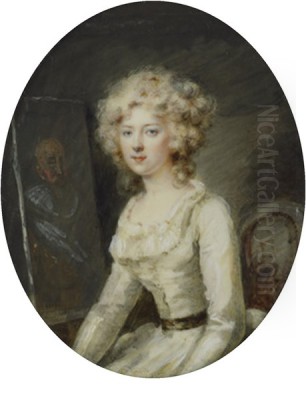
Jeanne-Philiberte Ledoux, born in Paris in 1767 and passing away in the same city on December 17, 1840, was a distinguished French painter. She carved a niche for herself in the bustling art world of late 18th and early 19th century France, a period marked by profound social and political upheaval, including the French Revolution and the Napoleonic era. Ledoux is primarily celebrated for her intimate and expressive portraits, particularly those of young women and children, which she exhibited at the prestigious Paris Salon between 1793 and 1819. Her work, often characterized by its delicate execution and sentimental charm, reflects the enduring appeal of such subjects even amidst the grandeur of Neoclassicism and the burgeoning drama of Romanticism.
Early Life and Artistic Formation
Born into a family with significant artistic connections, Jeanne-Philiberte’s path into the arts was perhaps more accessible than for many women of her time. It is widely believed, and supported by strong circumstantial evidence including her name, that she was the daughter of the renowned and visionary Neoclassical architect Claude-Nicolas Ledoux (1736-1806). Her father was a monumental figure in French architecture, known for his radical designs for the Saline Royale d'Arc-et-Senans and his ambitious, though largely unrealized, plans for the ideal city of Chaux. Growing up in such an environment would have undoubtedly exposed her to artistic discourse and practice from a young age.
Her formal artistic training was undertaken in the studio of Jean-Baptiste Greuze (1725-1805). Greuze was an immensely popular painter, famed for his sentimental genre scenes and his psychologically insightful portraits, particularly his "têtes d'expression" (expressive heads). His style, which emphasized naturalism, emotion, and often a subtle moral undertone, had a profound impact on his students. Ledoux absorbed these lessons, developing a similar sensitivity in her own portraiture, focusing on capturing the fleeting expressions and inner lives of her sitters. Greuze's studio was notable for welcoming female students, a practice not universally common at the time, and Ledoux was one of several women who benefited from his tutelage.
Navigating the Parisian Art World: The Salon
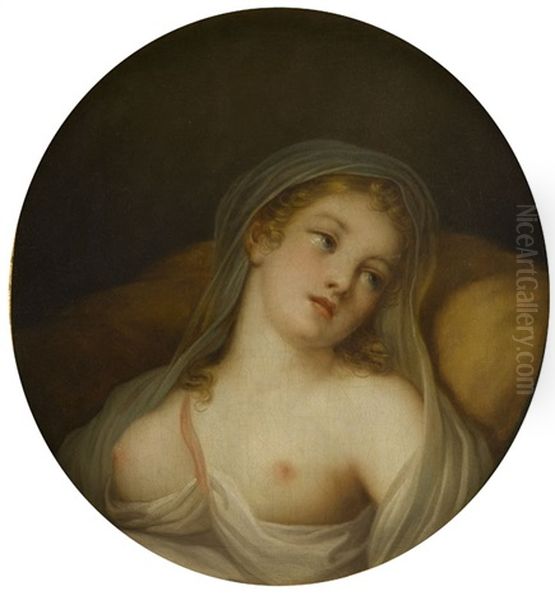
The Paris Salon, organized by the Académie Royale de Peinture et de Sculpture (and later its successors), was the most important public art exhibition in the Western world. For an artist, acceptance into the Salon was crucial for establishing a reputation, attracting patrons, and securing commissions. Jeanne-Philiberte Ledoux made her debut at the Salon of 1793, a tumultuous year in French history, and continued to exhibit her works there regularly until 1819.
Her participation in the Salon placed her within a vibrant, competitive, and evolving art scene. She exhibited alongside some of the most famous artists of her day. While Jacques-Louis David (1748-1825) was the towering figure of Neoclassicism, championing grand historical and allegorical subjects, the Salon also showcased a diversity of genres, including portraiture, landscape, and genre scenes, where artists like Ledoux found their voice.
For female artists, the Salon presented both opportunities and challenges. While the French Revolution initially brought a brief period of greater openness, allowing more women to exhibit, societal expectations and institutional biases still constrained their careers. Artists like Élisabeth Vigée Le Brun (1755-1842) and Adélaïde Labille-Guiard (1749-1803) had achieved remarkable success in the pre-Revolutionary era, but the path remained arduous. Ledoux, by consistently exhibiting, demonstrated her commitment and skill in this demanding environment.
Artistic Style and Thematic Focus
Jeanne-Philiberte Ledoux’s artistic style is characterized by its refinement, delicacy, and a gentle, often sentimental, approach to her subjects. Her brushwork is typically smooth and controlled, creating soft transitions in flesh tones and a subtle interplay of light and shadow. This technique lent itself well to her preferred subjects: young women and children.
Her portraits often focus on the "expressive head," a genre popularized by her master, Greuze. These works aimed to capture a particular emotion or state of mind, often imbuing the sitter with an air of innocence, contemplation, or gentle melancholy. Ledoux excelled at rendering the delicate features of youth, the soft texture of hair, and the luminous quality of young skin. Her palette was generally harmonious and restrained, contributing to the overall sense of intimacy and tenderness in her paintings.
The focus on women and children was not uncommon for female artists of the period, partly due to societal expectations and partly due to access to models. However, Ledoux’s depictions rise above mere convention through their genuine empathy and psychological acuity. She seemed to possess a particular ability to connect with her young sitters, capturing their unselfconscious charm and nascent personalities.
Key Works and Their Characteristics
Several works by Jeanne-Philiberte Ledoux exemplify her style and thematic concerns. While a comprehensive catalogue raisonné is still a subject of ongoing scholarship, notable examples frequently appear in collections and at auction.
One of her well-regarded paintings is often titled "Portrait of a Girl" (Retrato de niña). Such works typically feature a young female subject, often bust-length or half-length, with a direct yet gentle gaze. The emphasis is on the face, with careful attention paid to the eyes, which are often rendered with a liquid quality, conveying a sense of introspection or quiet emotion. The background is usually simple and unobtrusive, ensuring that the viewer's attention remains fixed on the sitter.
"Little Girl Holding a Dove" is another characteristic work. The inclusion of a dove, a traditional symbol of peace, love, and innocence, enhances the sentimental quality of the painting. The interaction between the child and the bird would have appealed to contemporary tastes, reflecting the Rousseauian emphasis on the natural innocence of childhood. Ledoux’s skill would be evident in the tender rendering of the child’s hands and the soft plumage of the dove.
A work sometimes referred to as "Boy with a Hatchet" or "Boy near an Apple with a Stick of Fists" (the latter title possibly a mistranslation or variation) demonstrates her ability to portray male children as well. These paintings, while less common than her depictions of girls, would still showcase her characteristic sensitivity and attention to individual character. The props, like a hatchet or an apple, might carry symbolic weight or simply serve as genre elements.
Other works, such as "Head of a Girl" and "Seated Girl Holding a Book," which have appeared at auction, further attest to her specialization. The girl with a book, for instance, might suggest themes of education, quiet contemplation, or the burgeoning intellectual life of young women, a topic of increasing interest during this period. Her watercolor works were also noted, with one fetching a respectable price at the Liddell auction in 1885, indicating a continued appreciation for her skill in this medium.
The intimate scale of many of her paintings, combined with their focus on personal expression, made them well-suited for private contemplation and domestic settings, rather than the grand public spaces often reserved for historical paintings.
A Network of Artists: Teachers, Peers, and Contemporaries
Jeanne-Philiberte Ledoux’s artistic journey was shaped by her interactions with other artists, both directly and indirectly.
Her primary mentor, Jean-Baptiste Greuze, was a pivotal figure. His influence extended beyond Ledoux to other notable female artists who studied with him, such as Constance Mayer (1775-1821). Mayer, like Ledoux, developed a refined style and often depicted sentimental subjects. She later became a close collaborator and companion of Pierre-Paul Prud'hon (1758-1823), another prominent artist whose soft, sfumato style and graceful figures shared some affinities with the Greuze school.
Another female artist associated with Greuze's circle was Marguerite Gérard (1761-1837), who was Greuze's sister-in-law and also a student of Jean-Honoré Fragonard. Gérard achieved considerable success with her intimate genre scenes, often depicting domestic life and women in leisurely pursuits, a thematic area that resonated with the interests of artists like Ledoux.
Marie-Geneviève Brossard de Beaulieu (1755-1832) was another contemporary female artist who, like Ledoux, studied with Greuze. Brossard de Beaulieu was versatile, working as a sculptor, painter, and gilder, and even founded a free drawing school for girls, highlighting the efforts of women to support each other in the arts. She exhibited at the Salon and received commissions, demonstrating the potential for female artists to achieve professional recognition.
Beyond Greuze's immediate circle, Ledoux worked during a time of extraordinary artistic ferment. The Neoclassical ideals championed by Jacques-Louis David and later by Jean-Auguste-Dominique Ingres (1780-1867) dominated official art. However, a counter-current of Romanticism was also emerging, with artists like Théodore Géricault (1791-1824) and Eugène Delacroix (1798-1863) exploring more dramatic and emotionally charged subjects. Ledoux’s work, with its emphasis on sentiment and individual psychology, can be seen as occupying a space that, while distinct from these grand movements, catered to a persistent demand for more personal and intimate art.
Other significant female artists of the broader period whose careers overlapped with Ledoux's include Élisabeth Vigée Le Brun and Adélaïde Labille-Guiard, both of whom were highly successful portraitists who navigated the complexities of royal and aristocratic patronage. Angélica Kauffman (1741-1807), a Swiss-Austrian Neoclassical painter active primarily in London and Rome, was another internationally renowned female artist whose success provided an inspiring example. Marie-Guillemine Benoist (1768-1826), a student of David, gained fame for her "Portrait of a Black Woman" (1800), a powerful and sensitive work that challenged conventions.
While direct records of Ledoux's interactions with all these figures may be scarce, she was undoubtedly aware of their work and the broader artistic currents they represented. Her father, Claude-Nicolas Ledoux, the architect, would have also connected her to a network of influential figures in the arts and society, even if his own career faced significant challenges during and after the Revolution. The mention of a connection to the master furniture maker Roger van der Cruse (Lacroix) (1728-1799) further suggests her embeddedness within the Parisian world of art and craftsmanship.
Later Career, Obscurity, and Legacy
Jeanne-Philiberte Ledoux enjoyed a period of notable popularity, particularly between 1804 and 1814, coinciding with the First French Empire. Her delicate and appealing portraits found favor among a clientele that appreciated their charm and sensitivity. She continued to exhibit at the Salon until 1819.
After this date, however, her presence in public records and exhibitions seems to diminish. The reasons for this are not entirely clear but could be attributed to a variety of factors, including changing artistic tastes, personal circumstances, or the increasing difficulty of securing patronage in a competitive market. The art world was in constant flux, and the styles that had brought her success might have gradually fallen out of vogue, or she may have chosen to retire from public exhibition.
Tragically, despite her period of success and the evident quality of her work, Jeanne-Philiberte Ledoux reportedly died in poverty in Paris on December 17, 1840. This unfortunate end was not unique among artists, especially women, who often lacked the sustained institutional support or financial independence available to some of their male counterparts.
Despite the relative obscurity into which she fell in the later 19th and early 20th centuries, Jeanne-Philiberte Ledoux's work has experienced a gradual rediscovery, particularly with the rise of scholarship focused on female artists. Art historians and collectors have increasingly recognized the quality and charm of her portraits. Her paintings are now found in various museum collections and continue to appear at art auctions, where they are appreciated for their technical skill and their sensitive portrayal of youth and femininity.
Conclusion: A Quiet Voice of Sensitivity
Jeanne-Philiberte Ledoux stands as a significant, if sometimes overlooked, figure in French art of the late 18th and early 19th centuries. As a student of Jean-Baptiste Greuze and likely the daughter of Claude-Nicolas Ledoux, she was well-positioned within the artistic milieu of her time. She skillfully navigated the competitive environment of the Paris Salon for over two decades, establishing a reputation for her refined and expressive portraits of young women and children.
Her art offers a more intimate and sentimental counterpoint to the dominant Neoclassical and burgeoning Romantic movements of her era. In her delicate brushwork, her empathetic portrayal of her sitters, and her focus on capturing subtle emotional states, Ledoux created a body of work that speaks to the enduring human interest in individual character and the charms of youth. While her later life was marked by hardship, her artistic contributions provide valuable insight into the diverse currents of French painting and the achievements of female artists in a transformative period of history. Her legacy is one of quiet sensitivity, technical finesse, and a heartfelt engagement with her subjects, ensuring her a respected place in the annals of art.