Johan Adam Klein (1792-1875) stands as a significant, if sometimes overlooked, figure in 19th-century German art. A prolific painter, etcher, and engraver, Klein's vast body of work offers a detailed and insightful window into the life, landscapes, and military conflicts of his time. His meticulous attention to detail, particularly in the depiction of horses and military subjects, combined with a sensitivity to the nuances of everyday life, places him firmly within the Biedermeier period, yet with undercurrents of Romanticism. This exploration delves into his life, artistic development, key works, stylistic characteristics, and his enduring, though often understated, legacy within the broader context of European art history.
Early Life and Artistic Awakening in Nuremberg
Born on November 24, 1792, in the historic city of Nuremberg, Johan Adam Klein was immersed from a young age in a region with a rich artistic heritage, famously home to Albrecht Dürer centuries earlier. Nuremberg, though past its medieval zenith, still fostered a strong tradition of craftsmanship and artistic production. Klein's innate talent for drawing became apparent early on, leading him to pursue formal artistic training.
His initial instruction in painting came from Georg Christoph von Bemmel, a local artist. However, a more formative period began around 1805, when, at the age of thirteen, Klein became an apprentice in the workshop of Ambrosius Gabler. Gabler was not only an artist but also a significant printer and art dealer in Nuremberg. This apprenticeship was crucial, as it was here that Klein was thoroughly trained in the techniques of copperplate engraving and etching. Gabler's collection and connections also exposed Klein to a wide array of artworks, notably 17th-century Dutch masters, whose influence, particularly in genre scenes and animal painting (artists like Paulus Potter and Philips Wouwerman), would resonate throughout Klein's career.
During these formative years, Klein developed a keen eye for observation and a disciplined hand, essential for the precise art of printmaking. He began to sketch prolifically, capturing the world around him – the bustling streets of Nuremberg, local characters, and, increasingly, animals, with a particular fascination for horses. This early focus on direct observation from life would become a hallmark of his artistic practice.
The Vienna Sojourn and the Napoleonic Imprint
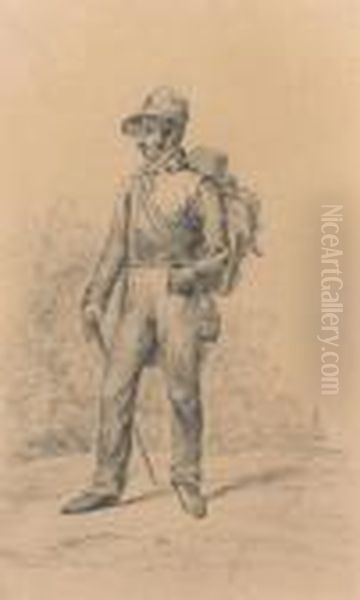
In 1811, armed with a recommendation from the Nuremberg artist and publisher Johann Friedrich Frauenholz, Johan Adam Klein embarked on a journey to Vienna. The Austrian capital was a major artistic center, and Klein sought to further his education and broaden his horizons. He enrolled at the Academy of Fine Arts Vienna, though his studies there were somewhat informal and self-directed, focusing more on independent work and observation than strict academic adherence.
His time in Vienna coincided with the tumultuous Napoleonic Wars. The city was a hub of military activity, with soldiers from various nations passing through. This environment profoundly impacted Klein. He was captivated by the military pageantry, the diverse uniforms, the meticulously equipped horses, and the daily life of the soldiers. These observations fueled a significant portion of his artistic output, leading to numerous sketches, watercolors, and etchings depicting soldiers, cavalry, military encampments, and baggage trains. His works from this period are characterized by their accuracy and lively detail, offering valuable historical records of military life. He was not alone in depicting these scenes; contemporaries like Albrecht Adam and Peter von Hess also gained renown for their battle paintings and military genre scenes.
Klein's studies in Vienna were briefly interrupted in 1815 when he undertook study trips to the Main and Rhine regions, as well as to Hungary. These journeys further enriched his visual vocabulary and provided new subjects for his sketchbooks. Despite the hardships of the post-war period, Klein's dedication to his art remained unwavering. He continued to refine his skills, particularly in etching, producing plates that demonstrated increasing technical mastery and compositional sophistication.
Travels, Rome, and Artistic Maturity
Following his Vienna years, Klein's desire for artistic growth led him to Italy, the traditional destination for Northern European artists seeking classical inspiration and picturesque landscapes. He arrived in Rome in 1819, a city teeming with international artists. Here, he encountered a vibrant community of German-speaking artists, including figures associated with the Nazarene movement like Johann Friedrich Overbeck and Peter von Cornelius, though Klein’s own artistic inclinations remained more grounded in realism than their idealized religious and historical subjects. He would have also been aware of landscape painters like Joseph Anton Koch, whose heroic landscapes of the Italian countryside were highly influential.
In Rome, Klein continued to sketch and paint, capturing the Italian scenery, local customs, and, of course, the ever-present animals. His Italian works often display a brighter palette and a greater sensitivity to atmospheric effects, influenced by the Mediterranean light. He formed close friendships with fellow artists, most notably Johann Christoph Erhard and the Reinhold brothers (Heinrich and Friedrich Philipp). These friendships were not merely social but also artistically stimulating. They often embarked on sketching expeditions together, sharing insights and inspiring one another. This camaraderie is beautifully captured in works like Klein's etching "The Painters' Journey" (1819), which depicts a group of artists, likely including himself and Erhard, on a sketching tour in a mountainous landscape, embodying the Romantic ideal of artistic fellowship in nature.
After his Italian sojourn, Klein returned to Nuremberg for a period before eventually settling in Munich in 1839, which had by then become a major art center under King Ludwig I. He remained highly productive throughout his life, continuing to create paintings and, most notably, a vast number of prints.
Artistic Style: Biedermeier Realism and Romantic Sensibilities
Johan Adam Klein's artistic style is most closely associated with the Biedermeier period, a Central European artistic and cultural movement that flourished between roughly 1815 (the Congress of Vienna) and 1848 (the year of European revolutions). Biedermeier art emphasized realism, domesticity, sentimentality, and a focus on the everyday life of the burgeoning middle class. Klein’s meticulous depiction of genre scenes, his attention to detail in clothing and environment, and his unpretentious subject matter align well with these characteristics.
His realism was exacting. Whether depicting the musculature of a horse, the intricate details of a soldier's uniform, or the texture of a stone wall, Klein demonstrated an unwavering commitment to accuracy. This was particularly evident in his animal studies. He possessed an almost scientific understanding of equine anatomy, allowing him to portray horses with remarkable vitality and correctness in various poses and actions. This skill drew comparisons to earlier masters of animal painting and set him apart as a leading animalier of his time. Artists like George Stubbs in England had earlier set a high bar for anatomical accuracy in horse painting, a tradition Klein continued in a German context.
However, to label Klein solely as a Biedermeier realist would be to overlook the Romantic undercurrents in his work. His landscape etchings, while detailed, often evoke a sense of atmosphere and a quiet appreciation for nature. His depictions of artists traveling together, as seen in "The Painters' Journey," reflect the Romantic emphasis on friendship, shared experience, and the artist's engagement with the natural world. There's a subtle poetry in his compositions, a quiet dignity afforded to his subjects, whether they are soldiers, peasants, or animals. This blend of objective observation and subtle emotional resonance is a key feature of his art. He shared this nuanced approach with other German Romantic realists like Ludwig Richter or Carl Spitzweg, though Klein's focus was often more on the dynamic and less on the idyllic or humorous.
Mastery in Printmaking: Etchings and Engravings
While Johan Adam Klein was a competent painter, his most significant and enduring contribution to art history lies in his prolific output as a printmaker. He produced over 2000 prints, primarily etchings, but also engravings and lithographs. His mastery of the etching needle was exceptional, allowing him to achieve a remarkable range of tones, textures, and details.
His prints cover a wide array of subjects: military scenes from the Napoleonic Wars, detailed studies of horses and other animals, genre scenes of rural and urban life, landscapes, and portraits. Many of his prints were based on his own on-the-spot sketches, imbuing them with a sense of immediacy and authenticity. He often published his prints in series or as individual sheets, which found a ready market among collectors and the public. The accessibility of prints made his work widely known.
Klein's etchings are characterized by their fine, precise lines, skillful use of cross-hatching to create shadow and volume, and well-balanced compositions. He often included meticulous details in the foreground and background, creating a rich and engaging visual experience. Many of his prints feature wide margins and include his signature, date, and sometimes a title or descriptive text, reflecting the care he took in their presentation. His technical proficiency was on par with other notable European printmakers of the era, such as the French artist Charles-Émile Jacque, who also specialized in rural scenes and animals.
The sheer volume of his graphic work is astonishing. Catalogues of his prints, such as the one compiled by C. Jahn (later revised by C. J. Wawra), attest to his relentless productivity. His prints served not only as artworks in their own right but also as important visual documents of his time, capturing aspects of society, military campaigns, and everyday life that might otherwise have been lost to history.
Key Collaborations and Artistic Circle
Johan Adam Klein was not an isolated artist; he thrived within a network of friendships and professional relationships. His most significant artistic bond was with Johann Christoph Erhard (1795-1822), a fellow Nuremberg artist who also specialized in animal and landscape etchings. Klein and Erhard were inseparable friends and frequent collaborators, often traveling and sketching together. Their styles were complementary, and they shared a deep mutual respect. Klein's poignant etching, "Klein und sein Freund Erhard zu Pferd" (Klein and his Friend Erhard on Horseback), is a testament to their close bond, depicting the two artists on a journey. Erhard's tragically early death in 1822 was a profound loss for Klein.
Beyond Erhard, Klein interacted with numerous other artists. During his time in Vienna and Rome, he was part of a lively community of German-speaking artists. The Reinhold brothers, Heinrich and Friedrich Philipp, were also part of his Roman circle. He collaborated on projects, such as the series "Illustrations of Napoleon's Military Defeats," which he co-created with Wilhelm von Kobell, a renowned Bavarian painter of battle scenes and animals. Such collaborations were common at the time, allowing artists to combine their strengths.
His association with publishers like Johann Friedrich Frauenholz in Nuremberg was also crucial for the dissemination of his prints. These relationships ensured that his work reached a wider audience and provided him with a steady income. The artistic environment of Nuremberg, Vienna, Rome, and later Munich, provided Klein with both inspiration and a supportive network that nurtured his talent. He would have been aware of the work of other German printmakers like Daniel Chodowiecki, whose earlier genre scenes in print set a precedent.
Notable Works and Their Significance
Given his vast output, selecting a few representative works is challenging, but several stand out for their artistic merit and historical importance.
"Illustrations of Napoleon's Military Defeats" (series, with Wilhelm von Kobell): This series of hand-colored engravings vividly captures the drama and human cost of the Napoleonic campaigns. Klein's contribution focused on the detailed depiction of soldiers, horses, and equipment, showcasing his keen observational skills and ability to render complex scenes with clarity.
"Two Cavalrymen: Hussar and Light Cavalryman with Led Horse": This work is typical of Klein's military genre scenes. It displays his mastery in portraying horses in various stances and his meticulous attention to the details of uniforms and accoutrements. The composition is balanced, and the figures are rendered with a sense of naturalism.
"The Painters' Journey" (1819, etching): As mentioned earlier, this iconic etching depicts four artists (likely including Klein and Erhard) on a sketching expedition in a mountainous landscape. It symbolizes the Romantic ideal of artistic friendship and the shared pursuit of inspiration in nature. The figures are dwarfed by the majestic scenery, yet their camaraderie is palpable.
"View North from Wien" (1811) and "View of the Danube from Leopolds und Kalesch Mountains" (1811): These early landscape etchings demonstrate Klein's ability to capture specific locales with accuracy while also imbuing them with a sense of atmosphere. They showcase his developing skill in rendering perspective and natural detail.
Works cataloged as 71-76 (Jahn/Wawra catalogue): This group includes various scenes of riding, horse-drawn carriages, views of Vienna, and the Knights' Hall at Laxenburg. For example, catalogue number 71 refers to a set of six prints from 1811 depicting horses in various equestrian and carriage scenarios, highlighting his early and enduring fascination with these animals. These works exemplify his Biedermeier focus on everyday activities and specific locations.
"Legere" (etching): This specific title, if referring to a light cavalryman or a general theme of lightness and agility, would fit well within his oeuvre of military and equestrian subjects. Such works, often donated to public collections like the one by the Fazzano brothers, help preserve his legacy.
His numerous individual studies of horses, dogs, and other animals are also highly prized for their anatomical accuracy and lifelike portrayal. Each sketch or etching, no matter how small, reveals Klein's dedication to his craft and his profound understanding of his subjects.
Later Life and Continued Production in Munich
In 1839, Johan Adam Klein relocated to Munich, the capital of Bavaria, which under King Ludwig I had become a vibrant artistic hub, attracting artists from all over Germany and beyond. Munich offered new opportunities, a thriving art market, and prestigious institutions like the Academy of Fine Arts. Here, Klein continued his prolific career, producing paintings and a steady stream of prints.
He remained active well into his old age, his passion for art undiminished. His later works show a consistent adherence to the realistic style he had honed throughout his career, though perhaps with an even greater refinement of technique. He continued to find subjects in the Bavarian landscape, in the city life of Munich, and in his beloved animals. His reputation as a master printmaker and a skilled animalier was firmly established.
Johan Adam Klein passed away in Munich on March 4, 1875, at the age of 82. He left behind an immense body of work that serves as a rich visual chronicle of his era. His dedication to his craft, his meticulous observation, and his ability to capture the essence of his subjects ensured his place in the annals of German art.
Legacy and Historical Evaluation
Johan Adam Klein is primarily remembered today for his exceptional contributions to printmaking and his masterful depictions of horses and military life. He is considered one of the foremost German etchers of the Biedermeier period. His work is valued for its technical skill, its historical accuracy, and its charming, unpretentious portrayal of 19th-century life.
While he may not have achieved the same level of international fame as some of his more overtly Romantic contemporaries like Caspar David Friedrich or the grand history painters, Klein's art possesses an enduring appeal. His prints are sought after by collectors and are held in major museum collections across Europe and North America, including the Albertina in Vienna, the British Museum in London, and various German print rooms. Exhibitions of his work, though perhaps not frequent blockbusters, continue to affirm his skill and historical importance. For instance, an exhibition at the Frauenhotel Nürnberg would serve to highlight his roots and contributions to his native city's artistic heritage.
Historically, Klein's art provides invaluable documentation of the Napoleonic era, military customs, and the social fabric of Germany and Austria in the first half of the 19th century. His detailed renderings of uniforms, weaponry, and equestrian equipment are a resource for historians. Beyond their documentary value, his works are appreciated for their artistic qualities – the lively compositions, the expressive rendering of animals, and the subtle humanism that pervades his genre scenes.
In the broader context of German art, Klein represents a particular strand of realism that coexisted with and sometimes intertwined with Romanticism. He was less concerned with the sublime or the allegorical than with the tangible world around him. His art celebrates the beauty and interest to be found in the ordinary, a hallmark of the Biedermeier sensibility. His influence can be seen in later German artists who specialized in genre scenes and animal painting, continuing a tradition of careful observation and skilled draftsmanship. Artists like Franz Krüger in Berlin, known for his equestrian portraits and parade scenes, worked in a similar vein.
Johan Adam Klein's legacy is that of a dedicated, highly skilled, and incredibly prolific artist. His thousands of etchings, engravings, and drawings offer a rich tapestry of his times, rendered with an honest eye and a masterful hand. He remains a key figure for understanding the artistic currents of 19th-century Germany, particularly the nuanced world of Biedermeier realism and the enduring tradition of fine printmaking.