Johann Georg Ziesenis: A Master of 18th-Century European Portraiture
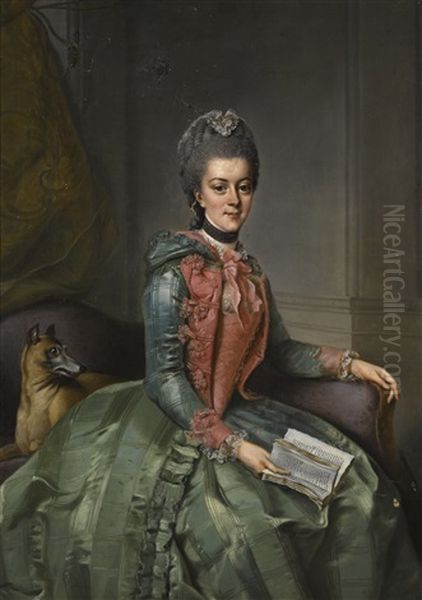
The 18th century was a period of profound transformation in Europe, an era marked by the intellectual ferment of the Enlightenment, the shifting tides of political power, and the flourishing of distinct artistic styles. Amidst this dynamic backdrop, portraiture remained a vital genre, serving not only to record likenesses but also to convey status, power, and evolving notions of individual identity. Within this specialized field, Johann Georg Ziesenis (1716-1776) emerged as a significant figure, a German-Danish painter whose meticulous technique and insightful characterizations earned him commissions from some of the most prominent royal and aristocratic houses of his time. His career, spanning several decades and geographical locations, offers a fascinating window into the world of courtly art and the nuanced aesthetics of the Rococo and late Baroque periods.
Early Life and Artistic Foundations
Johann Georg Ziesenis was born in Copenhagen in 1716. His father, Johann Georg Ziesenis the Elder (sometimes referred to as Jürgen Ziesenis), was himself a painter of German origin, likely providing the young Ziesenis with his initial exposure to the artistic craft. Growing up in an artist's household would have undoubtedly immersed him in the materials, techniques, and prevailing artistic discussions of the day. While specific details of his earliest training are somewhat scarce, it is reasonable to assume he received foundational instruction from his father, learning the rudiments of drawing, composition, and paint handling.
The artistic environment of Copenhagen in the early 18th century was influenced by broader European trends, with Dutch Golden Age painting still holding sway and French Rococo beginning to make its mark. Artists like Hendrick Krock and Benoît le Coffre were active in Denmark around this period, contributing to a rich, albeit perhaps not centrally dominant, artistic milieu. Ziesenis's early development would have been shaped by these influences, though his later career would see him more firmly rooted in the German states.
A pivotal moment in his personal and professional life occurred in 1743 when Ziesenis became a German citizen. This step likely facilitated his ability to work and seek patronage within the various German principalities, which were significant centers of artistic consumption. His movements during this period suggest a young artist actively seeking opportunities and honing his skills, possibly undertaking journeyman-like travels, a common practice for aspiring craftsmen and artists of the era.
The Development of a Distinctive Style: Baroque Grandeur and Rococo Intimacy
Ziesenis's artistic style is often characterized as belonging to the late Baroque, yet it also incorporates the elegance and lighter palette associated with the Rococo. His works demonstrate a remarkable ability to capture not only the physical likeness of his sitters but also a sense of their personality and social standing. This was achieved through a combination of meticulous attention to detail, particularly in the rendering of fabrics and adornments, and a sensitive approach to facial expression and posture.
A significant turning point in his artistic development reportedly occurred in the 1750s. It is noted that Ziesenis consciously studied the works of the Flemish Baroque masters Peter Paul Rubens and Anthony van Dyck. This engagement with the titans of 17th-century painting likely helped him overcome any earlier technical limitations and refine his ability to imbue his portraits with a greater sense of dynamism, richer color, and more sophisticated compositions. Rubens's robust figures and vibrant energy, and Van Dyck's unparalleled elegance in aristocratic portraiture, would have offered powerful models for an ambitious portraitist.
His brushwork became known for its delicacy, allowing for smooth transitions and a refined finish, particularly in rendering the textures of silk, lace, and velvet, which were de rigueur in aristocratic attire. Furthermore, Ziesenis demonstrated a keen understanding of light and shadow (chiaroscuro), using it not merely for modeling form but also to create mood and highlight the sitter's features. This careful manipulation of light contributed to the lifelike quality of his portraits and enhanced their dramatic impact, a hallmark inherited from the Baroque tradition. He often depicted his subjects with an air of dignified composure, yet there is frequently a subtle psychological insight that elevates his work beyond mere formal representation.
A Sought-After Court Painter
The culmination of Ziesenis's rising reputation came in 1760 when he was appointed court painter to the Elector of Hanover. At this time, the Elector of Hanover was also King George III of Great Britain, a personal union that created significant cultural and political ties between the German electorate and the British crown. This appointment was a prestigious one, placing Ziesenis in a position to receive regular commissions from the ruling family and their extensive network of courtiers and associates. Court painters were integral to the projection of power and image; their works served as diplomatic gifts, family records, and public declarations of status and lineage.
As a court painter, Ziesenis would have been expected to produce portraits in various formats, from grand, full-length state portraits to more intimate, smaller-scale works. His duties likely extended beyond simply painting the Elector and his immediate family to include other members of the court and visiting dignitaries. This role required not only artistic skill but also diplomatic tact and an understanding of courtly etiquette.
His connection to the Hanoverian court also facilitated his work for other royal houses. The interconnectedness of European aristocracy meant that a successful portrait of one royal could lead to commissions from their relatives in other courts. Ziesenis's ability to satisfy the demanding tastes of his patrons ensured a steady stream of work and cemented his reputation across Northern Europe. He was, in essence, part of a network of esteemed portraitists serving the elite, a group that included artists like Antoine Pesne at the Prussian court, Jean-Étienne Liotard with his sought-after pastels, and later, figures like Élisabeth Vigée Le Brun in France.
Masterpieces and Prominent Sitters
Johann Georg Ziesenis's oeuvre includes numerous portraits of European royalty and aristocracy, each reflecting his characteristic style and attention to detail. Among his most celebrated and representative works are:
Portrait of Princess Charlotte of Mecklenburg-Strelitz (later Queen Charlotte of Great Britain): This is perhaps one of his most historically significant commissions. Painted around the time of her marriage to King George III in 1761, Ziesenis created several versions. These portraits were crucial in introducing the future queen to her new subjects and establishing her royal image. Ziesenis depicted her with youthful grace, adorned in lavish attire that spoke to her new station. The paintings capture a sense of gentle dignity, and the meticulous rendering of her elaborate gown and jewels showcases Ziesenis's skill. These portraits are important not only as likenesses but also as documents of high fashion and royal presentation. It's interesting to note that other artists, such as Allan Ramsay, also famously painted Queen Charlotte, offering stylistic comparisons from the period.
Portrait of Stadtholder William V of Orange (1763): As the leader of the Dutch Republic, William V was a key figure in European politics. Ziesenis's portrait of him conveys authority and youthful confidence. The Stadtholder is typically shown in formal attire, often with military accoutrements or symbols of his office, set against a backdrop that might include classical columns or rich drapery, elements common in state portraiture. The attention to the textures of his uniform and the insignia of his rank would have been paramount. Such portraits served to reinforce the sitter's power and legitimacy.
Portrait of Princess Sophia Wilhelmina of Prussia (1768-1769): Sophia Wilhelmina was the wife of Stadtholder William V. Ziesenis painted her on multiple occasions, often as a pendant to portraits of her husband. These works emphasize her regal bearing and fashionable elegance. The depiction of her elaborate hairstyles, sumptuous gowns, and delicate jewelry are characteristic of Ziesenis's refined technique. These portraits often aimed to present an image of dynastic stability and cultural sophistication.
Portraits of Frederick the Great and his Family: Ziesenis is also known to have painted members of the Prussian royal family, including relatives of Frederick II, known as Frederick the Great. While some sources suggest he painted Frederick the Great himself, this claim is sometimes disputed or attributed to copies after an original that may or may not have been by Ziesenis. Nevertheless, his association with the Prussian court, even if primarily through other family members, underscores his high standing. Artists like Antoine Pesne were long-established at Frederick's court, providing a rich tradition of royal portraiture in Prussia.
His works often feature what has been termed "private court portraiture," where sitters might be depicted in slightly less formal settings or poses, allowing for a greater sense of intimacy and individual character to emerge, a subtle nod to the burgeoning Enlightenment emphasis on the individual. This contrasted with the more rigid, purely ceremonial portraits of earlier Baroque masters, though Ziesenis could certainly deliver grandeur when required.
Ziesenis in the Broader Artistic Context of the 18th Century
To fully appreciate Ziesenis's contribution, it's essential to place him within the wider artistic landscape of the 18th century. This era saw the flourishing of the Rococo style, particularly in France with artists like François Boucher, Jean-Honoré Fragonard, and Jean-Marc Nattier, known for their light-hearted themes, pastel palettes, and decorative elegance. While Ziesenis's work retains a certain gravitas from his Baroque inheritance, the refinement, attention to luxurious detail, and sometimes softer portrayal of his sitters show an affinity with Rococo sensibilities.
In Germany, the artistic scene was diverse. While some artists embraced the full exuberance of Rococo, others, like Anton Raphael Mengs (a contemporary, though with a different trajectory), became pioneers of Neoclassicism, looking to the clarity and order of classical antiquity. Ziesenis navigated a path that blended established traditions with contemporary tastes. His meticulous realism and psychological acuity found favor with patrons who desired both accurate likenesses and an affirmation of their status. Other German-speaking portraitists of note during or overlapping his time include Anna Dorothea Therbusch, who gained recognition in Berlin and Paris, and later, Angelica Kauffman, a Swiss-Austrian artist who achieved international fame and was a founding member of the Royal Academy in London.
In Great Britain, the portraiture scene was dominated by figures like Sir Joshua Reynolds and Thomas Gainsborough. Reynolds, the first president of the Royal Academy, advocated for the "Grand Manner," often imbuing his sitters with classical or historical allusions. Gainsborough, while also capable of grandeur, was celebrated for his more naturalistic and fluid style, often integrating his figures into landscape settings. Ziesenis's portraits of Queen Charlotte would have been seen in a context where these British masters were also highly active.
The Enlightenment also played a role in shaping portraiture. There was an increasing interest in capturing individual character and intellect, moving beyond mere representation of rank. While Ziesenis's portraits are undeniably focused on the elite, his ability to convey a sense of the sitter's inner life, however subtly, aligns with this broader cultural shift. Artists across Europe, from the pastellists Maurice Quentin de La Tour and Jean-Baptiste Perronneau in France, known for their penetrating psychological likenesses, to Pompeo Batoni in Rome, who painted many Grand Tour visitors, were all responding to this demand for portraits that were both representative and revealing.
Ziesenis's approach, therefore, can be seen as a skillful synthesis. He maintained the dignity and formality expected of court portraiture, drawing on Baroque conventions, while infusing his work with Rococo elegance and a nuanced attention to individual character that resonated with the spirit of his age. He did not radically innovate in the manner of a Goya (who came later) or experiment with the informality of some of Gainsborough's work, but he perfected a style that was highly suited to the needs and tastes of his patrons.
Anecdotes and Professional Standing
Several anecdotes and observations highlight Ziesenis's professional life and standing. His decision to study Rubens and Van Dyck in the 1750s, leading to a "technical breakthrough," suggests an artist committed to continuous self-improvement and aware of the standards set by past masters. This dedication to craft was essential for success in the competitive field of court portraiture.
His extensive work for various European royal families, particularly the British and Dutch, speaks volumes about his reputation. The commission to paint Princess Charlotte, a future queen, was a significant endorsement of his abilities. These royal portraits were not just private commissions; they were public statements, and the choice of artist was itself a reflection of taste and discernment. The fact that his portraits of Queen Charlotte were disseminated and copied indicates their importance.
The mention of a disputed encounter or portrait of Frederick the Great, while unclear in its specifics, still points to Ziesenis operating within the highest echelons of European society. Even if he did not paint the formidable Prussian king directly, his work for other members of the Prussian royal house placed him in that orbit.
Unlike some artists who formed prominent workshops with numerous assistants or engaged in public rivalries, Ziesenis's career appears to have been characterized more by consistent, high-quality individual production for specific patrons. The provided information notes a lack of direct evidence of significant collaborations or overt competitions with other named painters of his stature, which might suggest a more focused, commission-driven practice. This contrasts with, for example, the highly public rivalries seen in the Paris Salons or the collaborative workshop practices of earlier eras. His sphere was the more contained, though no less demanding, world of the royal courts.
Later Years and Legacy
Johann Georg Ziesenis continued to work productively throughout his career. In his later years, he chose to return to Hanover, the city where he had served as court painter and which had been a significant center for his professional life. He passed away in Hanover in 1776.
His legacy rests on his contribution to 18th-century portraiture. He is rightly considered one of the most accomplished portrait painters of his time in the German-speaking lands and beyond, particularly for his royal commissions. His works are valued not only for their artistic merit—their fine execution, pleasing compositions, and sensitive characterizations—but also as invaluable historical documents. They provide vivid visual records of key figures of the era, their fashions, and the material culture of the courts they inhabited.
Ziesenis's paintings can be found in numerous major museum collections and royal collections across Europe, including the Royal Collection Trust in the United Kingdom, the Rijksmuseum in Amsterdam, and various German museums. These holdings ensure that his work continues to be studied and appreciated by art historians and the public alike.
While he may not have founded a major school or dramatically altered the course of art history in the way some of his more revolutionary contemporaries did, Ziesenis excelled within his chosen specialization. He masterfully fulfilled the demands of courtly representation, creating portraits that were both elegant and insightful, capturing the likeness and the spirit of Europe's elite during a fascinating period of transition. His ability to blend the grandeur of the Baroque with the refined sensibility of the Rococo, all while delivering a high degree of realism and psychological nuance, secures his place as a distinguished master of 18th-century portraiture. His dedication to his craft and the consistent quality of his output mark him as a significant artist whose contributions continue to enrich our understanding of European art and history.