Johann Ludwig Ernst Morgenstern: A Frankfurt Master of Interiors, Miniatures, and Restoration
Johann Ludwig Ernst Morgenstern stands as a significant figure in late 18th and early 19th-century German art. Born in Rudolstadt, Thuringia, in 1738, he emerged from a lineage steeped in artistic tradition, a family that would ultimately span at least five generations of painters. As a painter, meticulous restorer, and skilled etcher, Morgenstern carved a distinct niche for himself, particularly in Frankfurt am Main, where he became a respected citizen and a prolific contributor to the city's vibrant artistic milieu. His legacy is characterized by a dedication to detailed realism, a mastery of complex perspectives, especially in his famed church interiors, and a commitment to the preservation and replication of artistic heritage.
Early Life and Artistic Foundations
The seeds of Johann Ludwig Ernst Morgenstern's artistic journey were sown in fertile ground. His father, Johann Christoph Morgenstern (1709-1767), was himself a painter, providing the young Ernst with his initial instruction and immersion into the world of art. This familial apprenticeship was a common and crucial mode of artistic education in the 18th century, ensuring the transmission of skills and workshop practices from one generation to the next. The Morgenstern household was likely a hub of artistic activity, filled with the tools, materials, and discussions that would have profoundly shaped the young artist's development.
Rudolstadt, his birthplace, was the capital of the small principality of Schwarzburg-Rudolstadt. While not a major artistic center on par with Dresden or Berlin, it possessed a court and a cultural environment that supported artists. The broader artistic landscape of Thuringia and Saxony, with their rich traditions in painting and crafts, would have formed the backdrop to his early artistic consciousness.
To further hone his skills beyond his father's tutelage, Morgenstern sought more formal training. This was a critical step for an aspiring artist aiming to transcend regional limitations and engage with broader artistic currents. His ambition led him to institutions and experiences that would refine his technique and expand his artistic vocabulary.
Formative Years: Salzdahlum and Early Travels
A pivotal moment in Morgenstern's formal education occurred in 1766 when he enrolled at the gallery academy in Salzdahlum, near Wolfenbüttel. The Salzdahlum Gallery, housing the extensive art collection of the Dukes of Brunswick-Wolfenbüttel, was a treasure trove of Old Master paintings. Here, students could study and copy works by renowned Dutch, Flemish, Italian, and German masters. This practice of copying was fundamental to artistic training, allowing students to deconstruct and internalize the techniques, compositions, and color palettes of established artists.
At Salzdahlum, Morgenstern studied under Ludwig Wilhelm Busch (1703-1772), a painter and inspector of the ducal gallery. Busch's guidance would have been instrumental in directing Morgenstern's studies and deepening his understanding of art history and connoisseurship. The experience at Salzdahlum undoubtedly fueled Morgenstern's interest in the Dutch and Flemish schools, whose influence is palpable in his later work, particularly in his meticulous attention to detail and his skillful rendering of light and texture. He also reportedly spent time studying at a monastery in Braunschweig (Brunswick), further immersing himself in artistic and perhaps architectural studies.
Following his academic training, Morgenstern embarked on a period of travel, a common practice for artists seeking to broaden their horizons and establish their careers. In 1768, he journeyed to Hamburg, a bustling port city with a thriving commercial and cultural life. In Hamburg, he began to establish himself as an art restorer, a profession that required not only technical skill but also a deep understanding of materials and artistic techniques. This work would become a significant and enduring part of his career.
During his time in Hamburg, Morgenstern briefly worked in the studio of Christian Georg Schütz the Elder (1718-1791). Schütz was a prominent Frankfurt-based landscape painter known for his idyllic river scenes, often in the style of Dutch masters like Herman Saftleven. This association, however brief, provided Morgenstern with valuable exposure to a successful contemporary artist's workshop and further connections within the German art world.
His travels continued, and in 1770, he was in Darmstadt. Here, he undertook a commission to paint a portrait for Johann Konrad Seekatz (1719-1768), a notable painter of genre scenes and court painter to the Landgraves of Hesse-Darmstadt. Although Seekatz had passed away two years prior, the commission suggests Morgenstern was gaining recognition and that his skills were in demand. This period of travel and varied experiences equipped him with a versatile skill set and a growing reputation.
Frankfurt am Main: A New Home and Flourishing Career
The year 1772 marked a significant turning point in Johann Ludwig Ernst Morgenstern's life and career. He made the decision to settle in Frankfurt am Main, a city that would become his home and the primary locus of his artistic activities for the remainder of his life. Frankfurt, a Free Imperial City, was a major commercial and financial center, boasting a wealthy bourgeoisie with a keen interest in art. This environment provided ample opportunities for patronage and a vibrant artistic community.
Shortly after his arrival, in the same year, Morgenstern achieved the status of a "freier Bürger" (free citizen) of Frankfurt. This was an important civic status that granted him rights and privileges, including the ability to practice his profession independently and participate more fully in the city's life. It signified his commitment to Frankfurt and his acceptance within its society.
In Frankfurt, Morgenstern's multifaceted talents found full expression. He continued his work as a painter, focusing increasingly on genres that found favor with local collectors. His reputation grew, particularly for his meticulously rendered church interiors and his lively battle scenes. These paintings appealed to the tastes of a clientele that appreciated technical skill, detailed realism, and subjects that were both edifying and engaging.
He also established himself as a leading art restorer in the city. His expertise in this field was highly valued, as wealthy collectors and institutions sought to preserve and maintain their art collections. Restoration work not only provided a steady income but also gave Morgenstern intimate access to a wide range of artworks, further deepening his knowledge of Old Master techniques.
Artistic Style and Thematic Focus
Johann Ludwig Ernst Morgenstern's artistic style is often situated within the currents of late Baroque and early Neoclassicism, with strong elements of realism that foreshadow later developments in German art. He was a versatile artist, adept in several genres, but certain themes and stylistic characteristics define his oeuvre.
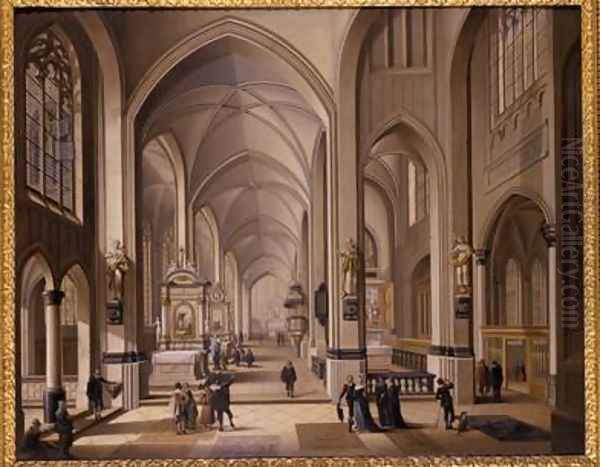
Church Interiors: Perhaps his most celebrated genre, Morgenstern's church interiors are masterpieces of perspective and light. He depicted the grand Gothic cathedrals of Frankfurt and other German cities with astonishing accuracy. These works showcase his mastery of linear perspective, creating a convincing illusion of depth and spatial complexity. His rendering of light, often streaming through stained-glass windows to illuminate intricate architectural details, stone textures, and wooden furnishings, is particularly noteworthy. These paintings were not merely architectural records; they often included small figures, adding a sense of scale and human presence, and evoking a contemplative, reverent atmosphere. His approach to this genre shows an affinity with 17th-century Dutch masters like Pieter Saenredam and Emanuel de Witte, who specialized in similar subjects.
Battle Scenes: Morgenstern also gained renown for his depictions of battle scenes. These compositions were typically dynamic and filled with figures, capturing the drama and chaos of military engagements. Such paintings were popular for their historical or allegorical content and allowed the artist to display his skill in rendering human anatomy, equine forms, and complex group arrangements.
Landscapes: While perhaps less central to his fame than his church interiors, Morgenstern also produced landscape paintings. Some of these, like the mentioned Tivoli Waterfalls, suggest an engagement with the picturesque and sublime, popular themes in late 18th-century landscape art, often inspired by Italianate scenery or the works of artists like Jacob van Ruisdael, whose works he is known to have copied. His German landscapes, such as Bauernhof anagoria (1794), depict tranquil rural scenes with a focus on everyday life and the harmonious integration of figures and nature.
Miniatures and Small-Scale Works: A distinctive aspect of Morgenstern's output was his creation of miniature paintings and small-scale cabinet pieces, often featuring religious scenes. His skill as a micro-painter was remarkable, and an anecdote survives that he continued this intricate work without the aid of eyeglasses even in his advanced years. This demonstrates exceptional eyesight and an incredibly steady hand. These miniatures were highly prized by collectors for their exquisite detail and craftsmanship.
General Stylistic Traits: Across his diverse subjects, Morgenstern's work is characterized by fine lines, clear and often cool color palettes, and an unwavering commitment to precise detail. Some critics have noted a certain "coldness" or smoothness in his finish, occasionally comparing the texture to that of Chinese painting. This meticulousness, however, can also be seen as a hallmark of the Enlightenment-era emphasis on observation and accuracy. His paintings often exhibit a polished, almost enamel-like surface.
The Art of Restoration and Copying
Beyond his original compositions, Johann Ludwig Ernst Morgenstern was a highly respected art restorer and copyist. In the 18th century, these activities were not seen as secondary to original creation but as integral parts of an artist's skill set and contribution to the art world. Restoration required a profound understanding of historical painting techniques, materials, and the chemistry of pigments. Morgenstern's expertise in this area was sought after in Frankfurt, helping to preserve the city's artistic heritage.
Copying Old Masters was a cornerstone of artistic training and a legitimate artistic practice in its own right. High-quality copies allowed a wider audience to experience famous artworks and were often commissioned by collectors who could not acquire the originals. Morgenstern was particularly adept at replicating the style of Dutch and Flemish painters.
He is known to have produced copies of works by Adriaen de Gryef (c.1657-1722), a Flemish painter known for his hunting scenes, still lifes with game, and animal paintings. Morgenstern's copies, such as Federvieh und Kaninchen (Poultry and Rabbit, before 1799) and Federvieh und Fuch (Poultry and Fox), would have faithfully reproduced de Gryef's detailed rendering of animals and textures.
He also copied works by the Frankfurt painter Johann Georg Trautmann (1713-1769), who was known for his genre scenes, often with dramatic "firelight" effects, and religious paintings. Additionally, his landscape copies included works after the celebrated Dutch master Jacob van Ruisdael (c.1629-1682), indicating his deep appreciation for the Dutch Golden Age tradition of landscape painting. This practice of copying not only showcased Morgenstern's technical virtuosity but also kept him in constant dialogue with the great masters of the past, enriching his own artistic practice.
The Morgenstern Miniature Cabinet
A unique and fascinating aspect of Johann Ludwig Ernst Morgenstern's legacy, often in collaboration with his family, was the creation of the "Morgenstern Miniature Cabinet" (or "Morgenstern'sches Miniaturkabinett"). This remarkable ensemble, primarily assembled between 1796 and its later iterations by his son Johann Friedrich, consisted of a collection of small-scale paintings, many of them meticulous copies of famous artworks, arranged within a specially designed cabinet.
These miniature galleries were a testament to the family's dedication to art history and connoisseurship. They served as a kind of visual encyclopedia of painting, showcasing different schools, styles, and masters in a compact and accessible format. The creation of such a cabinet required immense skill in miniature painting, a deep knowledge of art history, and a curatorial vision. Johann Ludwig Ernst's expertise in detailed work and his experience as a copyist made him ideally suited for such a project.
The Miniature Cabinet was more than just a collection of curiosities; it was an educational tool and a demonstration of artistic virtuosity. It reflected the Enlightenment interest in classification and the dissemination of knowledge. For the Morgenstern family, it was also a significant showpiece, highlighting their collective artistic talents and their role as custodians and interpreters of artistic tradition. The cabinet itself was often an elaborate piece of furniture, further enhancing the preciousness of the miniatures it contained. These cabinets were highly sought after and represented a unique fusion of painting, craftsmanship, and art historical documentation.
Notable Works: A Closer Look
While many of Morgenstern's works are dispersed in private and public collections, several are frequently cited as representative of his skill and thematic concerns.
Kirche des Deutschen Ordens in Frankfurt am Main (Church of the Teutonic Order in Frankfurt am Main): This, and similar church interiors, exemplifies his mastery in this genre. Such paintings would meticulously detail the Gothic architecture, the play of light through stained glass, and the textures of stone, wood, and metal. The inclusion of small figures engaged in worship or conversation would add life and scale to the scene, inviting the viewer into the sacred space.
Bauernhof anagoria (Farmyard Scene, 1794): This title, as recorded, might contain a slight misspelling or an obscure term, but it clearly points to a rural landscape. Such works would depict the rustic charm of farm life, with animals, farm buildings, and figures engaged in daily activities. These paintings reflect a broader 18th-century interest in pastoral themes and the picturesque qualities of the countryside. Morgenstern's approach would likely have been characterized by careful observation and a clear, detailed rendering of the scene.
Kloster Gießen (Gießen Monastery, 1819): Painted in the year of his death, this work suggests his continued engagement with architectural subjects, possibly interiors or exterior views of monastic complexes. It underscores his lifelong interest in capturing the character and atmosphere of significant buildings.
Federvieh und Kaninchen (before 1799) and Federvieh und Fuch: These copies after Adriaen de Gryef demonstrate his skill in animal painting and his ability to emulate the style of earlier masters. Such works would have appealed to collectors interested in sporting themes or detailed depictions of nature.
The Morgenstern Miniature Cabinet (primarily 1796 onwards, continued by his son): While not a single painting, this collective work is a significant achievement, showcasing his micro-painting skills and art historical knowledge. Individual panels within the cabinet would have been tiny masterpieces of replication.
Contemporaries and Artistic Milieu
Johann Ludwig Ernst Morgenstern operated within a rich network of artists, patrons, and institutions. His teacher, Ludwig Wilhelm Busch, was an important early influence. His brief association with Christian Georg Schütz the Elder in Hamburg connected him to one of Frankfurt's leading landscape painters. The commission involving Johann Konrad Seekatz in Darmstadt, even if posthumous for Seekatz, placed him in the orbit of courtly art.
In Frankfurt, he would have been aware of and likely interacted with other prominent artists. The Tischbein family was a vast artistic dynasty with members active across Germany; Anton Wilhelm Tischbein (1730-1804), known as the "Hanauer Tischbein," was active in nearby Hanau and Frankfurt during a similar period. Justus Juncker (1703-1767), though passing away early in Morgenstern's Frankfurt period, was a significant still-life painter whose influence might have lingered.
The artists whose works he copied were also part of his artistic dialogue: Adriaen de Gryef, Johann Georg Trautmann, and Jacob van Ruisdael. Through copying, he engaged directly with their techniques and aesthetics.
Looking at the broader German-speaking art world, figures like Anton Graff (1736-1813) in portraiture, Daniel Chodowiecki (1726-1801) in printmaking and genre scenes, and landscape painters like Adrian Zingg (1734-1816) and Philipp Hackert (1737-1807) were his contemporaries, shaping the artistic landscape of the era. While direct collaboration with all these figures is not documented, they formed the artistic context in which Morgenstern worked.
The user's provided information also mentions potential interactions with Daniel Fohr (1801-1862), Heinrich Crola (1804-1879), and Johann Georg von Dillis (1759-1841). Von Dillis, a significant figure in Bavarian art, particularly in landscape and as a gallery director, was a contemporary, and interaction is plausible, especially given shared interests in realism and landscape. Fohr and Crola belong to a slightly later generation, but the Frankfurt art scene was interconnected, and influences could have flowed across generations, or they might have known his son.
The Morgenstern Artistic Dynasty
Johann Ludwig Ernst Morgenstern was not an isolated artistic phenomenon but a key figure in a remarkable artistic family. The tradition began before him and continued vigorously after him.
His father, Johann Christoph Morgenstern (1709-1767), laid the foundation, providing Ernst with his initial training. This direct paternal tutelage was crucial.
Ernst, in turn, passed on this artistic legacy to his own son, Johann Friedrich Morgenstern (1777-1844). Johann Friedrich became a notable painter in his own right, also active in Frankfurt. He specialized in landscapes, architectural views (continuing his father's interest in church interiors), and genre scenes. He played a significant role in continuing and expanding the Morgenstern Miniature Cabinet, ensuring its preservation and development into the 19th century. He also worked as a restorer, like his father.
The dynasty extended further to Johann Ludwig Ernst's grandson (Johann Friedrich's son), Carl Morgenstern (1811-1893). Carl became a distinguished landscape painter. He traveled extensively, including to Italy, where he studied ancient art and absorbed the influences of the Italian landscape tradition. His style evolved towards a more Romantic and atmospheric depiction of nature, reflecting the changing artistic tastes of the 19th century.
This multi-generational commitment to the visual arts is a testament to the family's talent and dedication. Each generation built upon the achievements of the previous one while also adapting to contemporary artistic trends. The Morgenstern name became synonymous with artistic skill and a deep connection to Frankfurt's cultural life for over a century.
It is worth noting a distinction from another famous Morgenstern: the poet and writer Christian Morgenstern (1871-1914). While sharing the same surname and German heritage, the poet belonged to a later period and a different branch of creative endeavor, known for his humorous and philosophical verse, distinct from the visual arts dynasty of Johann Ludwig Ernst Morgenstern and his descendants.
Later Years and Enduring Legacy
Johann Ludwig Ernst Morgenstern remained active as an artist and restorer in Frankfurt throughout his life. His dedication to his craft, particularly his meticulous micro-painting which he reportedly pursued without glasses even in old age, speaks to his passion and physical resilience. He continued to produce works, such as the Kloster Gießen dated 1819, the very year of his passing.
He died in Frankfurt am Main in 1819, leaving behind a substantial body of work and a well-established reputation. His contributions to German art are multifaceted. As a painter, he excelled in specific genres, most notably church interiors, where his technical brilliance in rendering perspective and light was unparalleled among his Frankfurt contemporaries. His battle scenes, landscapes, and miniature works further demonstrate his versatility.
As a restorer, he played a vital role in preserving artistic heritage at a time when systematic conservation practices were still developing. His skills in this area were highly valued and contributed to the longevity of many artworks.
As a copyist, he helped disseminate knowledge of Old Master paintings and demonstrated his own technical prowess. The Morgenstern Miniature Cabinet, a collaborative family project, stands as a unique monument to art historical appreciation and miniature painting.
While some later critics might have found his style occasionally "cold" or overly meticulous, this assessment often overlooks the prevailing aesthetic values of his time, which prized precision, clarity, and detailed realism. His work provided a crucial link between the late Baroque traditions and the emerging trends of Neoclassicism and early Realism in Germany.
Today, Johann Ludwig Ernst Morgenstern's paintings are held in various museums and private collections, particularly in Germany. They are valued for their technical excellence, their historical documentation of architectural spaces, and their embodiment of the artistic culture of Frankfurt in the late 18th and early 19th centuries. He remains a significant figure in the history of German art, a master craftsman whose dedication to detail and diverse talents enriched the artistic landscape of his era and left a lasting legacy through his work and his remarkable artistic family.