John Frederick Tayler: A Master of Victorian Watercolour and Rural Life
John Frederick Tayler (1802-1889) stands as a significant figure in the landscape of 19th-century British art, particularly celebrated for his mastery of watercolour. His evocative depictions of sporting pursuits, pastoral idylls, and scenes of rural life captured the imagination of his contemporaries and continue to be appreciated for their elegance, technical skill, and gentle charm. Tayler's career spanned a transformative period in British art, witnessing the enduring legacy of Romanticism, the rise of Victorian genre painting, and the increasing professionalization of artists, particularly within the burgeoning watercolour societies.
Early Life and Artistic Formation
Born in Borehamwood, Hertfordshire, in 1802, John Frederick Tayler's artistic inclinations emerged early. He pursued formal training at the prestigious Royal Academy Schools in London, an institution that had nurtured talents like J.M.W. Turner and John Constable, laying a foundational understanding of academic principles. However, Tayler, like many aspiring artists of his generation, sought broader horizons to refine his craft. He subsequently travelled to Paris, a vibrant artistic hub, where he furthered his studies. It was here that he reportedly worked for, and was undoubtedly influenced by, prominent French artists Horace Vernet and Paul Delaroche.
Vernet, known for his large-scale battle scenes and Orientalist subjects, would have exposed Tayler to a dynamic and narrative-driven approach to composition. Delaroche, a master of historical genre painting, excelled in depicting dramatic and emotionally charged moments with meticulous detail. These encounters likely broadened Tayler's thematic and technical repertoire, instilling in him an appreciation for narrative clarity and polished execution, elements that would surface in his own mature work. His artistic education was further enriched by a period spent in Italy, the traditional destination for artists seeking to immerse themselves in classical art and picturesque landscapes, a journey also undertaken by contemporaries like Samuel Palmer and Richard Parkes Bonington, albeit earlier.
Development of a Distinctive Style: Sporting Scenes and Pastoral Elegance
Upon his return to England, Tayler began to carve out a niche for himself, becoming particularly renowned for his elegant and spirited depictions of hunting and sporting scenes. These works were not merely records of aristocratic pastimes but were imbued with a sense of movement, atmosphere, and a keen eye for the characteristic details of 18th-century costume and accoutrements. His paintings often featured groups of riders, hounds in full cry, and the lush backdrop of the British countryside, appealing to a clientele that valued both the sporting life and the picturesque.
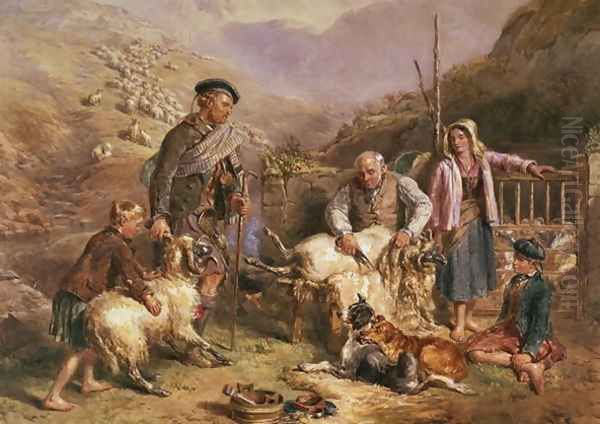
Tayler's proficiency in watercolour allowed him to capture the fleeting effects of light and weather, lending a freshness and immediacy to his compositions. He possessed a delicate touch, rendering figures, animals, and foliage with a graceful precision. Beyond the thrill of the chase, his oeuvre also encompassed quieter pastoral scenes, depicting tranquil rural life, agricultural activities, and animals in their natural settings. Works like Sheep Shearing exemplify this aspect of his art, showcasing his ability to observe and render the rhythms of country existence with sympathy and skill. His animal painting, while perhaps not on the scale of specialists like Sir Edwin Landseer, was nonetheless competent and integral to his chosen subjects.
Leadership in the Watercolour Society and Printmaking
John Frederick Tayler's commitment to the medium of watercolour extended beyond his personal practice. He became a prominent member of the Society of Painters in Water Colours (often known as the "Old" Water-Colour Society, and later the Royal Society of Painters in Water Colours or RSPW). His standing within this institution was such that he was elected its President, a position he held with distinction from 1858 to 1870. During his presidency, Tayler was instrumental in promoting the society's activities and enhancing the status of watercolour painting. Notably, he championed the introduction of winter exhibitions, providing artists with additional opportunities to showcase and sell their work, a significant contribution to the professional lives of fellow watercolourists like David Cox, Peter De Wint, and later, Myles Birket Foster.
In addition to his prolific output as a painter, Tayler also engaged with printmaking. He produced a series of "lithotinted etchings," a hybrid technique that combined the tonal qualities of lithography with the linear precision of etching. These prints, published by T. McLean in 1844, allowed his compositions to reach a wider audience, further disseminating his popular imagery of rural and sporting life. This engagement with printmaking was common among artists of the period, including Turner, who famously oversaw the production of his Liber Studiorum.
Royal Patronage and Social Standing
Tayler's artistic talents did not go unnoticed by the highest echelons of society. His work caught the discerning eye of the young Princess Victoria of Prussia, who would later become Queen Victoria of the United Kingdom. This royal interest developed into significant patronage. Queen Victoria acquired his paintings for the Royal Collection, with works gracing the walls of Windsor Castle and Osborne House, her beloved seaside retreat on the Isle of Wight.
This royal connection was more than just transactional; Tayler reportedly assisted the Queen in selecting her favourite horses, a task that speaks to his recognized expertise in animal depiction and his trusted position. Such favour undoubtedly enhanced his reputation and opened doors to commissions from numerous aristocratic families, who were keen to have their own sporting pursuits and country estates immortalized by an artist favoured by the Crown. Despite this success, Tayler's personal life seems to have been somewhat peripatetic. He is recorded as having moved frequently, almost annually, between London and Brighton. While the exact reasons for this are not fully documented, it might suggest a degree of restlessness or perhaps the pursuit of varied subject matter and social connections in these different locales.
His social standing was, by many accounts, excellent. He was described as a popular and engaging individual. The artist Stanhope Forbes, a leading figure of the later Newlyn School, reportedly referred to Tayler as "the sunshine of the home," a testament to his amiable personality. Another contemporary, Frank Bourdillon, noted Tayler's popularity in Penzance, Cornwall, suggesting his social network extended to artistic communities beyond London. This affability likely contributed to his success as President of the RSPW and his ability to navigate the often-complex social world of Victorian art.
Artistic Process, Challenges, and Anecdotes
Tayler's commitment to detail and finish was a hallmark of his style. While this meticulous approach contributed to the elegance and refinement of his watercolours, it also meant that he was not a particularly rapid worker. This careful, perhaps even laborious, method of painting, while ensuring high quality, may have impacted the volume of his output and, consequently, his financial earnings at times. In an art market that often valued prolificacy, such dedication to craft could be a double-edged sword.
His early career included a period of employment under the French artists Horace Vernet and Paul Delaroche. This experience, working directly for established masters, would have provided invaluable practical training and insight into the professional art world of Paris, supplementing his more formal academic studies. It was a form of apprenticeship that many artists, including later figures like John Singer Sargent who studied with Carolus-Duran, found beneficial.
The connection with the Newlyn School, primarily through his reported friendship with Stanhope Forbes, is intriguing. The Newlyn artists, active from the 1880s onwards, were known for their commitment to plein air (outdoor) painting and their naturalistic depictions of rural and coastal life. While Tayler's primary period of activity predates the full flourishing of Newlyn, his later works, with their increasing emphasis on naturalism and atmospheric effects, may have shared some common ground with the aesthetic sensibilities that would come to define the Newlyn painters like Forbes, Walter Langley, and Frank Bramley. His focus on everyday rural life, albeit often through the lens of sporting activities, also resonates with the Newlyn interest in authentic portrayals of working communities.
Notable Works and Their Context
Several of John Frederick Tayler's works stand out and offer insight into his thematic concerns and artistic strengths. Alms for the Blind (circa 1850), now in the collection of the Wichita Art Museum (though not always on display), is a poignant example of Victorian social commentary. The painting likely depicts a scene of charity, reflecting a common theme in Victorian art and literature that addressed social inequalities and the plight of the less fortunate. Artists like Augustus Egg with his triptych Past and Present, or Luke Fildes with Applicants for Admission to a Casual Ward, tackled such subjects with varying degrees of directness. Tayler's approach in Alms for the Blind would likely have been more sentimental and picturesque, in line with his general style.
His sporting scenes, though often untitled or generically titled (e.g., Hunting Scene, The Meet), were his bread and butter. These works captured the dynamism and social rituals of the hunt, appealing to a landowning class that saw these activities as central to their way of life. The attention to the specific attire, the breeds of horses and hounds, and the nuances of the landscape made these paintings highly desirable.
Sheep Shearing is another representative work, showcasing his interest in pastoral labour. Such scenes were part of a broader tradition in British art, romanticizing rural life, a tradition that includes earlier artists like George Morland and later ones like the aforementioned Newlyn School painters. Tayler's version would have emphasized the harmonious relationship between humans, animals, and the land.
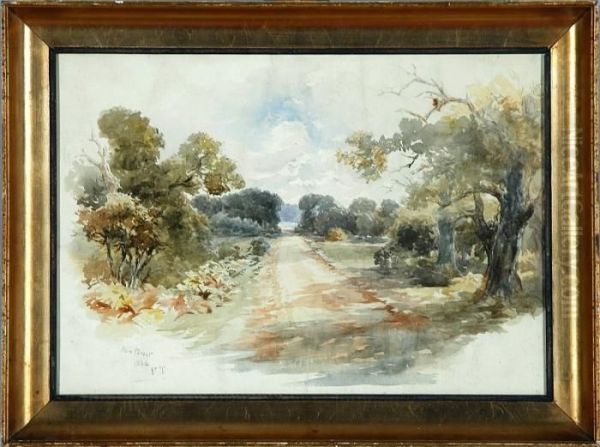
The painting titled New Forest, exhibited in 1875 at a specific New Forest exhibition held at 294 Regent Street, London, underscores his connection to particular British landscapes. The New Forest, with its ancient woodlands and open heaths, was a popular subject for artists, offering rich picturesque possibilities. His Stable Boy with Cart Horses, housed in the Paul Mellon Collection at the Yale Center for British Art, further demonstrates his skill in depicting working animals and the everyday life surrounding them, a subject also masterfully handled by artists like George Stubbs in an earlier era, though Stubbs's approach was more anatomical and monumental.
Exhibitions, Critical Reception, and Legacy
John Frederick Tayler was a regular exhibitor throughout his career, primarily at the Society of Painters in Water Colours, but also at other venues like the Royal Academy. His participation in the 1875 New Forest exhibition highlights his engagement with themed exhibitions focused on specific regions of Britain.
Critically, Tayler was generally well-received during his lifetime, particularly for his technical skill in watercolour and the appealing nature of his subjects. The Victorian art critic John S. Purcell, for instance, praised one of Tayler's works (the specific painting is not always identified in secondary sources) for its ability to encapsulate "the romance and psychology of a whole modern novel," suggesting a depth of narrative and emotional resonance in his genre scenes that went beyond mere illustration. This comment points to Tayler's capacity to imbue his scenes of domestic drama or social interaction with a subtle psychological insight, a quality also found in the works of contemporary genre painters like William Powell Frith, though Frith's canvases were typically much larger and more crowded.
However, his career was not without moments of contention. There is a record of some controversy surrounding his involvement in a Paris exhibition, where it was alleged that works by certain artists were unfairly treated or represented. The specifics of this incident are somewhat obscure, but it indicates the competitive and sometimes contentious nature of the international art world in the 19th century.
Tayler's influence on subsequent generations of watercolourists lies in his consistent advocacy for the medium and his refined technique. As President of the RSPW, he helped to solidify the institutional standing of watercolour painting. His elegant style, while perhaps seen as somewhat traditional by the time of his death in 1889 – a period that saw the rise of Impressionism and Post-Impressionism on the continent with artists like Claude Monet, Edgar Degas, and Vincent van Gogh – nevertheless represented a high point of Victorian watercolour practice. His dedication to capturing the nuances of British rural life and sporting traditions provided a rich visual record of his era.
He passed away in Hampstead, London, in 1889, at the age of 87, leaving behind a substantial body of work that continues to be held in public and private collections. His paintings offer a window into the tastes and preoccupations of Victorian England, celebrated for their charm, technical accomplishment, and enduring depiction of a way of life that was already beginning to change by the end of his long career. Artists like Helen Allingham would continue the tradition of idyllic rural watercolours into the early 20th century, echoing some of the gentle sentiment found in Tayler's work.
Conclusion: An Enduring Victorian Vision
John Frederick Tayler's legacy is that of a highly skilled and respected watercolourist who expertly captured the sporting and pastoral life of 19th-century Britain. His leadership within the Royal Society of Painters in Water Colours, his royal patronage, and his popular appeal attest to his significant standing in the Victorian art world. While his style remained largely within the picturesque and anecdotal traditions of his time, his technical finesse, keen observational skills, and the sheer charm of his subjects ensure his enduring place in the history of British watercolour painting. His works continue to evoke a sense of nostalgia for a particular vision of England, rendered with an elegance and sincerity that defined his artistic career. He remains a key figure for understanding the tastes and artistic currents of an era that valued narrative, detail, and the depiction of a romanticized rural England, standing alongside other notable Victorian artists who chronicled their times, from the grand historical statements of Daniel Maclise to the intimate genre scenes of Thomas Webster.