John James Chalon (1778–1854) stands as a notable, if sometimes overlooked, figure in the rich tapestry of early nineteenth-century British art. Swiss by birth but thoroughly British by artistic practice and affiliation, Chalon navigated the vibrant and competitive London art world with considerable skill, leaving behind a diverse body of work that spanned landscapes, marine subjects, genre scenes, animal studies, and portraiture. His career reflects the artistic currents of his time, from the enduring appeal of the picturesque to the burgeoning market for narrative and illustrative art. Understanding Chalon requires an appreciation for his dual heritage, his close artistic partnership with his brother, and his active participation in the key art institutions of his day.
Early Life and Artistic Formation
Born in Geneva in 1778, John James Chalon hailed from a French Huguenot family that had sought refuge in Switzerland and later, in 1789, moved to England following the turmoil of the French Revolution and the earlier revocation of the Edict of Nantes which had granted Calvinist Protestants substantial rights in France. This familial background, rooted in displacement and resilience, perhaps subtly informed the adaptable nature of his artistic pursuits. England, and specifically London, was to become the crucible for his artistic development.
Crucially, John James was not alone in his artistic endeavors. His younger brother, Alfred Edward Chalon (1780–1860), also embarked on a career as a painter, and the two brothers remained exceptionally close throughout their lives, often living and working together. They both enrolled as students at the prestigious Royal Academy Schools in 1796. The Royal Academy, founded under the patronage of King George III in 1768 with Sir Joshua Reynolds as its first president, was the paramount institution for artistic training and exhibition in Britain. Here, the Chalon brothers would have received a traditional academic grounding, involving drawing from casts of classical sculptures, life drawing, and studying the works of Old Masters. This education aimed to equip artists with the skills necessary for high art, particularly historical and mythological subjects, though the market and personal inclinations often led artists in diverse directions.
The artistic environment in London at the turn of the nineteenth century was dynamic. The towering figures of the previous generation, like Reynolds and Thomas Gainsborough, had established a strong tradition of portraiture and landscape. A new generation was emerging, with artists like J.M.W. Turner and Thomas Girtin revolutionizing watercolor painting, and others like John Constable beginning to explore a more direct and personal engagement with the English landscape. It was into this stimulating milieu that John James Chalon launched his career.
A Multifaceted Painter: Landscapes, Marine Art, and Genre
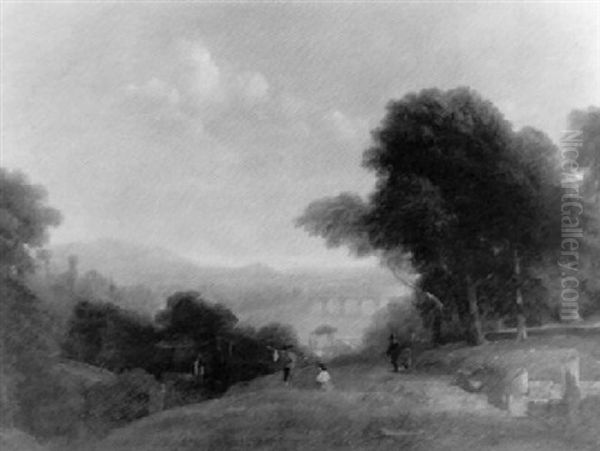
John James Chalon’s artistic output was characterized by its breadth. He did not confine himself to a single genre but demonstrated proficiency across several. His landscapes, often depicting scenes from his native Switzerland as well as British scenery, were particularly well-regarded. These works captured the picturesque beauty of mountainous terrains, tranquil lakes, and rural settings, often imbued with a gentle, romantic sensibility. His handling of light and atmosphere, whether in oil or watercolor, was adept, conveying the specific moods of the landscapes he portrayed. His painting Castle of Chillon, for instance, showcases his ability to combine topographical accuracy with an evocative depiction of a historically resonant site, a subject also famously treated by Lord Byron in poetry, highlighting the Romantic era's fascination with such locales.
Marine painting was another area where Chalon excelled. Works like Hastings Fishing Boats Making the Shore in a Breeze (1819) demonstrate his keen observation of maritime life and the dynamic interplay of sea, sky, and vessels. These scenes were popular with the British public, reflecting the nation's identity as a sea-faring power. His historical marine painting, The ‘Bellerophon’ with Napoleon at Plymouth (1816), now in the Royal Museums Greenwich, captures a significant moment in history – Napoleon Bonaparte aboard the British ship before his exile to St. Helena. This work combines meticulous depiction of the naval setting with the inherent drama of the historical event, appealing to patriotic sentiment and contemporary interest.
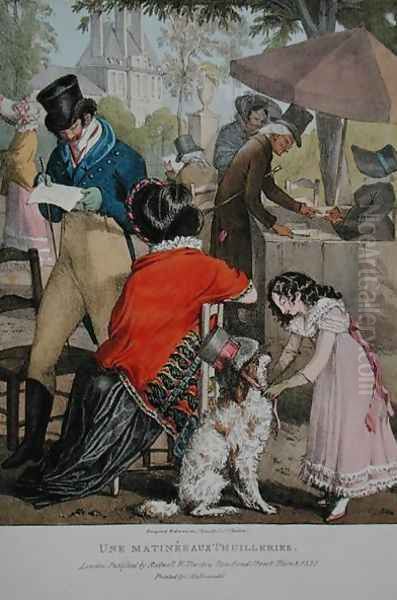
Chalon also ventured into genre painting, depicting scenes of everyday life, often with a touch of humor or social observation. Village Gossips (1815), once in the South Kensington Museum (now the Victoria and Albert Museum), is an example of this aspect of his work. These paintings provided a contrast to the grander themes of history or landscape, offering relatable vignettes that found a ready audience. His interest in contemporary life and manners is further evidenced by his series of 24 lithographs, Costume of Paris (published 1822), and his Sketches from Parisian Manners. These works, showcasing his skill as a draftsman and his observant eye, provide valuable insights into early 19th-century fashion and social customs, and demonstrate his engagement with the increasingly popular medium of lithography for illustration and dissemination of images.
The Ascendancy of Watercolor and Institutional Affiliations
John James Chalon was notably active in the burgeoning field of watercolor painting. The late eighteenth and early nineteenth centuries saw watercolor shed its status as a medium primarily for preparatory sketches and topographical records, emerging as a respected art form in its own right. Chalon was at the forefront of this movement. In 1804, a group of artists, including William Frederick Wells, Samuel Shelley, and William Sawrey Gilpin, frustrated by the Royal Academy's perceived bias towards oil painting and its inconsistent hanging of watercolors, founded the Society of Painters in Water Colours (often known as the "Old Watercolour Society").
John James Chalon became one of its earliest elected members in 1806 and a full member in 1807, exhibiting frequently with the society. His contributions helped to elevate the status of the medium and showcase its versatility. His watercolors were praised for their fresh, transparent washes and delicate yet confident execution. His involvement with this society placed him among key figures in the watercolor school, such as John Varley, a highly influential teacher, Cornelius Varley, his brother and an innovator in optical instruments, and later, artists like Peter De Wint and David Cox, who further expanded the expressive potential of the medium.
Beyond the Watercolour Society, Chalon sought recognition within the most prestigious art institution in Britain: the Royal Academy of Arts. He began exhibiting there in 1801 and continued to do so throughout his career. His consistent presence and the quality of his submissions eventually led to his election as an Associate of the Royal Academy (ARA) in 1827. This was a significant step, marking him as an artist of established reputation. Fourteen years later, in 1841, he achieved the distinction of being elected a full Royal Academician (RA), a testament to his sustained contribution and standing within the artistic community. As an RA, he joined the ranks of the most celebrated artists of his day, including Sir Thomas Lawrence (who was President of the RA until his death in 1830), J.M.W. Turner, John Constable (elected RA in 1829), Sir David Wilkie, known for his detailed genre scenes, and Sir Edwin Landseer, the famed animal painter.
Artistic Circles and Collaborations: The Chalon Brothers and Sketching Societies
The London art world of the early nineteenth century was characterized by a network of formal institutions, private patronage, and informal artistic associations. John James Chalon was an active participant in these circles. His closest artistic relationship was undoubtedly with his brother, Alfred Edward Chalon. While both were versatile, Alfred became particularly renowned for his fashionable portraits, especially in watercolor, and was appointed Portrait Painter in Water-Colours to Queen Victoria. The brothers often shared a home and studio, and their artistic lives were deeply intertwined. It is documented that they sometimes collaborated on works, with one perhaps focusing on figures and the other on landscape elements, a common practice among artist families or close associates.
The Chalon brothers were also instrumental in founding and participating in sketching societies. These informal clubs provided artists with opportunities for convivial practice, experimentation, and mutual criticism, away from the pressures of public exhibition. They co-founded the "Society for the Study of Epic and Pastoral Design," a rather grandly named group that was more informally known as the "Bread and Cheese Society" due to the simple refreshments served. This society later evolved into the "Chalon Sketching Society." Such groups were vital for fostering artistic development and camaraderie. Other members of these circles included artists like Michael Sharp, a painter of genre and theatrical scenes, and William Turner of Oxford (no relation to J.M.W. Turner), a landscape watercolorist. These societies were part of a broader culture of artistic association that included groups like "The Sketching Society" founded earlier by Thomas Girtin and later joined by artists like John Sell Cotman.
These interactions highlight the collaborative and social aspects of artistic life. While competition for commissions and recognition was undoubtedly fierce, these societies offered a supportive environment. Chalon's engagement in these groups underscores his commitment to the craft and his sociable nature. He would have encountered a wide array of artistic personalities and approaches, from the meticulous topographical work of artists like William Daniell to the more romantic and imaginative compositions of painters like Francis Danby or John Martin, whose dramatic biblical and apocalyptic scenes captivated audiences.
Notable Works in Focus
Several of John James Chalon's works deserve particular attention for what they reveal about his skills and thematic interests.
The ‘Bellerophon’ with Napoleon at Plymouth (1816): This oil painting is a significant historical piece. It depicts the HMS Bellerophon in Plymouth Sound, with Napoleon Bonaparte visible on deck, shortly after his surrender following the Battle of Waterloo and before his final exile. Chalon captures the scene with a marine painter's attention to nautical detail and a historian's sense of occasion. The presence of numerous small boats filled with curious onlookers underscores the public fascination with the defeated Emperor. The work is a fine example of narrative marine painting, a genre popularised by artists like Clarkson Stanfield and Edward William Cooke later in the century.
Castle of Chillon: While specific versions vary, Chalon's depictions of the Castle of Chillon on Lake Geneva tap into the Romantic sensibility for picturesque and historically evocative landscapes. His Swiss origins likely gave him a particular affinity for such subjects. The combination of majestic natural scenery – the lake and mountains – with the ancient, storied castle created a powerful visual appeal, resonating with the era's literary and artistic trends. He would have been aware of the broader European tradition of Alpine painting, which included artists like Caspar Wolf in the 18th century and, among his British contemporaries, J.M.W. Turner, who also famously depicted Swiss scenes.
Village Gossips (1815): This genre scene, likely an oil painting, would have depicted an everyday rural incident, focusing on character and narrative. Such works followed in the tradition of earlier British genre painters like George Morland and were contemporary with the highly successful narrative scenes of Sir David Wilkie. Chalon's ability to capture character and create engaging, often humorous, vignettes was a key part of his diverse appeal.
Costume of Paris (1822): This series of 24 lithographs demonstrates Chalon's skill as a draftsman and his engagement with contemporary urban life and fashion. Lithography, a relatively new printmaking technique invented in the 1790s by Alois Senefelder, was becoming increasingly popular for its ability to reproduce drawings with great fidelity. Chalon's series provides a charming and historically valuable record of Parisian attire and social types, akin to fashion plates but with an artist's touch. This work aligns with a broader interest in illustrated social commentary, seen in the works of caricaturists like Thomas Rowlandson and George Cruikshank, though Chalon's approach was generally less satirical and more observational.
Sketches from Parisian Manners: Similar to the Costume of Paris, these sketches, likely humorous and anecdotal, further showcase his talent for capturing the nuances of social behavior. His time spent observing Parisian life provided rich material for these works, which would have appealed to a British audience interested in the manners and customs of their continental neighbors.
His oeuvre also included pure animal studies, reflecting another popular strand in British art, epitomized by George Stubbs in the previous century and by Edwin Landseer among Chalon's contemporaries.
Later Years, Health, and Legacy
John James Chalon continued to paint and exhibit throughout the 1830s and into the 1840s. However, his later years were marred by ill health. In 1847, he suffered a paralytic stroke, which significantly impaired his ability to work and gradually led to a decline in his physical and mental faculties. His devoted brother, Alfred Edward Chalon, cared for him during this difficult period. John James Chalon passed away in Kensington, London, on November 14, 1854, at the age of 76.
His death was noted in the art press. The esteemed painter and writer Charles Robert Leslie, RA, a contemporary known for his paintings of literary subjects and his biography of John Constable, penned an obituary for Chalon in The Art Journal. This indicates the respect Chalon commanded within the artistic community.
In terms of legacy, John James Chalon's works are held in several significant public collections, including the British Museum, the Victoria and Albert Museum in London, and the National Gallery of Ireland in Dublin, as well as the Royal Museums Greenwich. While he may not have achieved the towering fame of some of his contemporaries like Turner or Constable, his contributions were substantial. He was a versatile and skilled artist who excelled in multiple genres, a respected member of the Royal Academy, and a key figure in the early development of the Society of Painters in Water Colours.
His art provides a valuable window into the tastes and preoccupations of early nineteenth-century Britain. His landscapes reflect the Romantic appreciation for nature, his marine paintings the nation's maritime identity, and his genre scenes the growing interest in everyday life and social observation. The collaborative relationship with his brother Alfred is also a noteworthy aspect of his career, highlighting the familial bonds that often shaped artistic lives. Artists like Augustus Wall Callcott, known for his landscapes and coastal scenes, or William Collins, who painted charming rustic genre scenes, occupied similar artistic territory, contributing to the rich diversity of the British school.
Conclusion: An Enduring Contribution
John James Chalon was a consummate professional artist who successfully navigated the complex art world of his time. His Swiss roots and British upbringing gave him a unique perspective, which he channeled into a diverse and accomplished body of work. From the evocative landscapes of Switzerland and England to the bustling energy of marine scenes and the charming details of Parisian life, Chalon demonstrated a keen eye, a skilled hand, and a broad artistic intelligence.
His active involvement with the Royal Academy and the Society of Painters in Water Colours underscores his commitment to the institutional framework of British art, while his participation in sketching societies speaks to the importance of informal artistic exchange. Though perhaps overshadowed in popular memory by more singular or revolutionary figures, John James Chalon's career is a testament to the enduring value of versatility, craftsmanship, and consistent dedication. He remains an important figure for understanding the breadth and depth of British art during a period of significant transformation and artistic flourishing, standing alongside other accomplished academicians of his era such as Abraham Cooper, known for his battle scenes and animal paintings, or Ramsay Richard Reinagle, a portrait and landscape painter. Chalon's art continues to be appreciated for its quiet charm, technical proficiency, and its insightful reflections of the world he inhabited.