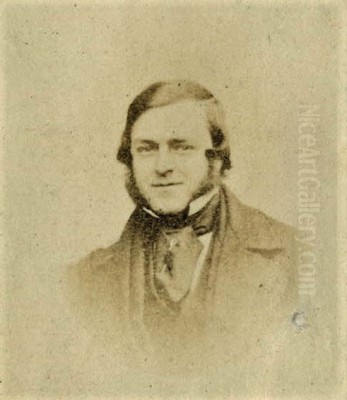
John Middleton, an English landscape painter of considerable talent, emerged as a significant figure in the later period of the celebrated Norwich School of Painters. Though his life was tragically short, spanning from 1827 to 1856, his artistic output demonstrated a profound sensitivity to the natural world, a masterful handling of light and detail, and a poetic vision that continues to resonate with admirers of British landscape art. His work, primarily in watercolour but also in oils, captured the subtle beauties of the English countryside, particularly the woodlands, heathlands, and waterways of his native Norfolk.
Early Life and Artistic Awakening in Norwich
Born in Norwich in 1827, John Middleton grew up in a city that was a vibrant hub of artistic activity, largely due to the enduring legacy of the Norwich School of Painters. This provincial school, the first of its kind in Britain, had been co-founded by John Crome and Robert Ladbrooke in 1803. It fostered a unique environment where local artists were encouraged to depict the landscapes and everyday scenes of their immediate surroundings with truthfulness and affection.
Middleton's innate artistic inclinations were likely nurtured by this rich local heritage. The achievements of earlier masters like John Crome, renowned for his robust and naturalistic portrayals of Norfolk's lanes and trees, and John Sell Cotman, celebrated for his elegant compositions and mastery of watercolour, would have been well-known and accessible. This environment provided a fertile ground for a young artist with a keen eye for nature. His formal artistic training began under the tutelage of John Berney Ladbrooke, son of Robert Ladbrooke and a respected landscape painter and teacher in his own right.
The Influence of John Berney Ladbrooke and Henry Bright
John Berney Ladbrooke (1803-1879) played a crucial role in shaping Middleton's early artistic development. Ladbrooke, himself an accomplished painter of woodland scenes and rural landscapes, imparted to Middleton a solid foundation in drawing and painting techniques. He emphasized careful observation and a direct engagement with nature, principles that were central to the Norwich School ethos.
Another significant influence on Middleton was Henry Bright (1810-1873). Bright, though not exclusively a Norwich artist for his entire career, spent formative years there and was associated with the school. He was particularly admired for his vigorous handling of paint, his rich textures, and his ability to capture dramatic atmospheric effects, especially in his pastels and watercolours. Middleton's association with Bright likely encouraged him to explore a more expressive and texturally rich approach in his own work, particularly in his depiction of foliage and skies. The interplay of light and shadow, a hallmark of Bright's style, also became a prominent feature in Middleton's art.
The Norwich School Context
To fully appreciate John Middleton's contribution, it is essential to understand the Norwich School of Painters. Founded on principles of direct observation of nature and a focus on local scenery, the school distinguished itself from the more academic traditions prevalent in London. John Crome (1768-1821), often referred to as "Old Crome," was its spiritual father. His works, such as "The Poringland Oak" and "Moonrise on the Yare," are characterized by their unpretentious realism, their deep understanding of tree structures, and their ability to convey the specific atmosphere of the Norfolk landscape.
John Sell Cotman (1782-1842), the other towering figure of the early Norwich School, brought a different sensibility. His work, exemplified by pieces like "Greta Bridge" and his Normandy series, is marked by a sophisticated sense of design, flat pattern, and a refined use of colour washes. While Crome's influence was perhaps more direct on the general stylistic tendencies of the school's landscape painters, Cotman's innovative approach to watercolour had a lasting impact on the medium.
Other notable members of the earlier generation included James Stark (1794-1859), a pupil of Crome known for his detailed woodland scenes, and George Vincent (1796-c.1832), who also excelled in depicting river scenes and landscapes with a Crome-like fidelity. John Thirtle (1777-1839) was another important watercolourist associated with the school, admired for his atmospheric river views. The legacy of these artists created a strong tradition upon which later painters like Middleton could build.
Middleton's Artistic Style: Detail, Light, and Atmosphere
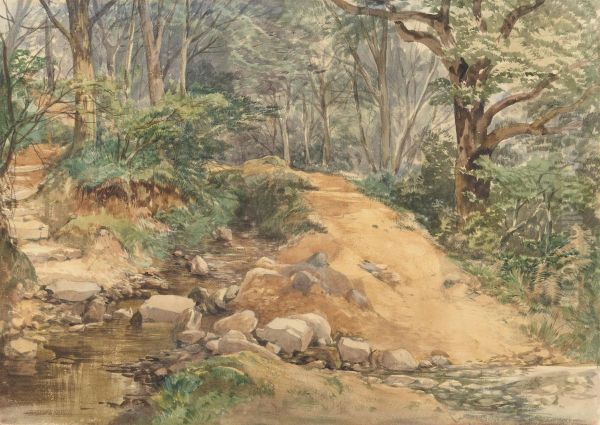
John Middleton's art is distinguished by its meticulous attention to detail, particularly in the rendering of foliage, tree bark, and foreground elements such as ferns, grasses, and wildflowers. This close observation was not merely for botanical accuracy but served to create a sense of intimacy and immersion in the scene. His trees are not generic forms but individuals, their character conveyed through careful drawing and subtle variations in colour and texture.
The treatment of light is perhaps the most captivating aspect of Middleton's work. He possessed an exceptional ability to capture the varied effects of light as it filters through leaves, illuminates a clearing, or reflects off water. His paintings often feature dappled sunlight, creating a dynamic interplay of light and shadow that animates the scene and enhances its three-dimensionality. This sensitivity to light allowed him to evoke specific times of day and particular atmospheric conditions, from the crisp clarity of a summer morning to the soft glow of an evening sky.
His compositions, while often focused on seemingly unassuming corners of nature, are thoughtfully constructed. He frequently employed a path or stream to lead the viewer's eye into the picture, creating a sense of depth and inviting exploration. While his focus was primarily on the natural landscape, figures are sometimes included, typically small and integrated into the scene, serving to emphasize the scale and tranquility of nature rather than dominating it.
Representative Works and Subject Matter
While specific titles can vary in records, John Middleton's oeuvre consistently features certain types of scenes that showcase his strengths. "A Study of Trees, Gunton Park" is indicative of his skill in portraying the majestic forms of mature trees, with intricate rendering of branches and leaves. Works titled "Lane Scene with Figure and Cottage" or similar often depict quiet, rustic pathways, perhaps with a glimpse of a humble dwelling, embodying the picturesque charm of the Norfolk countryside.
"At Gunton, Norfolk" and similar titles highlight his connection to specific locales, suggesting plein air studies or works inspired by direct observation of these places. Gunton Park, with its ancient trees and varied woodland, was a recurring source of inspiration for him, as it was for other Norwich artists.
Paintings like "A Fine Old Oak" demonstrate his reverence for the enduring character of ancient trees, a subject beloved by the Norwich School. "Woodland Scene with Stream" or "The Edge of the Wood" are typical of his preferred motifs, allowing him to explore the complexities of light filtering through canopies, the textures of undergrowth, and the reflective qualities of water. These woodland interiors are often imbued with a sense of quiet seclusion and natural abundance. His watercolours, in particular, show a remarkable freshness and transparency, with delicate washes and precise brushwork.
Exhibitions and Recognition During His Lifetime
Despite his short career, John Middleton achieved a notable degree of recognition. He began exhibiting his works at a young age, showing regularly with the Norwich Society of Artists. His talent was also acknowledged beyond his native county. He exhibited at prestigious London venues, including the Royal Academy and the British Institution. This exposure to a wider audience indicates that his work was well-regarded by his contemporaries and considered to be of a high standard.
His success in these exhibitions suggests that his particular vision of landscape, characterized by its blend of detailed realism and poetic sensibility, found favour with the art-buying public and critics of the time. The mid-19th century saw a continued appreciation for landscape painting in Britain, influenced by the earlier Romantic movement and the ongoing interest in the national scenery, as championed by artists like John Constable (1776-1837) and J.M.W. Turner (1775-1851), whose broader impact was felt across the British art scene.
Contemporaries in the Later Norwich School and Beyond
John Middleton was part of a later generation of Norwich School artists who carried forward the traditions established by Crome and Cotman, while also developing their own individual styles. Among his contemporaries within this group were Thomas Lound (1801-1861), a prolific watercolourist known for his charming sketches of Norwich and the Broads, and Robert Leman (1799-1863), whose works often shared a similar sensitivity to light and detail as Middleton's.
While the Norwich School provided his immediate artistic environment, Middleton's work can also be seen in the broader context of British landscape painting of the mid-19th century. The legacy of watercolourists like David Cox (1783-1859) and Peter De Wint (1784-1849), known for their expressive handling and atmospheric effects, continued to influence the medium. Though distinct in their approaches, these artists shared a common dedication to capturing the essence of the British landscape. The Pre-Raphaelite Brotherhood, founded in 1848, also championed truth to nature, albeit with a different stylistic and symbolic emphasis, and their detailed approach to natural forms may have found some resonance with Middleton's own meticulousness.
Other landscape painters active during Middleton's lifetime included artists like Myles Birket Foster (1825-1899), whose idyllic and highly detailed watercolours of rural life became immensely popular, and Frederick William Hulme (1816-1884), known for his picturesque landscapes. While Middleton's style remained rooted in the Norwich tradition, the broader artistic currents of the Victorian era undoubtedly formed part of the backdrop to his career.
A Promising Career Cut Short
Tragically, John Middleton's promising career was cut short by his premature death from tuberculosis in 1856, at the age of just twenty-nine. This was a common and often fatal illness in the 19th century, and it robbed the art world of a talent that was still developing and held great potential. One can only speculate on the artistic heights he might have achieved had he lived longer. His passing was a significant loss to the Norwich School and to British landscape painting.
The brevity of his working life means that his oeuvre is not as extensive as that of some of his longer-lived contemporaries. However, the quality and consistency of the works he did produce are a testament to his dedication and skill.
Legacy and Enduring Appeal
John Middleton is remembered as one of the most gifted and sensitive painters of the later Norwich School. His work stands out for its delicate beauty, its technical proficiency, especially in watercolour, and its genuine love for the natural world. He successfully combined the Norwich School's tradition of detailed observation with a personal, poetic response to landscape.
His paintings are prized by collectors and can be found in several public collections, notably the Norwich Castle Museum & Art Gallery, which holds a significant collection of works by Norwich School artists. His art continues to appeal to those who appreciate the subtle charms of the English countryside and the skillful rendering of light and atmosphere.
While he may not have achieved the widespread fame of Crome or Cotman, John Middleton holds a secure and respected place in the history of British landscape painting. His contribution to the Norwich School ensured that its traditions of naturalism and local focus were carried forward with freshness and vitality into the mid-19th century. His keen eye for the intricacies of nature, his masterful depiction of sylvan scenes, and the luminous quality of his light ensure that his art remains a source of delight and admiration. His legacy is that of a painter who, in a short time, created a body of work that beautifully encapsulates the enduring allure of the English landscape.
Conclusion
John Middleton's life, though brief, was artistically rich. As a prominent member of the later Norwich School, he absorbed the influences of its founders and his direct teachers, John Berney Ladbrooke and Henry Bright, yet forged a distinctive style characterized by meticulous detail, a masterful handling of light, and a deep, poetic engagement with the Norfolk landscape. His woodland scenes, studies of trees, and depictions of tranquil waterways are imbued with a quiet beauty and technical finesse that mark him as a significant talent within the broader tradition of British landscape painting. Despite his early death, John Middleton left behind a precious legacy of works that continue to enchant viewers with their freshness, intimacy, and profound appreciation for the natural world.