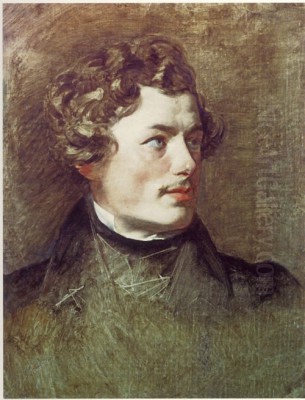
Josef Danhauser stands as a significant, albeit sometimes underappreciated, figure in 19th-century Austrian art. A painter and furniture designer, he was a pivotal artist of the Biedermeier era, a period characterized by a focus on domesticity, the burgeoning middle class, and a realistic yet often sentimental depiction of everyday life. His works offer a fascinating window into Viennese society of his time, marked by keen observation, subtle social commentary, and a versatile artistic talent that spanned multiple disciplines.
Early Life and Artistic Foundations
Born on August 19, 1805, in Vienna, Josef Danhauser was immersed in an artistic environment from his earliest years. His father, Joseph Ulrich Danhauser, was a respected sculptor and, crucially, a furniture manufacturer. This familial background provided young Josef with not only an early exposure to artistic creation but also a practical understanding of craftsmanship and design. It was within this stimulating household that his initial artistic inclinations were nurtured, likely under the direct tutelage and encouragement of his father.
The elder Danhauser's workshop would have been a place of constant activity, where the principles of form, material, and aesthetics were daily concerns. This early, informal education in the applied arts undoubtedly shaped Josef's later versatility and his appreciation for well-crafted objects, a sensibility that would manifest in his successful career as a furniture designer alongside his painting.
Formal Training and Influences
Recognizing his son's burgeoning talent, Josef Danhauser was enrolled in the prestigious Academy of Fine Arts Vienna (Akademie der bildenden Künste Wien) in 1820. Here, he began his formal artistic training, studying under Johann Peter Krafft. Krafft was a notable painter of historical scenes and portraits, and under his guidance, Danhauser would have honed his foundational skills in drawing and composition. This academic grounding was crucial for any aspiring artist of the period.
After his initial studies, Danhauser further refined his skills, particularly in the realm of historical painting and color theory, by becoming a student of Peter Krafft (often confused with Johann Peter Krafft, but a distinct figure, though both were influential at the Academy). Peter Krafft was himself a significant historical painter, and his mentorship, especially in the sophisticated use of color, would have been invaluable. During these formative years, Danhauser also began to look towards other artistic traditions. He was reportedly influenced by the narrative power and social satire of British artist William Hogarth, whose moralizing genre scenes resonated with Danhauser's own developing interest in depicting contemporary life with a critical eye.
A Necessary Detour: The Family Business
Danhauser's artistic trajectory faced an unexpected interruption. The sudden death of his father in 1829 placed a heavy burden on the young artist. As the eldest son, he felt compelled to take over the family's furniture manufacturing business to support his mother and siblings. This was a significant responsibility that temporarily diverted him from his primary passion for painting. The Danhauser furniture factory was a well-established enterprise, and managing it required considerable time and energy.
This period, though a departure from his artistic studies, was not entirely without benefit to his broader development. It provided him with practical business experience and a deeper understanding of the applied arts, which would later inform his own furniture designs. However, the pull of painting remained strong. Despite the demands of the business, Danhauser continued to paint whenever possible, his artistic ambitions undiminished.
Return to Art and the Rise of a Genre Painter
After a few years of managing the family enterprise, Danhauser, along with his brothers, made the decision to sell the furniture factory in 1833. This allowed him to dedicate himself fully to his artistic career once more. Initially, he focused on historical and epic paintings, subjects that were highly regarded in academic circles. However, he soon found his true calling in genre painting – the depiction of scenes from everyday life.
This shift was significant. Genre painting offered a means to connect with a broader public, moving beyond the elite patrons who typically commissioned grand historical or mythological works. Danhauser sought to capture the nuances of Viennese society, its customs, its virtues, and its foibles. His works from this period often carry a moral undertone, reflecting the Biedermeier era's emphasis on bourgeois values, domesticity, and social order, but frequently imbued with a gentle humor or subtle satire. He aimed to make art accessible and relatable, believing it could serve an educational and edifying purpose for the general populace.
Key Themes and Subjects in Danhauser's Oeuvre
Danhauser's genre paintings explored a variety of themes. He depicted scenes of domestic life, social gatherings, and moments of quiet contemplation. A recurring interest was the portrayal of human character and social dynamics. He was adept at capturing the interactions between individuals, revealing their personalities and relationships through gesture, expression, and setting.
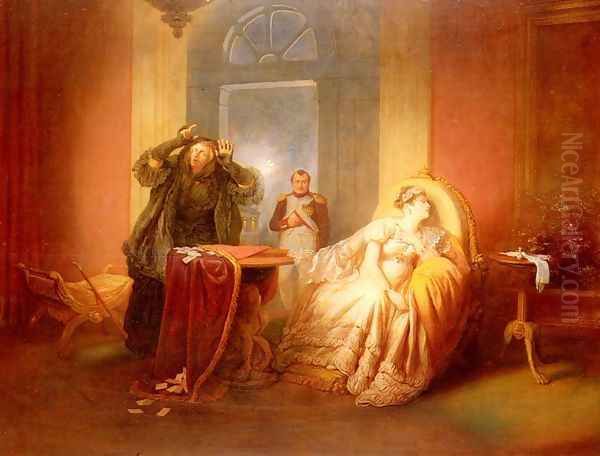
Music and literature also provided rich subject matter. Vienna was a vibrant cultural hub, and Danhauser was clearly attuned to its artistic currents. His paintings sometimes drew inspiration from literary works or depicted scenes related to the performing arts. For instance, one of his works was inspired by a tale of a countess's ghost and treasure hunters, showcasing his ability to blend narrative with a touch of the dramatic or even the macabre, albeit often with an underlying satirical intent.
His social commentary was often subtle but pointed. He might depict the ostentation of the newly wealthy, the anxieties of the middle class, or the simple pleasures of ordinary folk. Unlike the biting satire of some of his predecessors like Hogarth, Danhauser's critique was generally more tempered, reflecting the somewhat more conservative and inward-looking nature of the Biedermeier period.
Masterpieces and Signature Works
Several of Josef Danhauser's paintings have become iconic representations of the Biedermeier era and showcase his distinct artistic vision.
One of his most famous works is Liszt at the Piano (also known as Liszt am Flügel), painted in 1840. This remarkable group portrait depicts the celebrated composer and pianist Franz Liszt performing for an enraptured audience in a salon. The attendees include prominent literary and artistic figures of the day, such as Victor Hugo, George Sand (represented by a portrait as she was not physically present), Niccolò Paganini, Gioachino Rossini, and Alexandre Dumas père. A bust of Ludwig van Beethoven presides over the scene from atop the piano, symbolizing Liszt's reverence for the master. The painting is a masterful composition, capturing the intensity of the performance and the absorbed attention of the listeners. It is currently housed in the Alte Nationalgalerie in Berlin.
Another significant work is The Spendthrift (Der Prasser), which is considered one of his most important genre paintings. It depicts a wealthy man indulging in excess, surrounded by sycophants, while his family likely suffers from neglect. This painting serves as a moral tale, a common theme in Biedermeier art, cautioning against vice and extravagance. The detailed rendering of the figures and the opulent setting contribute to the painting's narrative power.
The Convent Soup (Die Klostersuppe) is another well-known piece. It portrays a scene within a monastery refectory, where monks are partaking in a simple meal. The painting is notable for its careful observation of character and its depiction of a quiet, ordered way of life, perhaps offering a contrast to the more worldly concerns often depicted in his other works.
The Reading of the Will (Die Testamentseröffnung) captures the dramatic and often contentious moment when a family gathers to hear the contents of a will. Danhauser skillfully portrays the varied emotions of the assembled relatives – anticipation, greed, disappointment, and perhaps grief – offering a microcosm of human nature.
These works, among others, demonstrate Danhauser's ability to combine technical skill with insightful social observation, creating paintings that are both aesthetically pleasing and intellectually engaging.
Danhauser's Technique and Stylistic Hallmarks
Josef Danhauser's style is firmly rooted in the Biedermeier aesthetic, which emphasized realism, clarity, and a certain degree of sentimentality. His paintings are characterized by meticulous attention to detail, smooth brushwork, and a carefully balanced composition. He had a fine sense for capturing textures – the sheen of silk, the grain of wood, the softness of velvet – which added to the verisimilitude of his scenes.
His use of color was sophisticated, influenced by his studies and perhaps by an appreciation for the Venetian School painters like Titian and Paolo Veronese, known for their rich palettes and mastery of light. Danhauser often employed a warm, harmonious color scheme, and he was adept at using light and shadow to model forms and create a sense of depth and atmosphere. While his realism was paramount, it was not a stark, unadorned naturalism; rather, it was often softened by a gentle light or a slightly idealized portrayal of his subjects.
The influence of Peter Paul Rubens can also be discerned in some of his more dynamic compositions and the richness of his portrayals, though Danhauser's overall temperament was more restrained than that of the Flemish Baroque master. His figures are typically well-drawn and expressive, conveying emotion through subtle gestures and facial expressions. The narrative clarity of his paintings was a key feature, ensuring that the story or moral message was easily understood by the viewer.
Beyond the Canvas: Danhauser as a Furniture Designer
Danhauser's artistic talents were not confined to painting. Drawing on his family background and his innate understanding of design, he also made significant contributions as a furniture designer. After selling the family factory, he continued to design furniture, and his creations are considered prime examples of the Biedermeier style.
Biedermeier furniture is characterized by its simplicity, elegance, and functionality. It favored clean lines, smooth surfaces, and often utilized light-colored woods like cherry, ash, and maple, sometimes accented with ebonized details or modest inlay. Danhauser's designs embodied these principles, creating pieces that were both beautiful and practical, perfectly suited to the comfortable, unpretentious interiors of the burgeoning middle class. Many of his furniture designs are preserved and highly valued today, with examples held in collections such as the Museum of Applied Arts (MAK) in Vienna. This dual career as a painter and designer underscores his versatile talent and his deep engagement with the broader aesthetic concerns of his time.
Contemporaries and Artistic Milieu
Josef Danhauser worked within a vibrant artistic community in Vienna. He was a contemporary of other leading figures of the Austrian Biedermeier period, most notably Ferdinand Georg Waldmüller and Peter Fendi. Waldmüller was renowned for his luminous landscapes, detailed portraits, and genre scenes, often characterized by a brighter palette and a more overt naturalism than Danhauser's. Peter Fendi was celebrated for his intimate genre scenes, often depicting children and domestic life with great sensitivity and charm, as well as his work as a lithographer.
Danhauser also had collaborative relationships, for instance, with Moritz von Schwind, a painter associated with late Romanticism, known for his fairytale illustrations and lyrical compositions. While their styles differed, their interactions reflect the interconnectedness of the Viennese art world. Another name mentioned in connection with joint work is Manuel Rantfelt, though he is a less widely known figure.
The broader European artistic context included figures like the German Biedermeier painter Carl Spitzweg, whose humorous and often eccentric genre scenes share some thematic similarities with Danhauser's work. The dominant Neoclassicism of artists like Jacques-Louis David and Jean-Auguste-Dominique Ingres was beginning to wane, making way for Romanticism, exemplified by artists such as Caspar David Friedrich in Germany, and the emerging Realist tendencies that Biedermeier art prefigured. The Nazarene movement, with artists like Friedrich Overbeck and Peter von Cornelius, also active during this period, pursued a revival of religious art inspired by early Renaissance masters, offering a stylistic counterpoint to the more secular and contemporary focus of Biedermeier painters like Danhauser. Portraiture was also a thriving genre, with artists like Friedrich von Amerling being a prominent Viennese contemporary of Danhauser, known for his elegant and psychologically astute portraits. Even earlier Viennese portraitists like Johann Baptist von Lampi the Elder had set a high standard in the city.
Personal Life: Triumphs and Tribulations
Danhauser's personal life appears to have been marked by both professional achievements and personal struggles. In 1833, he married Josephine Pyrker, the daughter of a physician. While details of their marital life are not extensively documented, it is known that the family faced challenges. The death of one of his brothers reportedly had a profound and lasting impact on Danhauser, contributing to periods of depression in his later years.
These personal sorrows may have deepened his understanding of human emotion, perhaps subtly influencing the empathetic quality found in some of his works. An anecdote from near the end of his life recounts a mysterious event: while attempting to take a portrait of his wife in his studio, he suddenly collapsed. This incident, whether apocryphal or not, adds a poignant note to his biography, hinting at underlying health issues or the cumulative stress of his life and work.
Academic Recognition and Later Career
Despite the challenges, Danhauser achieved a degree of professional recognition during his lifetime. In 1838, he was appointed as a "corrector" (a teaching position, sometimes referred to as rector in translations) at the Vienna Academy of Fine Arts, the very institution where he had received his training. This appointment signified his standing within the Viennese artistic establishment. He also received commissions for significant works, including murals for churches, demonstrating the breadth of his artistic capabilities.
However, he also faced obstacles, including reported difficulties with publication restrictions, which may have limited the dissemination of his work through prints and hampered his ability to gain wider support from certain artistic circles. Nevertheless, he remained committed to his artistic vision, continuing to produce works that reflected his unique perspective on the world around him.
Legacy and Historical Evaluation
Josef Danhauser died relatively young, on May 4, 1845, in Vienna, from typhus. At the time of his death, his work was respected, but perhaps not as widely acclaimed as that of some of his contemporaries. Like many Biedermeier artists, his reputation experienced a period of relative obscurity in the later 19th and early 20th centuries, as artistic tastes shifted towards new movements like Impressionism and Modernism.
However, the 20th century saw a renewed appreciation for Biedermeier art, and Danhauser's contributions have been re-evaluated and recognized for their true worth. He is now considered one of the foremost painters of the Austrian Biedermeier period, alongside Waldmüller and Fendi. Art historians and critics acknowledge his skillful technique, his insightful portrayal of Viennese society, and the unique blend of realism, humor, and moral commentary in his work. His paintings are valued not only for their artistic merit but also as important historical documents, offering vivid glimpses into the culture, customs, and social fabric of early to mid-19th-century Vienna.
His works are held in major museum collections, including the Belvedere Palace and the Wien Museum in Vienna, the Alte Nationalgalerie in Berlin, and others. Scholarly publications, such as the Wiener Jahrbuch für Kunstgeschichte and catalogues like Belvedere Werkeverzeichnisse, have further solidified his place in art history. Exhibitions and continued research ensure that his legacy endures.
Conclusion: An Enduring Vision
Josef Danhauser was more than just a painter of charming scenes; he was a thoughtful observer and a subtle critic of his society. His art captured the spirit of the Biedermeier era – its emphasis on domesticity, its burgeoning middle-class values, and its undercurrents of social change. Through his paintings and furniture designs, he contributed significantly to the cultural landscape of Vienna. His ability to infuse everyday scenes with narrative depth, psychological insight, and often a gentle wit, ensures that his work continues to resonate with audiences today. As an artist who navigated the demands of both fine art and applied design, and who persevered through personal and professional challenges, Josef Danhauser remains a compelling and important figure in the rich tapestry of European art history.