Johann Baptist Reiter: A Master of Biedermeier Portraiture and Genre
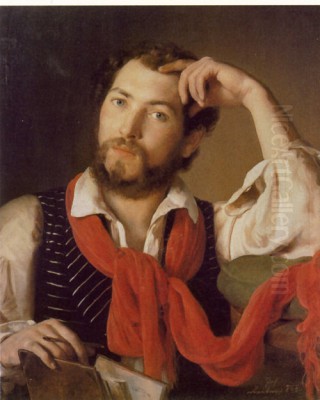
Johann Baptist Reiter (1813-1890) stands as a significant figure in Austrian art history, particularly renowned for his contributions during the Biedermeier period. An accomplished painter of portraits and genre scenes, Reiter's work is celebrated for its delicate execution, insightful character portrayal, and warm depiction of everyday life in 19th-century Austria. His legacy is one of quiet mastery, capturing the intimate spirit of an era with sensitivity and remarkable skill.
Early Life and Artistic Awakening in Upper Austria
Johann Baptist Reiter was born in 1813 in Urfahrt, a district of Linz in Upper Austria. This region, with its blend of urban and rural life, would subtly inform the backdrop of his later artistic sensibilities. His father was a carpenter, and Reiter initially spent three years as an apprentice in his father's workshop. This early exposure to craftsmanship and the meticulous demands of woodworking likely instilled in him a profound appreciation for detail, precision, and the tangible quality of materials – traits that would later manifest in the careful rendering of textures and forms in his paintings.
While the path of a craftsman was laid out for him, Reiter's true passion lay in the visual arts. The discipline and eye for detail honed in the carpentry workshop were not lost but rather redirected towards the canvas. He demonstrated an early aptitude for drawing and painting, suggesting a calling that transcended the family trade. This burgeoning talent would eventually lead him away from Urfahrt to seek formal artistic training, a common trajectory for aspiring artists of his time who sought to refine their innate abilities under the guidance of established masters and institutions. The decision to pursue art marked a pivotal moment, setting him on a course to become one of the Biedermeier era's most endearing visual chroniclers.
Formal Training and Formative Influences
Reiter's quest for artistic education led him to Vienna, the imperial capital and a vibrant center for the arts. He enrolled at the prestigious Academy of Fine Arts Vienna, where he had the opportunity to study under several influential figures. Among his teachers were Leopold Kupelwieser, known for his religious paintings, historical scenes, and portraits, and Thomas Ender, a celebrated landscape painter. The diverse specializations of his instructors would have exposed Reiter to a range of artistic approaches and subject matter, broadening his technical skills and aesthetic understanding. Joseph Hafner is also mentioned as one of his guides during his academic period.
An interesting note from his early career is a visit to the Vienna Art Academy in 1830 in the company of the painter Leopold Zignotin (often referred to as Leopold Zingg). Such interactions with fellow artists, even in these formative years, were crucial for exchanging ideas and understanding the contemporary art scene. Furthermore, Reiter's educational journey was not confined to Vienna. He also spent time studying in Würzburg, Germany. This experience abroad, though details are scarce, would have offered him exposure to different artistic traditions and perspectives, further enriching his development. Upon returning to his home region, he is noted for having actively promoted painting techniques in the Mühlviertel, the wider area encompassing Urfahrt, indicating an early desire to share his acquired knowledge and contribute to the local artistic culture.
The Biedermeier Era: A Cultural Context
To fully appreciate Johann Baptist Reiter's work, it is essential to understand the Biedermeier period in which he flourished. Spanning roughly from the end of the Napoleonic Wars in 1815 to the Revolutions of 1848, the Biedermeier era in Central Europe, particularly in Austria and Germany, was characterized by a turn towards the domestic, the private, and the sentimental. After years of political upheaval and war, there was a collective yearning for peace, stability, and the comforts of home. This sentiment permeated art, literature, music, and design.
Artistically, the Biedermeier style emphasized realism, meticulous detail, and a focus on everyday life, particularly that of the burgeoning middle class. Grand historical narratives and mythological allegories, favored in earlier Neoclassical and ongoing Romantic movements, took a backseat to intimate portraits, cozy domestic scenes, tranquil landscapes, and charming still lifes. There was a preference for clarity, order, and a somewhat idealized depiction of reality. The emotional tone was often one of gentle sentimentality, contentment, and quiet contemplation. Artists like Reiter became chroniclers of this inward-looking society, capturing its values and aspirations with a sympathetic eye. The Biedermeier aesthetic valued craftsmanship, unpretentious beauty, and an accessible emotional connection, qualities that are hallmarks of Reiter's oeuvre. His contemporaries, such as the preeminent portraitist Friedrich von Amerling, the master of genre and landscape Ferdinand Georg Waldmüller, and the sensitive portrayer of everyday life Peter Fendi, all contributed to defining this distinct artistic period.
Reiter's Mastery in Portraiture
Johann Baptist Reiter excelled in portraiture, a genre highly favored during the Biedermeier period. His portraits are distinguished by their psychological depth, refined technique, and the ability to capture not just a physical likeness but also the sitter's personality and inner state. He painted individuals from various walks of life, though his subjects often hailed from the comfortable bourgeoisie, reflecting the era's primary patrons of the arts.
Reiter's approach to portraiture was characterized by a careful attention to detail, from the subtle nuances of facial expression to the intricate rendering of clothing and accessories. He possessed a keen ability to convey the texture of fabrics, the sheen of hair, and the softness of skin, all contributing to a sense of realism and immediacy. Yet, his realism was not merely photographic; it was imbued with a warmth and sensitivity that made his subjects relatable and human. Works such as "A Young Girl in Profile" and "Viennese Girl" (also known as "Wienerin") exemplify his skill in capturing delicate expressions and the innocent charm of youth. In these, and many other portraits, Reiter demonstrated an almost uncanny ability to convey a sense of presence, as if the sitter might at any moment speak or turn their gaze. His portraits often feature a soft, diffused light that models the forms gently, avoiding harsh contrasts and contributing to the overall harmonious and tranquil mood typical of Biedermeier art. Other notable portraitists of the era, whose works provide a comparative context, include Franz Eybl, known for his sensitive portrayals, and Josef Danhauser, who, while also a genre painter, produced compelling portraits.
Chronicler of Everyday Life: Reiter's Genre Paintings
Beyond portraiture, Johann Baptist Reiter was a gifted genre painter, capturing scenes of daily life with charm and authenticity. His genre works offer a window into the Biedermeier world, depicting domestic interiors, family gatherings, leisurely pursuits, and the simple pleasures of ordinary people. These paintings resonate with a sense of warmth, intimacy, and often a gentle humor or sentimentality.
Reiter's genre scenes are meticulously composed and rich in narrative detail. He paid close attention to the settings, rendering furniture, household objects, and clothing with the same care he devoted to his portraits. This creates a strong sense of time and place, immersing the viewer in the depicted scene. His figures are often engaged in quiet activities – reading, sewing, playing music, or interacting with children – reflecting the Biedermeier emphasis on domestic harmony and the private sphere. One of his most famous genre pieces is "Die schlafende Näherin" (The Sleeping Seamstress), a tender depiction that evokes empathy and highlights the quiet dignity of labor. Through such works, Reiter not only documented the customs and lifestyles of his time but also explored universal human emotions and relationships. His contemporaries in genre painting, such as Carl Schindler, known for his depictions of military life with a Biedermeier sensibility, and Matthias Ranftl, who often included animals in his charming scenes, further illustrate the period's fascination with everyday subjects. The writer and painter Adalbert Stifter, though more known for his literary works, also created landscapes and genre-like scenes that captured the Biedermeier spirit.
Artistic Style and Technical Prowess
Johann Baptist Reiter's artistic style is firmly rooted in Biedermeier aesthetics, characterized by its blend of realism, meticulous detail, and subtle emotional expression. His technical skill was considerable, evident in his smooth brushwork, his sophisticated use of color, and his ability to render light and texture convincingly. He typically employed a warm and harmonious palette, often favoring soft, muted tones that contributed to the gentle and intimate mood of his paintings.
Reiter's compositions are generally well-balanced and thoughtfully arranged, guiding the viewer's eye effectively through the scene. In his portraits, the focus is invariably on the sitter's face and expression, with backgrounds often kept simple or subtly suggestive of their environment. In genre scenes, he adeptly managed multiple figures and a wealth of narrative details without sacrificing clarity or overall harmony. His early training in carpentry may have contributed to his precise draftsmanship and his understanding of form and structure. The influence of his teachers at the Vienna Academy, such as Leopold Kupelwieser with his refined technique and Thomas Ender with his observational skills in landscape, can also be discerned. Reiter's commitment to capturing the truth of his subjects, whether a human face or a domestic interior, was tempered by an inherent grace and a desire to create images that were both beautiful and emotionally resonant. This balance between objective representation and subjective feeling is a hallmark of his art.
Notable Works and Their Characteristics
Several works by Johann Baptist Reiter stand out as particularly representative of his talent and the Biedermeier style. "A Young Girl in Profile" is a prime example of his portraiture, showcasing his ability to capture youthful innocence and a pensive mood through subtle modeling and a delicate rendering of features. The profile view itself lends a certain classical simplicity and elegance to the composition. Similarly, "Viennese Girl" (or "Wienerin") is celebrated for its charming depiction of a young woman, her direct gaze and finely detailed attire embodying the Biedermeier ideal of modest beauty and refined sensibility.
"Die schlafende Näherin" (The Sleeping Seamstress), often dated around 1847, is perhaps his most iconic genre painting. It depicts a young woman slumped over her work, overcome by exhaustion. The scene is rendered with immense sympathy, highlighting the toil of working-class life while maintaining a sense of quiet dignity. The play of light on her figure and the meticulous detail of her surroundings, from the sewing basket to the simple room, create a poignant and compelling image. Another significant work is his "Self-Portrait," which offers insight into how the artist saw himself, likely with the same honesty and introspection he applied to his other sitters. These paintings, among others, demonstrate Reiter's consistent ability to combine technical finesse with emotional depth, making his work accessible and enduringly appealing. The quality of his work can be compared to that of other leading Austrian artists of the time, such as the slightly earlier master of historical and portrait painting, Johann Peter Krafft, whose precision laid some groundwork for Biedermeier realism.
Contemporaries and the Viennese Art Scene
Johann Baptist Reiter was part of a vibrant artistic community in Vienna, which, during the Biedermeier period, was a leading cultural capital in Europe. He worked alongside and was a contemporary of many notable artists who shaped the era's visual landscape. While the provided information suggests a lack of specific documented collaborations, artists of a period invariably influence and respond to one another.
Ferdinand Georg Waldmüller (1793-1865) was arguably the most prominent Austrian painter of the Biedermeier era, known for his luminous landscapes, insightful portraits, and lively genre scenes. His emphasis on direct observation from nature and his brilliant use of light set a high standard. Peter Fendi (1796-1842) was another key figure, celebrated for his sentimental genre scenes, often depicting children and family life, as well as his accomplished watercolors. Friedrich von Amerling (1803-1887) was a highly sought-after portrait painter, rivaling Waldmüller in popularity and skill, known for his elegant and psychologically astute depictions of Viennese society.
Josef Danhauser (1805-1845) contributed significant genre paintings, often with a moralizing or anecdotal character, as well as portraits and religious works. Franz Eybl (1806-1880) was a master of portraiture and genre scenes, known for his technical skill and sensitive portrayals. Reiter's own teacher, Leopold Kupelwieser (1796-1862), was a respected artist in his own right, contributing to religious art, historical paintings, and portraiture. The landscape painter Thomas Ender (1793-1875), another of Reiter's instructors, captured the Austrian scenery with remarkable detail. Other artists like Carl Schindler (1821-1842), known as "Soldaten-Schindler" for his military genre scenes, and Moritz von Schwind (1804-1871), though leaning more towards Romanticism and later active in Germany, had roots in the Viennese scene and contributed to the broader artistic currents of the time. This rich milieu provided both competition and inspiration for artists like Reiter.
Later Years, Death, and Enduring Legacy
Johann Baptist Reiter continued to paint throughout his life, remaining active well into the latter half of the 19th century. While the Biedermeier period officially ended with the revolutions of 1848, its stylistic influences persisted, and artists like Reiter carried its sensibilities forward, adapting to changing tastes while often retaining the core qualities of their established style. He passed away in Vienna in 1890, leaving behind a substantial body of work that continues to be appreciated for its artistic merit and historical significance.
Reiter's legacy lies in his sensitive and skillful portrayal of the Biedermeier era's people and their world. His paintings offer invaluable insights into the social customs, domestic life, and aesthetic preferences of 19th-century Austria. He masterfully captured the spirit of a time that valued intimacy, sentiment, and the quiet beauty of the everyday. His works are held in numerous Austrian collections, including the Belvedere Museum and the Wien Museum in Vienna, as well as the Oberösterreichisches Landesmuseum in Linz, his home region. As an art historian, one recognizes Reiter not just as a skilled technician, but as a perceptive observer of humanity. His ability to imbue his subjects with life and emotion ensures his enduring relevance. He remains a key representative of Biedermeier art, a movement that, despite its often modest subject matter, produced works of lasting charm and profound human connection. His contribution is a testament to the power of art to capture the essence of an age and the enduring appeal of finely crafted, heartfelt depictions of life.
Conclusion: Reiter's Place in Art History
Johann Baptist Reiter holds a distinguished place in Austrian art history as a quintessential painter of the Biedermeier period. His dedication to portraiture and genre painting resulted in a body of work that is both a valuable historical document and a collection of aesthetically pleasing and emotionally engaging artworks. His delicate brushwork, keen observation, and sympathetic portrayal of his subjects – from individual sitters to figures in everyday scenes – encapsulate the intimate and introspective spirit of his time.
While perhaps not as revolutionary as some of his contemporaries who pushed the boundaries of academic art, Reiter's strength lay in his consistent quality and his deep understanding of the Biedermeier ethos. He masterfully conveyed the warmth, realism, and subtle emotional nuances that defined the era's artistic preferences. His paintings, characterized by their meticulous detail, harmonious compositions, and gentle humanity, continue to resonate with viewers today. He stands alongside figures like Waldmüller, Amerling, and Fendi as a key contributor to one of the most distinctive and appealing periods in Central European art, ensuring his work remains a subject of appreciation and study for art historians and enthusiasts alike.