Joseph van Aken, a name perhaps not as universally recognized as some of his contemporaries, nonetheless carved out a crucial and highly specialized niche within the bustling art scene of 18th-century London. A Flemish émigré, he became renowned not primarily for his independent compositions, though he produced notable works in that vein, but for his exceptional skill in painting drapery, costumes, and accessories for many of the leading portraitists of his day. His proficiency in rendering the rich textures of silks, satins, and velvets was so esteemed that he earned the moniker "Van Aken the tailor," a testament to his indispensable role in the studios of others. This exploration delves into his life, his artistic contributions, his collaborations, and his complex legacy within British art history.
Early Life and Relocation to London
The precise birth year of Joseph van Aken (also documented as Josef) is subject to some scholarly debate, with sources suggesting either circa 1699 or, less commonly, 1709. The prevailing consensus leans towards the earlier date, placing his birth in Antwerp, a city with a rich artistic heritage that undoubtedly shaped his formative years. Antwerp, once the vibrant hub of masters like Peter Paul Rubens and Anthony van Dyck, still carried the echoes of their grandeur, and young artists would have been immersed in a tradition that prized technical skill, rich coloration, and dynamic composition.
Little is definitively known about Van Aken's early training in Flanders, but his later proficiency suggests a thorough grounding in Flemish painting techniques. Around 1720, Joseph, possibly accompanied by his brothers Alexander (also a painter) and Arnold (who would later specialize in mezzotint engraving after his brother's designs), made the pivotal decision to relocate to London. This move was part of a broader trend of Continental European artists seeking opportunities in England, where a burgeoning wealthy class provided ample patronage, particularly for portraiture. London, at this time, was becoming a significant cultural and economic powerhouse, attracting talent from across Europe.
Initial Artistic Endeavors in England
Upon his arrival in London, Van Aken initially focused on producing his own independent works. These primarily consisted of genre scenes and "conversation pieces"—informal group portraits depicting families or friends in domestic or garden settings, engaged in leisurely activities. These paintings often showcased a delightful blend of Flemish attention to detail and an emerging Rococo sensibility, characterized by lighter palettes, graceful figures, and an air of informal elegance.
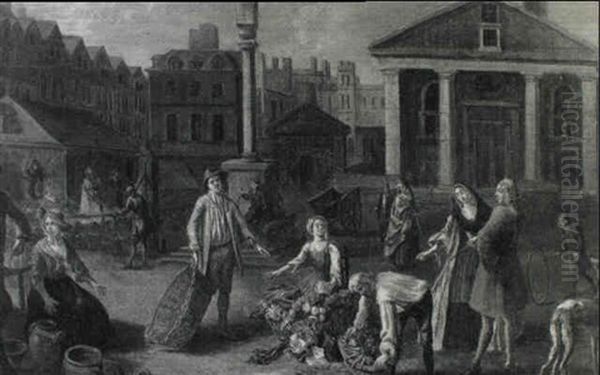
His genre scenes often depicted everyday life, markets, or interiors with a keen observational eye. Works from this period demonstrate his ability to capture lively human interaction and the textures of various materials, a skill that would later define his specialized career. He was adept at composing multi-figure scenes, managing complex arrangements with a sense of naturalism and charm. These early works established his reputation as a capable and versatile painter, comfortable with narrative and detailed representation. His style showed an understanding of both the Dutch Golden Age genre traditions and the more contemporary French influences that were beginning to permeate English taste.
The Rise of the Drapery Specialist: "Van Aken the Tailor"
While Van Aken demonstrated talent in independent compositions, it was his extraordinary ability to paint fabrics and costumes that truly set him apart in the competitive London art market. By the 1730s, he began to specialize as a "drapery painter" (sometimes referred to as a "posture painter"), a role that involved completing the attire, backgrounds, and often the general pose of figures in portraits for which the principal artist had painted the face and hands.
This specialization was a practical response to the demands of a busy portrait studio. Leading portraitists like Thomas Hudson and Allan Ramsay, who had numerous commissions, could significantly increase their output by delegating the time-consuming task of rendering elaborate costumes to a specialist. Van Aken's skill was such that his contributions were not merely functional but often enhanced the overall quality and grandeur of the portraits. He was known for his ability to depict the sheen of silk, the plushness of velvet, and the intricate patterns of lace with remarkable verisimilitude.
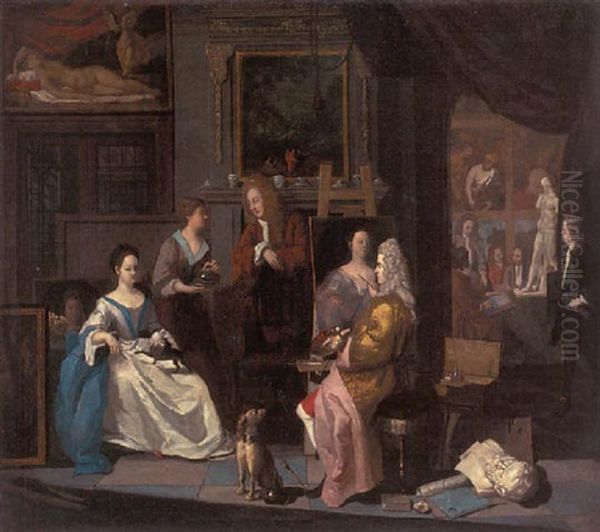
The diarist George Vertue, a contemporary engraver and antiquary whose notebooks are an invaluable source for 18th-century British art, commented on Van Aken's practice. Vertue noted that Van Aken would receive canvases with only the head painted, and he would then add the figure, posture, and drapery, often working from stock poses or lay figures dressed in fashionable attire. This "factory-like" system, while efficient, sometimes led to a degree of standardization in the poses and costumes seen in the works of various artists who employed him.
Key Collaborations and Prominent Contemporaries
Joseph van Aken's services were sought by a significant number of London's portrait painters. His most notable and extensive collaborations were with Thomas Hudson (1701-1779) and the Scottish painter Allan Ramsay (1713-1784). Both artists were leading figures in British portraiture during the mid-18th century, and Van Aken's contribution to their studios was substantial. It is said that after Van Aken's death, Hudson's and Ramsay's output and perhaps even the quality of their drapery painting noticeably suffered, at least initially.
Beyond Hudson and Ramsay, Van Aken is believed to have worked for a host of other artists. While direct documentation for every collaboration is scarce, the stylistic consistency of drapery in portraits by various painters of the period often points to his hand. Painters such as Arthur Pond (c. 1701-1758), George Knapton (1698-1778), Henry Pickering (fl. 1740-1771), and Bartholomew Dandridge (1691-c. 1754) are among those thought to have utilized his skills. Even artists with distinct styles, like William Hogarth (1697-1764), the master of the satirical "modern moral subject," operated in the same artistic milieu, though Hogarth's reliance on drapery specialists is less documented and likely minimal given his individualistic approach.
The London art world of this era was vibrant and interconnected. Other significant figures included the portraitist Jonathan Richardson the Elder (1667-1745), whose theoretical writings also influenced the period, and the slightly earlier generation of immigrant artists like Sir Godfrey Kneller (1646-1723) and Michael Dahl (1659-1743), who had dominated British portraiture in the late 17th and early 18th centuries, setting a standard for formal portraiture that Van Aken's employers often emulated. French artists like Jean-Baptiste van Loo (1684-1745), who worked in London for a period in the late 1730s and early 1740s, brought a more overt Rococo flair, further influencing tastes. The engraver and designer Hubert-François Gravelot (1699-1773), a fellow immigrant, was also highly influential in disseminating French Rococo aesthetics in England through book illustrations and design work.
Notable Works and Artistic Style
While much of his output is subsumed within the oeuvres of others, Van Aken did produce independent works that showcase his abilities.
An English Family at Tea (c. 1720s, Tate Britain): This charming conversation piece is a fine example of his early style. It depicts a prosperous family in a domestic interior, engaged in the fashionable ritual of tea drinking. The painting is notable for its detailed rendering of the figures, their attire, the tea service, and the room's furnishings. It captures a sense of relaxed gentility and familial harmony, characteristic of the conversation piece genre. The textures of the silk dresses and the polished wood are handled with care.
Covent Garden Market (versions exist, e.g., Museum of London, c. 1726-1740s): This lively scene, or series of scenes, captures the bustling atmosphere of one of London's most famous markets. Van Aken populates the canvas with a diverse array of figures – vendors, shoppers, porters – creating a vibrant tableau of urban life. These works demonstrate his skill in genre painting, his eye for anecdotal detail, and his ability to manage complex compositions. The depiction of fresh produce, flowers, and the varied attire of the market-goers showcases his versatility.
The Musical Party on a Terrace (c. 1720s): Another example of his conversation pieces, this work likely depicts an aristocratic or wealthy bourgeois group enjoying music in an elegant outdoor setting. Such scenes allowed for the display of fashionable dress and leisurely pursuits, appealing to the tastes of his clientele. The interplay of figures and the rendering of their costumes would have been key features.
The Old Stocks Market (c. 1737, Bank of England Museum): This painting provides a fascinating topographical and social record of another London market, located near the Mansion House. It is filled with figures and activity, offering a glimpse into the commercial life of the city. Van Aken's ability to organize numerous small figures and details into a coherent and engaging scene is evident.
When considering his drapery work within the portraits of others, his style is characterized by a certain fluency and richness. He often employed broad, confident brushstrokes to suggest the fall and fold of fabric, capturing the play of light on different surfaces. His figures, even when based on stock poses, often possess a degree of elegance and poise. He was particularly adept at rendering the elaborate silk gowns worn by women and the velvet coats and breeches favored by men of status. The influence of Anthony van Dyck's portrait style, with its emphasis on graceful poses and luxurious attire, can often be discerned in the drapery Van Aken painted, filtered through the prevailing tastes of the mid-18th century.
Artistic Reputation and Critical Reception
During his lifetime, Joseph van Aken was highly regarded for his specialized skill. The sheer volume of work he undertook for prominent portraitists attests to his indispensability. George Vertue's aforementioned notes confirm his active role and the system within which he operated. Horace Walpole, in his Anecdotes of Painting in England (published later in the century), acknowledged Van Aken's impact, famously remarking that "As he had the greatest name for it, the whole business of the nation was engrossed by Van Aken." Walpole even quipped that painters only needed to be able to paint a face, as Van Aken would "supply the figure and the drapery."
However, this specialization also led to criticism, both contemporary and subsequent. The reliance on a single drapery painter by multiple artists inevitably led to a degree of homogeneity in the poses and costume styles seen in mid-18th-century British portraiture. Some critics felt that this "Van Aken style" stifled individuality and innovation among portraitists. William Hogarth, ever the iconoclast and champion of native English artistic genius, was reportedly critical of the reliance on such specialists, viewing it as a shortcut that detracted from the overall artistic integrity of a work.
Later art historical assessments have been mixed. While his technical skill is undeniable, his role as primarily an assistant or "finisher" has sometimes led to his marginalization in narratives focused on singular artistic authorship. Some have viewed his work as contributing to a certain formulaic quality in portraiture of the period. However, others recognize the vital role he played in the London art economy, enabling portraitists to meet the high demand for their work. His skill undoubtedly elevated the visual appeal of many portraits, contributing to their impressiveness and the sitter's projection of status.
Controversies, Unresolved Questions, and Anecdotes
The primary "controversy" surrounding Van Aken, if it can be termed as such, relates to his birth year, as previously mentioned (1699 vs. 1709). Most reliable sources, including the RKD (Netherlands Institute for Art History) and major museum databases, favor circa 1699.
The alias "Johannes van Haecken" is another point of minor obscurity. It's possible this was an alternative name he used, or a name by which he was known in certain circles, perhaps a more formal or Flemish version of his name. Such variations were not uncommon for artists working across different linguistic contexts.
One anecdote, though its veracity can be debated, suggests the level of dependence some artists had on him. It was said that upon Van Aken's death in 1749, some portrait painters were so reliant on his skills that they feared they would have to "take to painting landscapes" or give up their profession. While likely an exaggeration, it underscores the perceived importance of his contribution. Thomas Hudson, for instance, is said to have briefly considered retiring before finding other assistants, including the young Joseph Wright of Derby for a period.
There was also the professional rivalry common in any competitive field. The provided information mentions a "John Robinson" (or Hodges) whose employers threatened dismissal unless he ceased collaboration with Van Aken. This highlights the competitive pressures and perhaps the desire by some principal painters to monopolize Van Aken's sought-after skills, or conversely, jealousy from other drapery painters.
Later Career, Death, and Legacy
Joseph van Aken continued to be highly active as a drapery painter throughout the 1730s and 1740s. He largely abandoned independent genre and conversation piece painting to focus on this lucrative specialization. He resided in London, likely in an area convenient for the artists he served, and seems to have maintained a successful practice until his death.
Joseph van Aken died in London on July 4, 1749, and was buried in St Pancras Old Church. His death was a significant event in the London art world, particularly for those who relied heavily on his services. As mentioned, artists like Hudson and Ramsay had to find new solutions for their drapery needs, sometimes employing other specialists or training pupils within their own studios. The young Joshua Reynolds (1723-1792), who would later become the dominant figure in British portraiture, was just beginning his rise around this time and, while initially a pupil of Hudson, developed his own distinct and dynamic approach to drapery and composition, moving beyond the somewhat static conventions associated with the Van Aken era.
Van Aken's legacy is complex. On one hand, he can be seen as a highly skilled craftsman who played an essential, if often uncredited, role in the production of a vast number of 18th-century British portraits. His work contributed to the polished and elegant aesthetic that characterized much of the portraiture of the time. On the other hand, his very success and the widespread adoption of his services may have contributed to a certain uniformity, a "house style" that some critics found uninspired.
In recent decades, art historians have paid more attention to the collaborative nature of art production in earlier centuries, and figures like Van Aken are being reassessed. Rather than being dismissed as mere assistants, their specialized skills are recognized as integral to the artistic output of their time. His independent works, though fewer in number, also provide valuable insight into his broader artistic capabilities and his contribution to genre painting and the conversation piece in England.
Conclusion: A Master of Fabric and Form
Joseph van Aken occupies a unique and fascinating position in the annals of British art. He was a master of his specific craft, the art of painting drapery, and his skills were so highly valued that he became an almost indispensable fixture in the London art world of the 1730s and 1740s. While the star portraitists painted the faces that captured the likeness and, ideally, the character of their sitters, it was often Van Aken who clothed these figures in the silks, satins, and velvets that signified their wealth and status, placing them in elegant poses and appropriate settings.
His career highlights the collaborative and often pragmatic nature of art production in the 18th century, a system that allowed for high output and specialized expertise. Though his name might not be as widely celebrated as those of the principal painters he served, his hand is present in countless portraits that adorn museum walls and private collections. His independent works further reveal a talented painter of genre and social scenes, adept at capturing the life and manners of his adopted city. Joseph van Aken, "the tailor," was far more than a mere assistant; he was a significant contributor to the visual culture of Georgian England, a painter whose brush brought texture, richness, and a particular kind of elegance to the art of his time. His story reminds us that the creation of art is often a multifaceted endeavor, reliant on a diverse array of talents and skills.