Karl Friedrich Schinkel: The Prussian Polymath Who Shaped an Era
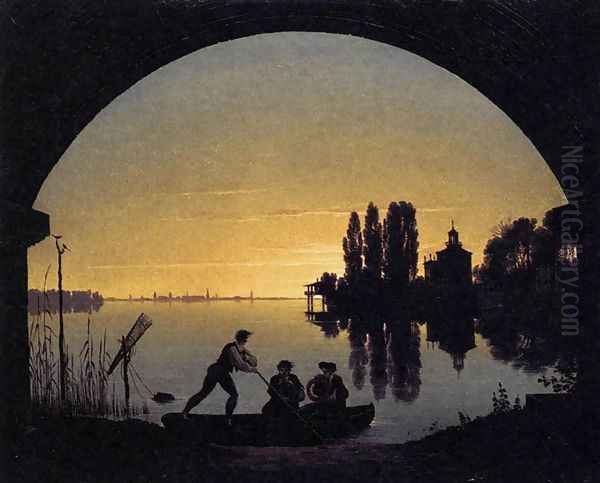
Karl Friedrich Schinkel stands as one of the most pivotal figures in German art and architectural history, a true polymath whose prodigious talents spanned architecture, urban planning, painting, and stage and furniture design. Active during the tumultuous and transformative early 19th century, Schinkel not only left an indelible mark on the cityscape of Berlin, transforming it into a modern European capital, but also profoundly influenced the aesthetic sensibilities of Prussia and beyond. His work, deeply rooted in Neoclassicism yet often infused with Romantic and Gothic Revival elements, sought to create a harmonious synthesis of beauty, functionality, and national identity.
Early Life and Formative Influences
Born on March 13, 1781, in Neuruppin, a town in the Margraviate of Brandenburg, Prussia, Karl Friedrich Schinkel's early life was marked by upheaval. His father, Johann Cuno Christoph Schinkel, was a Lutheran pastor and superintendent, and his mother was Dorothea Schinkel (née Rose). Tragedy struck when Karl Friedrich was merely six years old; a devastating fire swept through Neuruppin in 1787, and his father died from complications arising from his efforts to combat the blaze. This early loss undoubtedly shaped the young Schinkel. In 1794, his mother moved the family, which included Karl Friedrich as the second of five children, to Berlin, the vibrant heart of Prussia.
In Berlin, Schinkel attended the prestigious Graues Kloster Gymnasium, where he received a classical education, studying history, Latin, and Greek. However, his true passion was ignited by architecture. A pivotal moment came in 1797 when he attended an exhibition showcasing a design for a monument to Frederick the Great by the architect Friedrich Gilly. Schinkel was so captivated by Gilly's visionary drawings that he resolved to become an architect himself. He soon became a close friend of Friedrich Gilly and began his architectural studies under Friedrich's father, David Gilly, a respected architect and founder of the private Bauakademie (Building Academy) in Berlin.
Under the tutelage of David Gilly, and in the stimulating environment of the Bauakademie, Schinkel absorbed the principles of French Revolutionary Neoclassicism, characterized by its geometric clarity, rationalism, and monumental scale. He also formed lasting friendships, including one with Leo von Klenze, who would later become a significant architectural rival and a key figure in the Greek Revival movement in Bavaria. Though Schinkel initially dabbled in painting, and indeed would continue to paint throughout his life, his primary ambition crystallized around architecture. The untimely death of Friedrich Gilly in 1800 was a blow, but Schinkel, along with David Gilly, worked to complete some of his friend's unfinished projects, further honing his skills.
The Italian Sojourn: A Classical Awakening
Like many artists and architects of his generation, Schinkel embarked on an extensive study tour, a "Grand Tour" of sorts, to Italy. From 1803 to 1805, he traveled through Austria, Italy, and France. This journey was profoundly influential. In Italy, he immersed himself in the study of classical antiquity, sketching ancient Roman ruins, Renaissance palaces, and the sun-drenched landscapes that had inspired artists for centuries. He visited Rome, Naples, and Sicily, meticulously documenting what he saw.
This direct encounter with the masterpieces of classical architecture and art deepened his understanding of proportion, form, and the expressive power of architectural elements. While he absorbed the lessons of Roman grandeur, it was often the perceived purity and rationality of Greek architecture that resonated most strongly with him, an influence that would become increasingly apparent in his later Neoclassical designs. His travel sketchbooks from this period are filled with not only architectural studies but also picturesque landscapes, demonstrating his continued engagement with painting and his developing Romantic sensibility. The experience in Italy solidified his Neoclassical leanings but also broadened his artistic horizons, exposing him to diverse historical styles and the interplay of architecture with its natural and urban settings.
Return to Prussia and Rise to Prominence
Schinkel returned to Berlin in 1805 to find Prussia under French occupation following Napoleon's victories. Architectural commissions were scarce during this period of political instability and economic hardship. To support himself, Schinkel turned to painting, creating romantic landscapes, historical scenes, and, notably, panoramic displays and dioramas, which were popular forms of entertainment. His paintings from this era, such as Morning (1813) and Medieval City on a River (c. 1815), often exhibit a dramatic use of light and a sublime, atmospheric quality, showing the influence of German Romantic painters like Caspar David Friedrich. Friedrich, known for his allegorical landscapes such as Wanderer above the Sea of Fog, shared with Schinkel an interest in the spiritual and emotional power of nature and historical settings.
Schinkel also excelled as a stage designer. His imaginative and atmospheric sets for numerous theatrical and operatic productions, most famously for Wolfgang Amadeus Mozart's The Magic Flute in 1816, were highly acclaimed. These designs often combined classical architectural elements with fantastical, romantic imagery, showcasing his ability to create immersive and emotionally resonant environments. His work in stage design allowed him to experiment with spatial effects, lighting, and historical styles in a way that directly informed his later architectural practice. He collaborated with figures from the Romantic literary circle, including Ludwig Tieck and Clemens Brentano, further steeping him in the Romantic ethos of the time.
The defeat of Napoleon and the subsequent period of Prussian restoration brought new opportunities. In 1810, Schinkel was appointed to the Prussian Building Commission (Oberbaudeputation) and became a professor at the Royal Academy of Architecture (which had evolved from David Gilly's Bauakademie). His career truly took off in 1815 when, after the Napoleonic Wars, King Frederick William III appointed him Geheimer Oberbaurat, a high-ranking privy councillor for public works. This position gave him significant influence over state-sponsored architectural projects throughout Prussia, effectively making him the state architect.
The Architect of a New Berlin: Neoclassical Masterpieces
Schinkel's most significant architectural contributions were concentrated in Berlin, which he systematically began to reshape into a worthy capital for the resurgent Prussian state. His style, while predominantly Neoclassical, was a refined and often Hellenistic interpretation, distinct from the more Roman-influenced classicism of some of his contemporaries or the earlier Baroque grandeur. He sought what he termed a "Greek blossoming" for Prussia.
One of his earliest major public commissions was the Neue Wache (New Guardhouse, 1816-1818). Located on Unter den Linden, this compact, powerful building served as a royal guardhouse and a memorial to those who fell in the Napoleonic Wars. Its severe Doric portico, flanked by solid corner pylons, exudes a sense of solemnity and strength. The sculptural frieze, designed by Johann Gottfried Schadow (famous for the Quadriga on the Brandenburg Gate, designed by Carl Gotthard Langhans) and executed by his students, including Christian Daniel Rauch, depicted allegories of battle and victory. The Neue Wache exemplifies Schinkel's ability to imbue classical forms with contemporary meaning and emotional depth.
Perhaps his most celebrated Neoclassical work is the Schauspielhaus (Royal Playhouse, now the Konzerthaus Berlin, 1818-1821), located on the Gendarmenmarkt. Flanked by the existing French and German Cathedrals, Schinkel's theater provided a magnificent focal point for the square. He skillfully integrated the new structure with its surroundings, raising it on a high podium and fronting it with a majestic Ionic portico. The interior was renowned for its acoustics and its elegant, classically inspired decoration. The building demonstrated Schinkel's mastery of proportion, his sophisticated use of classical orders, and his ability to create a building that was both monumental and graceful.
The Altes Museum (Old Museum, 1823-1830) on Museum Island is another cornerstone of Schinkel's Neoclassical legacy and a landmark in museum design. Conceived as a public institution to house the royal art collections, its design was revolutionary. An imposing facade featuring an unbroken sweep of eighteen Ionic columns creates a powerful stoa-like impression. Behind this colonnade, a central, domed rotunda, inspired by the Pantheon in Rome, serves as the grand entrance hall and a space for displaying sculpture. This was a clear statement of the Enlightenment ideal of public access to culture and education, a "temple of art" for the people. The clarity of its plan and the majestic simplicity of its forms made it a model for museum architecture for decades to come. Other Neoclassical architects of the period, like Sir John Soane in England with his Bank of England designs, or Jacques-Louis David's pupils in France like Jean-Auguste-Dominique Ingres in painting, shared this reverence for classical forms, though Schinkel's interpretation was uniquely Prussian.
Schinkel also designed more intimate structures, such as the Charlottenhof Palace (1826-1829) in Sanssouci Park, Potsdam. This relatively modest summer residence for Crown Prince Frederick William (later King Frederick William IV) was designed in the style of a Roman villa, showcasing a more informal and picturesque classicism. He also designed the Palais Prinz August (later Palais am Festungsgraben) and numerous other villas and public buildings, each demonstrating his versatile command of the classical language.
Embracing the Gothic: National Identity and Romantic Spirit
While Schinkel is often primarily associated with Neoclassicism, he was also a significant proponent of the Gothic Revival style, particularly for ecclesiastical architecture and projects that sought to evoke a sense of national history and Romantic sentiment. This was not a contradiction but rather a reflection of the complex cultural currents of the era, where different historical styles were seen as appropriate for different functions and symbolic meanings. The Gothic style, in particular, was increasingly associated with German national identity and Christian piety, a counterpoint to the perceived paganism of classical antiquity or the French-dominated Neoclassicism.
His most famous Gothic Revival building is the Friedrichswerder Church (1824-1831) in Berlin. Constructed in red brick, a traditional building material in northern Germany, the church features a soaring nave, pointed arches, and delicate tracery. It was one of the first major Gothic Revival churches on the European continent and demonstrated Schinkel's ability to master and reinterpret historical styles with originality. The choice of brick also reflected a pragmatic approach, utilizing local materials to create a building that was both aesthetically striking and economically sensible. This interest in Gothic forms can be seen in some of his paintings too, like Gothic Cathedral by a River (c. 1813-14), which predates many of his Gothic architectural projects and shows an early romantic fascination with medieval architecture, akin to the works of painters like Carl Blechen, who also depicted ruins and Gothic structures.
Another highly influential, though tragically later demolished (and now partially reconstructed), building was the Bauakademie (Building Academy, 1832-1836) in Berlin. This structure, also built of red brick, was a radical departure from traditional academic architecture. Its design was remarkably functionalist, with a grid-like facade of exposed brick piers and large window openings that clearly expressed the building's internal structure and purpose. The terracotta ornamentation depicted scenes related to architecture and construction. The Bauakademie is often cited as a precursor to modern architecture, admired by later architects like Ludwig Mies van der Rohe for its structural honesty and rational design. It demonstrated Schinkel's forward-thinking approach and his willingness to innovate beyond established stylistic conventions.
His interest in Gothic was shared by other Romantics and architects across Europe, such as Augustus Pugin in England, who championed Gothic as the true Christian and national style. Schinkel's Gothic, however, was often more picturesque and less dogmatically archaeological than Pugin's.
Beyond Buildings: Schinkel the Painter, Designer, and Urban Visionary
Schinkel's creative energies were not confined to architecture. As mentioned, he was an accomplished painter. His landscapes often depicted idealized natural scenes or historical settings, imbued with a sense of awe and romantic longing. Works like View of the Elbe near Dresden or his imaginative depictions of ancient Greek life showcase his painterly skill and his ability to evoke specific moods and atmospheres. He was certainly aware of the work of other German Romantic painters like Philipp Otto Runge, who, like Friedrich, explored symbolic and spiritual themes in landscape.
His work as a stage designer continued throughout his career, and he created numerous influential designs that integrated architectural principles with dramatic effect. He also turned his hand to furniture design, creating pieces that complemented his architectural interiors, often in a refined Neoclassical or Biedermeier style. He designed everything from candelabra and cast-iron garden furniture to state regalia, aiming for a Gesamtkunstwerk – a total work of art – where all elements of a design were harmoniously integrated. This holistic approach was characteristic of his practice.
Furthermore, Schinkel was a visionary urban planner. As head of the Prussian Building Commission, he oversaw the development of Berlin's infrastructure, including roads, bridges, and public spaces. He sought to create a city that was not only beautiful and representative of Prussian power but also functional and livable. His plans for Museum Island, the layout of key public squares, and the strategic placement of his buildings all contributed to a more coherent and monumental urban fabric for Berlin. His influence extended to provincial towns as well, where he supervised the design of churches, schools, and administrative buildings, often providing standardized plans (Normalkirchen) to ensure quality and stylistic consistency.
Schinkel's Circle: Contemporaries and Collaborators
Schinkel did not work in a vacuum. He was part of a vibrant intellectual and artistic milieu in Berlin. He maintained a lifelong, sometimes competitive, friendship with Leo von Klenze, who became the court architect for King Ludwig I of Bavaria and designed many of Munich's Neoclassical landmarks, such as the Glyptothek and the Alte Pinakothek. While both championed Greek Revival, their interpretations differed, with Klenze often favoring a more archaeologically correct approach.
He collaborated closely with sculptors like Christian Daniel Rauch, whose statues and reliefs adorned many of Schinkel's buildings, including the Neue Wache and the Altes Museum. Rauch, a student of Johann Gottfried Schadow, became one of Germany's leading Neoclassical sculptors. Schinkel also interacted with prominent writers and thinkers of the Romantic movement, such as Johann Wolfgang von Goethe, whose ideas on art, nature, and classicism were highly influential. The Schlegel brothers, August Wilhelm and Friedrich, key theorists of German Romanticism, also shaped the intellectual climate in which Schinkel worked.
His architectural office was a training ground for many younger architects, who formed the "Schinkelschule" (Schinkel School) and disseminated his stylistic principles. Figures like Friedrich August Stüler, who designed the Neues Museum in Berlin, and Ludwig Persius, who worked extensively in Potsdam, carried forward Schinkel's legacy. Even architects who later developed in different directions, like Gottfried Semper (known for the Semper Opera in Dresden), acknowledged Schinkel's profound impact. The broader European context included architects like Friedrich Weinbrenner in Karlsruhe, who also promoted a stern Neoclassicism, and earlier figures like Anton Raphael Mengs, a key proponent of Neoclassicism in painting, whose theoretical writings had paved the way for the style's dominance. Even the work of international female artists like Angelica Kauffman, a Swiss-Austrian Neoclassical painter active in Rome and London, contributed to the widespread Neoclassical fervor.
Later Years and Enduring Legacy
In his later years, Schinkel continued to be immensely productive, though his health began to decline. He undertook further travels, including a trip to England and Scotland in 1826, where he was impressed by the industrial architecture and engineering feats he witnessed. This experience reinforced his interest in functional design and new materials, evident in projects like the Bauakademie.
One of his last major, though largely unexecuted, projects was a grandiose plan for a royal palace on the Acropolis in Athens for King Otto of Greece. He also worked on designs for Orianda Palace in Crimea. His published works, notably the Sammlung architectonischer Entwürfe (Collection of Architectural Designs, 1819-1840), which contained meticulously engraved plates of his executed and unexecuted projects, were instrumental in spreading his ideas and designs throughout Germany and Europe.
Karl Friedrich Schinkel suffered a stroke in September 1840 and remained incapacitated until his death in Berlin on October 9, 1841, at the age of 60. He was buried in the Dorotheenstadt Cemetery in Berlin.
Schinkel's influence on German architecture was immense and long-lasting. His Neoclassical buildings defined the image of Berlin as a "Spreeathen" (Athens on the Spree). His Gothic Revival work provided a model for ecclesiastical architecture, and his functionalist designs, like the Bauakademie, anticipated developments in modern architecture. He successfully synthesized classical ideals with Romantic sensibilities and a pragmatic approach to construction and materials. His pursuit of a unified aesthetic, from urban planning down to the smallest decorative detail, set a high standard for architectural practice.
Many of his buildings were damaged or destroyed during World War II, but several have been meticulously restored, testament to their enduring cultural significance. Schinkel remains a national icon in Germany, celebrated for his artistic genius, his intellectual rigor, and his profound impact on the cultural landscape of Prussia. His ability to adapt historical styles to contemporary needs, to create buildings that were both beautiful and meaningful, and to envision a harmonious urban environment continues to inspire architects and art lovers today. He was more than just an architect; he was a shaper of national identity and a visionary who understood architecture's power to reflect and mold society.