Karl Schweninger the Younger: A Viennese Master of Genre and Elegance
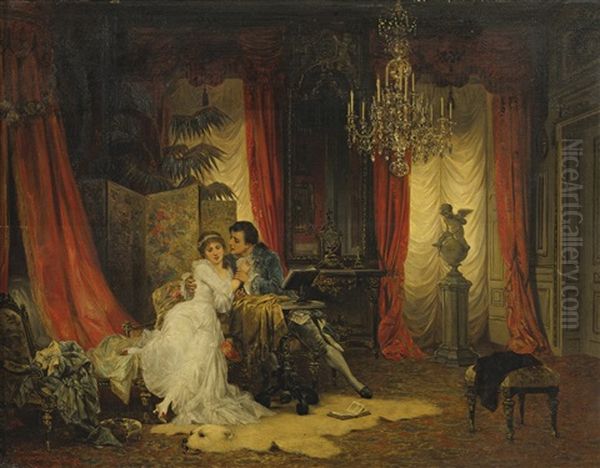
Karl Schweninger the Younger, also known as Carl Schweninger der Jüngere, stands as a notable figure in Austrian art of the late 19th and early 20th centuries. Born in Vienna on October 30, 1854, and passing away in the same city on December 27, 1910, Schweninger carved a niche for himself with his exquisitely detailed genre scenes, captivating landscapes, and elegant depictions of historical and contemporary high society. His work, often imbued with a Rococo Revival sensibility, resonated with the tastes of his era, offering glimpses into a world of refined leisure, romantic encounters, and picturesque settings.
An Artistic Heritage and Academic Formation
Karl Schweninger the Younger was born into an environment steeped in art. His father, Karl Schweninger the Elder (1818–1887), was himself a respected painter, known for his historical scenes, landscapes, and contributions to the Biedermeier tradition. This familial immersion in the arts undoubtedly shaped the younger Schweninger's inclinations from an early age. Vienna, during this period, was a vibrant cultural hub, the capital of the Austro-Hungarian Empire, and its artistic institutions were prestigious and influential.
To hone his innate talents, Schweninger enrolled at the esteemed Vienna Academy of Fine Arts (Akademie der bildenden Künste Wien). This institution was a bastion of academic tradition, emphasizing rigorous training in drawing, composition, and the study of Old Masters. During his time at the Academy, he would have been exposed to the prevailing artistic currents and the teachings of prominent figures. While specific records of his direct tutors in the provided information are sparse, professors like Carl von Blaas and Eduard von Engerth were influential at the Academy during these years, championing historical painting and a high degree of technical finish. The Academy's curriculum would have provided him with a strong foundation in anatomical accuracy, perspective, and the nuanced use of color and light.
His education was not limited to the confines of the Academy. Like many artists of his generation, Schweninger likely undertook study trips, particularly to Italy, a traditional destination for artists seeking inspiration from classical antiquity, Renaissance masterpieces, and the sun-drenched Mediterranean landscapes. The provided information notes him as an "Austrian and Italian landscape painter," suggesting that Italian scenery played a significant role in his oeuvre, complementing his depictions of Austrian locales.
The Flourishing of a Career: Themes and Subjects
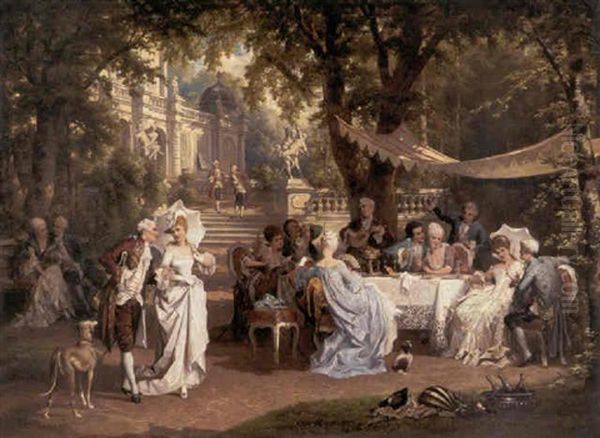
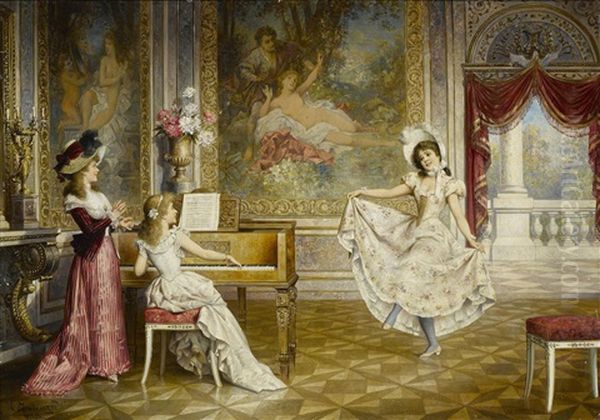
Schweninger's artistic output was diverse, yet consistently marked by a refined aesthetic and meticulous execution. He became particularly well-known for his genre paintings, often set in the 18th century or reflecting a Rococo-esque charm. These scenes frequently depicted romantic liaisons, elegant garden parties, musical interludes, and moments of quiet contemplation, appealing to a bourgeois clientele that appreciated narrative clarity and decorative beauty.
His figures are typically characterized by their graceful postures, expressive gestures, and elaborate costumes. Schweninger had a keen eye for the subtleties of human interaction, capturing fleeting glances and tender moments with sensitivity. The settings for these scenes were equally important, often featuring opulent interiors, lush gardens, or picturesque architectural backdrops, all rendered with a high degree of detail.
Beyond these intimate genre scenes, Schweninger also tackled landscape painting. His works in this domain captured the beauty of both the Austrian and Italian countryside. One notable example mentioned is a watercolor titled VIEW OF VIENNA, 1871, which would have showcased his ability to render topographical detail and atmospheric effects. Such cityscapes and landscape views were popular, reflecting a growing appreciation for local scenery and the picturesque.
Representative Works and Notable Commissions
Several specific works help to illustrate the scope and style of Karl Schweninger the Younger. Innamorati, painted in 1885, exemplifies his romantic genre scenes. The title itself, Italian for "lovers," suggests an intimate and tender subject, likely rendered with the delicate touch and rich coloration characteristic of his work. Such paintings often told a story, inviting viewers to imagine the narrative unfolding before them.
Another significant piece mentioned is The Garden Party. This title evokes images of elegant figures in fashionable attire, enjoying leisure in a beautifully manicured outdoor setting. Garden parties were a popular motif in 19th-century art, allowing artists to display their skills in depicting figures, costumes, and the interplay of light and shadow in a natural environment. These works often carried an air of nostalgia or idealized sociability.
Schweninger also undertook more ambitious public commissions. He was responsible for creating eight large murals for the Nordwestbahnhof (Northwest Railway Station) in Vienna. This was a significant project, as railway stations were becoming grand architectural statements in major European cities, often adorned with art that celebrated industry, travel, or regional identity. One of these murals reportedly depicted the interior of Vienna's Lessingtheater. Tragically, the Nordwestbahnhof and its murals were destroyed during World War II, a loss for Vienna's artistic heritage. The creation of such large-scale works demonstrates Schweninger's versatility and his ability to work on a monumental scale, a skill honed by academic training.
His landscape paintings also garnered recognition. A work depicting Vienna and its surrounding areas found a place in the prestigious Kunsthistorisches Museum in Vienna, a testament to its quality and historical significance. The Wien Museum (Vienna Museum) also holds works by Schweninger, further cementing his status as an artist who captured aspects of Viennese life and landscape.
Artistic Style: Detail, Color, and Narrative
Karl Schweninger the Younger's artistic style is characterized by several key elements. Firstly, his commitment to meticulous detail is evident in almost all his works. Whether depicting the intricate lace on a lady's gown, the delicate petals of a flower, or the architectural features of a building, Schweninger rendered his subjects with precision and care. This high level of finish was valued in academic circles and appreciated by the art-buying public of his time.
Secondly, his use of color was vibrant and harmonious. He employed a rich palette to bring his scenes to life, enhancing the luxuriousness of the fabrics, the warmth of the interiors, and the vibrancy of the landscapes. His colors were not merely descriptive but also contributed to the overall mood and atmosphere of his paintings, often imbuing them with a sense of warmth and elegance.
Thirdly, a strong narrative component runs through many of his genre paintings. He was adept at staging scenes that hinted at a larger story, capturing moments of emotional significance or social interaction. His figures, through their expressions and body language, convey a range of emotions, from romantic affection to playful coquetry or quiet introspection. This storytelling ability made his works engaging and accessible to a wide audience.
His style often shows an affinity with the Rococo Revival, a trend popular in the latter half of the 19th century that looked back to the lightheartedness, elegance, and decorative qualities of 18th-century Rococo art. Artists like Jean-Antoine Watteau and Jean-Honoré Fragonard from the original Rococo period may have served as distant inspirations for the mood and themes Schweninger explored.
The Schweninger Artistic Dynasty
The artistic talent within the Schweninger family was not confined to Karl the Elder and Karl the Younger. The provided information notes that the younger Schweninger's son and daughter also became successful artists. This continuation of an artistic lineage across multiple generations speaks to a supportive family environment where creative pursuits were encouraged and nurtured. While their specific names and specializations are not detailed in the source material, their success further underscores the Schweninger family's contribution to the Austrian art scene. Such artistic families were not uncommon, with skills and studio practices often passed down, creating a rich legacy.
Vienna's Artistic Milieu: Contemporaries and Context
To fully appreciate Karl Schweninger the Younger's career, it is essential to consider the vibrant artistic environment of Vienna during his lifetime. The late 19th century was a period of immense cultural ferment in the city, often referred to as the "Ringstrasse era," named after the grand boulevard built on the site of the old city walls, lined with opulent public and private buildings. This era was characterized by historicism in architecture and the arts, with a revival of various past styles.
Schweninger was a contemporary of many distinguished Austrian artists. Hans Makart (1840–1884) was a towering figure whose lavish historical and allegorical paintings, characterized by their theatricality and rich sensuality, defined an era – the "Makartstil." While Schweninger's work was generally more intimate in scale and subject matter than Makart's monumental canvases, he shared the era's taste for richness and decorative effect.
In the realm of landscape painting, Rudolf von Alt (1812–1905) was a master, renowned for his meticulous watercolors and oil paintings of cityscapes and landscapes, capturing Vienna and other parts of the Austro-Hungarian Empire with remarkable precision and atmospheric sensitivity. Schweninger's own landscape work, like his VIEW OF VIENNA, 1871, would have been part of this strong Austrian tradition. Another key figure in Austrian landscape was Emil Jakob Schindler (1842–1892), known for his atmospheric "Stimmungsimpressionismus" (Mood Impressionism).
Portraiture was also a prominent genre, with artists like Friedrich von Amerling (1803–1887) having established a high standard earlier in the century. Later figures continued this tradition. Genre painting, Schweninger's forte, was popular, with artists like Anton Ebert (1845–1896) also active in Vienna, depicting scenes of everyday life and historical settings.
The German artist Moritz von Schwind (1804–1871), though primarily associated with German Romanticism, spent significant periods in Vienna and his narrative, often fairy-tale-like compositions, had an influence on the illustrative and storytelling aspects of art in the German-speaking world. Similarly, the German Biedermeier painter Carl Spitzweg (1808-1885), known for his humorous and anecdotal genre scenes, catered to a similar bourgeois taste for relatable and charming narratives, though his style was distinct from Schweninger's more polished academicism.
Towards the end of Schweninger's career, the Viennese art scene witnessed a radical shift with the emergence of the Vienna Secession in 1897, led by artists like Gustav Klimt (1862–1918) and Koloman Moser (1868–1918). This movement sought to break away from the historicism of the established art institutions and embrace modern artistic expressions. While Schweninger remained largely within the academic tradition, the rise of the Secession marked a significant turning point in Austrian art. Figures like Oskar Kokoschka (1886–1980), who would become a leading Expressionist, were just beginning their artistic journeys as Schweninger's career was drawing to a close, heralding a new era. Other artists mentioned in the context, such as Franz Richard Unterberger (1837-1902), known for his Italian coastal scenes, and Ernst Novak (dates vary, but a painter of this name was active), contributed to the diverse tapestry of the art world at the time. The names "Edward Viede," "Geiter von Füredy," and "Franz de Paula Vögele" are less prominent in standard art historical records and may refer to more minor figures or require further specific research for detailed contextualization.
Legacy and Lasting Influence
Karl Schweninger the Younger's death in 1910 occurred as modern art movements were gaining momentum across Europe. While his style might have been seen as more traditional by the avant-garde, his work retained its appeal for many collectors and connoisseurs. His paintings offered a sense of beauty, elegance, and narrative charm that resonated with a public appreciative of technical skill and pleasing subject matter.
The inclusion of his works in significant Austrian collections, such as the Kunsthistorisches Museum and the Wien Museum, underscores his recognition as an artist of merit who contributed to the cultural landscape of his time. His paintings serve as valuable visual documents of the tastes, fashions, and social customs of late 19th-century Vienna, particularly its more affluent circles. They capture a certain romanticized vision of life, often looking back to earlier, seemingly more graceful eras, or celebrating the refined pleasures of contemporary society.
While he may not have been a radical innovator in the vein of the Secessionists, Karl Schweninger the Younger was a highly skilled and successful painter who excelled within his chosen genres. He catered to and helped shape the aesthetic preferences of his era, producing works that were admired for their beauty, craftsmanship, and storytelling qualities. His legacy lies in these charming and meticulously rendered canvases that continue to offer a window into a bygone world of Viennese elegance. His contribution to the tradition of Austrian genre and landscape painting ensures his place in the annals of the nation's art history. The unfortunate destruction of his murals for the Nordwestbahnhof also serves as a poignant reminder of the vulnerability of cultural heritage.
In conclusion, Karl Schweninger the Younger was a quintessential Viennese artist of his time. Nurtured in an artistic family and trained at the prestigious Vienna Academy, he developed a distinctive style characterized by fine detail, rich color, and engaging narratives. His depictions of romantic encounters, elegant social gatherings, and picturesque landscapes found favor with a discerning public and earned him a respected place within the Austrian art scene of the late 19th and early 20th centuries. His works remain a testament to his skill and a charming reflection of the cultural sensibilities of Imperial Vienna.