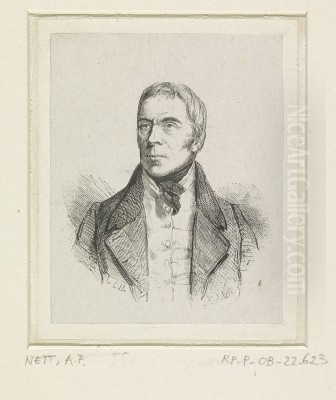
Leendert de Koningh (1777-1849) was a Dutch painter whose life and career were intrinsically linked to his birthplace and place of death, the historic city of Dordrecht. Active during the late 18th and first half of the 19th century, a period of transition in European art, de Koningh carved out a niche for himself primarily as a painter of landscapes, though his oeuvre also included still lifes and, according to some accounts, portraiture. His work reflects both the enduring traditions of Dutch art and the emerging sensibilities of his time.
The Artistic Heritage of Dordrecht
Dordrecht, one of the oldest cities in Holland, boasts a rich artistic legacy that predates Leendert de Koningh by centuries. During the Dutch Golden Age in the 17th century, the city was a vibrant center for painters. Masters such as Aelbert Cuyp, renowned for his luminous landscapes often featuring cattle and the golden light of the Dutch countryside, hailed from Dordrecht. Other significant figures associated with the city included Ferdinand Bol and Nicolaes Maes, both pupils of the great Rembrandt van Rijn, who developed their own distinct styles in portraiture and genre scenes. Samuel van Hoogstraten, another Rembrandt pupil from Dordrecht, was not only a painter but also an influential art theorist. The chronicler of Dutch Golden Age painters, Arnold Houbraken (father of Jacob Houbraken, an engraver), also had strong ties to the city, further cementing its place in art history. This rich artistic soil undoubtedly provided a backdrop and perhaps an indirect influence on later generations of Dordrecht artists, including de Koningh.
Life and Artistic Pursuits
Leendert de Koningh was born in Dordrecht in 1777 and passed away in the same city in 1849. His artistic career unfolded primarily in the early 19th century. While detailed biographical information about his training and personal life is not extensively documented, his body of work indicates a dedicated artist working within established genres. He is noted primarily for his landscape paintings, which often depicted the natural scenery of the Netherlands, and also for his still life compositions.
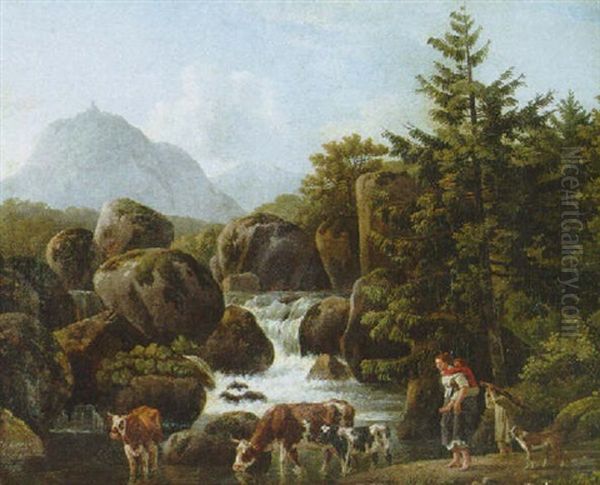
Some sources suggest a connection or line of succession to Gillis van Coninxloo II (c. 1544–1607), a Flemish painter of forest landscapes who was influential at the turn of the 17th century. Given the significant chronological gap of nearly two centuries between Coninxloo's death and de Koningh's active period, a direct master-pupil relationship is impossible. This suggested link likely refers to a perceived stylistic affinity or a continuation of certain landscape traditions, perhaps a shared interest in detailed natural observation or specific compositional approaches that echoed the earlier master's style. Coninxloo himself was a pivotal figure in the development of landscape painting, moving away from the world landscapes of Joachim Patinir towards more naturalistic and immersive forest scenes.
There is also a mention of de Koningh working as a portrait painter around 1860. This date is problematic as it falls more than a decade after his recorded death in 1849. It is possible this refers to posthumous attributions, the activities of a family member or another artist with a similar name, or simply an error in historical records. However, it indicates that the name de Koningh was associated with portraiture in some capacity around that time.
Artistic Style and Thematic Focus
Leendert de Koningh's primary artistic style revolved around landscape painting. His works often capture the characteristic Dutch environment, with its waterways, flat terrain, and distinctive light. He demonstrated a keen eye for the nuances of nature, and his paintings likely appealed to a contemporary taste for recognizable local scenes. The tradition of Dutch landscape painting was long and distinguished, with 17th-century masters like Jacob van Ruisdael and Meindert Hobbema setting incredibly high standards for depictions of the natural world, often imbued with symbolic meaning or a profound sense of atmosphere. While de Koningh worked in a later period, the legacy of these artists would have been pervasive.
His engagement with still life painting also places him within a strong Dutch tradition. Dutch still lifes, whether opulent "pronkstilleven" or more modest "ontbijtjes" (breakfast pieces), were celebrated for their meticulous detail and illusionistic skill, with artists like Willem Claesz. Heda and Jan Davidsz. de Heem being leading exponents in the Golden Age. De Koningh's still lifes would have drawn upon this heritage, focusing on the careful arrangement and rendering of objects.
The early 19th century, when de Koningh was most active, saw the influence of Romanticism spreading across Europe. While Dutch art of this period often displayed a more restrained character compared to the dramatic Romanticism of Germany or France, elements such as an increased emphasis on mood, atmosphere, and the picturesque qualities of nature became more prominent. Artists like Barend Cornelis Koekkoek and Andreas Schelfhout, contemporaries or slightly younger than de Koningh, became leading figures in Dutch Romantic landscape painting, often depicting dramatic forests, winter scenes, or coastal views. De Koningh's work would have existed within this evolving artistic climate.
Representative Works and Their Significance
Several works are attributed to Leendert de Koningh, offering insights into his thematic interests and artistic capabilities.
One notable example is a painting often titled in German or Dutch, such as Reges Treiben auf einem gefrorenen Fluß or Reges Trebable op eener ge冻ren Fluß, which translates to "Lively Activity on a Frozen River" or "Kings' Activities on a Frozen River." Winter landscapes, particularly scenes of people skating and enjoying themselves on frozen canals and rivers, were a beloved theme in Dutch art, popularized by artists like Hendrick Avercamp in the early 17th century and continued by painters such as Aert van der Neer. These scenes offered opportunities to depict lively social interactions, varied human activities, and the specific atmospheric conditions of winter. De Koningh's interpretation of this theme would have connected with a long-standing cultural appreciation for such imagery. The work showcases his ability to handle complex compositions with multiple figures and to capture the essence of a Dutch winter.
Another significant piece is Bedouin Figures. This oil on canvas, measuring approximately 21.5 x 18 inches (54.6 x 45.7 cm) and noted as signed and labeled on the reverse, indicates an interest in Orientalist themes. The depiction of Bedouin figures suggests an engagement with the 19th-century European fascination with the cultures of North Africa and the Middle East. This was a subject explored by many prominent European artists of the era, such as the French painters Eugène Delacroix and Jean-Léon Gérôme, who traveled to these regions and created vivid, often romanticized, portrayals. While de Koningh may not have traveled so extensively, the presence of such a theme in his work points to his awareness of broader artistic trends and a desire to explore subjects beyond the immediate Dutch environment. It highlights his versatility in moving from local landscapes to more exotic figure studies.
A work titled Blick in die Bucht von Neapel, in Hinter dem Vesuv (View into the Bay of Naples, behind Vesuvius), dated by some sources to 1860, also appears in his attributed oeuvre. As with the portraiture date, 1860 is problematic given his death in 1849. If the work is indeed by him, the date might refer to a posthumous exhibition, sale, or a misattribution. Alternatively, it could be a work completed earlier in his career. The subject itself—an Italianate landscape—was another enduring tradition in Dutch art. From the 17th century onwards, artists known as the "Italianates," such as Jan Both, Nicolaes Berchem, and later Abraham Teerlink (a contemporary of de Koningh), traveled to Italy and brought back sketches and inspiration for sun-drenched landscapes that were highly popular in the Netherlands. A depiction of the Bay of Naples with Mount Vesuvius would fit squarely within this tradition, showcasing an interest in classical landscapes and the picturesque beauty of Italy.
De Koningh in the Context of His Contemporaries
Leendert de Koningh worked during a period when Dutch art was seeking to redefine itself after the political and economic upheavals of the late 18th and early 19th centuries, including the Napoleonic occupation. The towering achievements of the Golden Age cast a long shadow, and many artists looked to this past for inspiration while also responding to new artistic currents like Neoclassicism and Romanticism.
His focus on landscape painting aligned him with a dominant genre in Dutch art. Contemporaries such as Andreas Schelfhout (1787-1870) achieved considerable fame for his meticulously painted winter scenes, panoramic landscapes, and seascapes, becoming one of the most influential Dutch landscape painters of the 19th century. Barend Cornelis Koekkoek (1803-1862), often dubbed the "Prince of Landscape Painters," was renowned for his romantic forest scenes and expansive summer landscapes, gaining international recognition. While de Koningh may not have achieved the same level of widespread fame as Koekkoek or Schelfhout, his work contributed to the continuation and evolution of landscape painting in the Netherlands during this era.
The mention of his name in art historical contexts alongside earlier Dordrecht figures like Samuel van Hoogstraten and Jacob Houbraken (likely referring to the engraver, son of Arnold Houbraken) suggests that he was recognized, at least locally or in certain surveys of Dutch art, as a notable artist from Dordrecht who continued the city's artistic traditions into the 19th century.
Art Historical Evaluation and Legacy
In the broader sweep of art history, Leendert de Koningh is considered a competent and skilled painter who worked diligently within established genres, particularly landscape. His works demonstrate a solid technique and an observant eye for detail, whether depicting the familiar Dutch countryside, a lively winter scene, or more exotic subjects like Bedouin figures.
His paintings, such as Bedouin Figures, have appeared on the art market, with auction estimates for this particular piece in the range of £1000-£1500. This price range suggests that while his works are collected and appreciated, he is not typically valued at the same level as the leading masters of the Dutch Golden Age or the most prominent figures of 19th-century European Romanticism. His influence appears to have been more localized, primarily within the context of Dutch art of his period.
The available information does not point to de Koningh as a radical innovator who dramatically altered the course of art history. Instead, he can be seen as a dedicated practitioner who upheld the high standards of Dutch painting, adapting traditional themes and techniques to the tastes and sensibilities of his time. His contribution lies in his consistent production of quality artworks that captured various facets of the world around him, from the frozen rivers of Holland to imagined scenes of distant lands.
The lack of extensive biographical details or widely documented anecdotes means that his personal story remains somewhat elusive. However, his art provides a window into the subjects and styles that interested a Dutch painter in the early 19th century. He represents a generation of artists who bridged the gap between the lingering influence of 18th-century traditions and the burgeoning Romantic movement, contributing to the rich tapestry of Dutch art.
Conclusion
Leendert de Koningh stands as a noteworthy artist from Dordrecht, a city with a proud artistic heritage. Throughout his career, spanning from the late 18th century into the mid-19th century, he dedicated himself to painting, with a particular emphasis on landscapes that celebrated both his native Holland and, at times, more distant, exotic locales. Works like Lively Activity on a Frozen River and Bedouin Figures showcase his skill in composition, his attention to detail, and his ability to engage with diverse thematic material.
While perhaps not as widely celebrated as some of his Dutch predecessors like Johannes Vermeer or contemporaries like B.C. Koekkoek, de Koningh played a role in maintaining the vitality of Dutch painting traditions. His connection, however indirect or stylistic, to earlier figures like Gillis van Coninxloo II, and his place within the lineage of Dordrecht artists, underscores his participation in a long and evolving artistic narrative. Leendert de Koningh's paintings remain as testaments to his talent and his contribution to the Dutch art scene of his era, offering valuable examples of early 19th-century landscape and figure painting.