Louis Pierre Verwee: A Belgian Master of Pastoral and Animal Painting
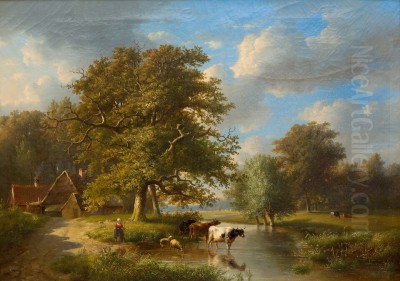
Louis Pierre Verwee (1807-1877) stands as a significant figure in 19th-century Belgian art, particularly renowned for his evocative landscapes and meticulously rendered animal subjects. His work, deeply rooted in the rich Flemish tradition, captured the bucolic charm of the countryside and the gentle nature of its inhabitants, earning him a respected place among his contemporaries. Verwee's career was characterized by a dedication to his craft, influential tutelage, and fruitful collaborations that enriched the artistic tapestry of his era.
Early Life and Artistic Genesis
Born in Kortrijk (Courtrai), Belgium, in 1807, Louis Pierre Verwee emerged during a period of artistic transition and national identity formation in Europe. Belgium itself was on the cusp of independence, which it achieved in 1830, fostering a renewed sense of cultural pride that often found expression in the arts. The artistic environment was still heavily influenced by the legacy of the great Flemish Masters of the 17th century, such as Peter Paul Rubens and Anthony van Dyck for their grandeur, and more specifically for Verwee's genre, painters like Paulus Potter, renowned for his lifelike depictions of cattle in landscapes.
Verwee's formal artistic training was pivotal in shaping his style and thematic preferences. He became a student of Eugène Joseph Verboeckhoven (1798-1881), one of the most celebrated Belgian animal painters of the 19th century. Verboeckhoven was a dominant figure, known for his almost photographic precision in depicting sheep, cattle, and other livestock, often set within idealized pastoral landscapes. His influence on Verwee was profound and lasting. Verwee not only learned the technical skills of painting from Verboeckhoven but also absorbed his master's predilection for animal subjects and his meticulous approach to detail.
Artistic Style and Thematic Focus
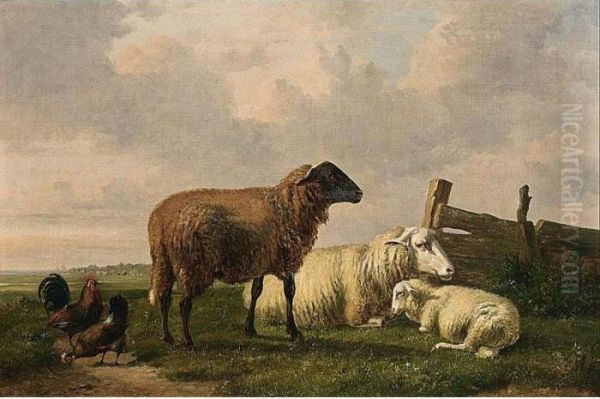
Louis Pierre Verwee's artistic style is a harmonious blend of traditional Flemish aesthetics and the burgeoning Romantic sensibilities of the 19th century. His paintings are characterized by their rich, warm color palettes, which lend a sense of vitality and naturalism to his scenes. He employed lively yet controlled brushwork, allowing for both fine detail in the rendering of animals and a softer, more atmospheric quality in his landscapes. A deep understanding of nature is evident in his work, showcased through the accurate depiction of animal anatomy and behavior, as well as the careful observation of light and shadow.
His primary thematic focus was on pastoral scenes, often featuring cattle, sheep, and occasionally horses, set within serene landscapes. These were not wild, untamed wildernesses, but rather the cultivated, gentle countryside of Flanders and the Ardennes, often imbued with a sense of peace and tranquility. Verwee excelled in capturing the textures of animal fur and hide, the play of sunlight on a meadow, or the cool shadows of a forest edge. While he often worked in the detailed, polished manner of his teacher, Verboeckhoven, Verwee's works also possess a distinct Romantic emotional expression, a subtle infusion of sentiment that resonated with the tastes of the time. He was particularly adept at winter landscapes, where the starkness of the season was often softened by the presence of warmly clad figures or resilient livestock.
The popularity of animal painting in the 19th century, particularly in Belgium and the Netherlands, can be attributed to several factors. It represented a continuation of a strong local tradition, harking back to the Golden Age of Dutch and Flemish art. Furthermore, in an era of increasing industrialization, idyllic rural scenes offered an escape and a nostalgic connection to a perceived simpler way of life. Verwee's art catered perfectly to this sentiment.
Key Collaborations and Artistic Circle
Collaboration was a common practice among 19th-century artists, especially when painters specialized in different areas, such as figures, animals, or landscapes. Louis Pierre Verwee was no exception and engaged in several notable artistic partnerships.
His most significant collaborative relationship was undoubtedly with his teacher, Eugène Verboeckhoven. Even after establishing his own career, Verwee sometimes worked with Verboeckhoven, where one might paint the landscape and the other the animals, or they might jointly refine a composition. This master-pupil dynamic evolved into a collegial one, built on mutual respect for each other's skills. An example includes a landscape painting measuring 53.8 x 75.5 cm, which stands as a testament to their combined talents.
Verwee also collaborated with other prominent landscape painters of his time. Among them were the Dutch Romantic artists Frederik Marinus Kruseman (1816-1882) and Barend Cornelis Koekkoek (1803-1862). Koekkoek, often hailed as the "Prince of Landscape Painters" in the Netherlands, was a leading figure of Dutch Romanticism, known for his majestic forest scenes and panoramic views. His teacher, Andreas Schelfhout (1787-1870), was another highly influential Dutch landscape painter, specializing in winter scenes, whose impact was felt across the Low Countries. Collaborations with artists of such stature indicate Verwee's respected position within the broader Benelux artistic community. In these joint efforts, Verwee would typically be responsible for adding the animal staffage that brought life and narrative focus to the landscapes created by his partners.
The artistic circle in Brussels and other Belgian art centers was vibrant. Besides Verboeckhoven, other notable Belgian animal painters included Joseph Stevens (1816-1892) and his brother Alfred Stevens (though the latter became more famous for his society portraits). Charles Verlat (1824-1890) was another contemporary who excelled in animal painting and historical scenes. While direct competition is not extensively documented, artists working in similar genres would naturally have been aware of each other's work and vied for patronage and recognition at the Salons and exhibitions. The Robbe brothers, Louis Robbe (1806-1887) and Henri Robbe (1807-1899), were also contemporaries, with Louis particularly known for his realistic depictions of cattle.
Representative Works
While a comprehensive catalogue of Louis Pierre Verwee's oeuvre is extensive, several works and types of compositions are representative of his artistic output.
One of his documented pieces is titled "Pastorale," created in 1833. This oil painting, measuring 99 x 132 cm, exemplifies his commitment to the pastoral genre. The title itself evokes a sense of idealized rural life, and one can imagine a scene populated with contented livestock under a gentle sky, rendered with Verwee's characteristic attention to detail and warm lighting. Such works were highly sought after by the bourgeois collectors of the period.
Another notable work is "Sheep on heathland," a smaller oil on panel measuring 16 x 22 cm. This piece likely showcases his skill in depicting sheep, a subject favored by his mentor Verboeckhoven, set against the backdrop of a rugged, open heath. The smaller scale suggests it might have been a more intimate study or a cabinet piece, prized for its detailed execution.
Many of Verwee's paintings feature cattle grazing by a riverbank, sheep huddled together in a winter landscape, or horses resting near a rustic cottage. His winter scenes are particularly noteworthy, often depicting figures skating on frozen rivers or trudging through snow, with animals patiently enduring the cold. These compositions allowed him to explore the effects of light in different seasons and atmospheric conditions, from the crisp clarity of a winter morning to the hazy warmth of a summer afternoon. The human figures in his paintings, while often secondary to the animals and landscape, are typically peasants or herders, adding to the rustic authenticity of the scenes.
His collaborative works, such as those with Verboeckhoven or Koekkoek, would seamlessly integrate his animal figures into their respective landscape styles, demonstrating his versatility and ability to harmonize his contributions with those of his peers.
The Verwee Artistic Legacy: His Son Alfred
Louis Pierre Verwee's artistic influence extended directly to his own family. His son, Alfred Jacques Verwee (1838-1895), also became a distinguished painter, following in his father's footsteps by specializing in animal subjects, but developing his own distinct style. Alfred initially learned from his father, absorbing the foundational skills of drawing and painting animals.
However, Alfred Verwee's artistic trajectory diverged from his father's more Romantic and meticulously detailed approach. Influenced by the rising tide of Realism and later by Impressionism, Alfred developed a bolder, more painterly style. He became particularly known for his powerful depictions of cattle and horses in the polders and along the North Sea coast, often working en plein air to capture the immediate effects of light and atmosphere. His work shows a greater emphasis on the raw, untamed aspects of nature and animal life, contrasting with the more polished and serene compositions of Louis Pierre. Artists like Constant Troyon (1810-1865) from the Barbizon School in France, known for his animal and landscape paintings, and later the Dutch Hague School painters such as Anton Mauve (1838-1888), represent a similar shift towards Realism in depicting rural life and animals.
The relationship between Louis Pierre and Alfred Verwee illustrates the generational shifts in artistic taste and technique during the 19th century. While Louis Pierre remained a respected practitioner of a more traditional, Romantic style, Alfred embraced newer artistic currents, becoming a leading figure of Belgian Realism in animal painting and a co-founder of the Société Libre des Beaux-Arts in Brussels, a group that championed artistic freedom and modern approaches.
The Wider Artistic Context and Verwee's Place
Louis Pierre Verwee operated within a dynamic 19th-century European art world. In Belgium, the period after independence saw a flourishing of the arts, with artists exploring national identity through historical painting, genre scenes, landscape, and portraiture. The Royal Academy of Fine Arts in Brussels and Antwerp were key institutions, and the regular Salons provided platforms for artists to exhibit their work and gain recognition.
The Romantic movement, which emphasized emotion, individualism, and the beauty of nature, was a dominant force in the first half of the century. Verwee's work, with its idyllic landscapes and sensitive portrayal of animals, aligns well with Romantic sensibilities. He can be seen alongside other Belgian landscape painters of the era, such as Théodore Fourmois (1814-1871), who also depicted the Belgian countryside, though often with a greater emphasis on topographical accuracy, or later, Hippolyte Boulenger (1837-1874), a key figure in the Tervuren School, which leaned towards a more realistic and atmospheric depiction of nature, prefiguring Impressionism.
The enduring appeal of the Flemish tradition provided a solid foundation for artists like Verwee. The meticulous detail and skilled rendering of textures seen in his work echo the qualities prized by 17th-century masters. However, he was not merely an imitator; he adapted these traditions to the tastes and artistic concerns of his own time. His focus on animal painting placed him in a specialized but popular niche. The demand for such works was steady, both domestically and internationally, with collectors appreciating the technical skill and charming subject matter.
While perhaps not as revolutionary as some of his contemporaries who pushed the boundaries of art towards Modernism, Louis Pierre Verwee was a highly accomplished and respected artist who excelled within his chosen genre. His dedication to capturing the beauty of the natural world and its animal inhabitants contributed significantly to the Belgian artistic landscape of the 19th century. His collaborations with leading figures like Koekkoek and his tutelage of his talented son Alfred further underscore his active participation in the artistic currents of his time.
Conclusion: An Enduring Pastoral Vision
Louis Pierre Verwee's life and career spanned a period of significant artistic and social change in Belgium and Europe. From his formative years under the guidance of Eugène Verboeckhoven to his mature period as an established painter and collaborator, he remained committed to a vision of art that celebrated the pastoral and the intrinsic beauty of the animal kingdom. His paintings, characterized by their technical finesse, warm palettes, and gentle Romanticism, offered viewers an escape into serene, idealized landscapes.
He successfully navigated the art market of his day, producing works that appealed to the prevailing tastes for detailed, naturalistic, and emotionally resonant scenes. His collaborations with other esteemed artists like Frederik Marinus Kruseman and Barend Cornelis Koekkoek highlight his standing in the artistic community, while his role as the first teacher to his son Alfred Verwee demonstrates a direct familial contribution to the evolution of Belgian art.
Though the art world would eventually move towards Realism, Impressionism, and subsequent modernist movements, the charm and skill evident in Louis Pierre Verwee's work ensure his place in the annals of 19th-century Belgian art. He remains a testament to the enduring appeal of the Flemish tradition, adapted and reinterpreted through the lens of 19th-century Romanticism, leaving behind a legacy of beautifully rendered pastoral visions that continue to be appreciated for their artistry and tranquil charm. His contributions, alongside those of contemporaries like Jean-Baptiste Madou (1796-1877) in genre scenes or Henri Leys (1815-1869) in historical romanticism, paint a fuller picture of a vibrant Belgian artistic era.