Mariano Salvador Maella: A Pivotal Figure in Spanish Neoclassicism
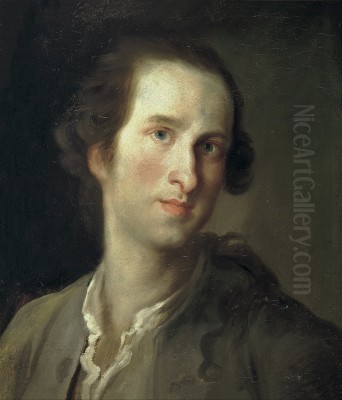
Mariano Salvador Maella (1739–1819) stands as a significant, if sometimes overlooked, figure in the landscape of Spanish art during the late 18th and early 19th centuries. Born in Valencia, his career unfolded against the backdrop of the Enlightenment's influence in Spain, the transition from late Baroque and Rococo sensibilities to the burgeoning Neoclassical movement, and the profound political upheavals of the Napoleonic era. Maella's extensive oeuvre, encompassing grand religious frescoes, official royal portraits, and intricate allegorical compositions, reflects both the artistic currents of his time and his unique ability to synthesize diverse influences into a distinctive, elegant style. He navigated the complex world of royal patronage and academic institutions, ultimately leaving an indelible mark on Spanish art.
Early Life and Artistic Formation in Valencia and Madrid
Mariano Salvador Maella's artistic journey began in Valencia, a city with a rich artistic heritage. Born on August 21, 1739, he received his initial training from his father, Mariano Maella, who was also a painter. This early familial introduction to the arts provided a foundational understanding of technique and composition. Recognizing his son's burgeoning talent, the elder Maella facilitated his move to Madrid to pursue more formal and advanced studies.
In the capital, Maella enrolled at the prestigious Real Academia de Bellas Artes de San Fernando. This institution, founded to promote and regulate artistic education in Spain, was a crucible for aspiring artists. Here, Maella studied under Antonio González Velázquez, a respected painter who himself had trained in Italy and was known for his work in the late Baroque tradition, particularly in fresco painting. Under González Velázquez's tutelage, Maella honed his skills, absorbing the prevailing artistic tastes which still bore the hallmarks of Rococo grace and Baroque dynamism. His talent was evident, and he quickly distinguished himself among his peers.
The Roman Sojourn: Deepening Neoclassical Sensibilities
A pivotal experience in Maella's development was his time spent in Rome. Supported by a pension, he traveled to the Eternal City between 1758 and 1765. Rome, at this time, was the epicenter of the burgeoning Neoclassical movement, with artists and scholars flocking there to study classical antiquity and the works of Renaissance masters. This environment profoundly shaped Maella's artistic outlook.
During his Roman sojourn, Maella immersed himself in the study of classical sculpture and the paintings of masters like Raphael and Guido Reni. He also came under the direct influence of Anton Raphael Mengs, a Bohemian painter who was a leading proponent and theorist of Neoclassicism. Mengs, who would later become a dominant figure in the Spanish court, advocated for a return to the idealized forms, clear compositions, and moral seriousness of classical art. Maella absorbed these principles, which tempered his earlier Rococo inclinations with a greater emphasis on line, form, and restrained elegance. His Italian sketchbooks, many of which are now housed in the Prado Museum, attest to his diligent study of classical and Renaissance models.
Return to Spain and Ascent in the Royal Court
Upon his return to Spain in 1765, Maella's career began to flourish. His Roman training and refined Neoclassical style were well-suited to the tastes of the Spanish court, which, under Charles III, was increasingly embracing Enlightenment ideals and the aesthetic principles championed by Mengs. Maella's association with Mengs proved beneficial; he was soon involved in significant royal commissions.
One of his early major projects was assisting Mengs in the decoration of the Royal Palace of Madrid. This collaboration provided invaluable experience and further solidified his position within the artistic circles of the court. Maella's talent for large-scale compositions and his ability to work within the Neoclassical idiom did not go unnoticed. In 1774, he achieved a significant milestone, being appointed Pintor de Cámara del Rey (Court Painter to the King). This prestigious position brought him into direct service of the monarchy, with responsibilities including portraiture and the creation of works for royal residences.
First Chamber Painter: A Shared Pinnacle with Goya
Maella's stature continued to grow under Charles III and his successor, Charles IV. His dedication, skill, and adaptability ensured a steady stream of commissions. In 1799, he reached the zenith of his career at court when he was appointed Primer Pintor de Cámara (First Chamber Painter), the highest artistic office. Notably, he shared this distinguished title with Francisco Goya, another towering figure of Spanish art.
The co-appointment of Maella and Goya highlights the diverse artistic landscape of the Spanish court at the turn of the 19th century. While both artists operated within the sphere of royal patronage, their styles and artistic temperaments differed. Maella largely remained a proponent of a more academic, refined Neoclassicism, infused with a lingering Rococo grace. Goya, while also adept at fulfilling courtly duties, was already beginning to explore more personal, expressive, and often darker themes that would later define his revolutionary art. Their shared role underscores Maella's established position and the respect he commanded.
Maella's Artistic Style: A Synthesis of Traditions
Mariano Salvador Maella's artistic style is best characterized as an elegant synthesis of various influences, primarily Neoclassicism, but with discernible traces of late Baroque dynamism and Rococo charm. His early training under Antonio González Velázquez exposed him to the more exuberant and decorative aspects of the Rococo. However, his time in Rome and his association with Anton Raphael Mengs were transformative, steering him towards the clarity, order, and idealized forms of Neoclassicism.
Unlike some of the more austere Neoclassicists, such as Jacques-Louis David in France, Maella's Neoclassicism was often softer and more decorative. His compositions are typically well-balanced and harmonious, with figures rendered with anatomical precision and a sense of graceful movement. He possessed a fine command of color, often employing a palette that was both rich and subtle. His brushwork, while controlled, could also exhibit a certain fluidity, particularly in his sketches and less formal works. This blend made his art particularly suitable for the grand decorative schemes required by the court and religious institutions.
Major Commissions and Thematic Concerns
Throughout his career, Maella undertook a wide array of commissions, demonstrating his versatility. His thematic concerns ranged from religious narratives and allegories to official portraiture and mythological scenes. He was particularly renowned for his large-scale frescoes, which adorned the ceilings and walls of royal palaces and prominent churches.
Among his significant works are the decorative schemes for various royal sites, including the Royal Palace of Madrid, the Palacio Real de Aranjuez, the Palacio Real de La Granja de San Ildefonso, and the Palacio Real de El Pardo. These often involved complex allegorical programs celebrating the virtues of the monarchy or depicting mythological subjects. For instance, his work in the Casita del Príncipe at El Escorial showcases his skill in creating harmonious and elegant decorative ensembles. His painting La Primavera (Spring), now in the Prado Museum, exemplifies his graceful allegorical style.
Religious Artistry: Devotion and Decoration
Religious themes formed a substantial part of Maella's output. Spain, with its deep Catholic traditions, provided ample opportunities for artists to create works for churches, cathedrals, and monastic orders. Maella excelled in this genre, producing altarpieces, frescoes, and devotional paintings that combined technical skill with appropriate piety.
He executed important frescoes for several cathedrals, including Toledo Cathedral, where he worked on the restoration and completion of earlier schemes, and also created new works. He also painted for the Cathedral of Jaén and the Cathedral of Burgo de Osma. One of his notable religious paintings is The Assumption of the Virgin, a theme he revisited, showcasing his ability to handle complex multi-figure compositions with a sense of divine grandeur. His religious works often display a clear narrative, emotional restraint, and a harmonious use of light and color, consistent with Neoclassical ideals but often retaining a warmth that appealed to devotional sensibilities. His drawing Saint Lawrence (c. 1800, Prado Museum) shows his mastery in capturing saintly figures.
Portraiture: Capturing the Royal Image
As a Court Painter, portraiture was a crucial aspect of Maella's responsibilities. He painted numerous portraits of the Spanish royal family, including Charles III, Charles IV, Queen Maria Luisa of Parma, and various princes and infantas. These official portraits were intended to project an image of majesty, dignity, and authority.
Maella's royal portraits are characterized by their meticulous attention to detail in rendering costumes, regalia, and settings. While adhering to the formal conventions of state portraiture, he often managed to imbue his sitters with a sense of individual presence. His portrait of Charles III in Hunting Dress (Banco de España Museum) is a fine example, capturing the monarch in a less formal but still regal pose. He also painted group portraits, such as The Family of the Infante Don Luis de Borbón, a contemporary of Goya's more famous rendition of the same family. Maella's approach to portraiture was generally more idealized and less psychologically probing than Goya's, reflecting the prevailing Neoclassical taste for decorum and idealization.
Decorative Schemes and Frescoes: Adorning Palaces
Maella's talent for large-scale decorative painting was highly sought after for the interiors of royal residences. He was a master of fresco technique, capable of creating vast, illusionistic scenes that transformed ceilings and walls into vibrant displays of mythological, allegorical, or historical subjects. These works required not only artistic skill but also a sophisticated understanding of perspective, composition, and the integration of art with architecture.
His contributions to the Royal Palace of Madrid were extensive, working alongside Mengs and later independently. He also played a key role in decorating the smaller, more intimate royal retreats or "casitas," such as the Casita del Príncipe at El Pardo and the Casita del Labrador at Aranjuez. These projects often involved intricate iconographic programs, designed to flatter the monarch or reflect Enlightenment virtues. His style, which balanced Neoclassical order with a degree of Rococo lightness, was perfectly suited to these elegant interiors. Other artists like Francisco Bayeu, his brother Ramón Bayeu, and later Vicente López Portaña, also contributed to this rich tradition of palace decoration.
Drawing and Preparatory Work: The Foundation of His Art
Like many artists of his era, Maella placed great importance on drawing as a foundational practice. His surviving drawings, many of which are preserved in institutions like the Prado Museum and the Real Academia de Bellas Artes de San Fernando, reveal his meticulous working process and his technical versatility. He employed a range of media, including pencil, pen and ink, wash, and chalk, often heightened with white.
His preparatory sketches for large compositions, such as frescoes or altarpieces, demonstrate his careful planning of figures, groups, and overall design. These drawings often possess a spontaneity and freshness that can be more immediate than the finished paintings. His Italian sketchbooks are particularly valuable, showing his direct engagement with classical and Renaissance art. He also produced finished drawings intended as independent works of art. The use of techniques like grisaille, as seen in preparatory studies like one for The Annunciation, allowed him to work out light and shadow effects before committing to the final colored version.
Collaborations and Contemporaries: A Network of Artists
Maella's career was interwoven with those of many other prominent artists of his time. His most significant early mentor and collaborator was Anton Raphael Mengs, whose influence was crucial in shaping Maella's Neoclassical direction and facilitating his entry into court circles. He also worked alongside Francisco Bayeu on various royal decorative projects. Bayeu, another key figure in Spanish Neoclassicism, shared many commissions with Maella, and their styles, while distinct, were often complementary.
His relationship with Francisco Goya was more complex. As co-First Chamber Painters, they were nominally equals, yet their artistic paths diverged significantly. While Maella remained a pillar of the established academic tradition, Goya pushed the boundaries of art in revolutionary ways. Other contemporaries included Luis Paret y Alcázar, a master of the Spanish Rococo, whose delicate and charming style offered a contrast to Maella's more formal Neoclassicism. Maella also commissioned work from artists like Ginés de Aguirre for projects such as the decoration of the Trinity Church in San Sebastián. He restored works by earlier masters, such as frescoes by Antonio Vicente Gómez in Toledo Cathedral, demonstrating his respect for artistic heritage. The artistic environment also included figures like Corrado Giaquinto and Giovanni Battista Tiepolo, whose earlier work in Spain had left a significant Baroque and Rococo legacy.
The Academician: Role at the Royal Academy of San Fernando
Beyond his activities as a court painter, Mariano Salvador Maella played an important role within the Real Academia de Bellas Artes de San Fernando, the institution where he had received his own training. His commitment to academic principles and his esteemed position at court led to his increasing involvement in the Academy's affairs.
From 1795 to 1798, Maella served as Director General of the Academy. In this capacity, he was responsible for overseeing the curriculum, guiding students, and upholding the standards of artistic excellence promoted by the institution. His leadership would have reinforced the Neoclassical principles that had become dominant, emphasizing drawing from the antique, the study of anatomy, and the pursuit of idealized beauty. His tenure as Director reflects his status as a leading figure in the official art world of Spain, shaping the education of the next generation of artists, which would include figures like José de Madrazo y Agudo, who would later become a prominent Neoclassical painter and director of the Prado Museum.
The Tumultuous Years: Political Upheaval and Career's End
The latter part of Maella's career was overshadowed by the dramatic political events that engulfed Spain. The Napoleonic invasion in 1808, the abdication of Charles IV and Ferdinand VII, and the imposition of Joseph Bonaparte as King of Spain created a period of profound instability and divided loyalties.
Maella, like many who had served the Bourbon monarchy, faced a difficult choice. He ultimately chose to serve the new French-installed regime of Joseph Bonaparte, continuing in his role as a court artist. This decision, while perhaps pragmatic at the time, had severe consequences. When Ferdinand VII was restored to the throne in 1814, those who had collaborated with the French, known as "Afrancesados," were often viewed with suspicion or hostility. Maella was accused of being an "Afrancesado" and, as a result, was dismissed from his position as First Chamber Painter. His official career effectively ended in 1808 with the fall of the Bourbon monarchy he had served for so long.
Later Years, Legacy, and Controversies
Stripped of his official titles and royal patronage after the restoration of Ferdinand VII, Mariano Salvador Maella spent his final years in relative obscurity. He was granted a modest pension but never regained his former prominence. He passed away in Madrid on May 10, 1819.
For a considerable time, Maella's artistic contributions were somewhat overshadowed by those of his more famous contemporary, Goya, and by the dramatic shifts in artistic taste that followed the Neoclassical era. However, modern art historical scholarship has increasingly recognized his importance as a key figure in Spanish Neoclassicism and a prolific and skilled artist who significantly shaped the visual culture of his time.
Controversies and scholarly debates have sometimes arisen regarding the attribution of certain works, with some pieces occasionally misattributed to other artists or, conversely, works by students or workshop assistants being assigned to him. For example, a portrait once thought to be of Froliano Berganza was later re-identified as Pedro López de Lerena by Maella. Such re-evaluations are part of the ongoing process of refining our understanding of his oeuvre. His style, while praised for its elegance and technical proficiency, has sometimes been criticized by later commentators as lacking the profound innovation or emotional depth found in Goya's work, though this often reflects a misunderstanding of the differing aims and contexts of Neoclassical art.
Notable Works and Collections
Mariano Salvador Maella's works are held in numerous prestigious collections, primarily in Spain. The Museo Nacional del Prado in Madrid houses a significant collection of his paintings and drawings, including allegorical works like La Primavera, religious scenes, portraits, and his invaluable Italian sketchbooks.
Other important institutions holding his works include the Real Academia de Bellas Artes de San Fernando in Madrid, which possesses many of his academic studies and paintings. His frescoes can still be seen in situ in several royal palaces, such as the Royal Palace of Madrid and the Casita del Príncipe at El Escorial, as well as in cathedrals like Toledo and Jaén. The Banco de España Museum holds his portrait of Charles III, and the Brooklyn Museum in New York has his allegorical painting Time Discovering Truth (1765). Works can also be found in the Cordoba Museum and various other regional museums and private collections across Spain and internationally. His Allegory of Christopher Columbus (1793) is another notable piece.
Conclusion: Maella's Enduring Place in Spanish Art History
Mariano Salvador Maella was a pivotal artist in late 18th and early 19th-century Spain. As a leading exponent of Neoclassicism, he skillfully blended this international style with enduring elements of earlier Spanish and Italian traditions. His prolific output as a court painter to Charles III and Charles IV, his extensive work for religious institutions, and his influential role at the Real Academia de Bellas Artes de San Fernando solidify his importance. While his career ended amidst political turmoil, and his fame was for a time eclipsed, Maella's contribution to the artistic patrimony of Spain is undeniable. His elegant compositions, refined technique, and dedication to the ideals of beauty and order ensure his place as a distinguished master of his era, a contemporary of giants like Goya, Mengs, and Bayeu, and a crucial figure in the story of Spanish art's transition into the modern age.