Michalis Economou: A Luminous Interpreter of the Greek Landscape
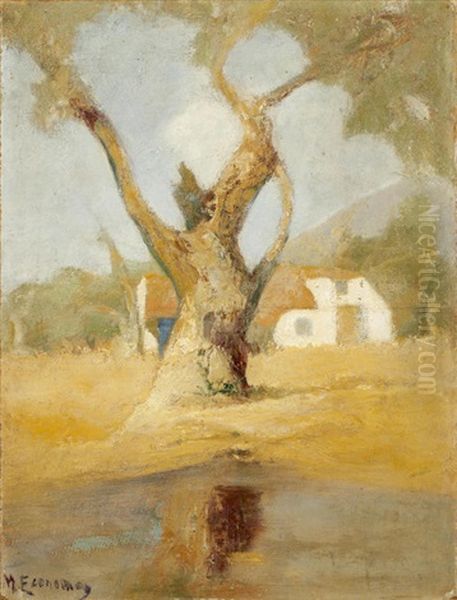
Michalis Economou (Μιχάλης Οικονόμου, 1888–1933) stands as a pivotal figure in the annals of modern Greek art, an artist whose canvases radiate with the distinctive light and atmosphere of his homeland. As a prominent Greek Impressionist painter, Economou carved a unique niche for himself, particularly celebrated for his evocative landscapes that captured not just the topography of Greece but its very soul. His relatively short but impactful career contributed significantly to the revitalization of Greek painting in the early 20th century, moving it beyond the established academic traditions towards a more personal and modern expressive language. This exploration delves into the life, artistic journey, stylistic evolution, and enduring legacy of a painter who, with every brushstroke, sought to translate the ephemeral beauty of the Greek world onto canvas.
Early Life and Artistic Awakening in Athens
Born in Piraeus in 1888 (some sources suggest 1884, but 1888 is more commonly cited), Michalis Economou's artistic inclinations emerged at a young age. His formative years were spent in an Athens that was gradually embracing new artistic currents, although still largely influenced by the academic realism of the Munich School, a legacy of artists like Nikiforos Lytras and Konstantinos Volanakis who had trained in Germany. Economou received his initial artistic training in this environment, likely at the Athens School of Fine Arts or under private tutors who were themselves products of this tradition.
However, the seeds of Impressionism and other modern European movements were beginning to find fertile ground in Greece. Young artists were growing restless with the constraints of academicism and were looking towards Paris, the undisputed art capital of the world, for inspiration and new modes of expression. Economou was among this generation, eager to absorb the revolutionary ideas that were reshaping visual art. His early works from this period, though less documented, would have shown him mastering foundational skills while simultaneously developing a sensitivity to light and color that would later define his mature style. This foundational period in Athens provided him with the technical grounding necessary before his transformative experiences abroad.
The Parisian Crucible: Forging an Impressionist Identity
The allure of Paris proved irresistible for Economou, as it did for many aspiring artists of his time. Around 1906, he made the pivotal decision to move to the French capital to further his studies and immerse himself in its vibrant artistic milieu. Paris was a melting pot of innovation, home to the fading glories of Impressionism, the structural explorations of Post-Impressionism, the bold colors of Fauvism, and the nascent deconstructions of Cubism. For a young painter like Economou, it was an environment of immense stimulation and learning.
In Paris, Economou actively engaged with the city's art scene. He is known to have associated with fellow Greek artist Periklis Vyzantios (1893-1972), another important figure in 20th-century Greek art who also spent time in Paris. Such connections provided a supportive network and a forum for exchanging ideas. More significantly, Economou came into contact with leading figures of the avant-garde, including the Spanish Cubist painter Juan Gris (1887-1927). While Economou's own path would firmly remain within the realm of Impressionistic and Post-Impressionistic landscape painting, exposure to diverse movements like Cubism would have broadened his artistic horizons and understanding of form and composition.
A significant milestone in his Parisian period was his first solo exhibition in 1913 at the prestigious Galerie Bernheim-Jeune. This gallery was renowned for championing Impressionist and Post-Impressionist artists, having hosted exhibitions for giants like Pierre Bonnard, Édouard Vuillard, Henri Matisse, and Kees van Dongen. To exhibit there was a considerable achievement for a young foreign artist and signaled his arrival and acceptance within the competitive Parisian art world. His time in Paris was not just about formal study; it was an immersion that shaped his artistic vision, refining his understanding of light, color, and atmospheric effect, principles central to Impressionism.
Artistic Style: Capturing the Hellenic Light
Michalis Economou is best characterized as an Impressionist, though his work often incorporates Post-Impressionist sensibilities. His primary concern was the depiction of the Greek landscape, not as a static, photographic representation, but as a living, breathing entity, suffused with the unique, brilliant light of the Mediterranean. He possessed an extraordinary ability to capture the nuances of this light – its clarity, its intensity, and its transformative effect on color and form.
His technique involved a departure from the smooth, blended brushwork of academic painting. Instead, he often employed broken color and visible brushstrokes, characteristic of Impressionism, to convey the vibrancy and immediacy of his subjects. His palette was rich and varied, capable of rendering the cool blues and greens of the sea and sky, the warm ochres and terracottas of the earth and vernacular architecture, and the silvery greens of olive groves. He demonstrated a remarkable sensitivity to the interplay of light and shadow, using it to model forms and create depth, but also to evoke mood and atmosphere.
Economou's landscapes are imbued with a profound sense of place. He was particularly drawn to the rugged beauty of the Greek islands, with Hydra being a recurring and beloved subject. He didn't just paint what he saw; he painted what he felt. There is a lyrical, almost poetic quality to his work, a quiet introspection that invites the viewer to share in his personal experience of the landscape. This "psychological depth," as some critics have noted, elevates his paintings beyond mere topographical studies into meditations on nature and human presence within it. He experimented with materials and techniques, always seeking the most effective means to translate his vision onto canvas, contributing to the innovative spirit of Greek painting in his era. His approach was influenced by French masters like Claude Monet, for his dedication to capturing fleeting moments of light, and perhaps Henri Matisse, for a certain boldness in color and simplification of form that can be seen in some works.
Masterpieces of Light and Landscape
Several works stand out in Michalis Economou's oeuvre, each exemplifying his distinct artistic vision and technical skill.
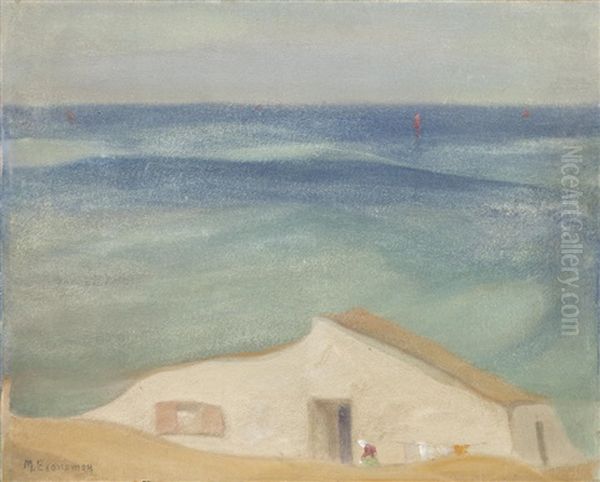
House by the Sea (Θαλασσινό σπίτι) is a quintessential Economou painting. It often features a simple dwelling set against the vast expanse of the Aegean. In such works, he masterfully uses varying shades of blue for the sea and sky, creating a harmonious yet dynamic composition. The houses, typically rendered with a degree of abstraction, seem to float in an ethereal space, bathed in a clear, almost palpable light. The painting evokes a sense of tranquility and timelessness, capturing the serene beauty of coastal Greece. The bold use of blue and the somewhat abstract rendering of the house can create a dreamlike, almost floating sensation for the viewer.
The Old Mill in Hydra (Παλιός Μύλος στην Ύδρα) is another iconic subject. Hydra, with its dramatic cliffs, distinctive architecture, and brilliant light, provided endless inspiration for Economou. The old windmills, perched on the island's heights, become powerful symbols in his paintings. He captures their weathered textures and their stark silhouettes against the sky, often emphasizing the interplay of light and shadow on their stone surfaces and the surrounding rugged terrain. These paintings are not just picturesque; they convey the history and enduring spirit of the island, filled with a poetic and symbolic resonance.
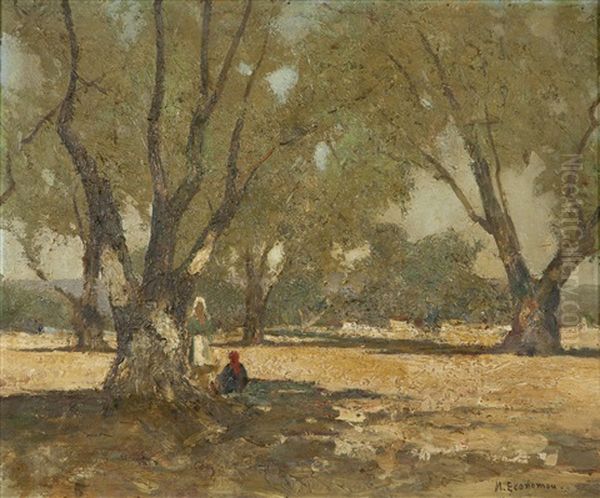
House in the Olive Grove (Σπίτι στον Ελαιώνα) showcases his ability to render the quintessential Greek agricultural landscape. The gnarled, ancient olive trees are depicted with a keen eye for their unique forms and the silvery-green hue of their leaves. Light filters through the branches, dappling the ground and the simple structures nestled within the grove. These works often possess a "humble monumentality," celebrating the quiet dignity of rural life and the enduring connection between the Greek people and their land. The meticulous attention to the texture of the olive trees and the precise capture of light and shadow are hallmarks of these compositions.
His Hydra series, more broadly, encompasses numerous views of the island, each a testament to his fascination with its unique character. He painted its harbors, its winding streets, and its stark, sun-drenched hillsides, always with an unerring sense of its atmosphere. These works are crucial for understanding his deep connection to the Greek landscape and his ability to translate its specific visual and emotional qualities into paint.
The Greek Context: Contemporaries and the Modernist Current
Michalis Economou emerged during a transformative period for Greek art. The early 20th century saw a decisive shift away from the 19th-century academicism of the "Munich School," which, while important in establishing a national artistic identity, had become somewhat stagnant. A new generation of artists, often trained or influenced by Parisian modernism, sought fresh modes of expression.
Economou was a key part of this wave, often referred to as the "Generation of the '30s" (though he was slightly earlier, his influence carried through). He shared this era with other significant figures who were reshaping Greek art. Konstantinos Parthenis (1878-1967) was a towering figure, whose work blended Symbolism, Art Nouveau, and Post-Impressionist elements into a highly personal, spiritual style. While Parthenis's work was often more allegorical and stylized, both he and Economou were pioneers in bringing modern European sensibilities to Greek painting.
Spyros Papaloukas (1892-1957) was another contemporary landscape painter, known for his deeply spiritual and often Byzantine-influenced depictions of Greek nature, particularly Mount Athos. Like Economou, Papaloukas was a master of light and color, though his approach often had a more overtly spiritual or mystical dimension.
Periklis Vyzantios (1893-1972), with whom Economou associated in Paris, also contributed to this modernist current, known for his vibrant cityscapes and portraits. The older Nikiforos Lytras (1832-1904), though primarily a Munich School figure, had already begun to explore plein air painting and more naturalistic light in his later genre scenes, laying some groundwork for the Impressionistic explorations that followed.
In contrast to these more "Europeanized" modernists, there was also the unique phenomenon of Theofilos Hatzimichail (c. 1870-1934), a self-taught folk painter whose vibrant and naive depictions of Greek history, mythology, and everyday life gained recognition during this period, championed by critics like Stratis Eleftheriadis (Tériade). While stylistically worlds apart, Theofilos represented another facet of the search for authentic Greek expression.
Later, artists like Georgios Bouzianis (1885-1959) would bring German Expressionism to Greece, further diversifying the artistic landscape. Economou's contribution, specifically his refined Impressionism, provided a crucial link between the academic past and the more radical modernist movements that would follow, championed by artists like Yiannis Tsarouchis (1910-1989) or Nikos Engonopoulos (1907-1985). His dedication to capturing the Greek landscape through an Impressionist lens helped to establish landscape painting as a vital genre within modern Greek art, one that resonated deeply with the national identity.
International Recognition and Exhibitions
Economou's talent was not confined to Greek borders. His early success with the solo exhibition at Galerie Bernheim-Jeune in Paris in 1913 was a significant indicator of his international potential. Throughout his career, he participated in various group exhibitions in Paris, London, and Athens. This international exposure was crucial for an artist from a country then considered on the periphery of the European art world. It demonstrated that Greek artists could engage with and contribute to the major artistic currents of the time.
His works were appreciated for their technical skill, their sensitive portrayal of light, and their authentic depiction of the Greek environment. While he may not have achieved the same level of international fame as some of his French Impressionist predecessors like Monet or Post-Impressionists like Paul Cézanne (whose structural concerns influenced many modernists), Economou's participation in international shows helped to raise the profile of modern Greek art. His paintings offered a unique perspective, filtering Impressionist techniques through the lens of the distinctive Mediterranean environment.
Later Years, Tragic End, and Enduring Legacy
Tragically, Michalis Economou's promising career was cut short. He suffered from mental health problems which intensified, leading to the cessation of his artistic activities around 1933, the year of his untimely death. This premature end deprived Greek art of a mature talent that undoubtedly had more to offer. The exact nature of his mental health issues is not extensively documented, but its impact on his ability to work was definitive.
Despite his relatively brief career, Michalis Economou left an indelible mark on Greek art. He is widely regarded as one of Greece's foremost Impressionist painters. His work is celebrated for its technical brilliance, its poetic sensibility, and its profound connection to the Greek landscape. He successfully synthesized the lessons of French Impressionism with a deeply personal vision of his homeland, creating a body of work that is both modern and unmistakably Greek.
His paintings are held in high esteem in public and private collections in Greece, including the National Gallery in Athens and the Alpha Bank Art Collection. The latter institution notably organized a major retrospective of his work in 2024, titled "Michalis Economou. The alchemy of painting," featuring around 120 works. This exhibition underscored his innovative experiments with materials and expressive techniques, and reaffirmed his importance in the narrative of 20th-century Greek art. Such retrospectives are vital in bringing his work to new generations and ensuring his legacy endures.
Art critics and historians continue to appreciate his subtle yet powerful interpretations of nature. His ability to imbue landscapes with psychological depth and emotional resonance sets him apart. He was not merely a chronicler of scenes, but an interpreter of atmosphere and feeling, a painter who understood the "alchemy" of transforming pigment and canvas into luminous visions of reality.
Conclusion: A Luminous Vision of Hellas
Michalis Economou remains a cherished figure in Greek art history. His dedication to capturing the unique light and character of the Greek landscape through an Impressionist lens resulted in a body of work that is both aesthetically beautiful and culturally significant. He navigated the currents of European modernism, adapting its principles to forge a style that was authentically his own and deeply rooted in his Hellenic identity. From the sun-drenched shores of Hydra to the tranquil olive groves of the mainland, his canvases offer an enduring vision of Greece, filtered through a sensitive and masterful artistic temperament. Though his life was short, his artistic light continues to shine, illuminating a crucial chapter in the story of modern Greek painting and inspiring admiration for his profound connection to the land he so lovingly depicted. His legacy is a testament to the power of art to capture the essence of a place and the enduring allure of the Impressionist vision.