Mikhail Nikolaevich Yakovlev: A Russian Artist Navigating Tradition and Modernity
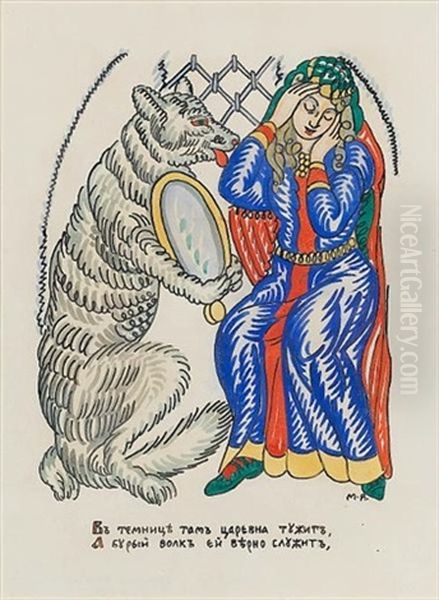
Mikhail Nikolaevich Yakovlev (1880–1942) stands as an intriguing, if somewhat enigmatic, figure in the rich tapestry of Russian art during a period of profound societal and artistic transformation. His life and career spanned the final decades of the Tsarist empire, the turmoil of revolution, and the formative years of the Soviet state. While perhaps not as globally renowned as some of his avant-garde contemporaries, Yakovlev’s work offers a valuable lens through which to examine the artistic currents of his time, particularly the interplay between established academic traditions, the burgeoning influence of European modernism, and the nascent cultural ideologies of a new Russia.
Early Life and Unconventional Path to Art
Born in 1880, Mikhail Nikolaevich Yakovlev's journey into the world of art was not a direct one. Initially, his academic pursuits lay in the realm of science. He attended Moscow University, dedicating himself to studies in the Faculty of Physics and Mathematics. This rigorous scientific training culminated in a degree in 1911. Such a background was not entirely uncommon for individuals who later found their calling in the arts, as the discipline and analytical thinking fostered by scientific study could, for some, translate into a unique approach to artistic composition and observation.
However, the allure of artistic expression eventually proved stronger. Following his university graduation, Yakovlev made a decisive shift towards the visual arts. Between 1913 and 1914, he sought formal artistic instruction in the studio of Vasily Nikitich Meshkov (1867–1946). Meshkov was a respected painter and pedagogue, known for his realist works and portraits, and associated with the Peredvizhniki (Wanderers) movement in his earlier years, later becoming a prominent teacher in the Soviet era. Studying under Meshkov would have provided Yakovlev with a solid grounding in academic drawing and painting techniques, emphasizing keen observation and faithful representation.
Artistic Development and Stylistic Inclinations
The period during which Yakovlev was developing as an artist was one of extraordinary dynamism in Russian art. The early 20th century saw the flourishing of the "Silver Age," a time of immense creativity across literature, music, and the visual arts. Movements like Symbolism, with its mystical and introspective themes, had a profound impact, championed by artists such as Mikhail Vrubel (1856–1910) and Victor Borisov-Musatov (1870–1905). Simultaneously, Russian artists were eagerly absorbing and reinterpreting Western European trends, particularly French Impressionism and Post-Impressionism.
Information suggests Yakovlev’s art was influenced by Russian tradition and, later, an attempt to reconcile classical approaches with the emerging ideals of Socialist Realism. Given his death in 1942, his engagement with fully-fledged Socialist Realism (officially promulgated in 1934) would have been in its earlier, more varied phases. It's plausible his work reflected the broader trend among many Russian artists of his generation who, while trained in realism, were also open to the expressive possibilities of color and light explored by the Impressionists. Artists like Konstantin Korovin (1861–1939) and Valentin Serov (1865–1911) had already masterfully adapted Impressionist techniques to Russian subjects, paving the way for others.
The provided information also notes an influence of French Impressionism on Yakovlev, particularly in his use of color and brushwork, lending a "dramatic and visual impact" to his paintings. This aligns with the broader European artistic climate and its reception in Russia. His education with Meshkov would have provided a realist foundation, but exposure to the works of Russian Impressionists and original French pieces (many of which were in prominent Russian collections like those of Sergei Shchukin and Ivan Morozov) could certainly have steered him towards a more vibrant palette and looser brushwork.
There is also a mention of Yakovlev's style evolving from Symbolism towards Impressionism, exemplified by a work like Boats on the River (1910). If this work is indeed by Mikhail Nikolaevich Yakovlev (1880-1942), it would place his early inclinations firmly within the artistic explorations of the Silver Age, where Symbolist aesthetics often blended with decorative Art Nouveau tendencies and an Impressionistic rendering of light and atmosphere. Artists like Konstantin Somov (1869–1939) or Léon Bakst (1866–1924) of the Mir Iskusstva (World of Art) movement often navigated these stylistic intersections.
Representative Works and Thematic Concerns
Among Mikhail Nikolaevich Yakovlev's documented works, still lifes, particularly floral compositions, feature prominently. His painting Vase de fleurs (Vase of Flowers), dated 1926, is cited as a representative piece. This oil on canvas, measuring 40x30 cm, would likely showcase his approach to color, light, and texture in rendering the delicate forms of flowers. Another work, titled Still Life of Flowers, further underscores his interest in this genre. Flower painting, a traditional subject, offered ample opportunity for artists to explore formal qualities of color harmony, composition, and the expressive potential of brushstrokes, aligning well with Impressionistic sensibilities.
His artistic output was not limited to painting. Yakovlev also engaged in book illustration. A significant example is his illustration for the preface of Alexander Pushkin's epic fairy tale Ruslan and Lyudmila, created in 1914. Book illustration was a highly developed art form during the Russian Silver Age, with artists like Ivan Bilibin (1876–1942) and members of the Mir Iskusstva group producing iconic works that fused traditional Russian folk motifs with Art Nouveau elegance. Yakovlev's contribution to such a classic of Russian literature indicates his standing and engagement within the broader cultural milieu.
A particularly interesting collaborative work mentioned is the double portrait Arlekin and Pierrot, also from 1914, created with "Shukhov." This is very likely Vasily Shukhayev (1887–1973), a prominent artist known for his Neoclassical style and his close association with Alexander Yevgenyevich Yakovlev (another artist with the same surname, see below). Themes from the Commedia dell'arte, featuring characters like Harlequin and Pierrot, were immensely popular among Russian artists of the early 20th century, including figures like Konstantin Somov and Sergei Sudeikin (1882–1946), as they offered rich avenues for exploring theatricality, symbolism, and human emotion. If this collaboration is accurate, it places Mikhail Nikolaevich Yakovlev in direct artistic dialogue with key figures leaning towards Neoclassicism, even as he might have been exploring Impressionistic avenues.
Literary Pursuits
Beyond his visual art, Mikhail Nikolaevich Yakovlev also possessed literary talents, expressing himself through poetry. His poems reportedly revolved around themes of friendship, brotherhood, freedom, beauty, love, and loyalty. Specific titles mentioned include a poem named Two Paintings and another dedicated to an A.A. Voyvodova. This dual engagement in visual art and poetry was not uncommon in the creatively charged atmosphere of the Silver Age, where artists often crossed disciplinary boundaries. Figures like Maximilian Voloshin (1877–1932) were both respected poets and accomplished watercolorists. Yakovlev's literary inclinations suggest a multifaceted artistic personality, sensitive to the expressive potentials of both word and image.
The Complex Web of Contemporaries and Artistic Milieu
To fully appreciate Mikhail Nikolaevich Yakovlev's position, it's essential to consider the vibrant and diverse art world he inhabited. His teacher, Vasily Meshkov, connected him to the realist traditions of the Peredvizhniki. However, the early 20th century in Russia was a crucible of innovation.
The Mir Iskusstva (World of Art) movement, with leading figures like Alexandre Benois (1870–1960) and Léon Bakst, advocated for aestheticism, artistic freedom, and a synthesis of Russian and Western European art forms. Their influence was pervasive, particularly in stage design and book illustration.
Simultaneously, the Russian avant-garde was taking shape, pushing the boundaries of artistic expression in radical new directions. Artists like Kazimir Malevich (1879–1935) with Suprematism, Wassily Kandinsky (1866–1944) with his pioneering abstraction, and the Cubo-Futurist explorations of Natalia Goncharova (1881–1962) and Mikhail Larionov (1881–1964) were revolutionizing the very definition of art. While Yakovlev's known work doesn't appear to align directly with these radical movements, their explosive energy formed the backdrop to his career.
Groups like the Jack of Diamonds (Bubnovy Valet), including artists such as Pyotr Konchalovsky (1876–1956) and Ilya Mashkov (1881–1944), were heavily influenced by Cézanne, Fauvism, and Cubism, focusing on the materiality of paint and vibrant color in still lifes and portraits. Their robust, earthy aesthetic offered another distinct path in Russian modernism.
Within this context, Yakovlev's reported Impressionistic leanings and his work in traditional genres like still life and portraiture (implied by the Arlekin and Pierrot piece) suggest an artist who was absorbing modern influences while perhaps maintaining a connection to more established forms of representation. His work as an illustrator also placed him within a strong Russian tradition.
The mention of his attempt to combine classical masters' style with Socialist Realism is noteworthy. In the 1930s, as Socialist Realism became the official artistic doctrine, many artists had to navigate its demands. Some, like Alexander Deyneka (1899–1969), found ways to create powerful, dynamic works within its framework, while others struggled. For Yakovlev, whose formative years were in a freer artistic climate, this would have been a significant shift to negotiate in the last decade of his life. Artists like Isaak Brodsky (1884–1939) became exemplars of the more academic wing of early Socialist Realism.
Navigating the Yakovlevs: Clarifications and Distinctions
It is crucial to address a point of potential confusion arising from the common surname "Yakovlev" in Russian art history. The provided information itself hints at this by referencing details that seem to belong to other artists.
Mikhail Nikolaevich Yakovlev (1880–1942), the subject of this article, should be distinguished from:
1. Alexander Evgenievich Yakovlev (1887–1938): A highly accomplished and internationally recognized painter and graphic artist, known for his elegant Neoclassicism, remarkable draftsmanship, and ethnographic expeditions (e.g., the Citroën-Haardt Trans-Asiatic Expedition). He was a close associate of Vasily Shukhayev, with whom he developed a distinctive Neoclassical style. His work is characterized by precision, refined lines, and often exotic subject matter.
2. Vasily Nikolaevich Yakovlev (1893–1953): A prominent Soviet painter, People's Artist of the USSR, and a Stalin Prize laureate. He was a master of Socialist Realist portraiture and thematic paintings, known for his academic skill and adherence to Soviet ideology. He also studied with Vasily Meshkov, like Mikhail Nikolaevich.
3. Vladimir Igorevich Yakovlev (1934–1998): A significant figure in Soviet Nonconformist Art (the "Second Avant-Garde"). His work is characterized by an expressive, often tragic style, focusing on subjects like flowers, cats, and portraits, rendered with a raw emotional intensity. The anecdotes about an artist working in a mental asylum despite failing eyesight and being part of "non-formal art" circles, exchanging works with artists like Mikhail Grobman, almost certainly refer to Vladimir Yakovlev, not Mikhail Nikolaevich Yakovlev (1880-1942).
These distinctions are vital for an accurate art historical assessment. Mikhail Nikolaevich Yakovlev's career unfolded primarily in the pre-Soviet and early Soviet periods, with stylistic leanings towards Impressionism and traditional genres, and an engagement with illustration.
Legacy and Position in Russian Art History
Mikhail Nikolaevich Yakovlev's legacy is that of an artist who contributed to the diverse artistic landscape of early 20th-century Russia. His work in still life, particularly floral subjects, reflects an engagement with Impressionistic principles of light and color. His illustrations, such as for Pushkin's Ruslan and Lyudmila, connect him to the rich tradition of Russian book art. The collaboration on Arlekin and Pierrot with Shukhayev suggests an interaction with the Neoclassical currents of the time.
His scientific background followed by a dedicated pursuit of art education under Vasily Meshkov marks an interesting personal trajectory. His artistic journey seems to have been one of absorbing various influences – from Russian realism and Symbolism to French Impressionism – and endeavoring to forge a personal style within a rapidly changing cultural and political environment.
While perhaps not achieving the widespread fame of some of his more radical contemporaries or those who became pillars of the Socialist Realist establishment, Mikhail Nikolaevich Yakovlev's contributions are part of the complex narrative of Russian art in the first half of the 20th century. His work warrants further study to fully elucidate his specific stylistic evolution and his place among the many talented artists who navigated the momentous shifts from the Silver Age to the Soviet era. He represents a generation that witnessed and participated in one of the most turbulent and creatively fertile periods in art history, leaving behind a body of work that reflects both personal artistic concerns and the broader cultural currents of his time. His death in 1942 occurred during the Great Patriotic War, a period that brought immense hardship and further reshaped the Soviet artistic landscape.
Further research into exhibition records, period art criticism, and potential archival materials would be invaluable in painting an even clearer picture of Mikhail Nikolaevich Yakovlev's artistic career, his specific contributions, and the full extent of his engagement with contemporaries like Igor Grabar (1871-1960), another prominent Russian Impressionist and art historian, or Kuzma Petrov-Vodkin (1878-1939), whose unique style blended symbolism, modernism, and Russian icon painting traditions. Understanding his interactions, or lack thereof, with such figures would further contextualize his artistic path.