Paulin Andre Bertrand (1852-1940) stands as a distinguished figure in French art, a painter whose career bridged the late 19th and early 20th centuries. He is celebrated for his evocative landscape paintings, particularly those capturing the luminous beauty of Southern France. Bertrand skillfully navigated the artistic currents of his time, forging a personal style that resonated with both the academic traditions he was trained in and the burgeoning modern sensibilities that prized direct observation and the fleeting effects of light and atmosphere. His dedication to his craft, his keen eye for natural beauty, and his ability to translate the essence of a place onto canvas have secured him a notable, if sometimes understated, position in the annals of French art.
Early Life and Artistic Awakening in Toulouse and Paris
Born in the vibrant city of Toulouse in 1852, Paulin Andre Bertrand's artistic inclinations manifested at a young age. While his family, particularly his father, initially envisioned a more conventional career path for him, perhaps in engineering, fate and passion intervened. An illness, reportedly typhoid fever contracted around the age of sixteen, forced a change in direction, allowing Bertrand to more fully dedicate himself to his burgeoning love for art. This pivotal moment set him on a course that would define his life.
His formal artistic education began in his hometown at the Toulouse School of Fine Arts (École des Beaux-Arts de Toulouse). This institution would have provided him with a solid grounding in academic principles, including drawing, perspective, and composition. Eager to immerse himself in the artistic heart of France, Bertrand later moved to Paris. There, he continued his studies at the prestigious École Nationale Supérieure des Beaux-Arts. In Paris, he had the opportunity to learn from established masters; sources suggest he studied under figures such as Pierre Andrieu, a known collaborator of Delacroix, or perhaps Alexandre Cabanel, a dominant figure in academic art, or even Pierre-Gustave-Louis-Nicolas de Coriolis (sometimes known as Pierre Decorès), further refining his technique and expanding his artistic horizons. The Parisian art scene, with its Salons, museums, and vibrant artistic debates, undoubtedly played a crucial role in shaping his development.
The Allure of the South: Provence and the Côte d'Azur
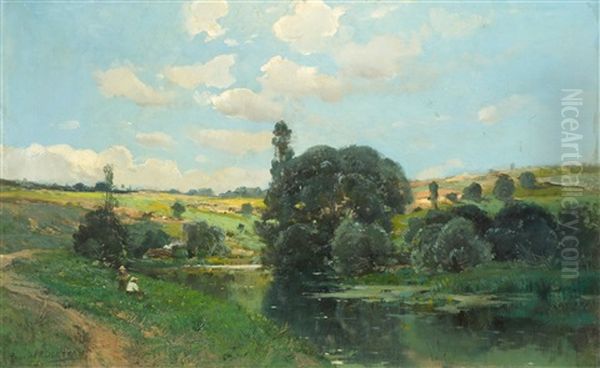
While Paris remained a central hub for much of Bertrand's professional life, it was the sun-drenched landscapes of Southern France, particularly Provence and the Côte d'Azur, that truly captured his artistic imagination and became a recurring muse. He made frequent journeys to this region, drawn by its unique light, vibrant colors, and picturesque scenery. The "Azure Coast," with its dramatic cliffs, sparkling Mediterranean waters, and lush vegetation, offered an inexhaustible source of inspiration.
Bertrand's depictions of this region are characterized by a sensitivity to atmosphere and a nuanced understanding of light. He was particularly adept at capturing the subtle interplay of light and shadow, the haze of a summer day, or the cool clarity of the morning air. His palette, while often incorporating the bright hues of the Mediterranean, also famously included a sophisticated use of greys and muted tones to convey depth, distance, and specific atmospheric conditions. This mastery of "grisaille" or grey-toned landscapes became one of his hallmarks, allowing him to achieve a remarkable sense of realism and poetic charm simultaneously.
Artistic Style: A Synthesis of Naturalism and Impressionistic Sensibilities
Paulin Andre Bertrand's artistic style is often described as a harmonious blend of Naturalism and Impressionism. From Naturalism, he inherited a commitment to depicting the world with accuracy and a focus on the objective reality of the landscape. His works demonstrate careful observation of geological formations, botanical details, and the specific character of a location. There is a tangible quality to his scenes, a sense of place that grounds them firmly in the observable world.
However, Bertrand was not immune to the revolutionary changes brought about by Impressionism. He absorbed the Impressionists' fascination with light and its ephemeral effects, their practice of en plein air (outdoor) painting, and their desire to capture the fleeting moment. While he may not have adopted the broken brushwork or the purely optical color theories of Claude Monet or Camille Pissarro to the same extent, his paintings often exhibit a luminous quality, a vibrancy, and an attention to atmospheric conditions that betray an Impressionistic sensibility. He sought to convey not just the physical appearance of a landscape, but also the feeling and the sensory experience of being within it. This synthesis allowed him to create works that were both descriptively rich and emotionally resonant.
Notable Works and Thematic Concerns
Several works stand out in Paulin Andre Bertrand's oeuvre, exemplifying his stylistic characteristics and thematic preoccupations.
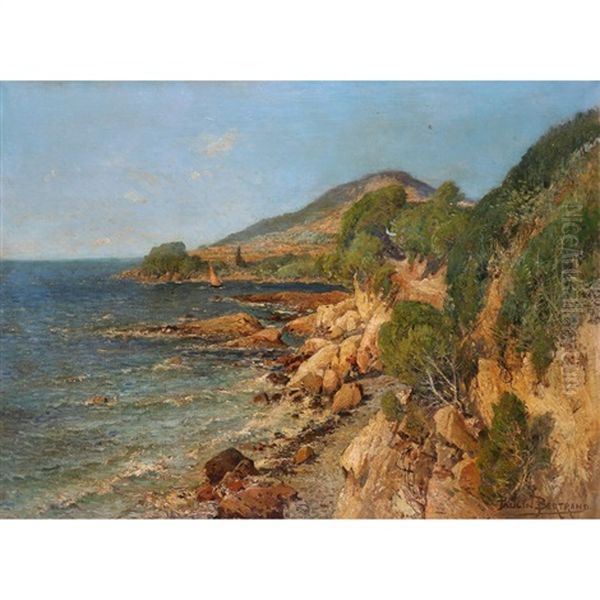
Cote d'Azur (circa 1920) is perhaps one of his most emblematic paintings. This work, often cited for its masterful use of grey tones, captures the expansive beauty of the Mediterranean coastline. It likely depicts a panoramic view, showcasing the interplay of sea, sky, and rugged terrain, all bathed in the distinctive light of the region. The painting demonstrates his ability to convey vastness and intimacy simultaneously, drawing the viewer into the serene yet powerful landscape.
River Landscape is another significant piece, or a recurring theme, that highlights his skill in depicting inland waterscapes. Whether portraying the Seine or other French rivers, these works often feature winding waterways, lush riverbanks, and reflections on the water's surface. Such paintings showcase his ability to capture the tranquil beauty of these environments, often with a subtle, almost melancholic atmosphere. The delicate rendering of foliage and the nuanced depiction of light filtering through trees are characteristic of these compositions.
Les Sains de Hyères (The Bay of Hyères), a work reportedly held in the collection of the Musée d'Art de Toulon (though sometimes mistakenly attributed to Toulouse for this specific piece, given his strong connections to the Var region), further underscores his attachment to the Mediterranean coast. Hyères, with its islands and sheltered bay, was a favored spot for many artists, and Bertrand's interpretation would have captured its unique charm and maritime character.
His role as an official painter for the French Navy (Peintre Officiel de la Marine) also led him to create significant marine paintings. This prestigious appointment, typically awarded to artists demonstrating exceptional skill in depicting maritime subjects, allowed him to explore themes of the sea, ships, and coastal defenses. One notable commission involved creating a marine painting for the French government, further cementing his reputation in this genre.
Career, Recognition, and Personal Connections
Paulin Andre Bertrand enjoyed a successful career, exhibiting his works regularly at the Paris Salon, the premier art exhibition of its time. Participation in the Salon was crucial for an artist's reputation and commercial success, and Bertrand's consistent presence there indicates the esteem in which his work was held. He received several accolades for his artistic achievements, including a Salon artist medal, a significant honor recognizing the quality of his submissions.
Further testament to his standing in the French cultural establishment was his award of the Legion of Honour (Chevalier de la Légion d'honneur), one of France's highest civilian decorations, which he reportedly received in 1921. This honor acknowledged his significant contributions to French art.
Beyond his artistic pursuits, Bertrand cultivated meaningful personal connections. A particularly notable friendship was with the esteemed Provençal poet Jean Aicard (1848-1921). Aicard, a member of the Académie française and a celebrated literary figure, shared Bertrand's love for Provence. Their friendship was deep and enduring. Upon Aicard's death, Bertrand inherited the poet's villa, "La Solitude," located in La Garde, near Toulon. This inheritance further solidified Bertrand's ties to the region that so profoundly inspired his art. It is said that Bertrand often provided landscape paintings for Aicard's villa, indicating a mutual appreciation and a shared aesthetic sensibility.
Interestingly, Bertrand also engaged in literary pursuits, especially after World War I. He is credited with writing memoirs and poetry, suggesting a multifaceted creative personality. During the war, he also contributed his artistic talents to the national effort, reportedly creating an official depiction of the Marseillaise for the Navy.
The Artistic Milieu: Contemporaries and Influences
Paulin Andre Bertrand's long career, spanning from the 1870s to the late 1930s, placed him amidst a period of extraordinary artistic ferment in France. He was a contemporary of the Impressionists, Post-Impressionists, Fauves, and Cubists, witnessing firsthand the radical transformations that reshaped Western art.
While he carved his own path, he was undoubtedly aware of and, to some extent, engaged with the artistic currents around him. His early training would have exposed him to the academic art of painters like Jean-Léon Gérôme and William-Adolphe Bouguereau, who dominated the Salons in the mid-19th century. The Barbizon School painters, such as Jean-Baptiste-Camille Corot and Charles-François Daubigny, with their emphasis on realistic landscape painting and outdoor studies, were significant precursors to both Naturalism and Impressionism and would have been influential.
The Impressionist revolution, led by figures like Claude Monet, Pierre-Auguste Renoir, Camille Pissarro, and Alfred Sisley, fundamentally changed landscape painting. Their focus on capturing fleeting moments, the effects of light and atmosphere, and their vibrant palettes, certainly left an imprint on Bertrand, even if he maintained a more structured, naturalistic approach.
In Provence, Bertrand would have been aware of the legacy of Adolphe Monticelli, whose richly impastoed and romantic scenes were admired by artists like Van Gogh. He was also a contemporary of other painters who celebrated the South of France, such as Jean-Baptiste Olive, known for his depictions of the port of Marseille and the calanques, and Frédéric Montenard, another painter of Provençal landscapes and marine scenes, who also became an official Navy painter. Vincent Courdouan, associated with the Toulon school, was another significant regional landscape artist whose work shared thematic similarities.
The Post-Impressionists, including Paul Cézanne, who meticulously deconstructed and reconstructed the landscapes of Provence, Vincent van Gogh, with his intensely expressive depictions of Arles and Saint-Rémy, and Paul Gauguin, who sought a more symbolic and primitive art, were all active during Bertrand's career. While Bertrand's style differed significantly, the artistic energy and innovation emanating from these figures contributed to the rich artistic environment of the time.
Later, movements like Fauvism, with Henri Matisse and André Derain using color in bold, non-naturalistic ways, often in Southern French settings like Collioure, and the rise of Cubism with Georges Braque and Pablo Picasso, further transformed the artistic landscape. While Bertrand remained largely committed to his established style, the pervasive spirit of experimentation and the redefinition of artistic representation characterized the era in which he worked. Other contemporaries mentioned in various contexts include Gustave Garaud, Eugène Dauphin, Albert André, and Charles Camoin, the latter two having connections to Renoir and the Fauvist circle respectively, highlighting the diverse artistic community of the period.
Legacy and Collections
Paulin Andre Bertrand passed away in 1940, leaving behind a substantial body of work that continues to be appreciated for its technical skill, aesthetic beauty, and evocative portrayal of French landscapes. His paintings are held in various public and private collections.
Notably, the Musée d'Art de Toulon is a significant repository for his works, reflecting his strong ties to the Var department and the Mediterranean coast. The Musée des Augustins in Toulouse, his city of birth and early training, also likely holds examples of his art. There are mentions of his works being donated by his wife, Julia, to a museum in Corsica, which, if accurate, would further extend the geographical reach of his public legacy. More niche collections, such as a "Jean Paulhan/Maurice Barrès Museum" or a "La Guerre et Paulin Andre Bertrand Museum" in the Loire region, have been mentioned, suggesting that his works may be found in smaller, specialized institutions or private foundations that honor specific aspects of his life or regional connections.
While perhaps not as globally renowned as some of his more revolutionary contemporaries, Paulin Andre Bertrand holds a respected place as a dedicated and talented landscape painter. He is often considered a key figure within the Provençal school of painting, an artist who captured the unique essence of a region that has captivated painters for centuries. His ability to synthesize academic rigor with a modern sensitivity to light and atmosphere allowed him to create works of enduring appeal. He was described by some as embodying the "roots of painting," a testament to his foundational skills and his deep connection to the tradition of landscape art, even as he subtly incorporated contemporary innovations.
Conclusion: An Enduring Vision of France
Paulin Andre Bertrand's artistic journey was one of dedicated observation and lyrical expression. From the art schools of Toulouse and Paris to the sun-drenched shores of the Côte d'Azur, he pursued a vision of landscape painting that was both faithful to nature and imbued with a poetic sensibility. His mastery of light, his nuanced palette, and his ability to convey the distinct atmosphere of a place define his contribution to French art.
As a chronicler of the French landscape, particularly the beloved regions of Provence and the Mediterranean coast, Bertrand created a body of work that continues to resonate with viewers. His paintings offer a window into the timeless beauty of these locales, rendered with a skill and sensitivity that affirm his place among the significant landscape artists of his generation. His legacy endures in the collections that preserve his art and in the ongoing appreciation for his luminous and heartfelt depictions of the world around him.