Philip H. Rideout, a British artist active during the late nineteenth and early twentieth centuries, carved a distinct niche for himself as a painter of coaching scenes, equestrian subjects, and the vibrant life surrounding horse-drawn transportation. While perhaps not as widely known today as some of his more famous contemporaries who dominated the Royal Academy exhibitions, Rideout's work offers a valuable and evocative window into a specific aspect of British life that was rapidly changing with the advent of new technologies. His paintings, characterized by their attention to detail, dynamic compositions, and an affectionate portrayal of horses and human activity, continue to find appreciation among collectors and enthusiasts of sporting art and historical genre scenes.
The Scant Biographical Record
Detailed biographical information on Philip H. Rideout remains somewhat elusive, a common fate for many competent artists who operated outside the very top echelons of the art world or whose personal papers were not preserved. What we can ascertain comes primarily from the dating of his works and the nature of his subject matter, which firmly places his active period from roughly the 1870s through to at least the first decade of the 20th century. His consistent focus on British coaching scenes, landscapes that appear to be English countryside, and the style of dress and equipage depicted all point to a career centered in Great Britain.
The very existence of works dated as early as 1877 (such as "End of the Chase") and as late as 1908 (like "Pair of Coaching Scenes") suggests a career spanning several decades. This period was one of immense social and technological transformation in Britain. The coaching era, which Rideout so often depicted, was in its twilight years as a primary mode of long-distance transport, increasingly romanticized as railways had already become dominant and the motorcar was beginning to make its presence felt. Artists like Rideout, therefore, were not just painting contemporary scenes but were also, perhaps inadvertently, documenting a way of life that was receding into nostalgia.
Without extensive records of his training, affiliations with specific art societies, or detailed exhibition history beyond auction records, we are left to analyze the artworks themselves to understand his skill and artistic lineage. His proficiency in both oil and watercolor suggests a formal, or at least thorough, artistic education, common for professional artists of the period.
Artistic Style and Dominant Themes
Philip H. Rideout's artistic output is overwhelmingly dominated by themes related to horses and coaching. His canvases and paper are populated with stagecoaches, private carriages, hunting scenes, and the bustling activity of inns and roadways. This specialization was not uncommon; many Victorian and Edwardian artists found success by focusing on particular genres that appealed to specific segments of the art-buying public, particularly the landed gentry and the burgeoning middle class who appreciated sporting pursuits and scenes of traditional country life.
Realism and Detail: Rideout's style is rooted in realism. He paid considerable attention to the accurate depiction of equine anatomy, the intricate details of harnesses and carriages, and the period attire of his figures. This meticulousness lends an air of authenticity to his scenes. One can almost hear the clatter of hooves, the rumble of wheels, and the calls of the coachmen. His horses are not merely generic representations but often appear as individuals, their musculature and movement captured with a knowing eye. This suggests a genuine familiarity with and appreciation for his primary subject.
Dynamic Composition: Many of Rideout's coaching scenes are imbued with a sense of movement and energy. Coaches are often shown at full tilt, horses straining, dust rising from the road. He employed diagonal lines and carefully arranged groups of figures and animals to create a lively and engaging visual narrative. Even in more static scenes, such as a coach arriving at an inn, there is an implied bustle and anticipation.
Narrative Quality: Like many Victorian painters, Rideout often infused his works with a narrative element. Titles such as "On the Scent" and "End of the Chase" explicitly point to a story unfolding. His coaching scenes, too, tell tales of journeys, encounters, and the daily dramas of travel. Viewers are invited to imagine the lives of the passengers, the challenges of the journey, and the skill of the drivers and grooms.
Atmosphere and Landscape: While the horses and carriages are central, Rideout did not neglect the settings. His landscapes, though often secondary to the main action, effectively establish the mood and location. Whether it's a sun-dappled country lane, a misty morning, or the welcoming glow of an inn, the environment plays a role in the overall impact of the painting. He demonstrated a competent handling of light and shadow to enhance the three-dimensionality of his subjects and the atmosphere of the scene.
Representative Works
Several works by Philip H. Rideout have appeared in public sales, allowing us to appreciate his consistent themes and stylistic approach.
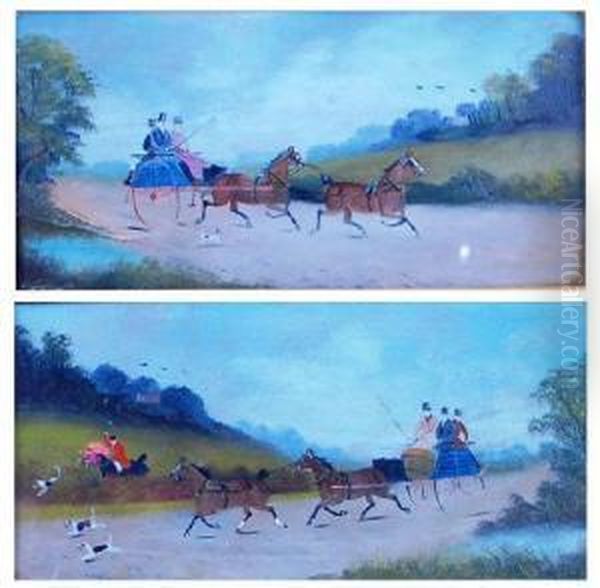
"Pair of Coaching Scenes" (1908, oil): This pair, created relatively late in the coaching era, likely captures the enduring appeal of these subjects. Measuring approximately 17 x 13 inches (or 17 x 25 cm as per another listing, suggesting variations or different pairs), these oil paintings would have showcased Rideout's skill in rendering the gloss of the horses' coats, the polished wood and metal of the carriages, and the lively interaction of figures. The 1908 date indicates that even as automobiles were becoming more common, the romance of the coaching days held a strong nostalgic pull.
"Pair of Stagecoach Scenes" (watercolor): These smaller works, around 12 x 27 cm, demonstrate Rideout's versatility in different media. Watercolor allows for a lighter, perhaps more immediate touch than oil. Such scenes might depict different stages of a journey – perhaps one setting off and another arriving, or traversing different types of terrain. The medium would lend itself well to capturing the fleeting effects of light and weather on the road.
"Figures in a Horse-Drawn Carriage" (1892, oil): This earlier piece, measuring 5.5 x 9 inches (approximately 14 x 23 cm), focuses more intimately on the occupants of a carriage. It offers a glimpse into the social aspects of travel and leisure in the late Victorian period. The smaller scale might suggest a more personal commission or a study. The existence of a "pair" to this work implies a narrative or thematic connection between two distinct but related scenes.
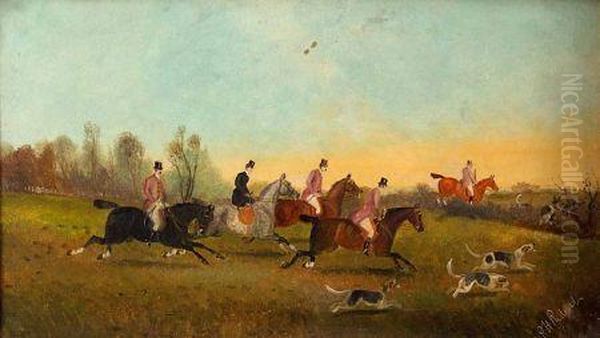
"On the Scent" (1896) and "End of the Chase" (1897, oil on card): This pair of hunting scenes, each measuring 16 x 33.5 cm, explicitly tells a story. "On the Scent" would likely depict hounds and riders eagerly pursuing their quarry, full of anticipation and energy. "End of the Chase" would capture the culmination of the hunt, perhaps a moment of triumph or exhaustion. Such subjects were immensely popular, appealing to the sporting interests of many patrons. The use of oil on card was a common practice for smaller works or studies, offering a stable and receptive surface.
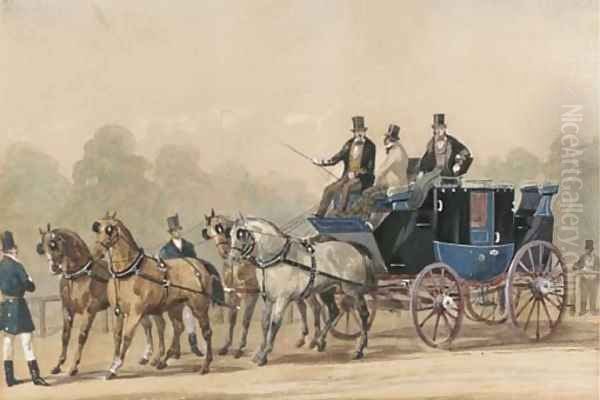
"Coaching scene" (1905, oil): Another example from the early 20th century, this 17 x 36 cm oil painting reinforces Rideout's dedication to his signature theme. The elongated format might suggest a panoramic view of a coach traversing a landscape, allowing for a more expansive composition.
These works, collectively, paint a picture of an artist dedicated to capturing the dynamism, romance, and intricate details of the equestrian world, particularly as it related to coaching and country sports. His consistent production over several decades underscores a sustained demand for such imagery.
The Artistic Context: Victorian and Edwardian Britain
To fully appreciate Philip H. Rideout's contribution, it's essential to place him within the bustling and diverse art world of late Victorian and Edwardian Britain. This era saw a wide range of artistic styles and preoccupations, from the high-minded historical and allegorical paintings favored by the Royal Academy establishment to the burgeoning influence of Impressionism and other avant-garde movements.
The Heyday of Sporting and Animal Art: Rideout operated within a strong tradition of British sporting and animal art. The love of horses, hunting, and rural life was deeply ingrained in British culture, particularly among the aristocracy and the increasingly affluent middle classes. This created a robust market for artists specializing in these subjects.
Sir Edwin Landseer (1802-1873): Though his peak was slightly before Rideout's main period, Landseer's immense popularity and his sentimental yet powerful depictions of animals (especially dogs and stags) set a high bar and influenced public taste for generations.
John Frederick Herring Sr. (1795-1865) and John Frederick Herring Jr. (1820-1907): This father-and-son dynasty was renowned for their paintings of racehorses, farm scenes, and coaching subjects. Herring Jr. was a direct contemporary of Rideout, and their thematic concerns often overlapped.
Heywood Hardy (1842-1933): A prolific contemporary, Hardy was known for his elegant 18th-century costume pieces, hunting scenes, and coaching pictures, often characterized by a lively and anecdotal quality. His work shares a similar nostalgic charm with Rideout's.
Alfred de Prades (fl. 1844-1883): A French-born artist active in Britain, de Prades specialized in equestrian portraits and coaching scenes, often with a meticulous attention to detail similar to Rideout's.
John Charles Maggs (1819-1896): Based in Bath, Maggs was one of the most prolific painters of mail coaches, often depicting them in specific locations or battling challenging weather conditions. His work is a key reference point for coaching art of the period.
Charles Cooper Henderson (1803-1877): Active slightly earlier but highly influential, Henderson was celebrated for his spirited and accurate coaching scenes, capturing the speed and excitement of the road. His legacy would have been well-known to artists like Rideout.
George Wright (1860-1942) and Gilbert Scott Wright (1880-1958): This pair of brothers also specialized in coaching and hunting scenes, often with a very polished and commercially successful style, active into the 20th century.
Narrative and Genre Painting: The Victorian era was the golden age of narrative painting. Artists sought to tell stories, evoke emotions, and comment on contemporary life. While Rideout's narratives were generally straightforward depictions of travel or sport, they fit within this broader cultural interest in art that "spoke" to the viewer.
William Powell Frith (1819-1909): Famous for his panoramic scenes of Victorian life, such as "The Derby Day" and "The Railway Station," Frith was a master of capturing the social fabric of his time in intricate detail. While grander in scale, his work shares with Rideout an interest in depicting everyday activities and social interactions.
Luke Fildes (1843-1927): Known for his powerful social realist paintings like "Applicants for Admission to a Casual Ward," Fildes also painted more conventional genre scenes. His commitment to realism, albeit often with a stronger social message, was part of the era's artistic currency.
Landscape Painting: The British tradition of landscape painting continued to thrive. While Rideout's landscapes were often backdrops, they were informed by a long lineage of artists who celebrated the British countryside.
Benjamin Williams Leader (1831-1923): His picturesque and often sentimental landscapes of rural England and Wales were immensely popular, reflecting a widespread appreciation for the beauty of the British Isles.
George Vicat Cole (1833-1893): Another popular landscape painter, Vicat Cole was known for his lush, detailed views of the English countryside, particularly Surrey.
The Rise of New Movements: It's also important to note that Rideout's traditional realism coexisted with newer, more radical artistic developments. The influence of French Impressionism was beginning to be felt in Britain, leading to movements like British Impressionism.
Philip Wilson Steer (1860-1942): A leading figure in British Impressionism, Steer's work explored light and atmosphere in a way that was stylistically quite different from Rideout's detailed realism.
Walter Sickert (1860-1942): Associated with the Camden Town Group, Sickert's urban scenes and interiors, often characterized by a more somber palette and psychological depth, represented another departure from traditional academic painting.
The Pre-Raphaelite Brotherhood, though its initial phase was earlier (mid-19th century), continued to exert an influence through artists like John Everett Millais (in his later, more popular phase), William Holman Hunt, and the enduring legacy of Dante Gabriel Rossetti. Their emphasis on detail and truth to nature, albeit often in the service of literary or symbolic themes, contributed to the Victorian penchant for meticulous representation.
Rideout's work, therefore, can be seen as occupying a comfortable and well-established position within this artistic landscape. He catered to a taste for traditional, representational art that celebrated familiar aspects of British life and heritage, a taste that remained strong even as modernist ideas began to take root.
Technique and Media
Philip H. Rideout demonstrated proficiency in both oil paint and watercolor, the two dominant painting media of his time.
Oil Painting: His oil paintings, such as the "Pair of Coaching Scenes" (1908) and "Figures in a Horse-Drawn Carriage" (1892), would have allowed him to build up rich layers of color and detail. Oil paint's slow drying time facilitates blending and precise rendering, essential for capturing the sheen of a horse's coat, the complex harnessing, the textures of fabric, and the subtle play of light on surfaces. The traditional academic approach, which emphasized careful drawing and underpainting followed by layers of glazing and scumbling, would have been the standard method. Rideout's attention to detail suggests a methodical approach consistent with these practices. The durability and richness of oil paint also made it the preferred medium for finished exhibition pieces intended for lasting display.
Watercolor: Rideout's "Pair of Stagecoach Scenes" in watercolor highlight his versatility. Watercolor, with its transparency and fluidity, offers different expressive possibilities. It can be used for quick sketches and studies, capturing fleeting moments and atmospheric effects with freshness and spontaneity. However, British artists had also developed watercolor into a highly refined medium capable of achieving considerable detail and finish. Rideout's watercolors were likely finished works in their own right, perhaps appealing to collectors who preferred the lighter aesthetic of the medium or sought more affordable pieces. The challenges of watercolor, such as the need for precise brushwork and the difficulty of making corrections, would have required considerable skill.
Oil on Card: The mention of "On the Scent" and "End of the Chase" being executed in oil on card is also noteworthy. Artists' board or card provided a stable, relatively inexpensive, and portable support for oil painting, especially for smaller works or studies. It was less cumbersome than stretched canvas and readily available. Many artists used it for preparatory sketches or for smaller, more informal paintings.
Regardless of the specific medium, Rideout's underlying skill in drawing would have been paramount. Accurate draftsmanship was the foundation of representational art in this period, essential for convincingly portraying the complex anatomy of horses in motion and the structure of carriages.
Legacy and Reception
Philip H. Rideout's legacy is primarily that of a skilled specialist painter who captured a particular facet of British life with charm and accuracy. He was not an innovator in the mold of the Impressionists or other avant-garde figures, nor did he achieve the widespread fame of academy stalwarts like Lord Leighton or Sir Lawrence Alma-Tadema. However, within the realm of sporting and coaching art, he was a competent and respected practitioner.
The continued appearance of his works at auction indicates an ongoing interest among collectors. These collectors are likely drawn to several aspects of his art:
Nostalgia: His scenes evoke a bygone era, appealing to a sense of nostalgia for the perceived romance and adventure of the coaching days.
Equestrian Interest: For those passionate about horses and equestrian history, Rideout's paintings offer detailed and affectionate portrayals.
Decorative Quality: His works, with their lively compositions and attractive subject matter, have considerable decorative appeal.
Historical Documentation: While not their primary purpose, his paintings serve as visual documents of the vehicles, costumes, and social customs of his time.
His works are predominantly found in private collections rather than major public museum holdings, which is typical for many artists who specialized in genre or sporting subjects that were popular with private patrons but perhaps less sought after by public institutions focused on "high art" or major art historical movements.
The fact that his paintings are often sold as "pairs" (e.g., "Pair of Coaching Scenes," "On the Scent" and "End of the Chase") suggests he may have conceived of works in series or that patrons commissioned complementary pieces. This practice enhances the narrative potential and decorative impact of the art.
While art history tends to focus on groundbreaking movements and iconic figures, artists like Philip H. Rideout play a crucial role in forming a complete picture of an era's artistic production. They represent the broad base of professional artists who catered to contemporary tastes, documented their society, and practiced their craft with skill and dedication. His paintings offer a delightful and informative glimpse into the world of late Victorian and Edwardian Britain, a world where the rhythm of life was still often set by the pace of the horse.
Conclusion
Philip H. Rideout stands as a noteworthy British artist of the late 19th and early 20th centuries, whose oeuvre provides a vivid and detailed chronicle of the coaching era and equestrian life. Working primarily in oil and watercolor, he demonstrated a keen eye for the specifics of equine anatomy, the mechanics of carriages, and the human element within these dynamic scenes. His paintings, characterized by their realism, narrative interest, and atmospheric settings, found favor with a public that appreciated sporting themes and nostalgic depictions of a rapidly changing world.
While not a revolutionary figure in the grand narrative of art history, Rideout's contribution lies in his skillful and consistent portrayal of his chosen subjects. He operated within a strong British tradition of sporting art, alongside contemporaries like John Frederick Herring Jr., Heywood Hardy, and John Charles Maggs, all of whom celebrated the horse and its role in British society. His works continue to be valued by collectors for their historical charm, decorative qualities, and as evocative records of a bygone age. Through his art, Philip H. Rideout ensures that the sights and sounds of the coaching road, the thrill of the chase, and the enduring partnership between humans and horses remain accessible to us today.