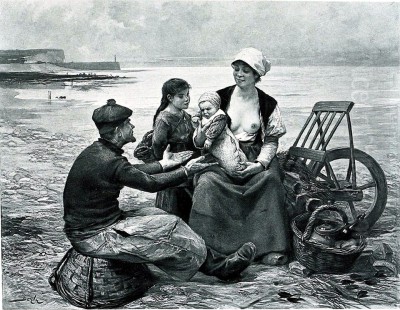
Pierre-Marie Beyle (1838-1902) was a notable French painter and engraver of the 19th century, recognized for his commitment to social realism and his poignant depictions of the everyday lives of ordinary people. Born in Lyon, he pursued his artistic training in Paris, the vibrant heart of the European art world. It is essential at the outset to distinguish Pierre-Marie Beyle, the artist, from his near-contemporary, the celebrated writer Marie-Henri Beyle (1783-1842), famously known by his pen name Stendhal. These were two distinct individuals, and any conflation of their biographies or achievements would be erroneous. Pierre-Marie Beyle, the painter, carved his own niche by focusing his artistic lens on the working classes, the marginalized, and scenes of labor, often imbued with a deep sense of empathy and observation.
Early Artistic Development and Parisian Debut
Having made his way from Lyon to Paris, Pierre-Marie Beyle immersed himself in the artistic milieu of the capital. The city offered unparalleled opportunities for study, exposure to influential art movements, and the crucial chance to exhibit at the Paris Salon, the official art exhibition of the Académie des Beaux-Arts, which was the primary avenue for artists to gain recognition and patronage during that era.
Beyle made his official debut at the Paris Salon in 1867 with a painting titled Une Bohémienne (A Bohemian Woman). This initial showing marked his entry into the competitive Parisian art scene. The choice of a "bohemian" subject, often associated with a romanticized view of marginalized or unconventional lifestyles, hinted at his burgeoning interest in figures existing outside the mainstream of bourgeois society, a theme that would continue to evolve and deepen throughout his career.
Emergence of a Social Realist Voice
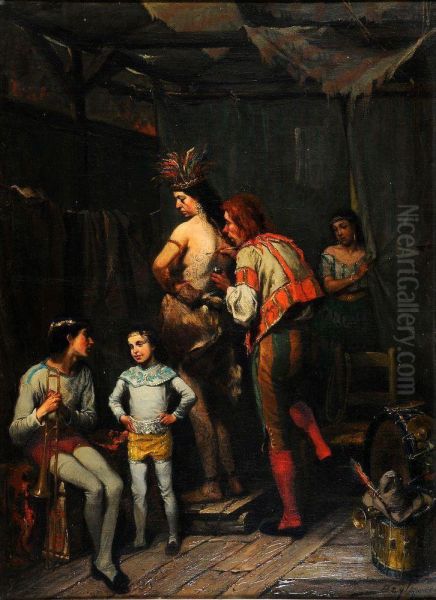
Following his debut, Beyle continued to exhibit works that solidified his reputation as a painter keen on portraying the realities of life, particularly within the working class and among performers or itinerant communities. In 1869, he presented La Toilette de la Femme Sauvage (The Wild Woman's Toilette), and in 1872, La Toilette du Général Jacko (General Jacko's Toilette). These titles suggest an interest in the world of travelling fairs and shows, which were a common feature of 19th-century popular entertainment and often involved individuals living on the fringes of society.
These works, focusing on the preparations or private moments of public performers, allowed Beyle to explore themes of identity, spectacle, and the human condition behind the facade. His approach was increasingly aligned with the tenets of Social Realism, an artistic movement that aimed to depict contemporary social realities and the lives of the working class without idealization, often carrying an implicit or explicit critique of social structures. This movement had prominent proponents in France, such as Gustave Courbet and Jean-François Millet, whose works often highlighted the dignity and hardship of rural peasant life.
Artistic Style, Influences, and Thematic Concerns
Pierre-Marie Beyle's artistic style was characterized by a commitment to verisimilitude, a sober palette often suited to his subjects, and a compassionate yet unsentimental gaze. His work resonated with the broader European trend of realism and naturalism that sought to portray life "as it is." A significant influence on Beyle's artistic development was the Dutch Hague School, particularly the work of Jozef Israëls. Israëls was renowned for his somber, empathetic portrayals of Dutch fishermen and rural peasants, capturing their resilience and the harshness of their existence. This influence can be seen in Beyle's own attention to the dignity of labor and the emotional weight carried by his subjects.
Beyle's work was also contextualized alongside other contemporary artists who shared similar concerns. Comparisons were drawn with British artist Sir George Clausen, known for his depictions of rural laborers in a style that blended realism with impressionistic touches. Other figures in this artistic constellation included the Dutch painter Philip Lodewijk Jacob Frederik Sadee, who often painted scenes of fisherfolk and coastal life, and Bernardus Johannes Blommers, another Hague School artist celebrated for his intimate genre scenes of peasant families. The French painter Jules Bastien-Lepage, a key figure in Naturalism, also provides a relevant parallel with his meticulously detailed and psychologically insightful portrayals of rural life. Beyle's engagement with these artistic currents demonstrates his participation in a wider European dialogue about the role of art in reflecting contemporary society.
Depictions of Labor and Animal Welfare
A particularly poignant and recurring theme in Beyle's oeuvre was the depiction of labor, often extending to the animals that shared in human toil. His 1878 painting, Le Dernier Gîte de Coco (Coco's Last Resting Place), also exhibited as The Last Resting Place of Coco, stands as a powerful example. This work, portraying a horse collapsed and dying from exhaustion, deeply moved contemporary audiences. It was not merely an animal painting but a commentary on the harsh realities of animal labor and, by extension, the grueling conditions faced by many working-class individuals. Such a work invited empathy and highlighted a social consciousness that was a hallmark of his art.
The emotional impact of Coco's Last Resting Place underscores Beyle's ability to transcend mere depiction and evoke a profound human response. This concern for the suffering of working animals aligns him with other artists who addressed similar themes, such as Rosa Bonheur, though Bonheur's approach was often more focused on the majesty and anatomical accuracy of animals. Beyle's work, in contrast, frequently emphasized their role within the human world of labor and their shared vulnerability.
Algerian Scenes and Orientalist Echoes
Between 1877 and 1878, Pierre-Marie Beyle produced a series of paintings inspired by Algeria. This venture into North African subjects placed him within the broader 19th-century European fascination with the "Orient," a trend known as Orientalism. Many artists, including masters like Eugène Delacroix and Jean-Léon Gérôme, travelled to North Africa and the Middle East, producing works that ranged from romanticized fantasies to more ethnographic observations.
While the specific nature of Beyle's Algerian paintings isn't fully detailed in the provided summaries, it is likely that, consistent with his overall artistic inclinations, he would have focused on the everyday life and people of Algeria rather than purely exotic or sensationalized scenes. Artists like Eugène Fromentin, who also painted Algerian scenes, often combined landscape with depictions of local life. Beyle's Algerian series would have added another dimension to his exploration of diverse human experiences, viewed through his characteristic realist lens.
Maritime Themes and Recognition at the Salon
Maritime subjects also featured prominently in Beyle's work, reflecting the lives of coastal communities and seafarers. His painting Pêcheuses de Moules à Pola (Mussel Gatherers at Pola), exhibited in 1881, earned him a bronze medal at the Paris Salon. This work likely depicted the arduous labor of women in a coastal setting, a theme also explored by artists like the aforementioned Philip Sadee or the French painter Léon-Augustin Lhermitte, who, though more focused on rural agricultural scenes, shared a similar commitment to portraying working life with dignity.
In 1887, Beyle achieved further recognition at the Salon, receiving a silver medal for his painting Un Sauvetage à Dieppe (A Rescue at Dieppe). This work, presumably a dramatic scene of maritime rescue, would have allowed him to explore themes of heroism, danger, and communal solidarity in the face of nature's power. Such themes were popular in the 19th century, and artists like Hendrik Willem Mesdag of the Hague School were renowned for their powerful seascapes and depictions of fishing fleets. Beyle's success with these maritime paintings demonstrated his versatility and his ability to capture both the quiet toil and the dramatic moments of life connected to the sea.
International Exhibitions and Later Works
Pierre-Marie Beyle's reputation was not confined to France. His works were exhibited internationally, indicating a broader appreciation for his art. Coco's Last Resting Place, for instance, was shown in Sydney, Australia, in 1879 and in Melbourne in 1880-1881. This international exposure highlights the reach of European art during this period and the appeal of social realist themes to diverse audiences.
As his career progressed into the later 19th and early 20th centuries, Beyle continued to produce significant works. Les Travailleurs de la mer (The Toilers of the Sea), exhibited at the Exposition Universelle (World's Fair) in Paris in 1900, reaffirmed his enduring interest in maritime labor. The title itself evokes Victor Hugo's famous novel, suggesting a shared concern for the struggles and heroism of those who make their living from the sea. His last recorded Salon entry, also in 1900, was a painting titled L'Espoir (Hope), which, without further visual information, suggests a potentially more allegorical or emotionally uplifting theme, perhaps offering a counterpoint to some of his more somber depictions of hardship.
Beyond his paintings, Beyle was also a prolific caricaturist, contributing numerous satirical drawings to Parisian journals. This aspect of his work provided him with an additional source of income and another avenue for social commentary, likely employing humor and exaggeration to critique contemporary manners and societal issues, in a vein similar to the great French caricaturist Honoré Daumier.
The Crucial Distinction: Pierre-Marie Beyle and Stendhal
It is imperative to reiterate and elaborate on the distinction between Pierre-Marie Beyle, the painter (1838-1902), and Marie-Henri Beyle, the writer known as Stendhal (1783-1842). The similarity in their names has occasionally led to confusion, but their lives and contributions were entirely separate.
Stendhal was one of the most important French novelists of the 19th century, celebrated for masterpieces such as Le Rouge et le Noir (The Red and the Black) and La Chartreuse de Parme (The Charterhouse of Parma). His literary work is characterized by psychological acuity, romantic irony, and a critical examination of post-Napoleonic French society. Anecdotes concerning a rebellious youth, the development of a "double worldview," a theory of life known as "beylisme" (emphasizing passion, energy, and individualism), a dramatic love affair with Angela Pietraglia in Milan, the adoption of the pen name "Stendhal" inspired by the German town of Stendal, and the use of over a hundred pseudonyms are all part of the biography and legend of Marie-Henri Beyle, the writer. These details do not pertain to Pierre-Marie Beyle, the painter.
The painter Pierre-Marie Beyle's life was dedicated to the visual arts, his identity forged through his canvases and engravings, his recognition earned in the Salons and exhibitions of his time. His legacy is built upon his artistic output, his social realist depictions of 19th-century French life, and his empathetic portrayal of the common man and woman.
Furthermore, it is important to correct any misinformation that might associate Pierre-Marie Beyle with the Impressionist painter Pierre-Auguste Renoir. Renoir (1841-1919) was a contemporary and a towering figure of Impressionism, known for his vibrant depictions of Parisian leisure, portraits, and sensuous nudes. He is an entirely different artist from Pierre-Marie Beyle, and there is no basis for them being the same person or for Beyle being known as Renoir.
Legacy and Conclusion
Pierre-Marie Beyle passed away in 1902. While he may not have achieved the revolutionary fame of some of his contemporaries, such as the Impressionists Claude Monet or Edgar Degas, or the Post-Impressionists like Vincent van Gogh or Paul Cézanne, his contribution to 19th-century French art is significant in its own right. He was a dedicated practitioner of social realism, a movement that sought to bring the lives of the unrepresented and the realities of social conditions to the forefront of artistic discourse.
His paintings serve as valuable historical documents, offering insights into the labor, leisure, and social fabric of his time. Works like Coco's Last Resting Place demonstrate a profound humanitarian concern that resonated with audiences and critics. His consistent focus on the dignity of ordinary people, the hardships of their labor, and the quiet moments of their lives provides a compelling counter-narrative to the more idealized or academic art of the period.
In the grand tapestry of 19th-century art, Pierre-Marie Beyle stands as a sincere and skilled observer of the human condition. His engagement with themes of social justice, his influence by and comparison with artists like Jozef Israëls, Sir George Clausen, and Jules Bastien-Lepage, and his consistent presence in major exhibitions like the Paris Salon and the Exposition Universelle, all attest to his active participation in the artistic life of his era. He remains a noteworthy figure for those interested in the evolution of realism and the portrayal of social themes in French art, a chronicler who used his brush to tell the stories of the often-unseen members of society.